



Jump to the section that meets your needs best below:
Average Tech Business Insurance Cost (2026 Report)
Tech business insurance runs from $17 to $198 a month. Costs vary by sub-industry, employee count, state and whether the business operates vehicles.
If you're ready for quotes, MoneyGeek can get connect to your best tech business insurer using our matching tool below.
Select state
Updated: September 13, 2026
Advertising & Editorial Disclosure
How Much Does Tech Business Insurance Cost?
The average cost of tech business insurance is $77 a month, or $924 a year, based on MoneyGeek's analysis across six common coverage types, eight sub-industries, 50 states and Washington, D.C., for businesses with one to four employees at $1 million per occurrence limits.
Featured Partner

The Hartford
- Tech business insurance from The Hartford averages $71 a month, about 8% below the $77 Tech/IT benchmark, ranking first of seven at 4.43 out of 5.
- Businesses with 10 to 19 employees save about $564 a year with The Hartford, rising to $1,237 at 20 to 49, per MoneyGeek's 2026 composite analysis.
- The Hartford's FailSafe Technology Errors and Omissions policy combines professional liability with data privacy and network security coverage.
- Coverage depth ranks first for The Hartford in Tech/IT among the seven carriers MoneyGeek analyzed.
On The Hartford's site
*MoneyGeek featured partner. Editorial rankings below are independent of this placement. Rates, rankings and savings comparisons are based on MoneyGeek's independent research and Hartford-reported data as of 2026. Figures are estimates and averages, not a guarantee of any individual quote, premium or discount.
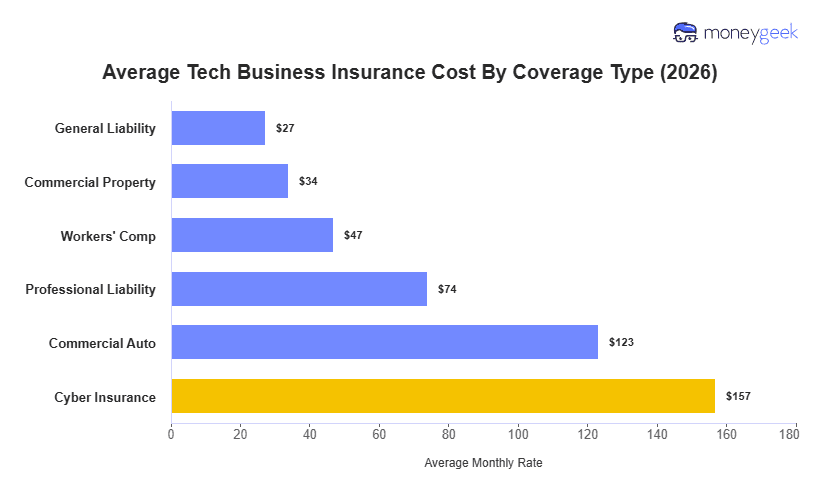
General liability costs around $27 a month, the lowest of the six coverage types, because most tech businesses have limited exposure to third-party physical claims. Cyber insurance averages $157 a month, more than five times the GL figure. That gap comes from the data exposure, software liability and system access risks that insurers price heavily for tech operations.
| General Liability | $27 | $328 | -78% | 1 |
| Commercial Property | $34 | $407 | 73% | 11 |
| Workers' Comp | $47 | $562 | 58% | 9 |
| Professional Liability | $74 | $888 | -31% | 14 |
| Commercial Auto | $123 | $1,478 | 25% | 6 |
| Cyber Insurance | $157 | $1,882 | -88% | 25 |
We analyzed quote data from major U.S. commercial insurance providers and modeled standardized premium estimates across business profiles representing around 95% of the market. Results are designed to provide a consistent national benchmark showing how premiums vary by key baseline factors including business size, tech profession type, location and vehicle type for operations that use commercial vehicles.
Dataset Scope and Assumptions
Our cost modeling uses standardized inputs for consistent comparisons across businesses.
- Total estimates modeled: just over 6 million standardized pricing estimates
- Providers analyzed: 10 major insurance providers
- Professions covered: 8 tech profession categories
- Geography: all U.S. states including Washington, D.C.
- Employee count bands: solo practitioners, one to four, five to nine, 10 to 19, and 20 to 49 employees
- Vehicle types studied: Sedans, SUVs, pickup trucks, vans, taxis, limousines, tractors, food trucks, semi-trucks (non-HAZMAT and HAZMAT), tanker trucks (non-HAZMAT and HAZMAT), buses, box trucks, dump trucks, flatbed trucks
- Policies studied: general liability, workers' comp, professional liability, commercial auto, commercial property, and cyber insurance
- General liability: $1 million per occurrence and $2 million aggregate
- Workers' comp: state required coverage
- Professional liability: $1 million per claim and $1 million aggregate
- Commercial auto: minimum coverage
- Commercial property: personal property coverage limits personalized to industry, business size and state
- Cyber insurance: $1 million per occurrence and $1 million aggregate
How We Calculated Average Tech Business Insurance Costs
Our published averages represent modeled premiums for standardized business profiles and were aggregated in two ways.
- National benchmark average: The national average cost reflects the modeled premium for a standardized one to four employee business across all tech profession categories and states included in our dataset for a standard professional liability policy
- Segment averages: To show how costs vary, we calculated average modeled premiums for our national base profile and isolated for variables, including:
- Employee count (business size ranges)
- Profession/industry categories
- Vehicle types (for commercial auto)
- States (including Washington, D.C.)
Segment averages were produced by aggregating modeled pricing trends across the full dataset so readers can compare how premiums shift across profession types and regions.
See our full business insurance methodology.
If you want to see business insurance costs for specific tech sub-industries, these pages provide more information:

Get Tech Business Insurance Cost Estimates
Use the small business insurance calculator below to build an estimate based on your specific tech business's details.
Get Tech Business Insurance Cost Estimates
Select Coverage Type
Select State
Select Employee Count
Select Vehicle Type
Average Monthly Estimate—
Select Coverage Type
Average Monthly Estimate—
Select State
Select Employee Count
Select Vehicle Type
Factors Affecting Tech Business Insurance Costs
Six factors have the most consistent impact on tech business insurance costs. Not all apply equally. A cloud-native SaaS startup and a telecom business with field crews carry very different cost profiles.
 Business size
Larger teams take on more client work and run more projects at the same time. That wider footprint pushes liability exposure higher across most coverage types. A solo developer and a 20-person software firm carry very different risk profiles even within the same tech sub-industry.
 Location
State affects workers' comp rates most sharply. In some states, workers' comp costs run three to four times higher than in others. Commercial auto and professional liability also vary by state because of differences in litigation rates, workers' comp systems and commercial real estate costs.
 Services and deliverables
A business that writes code for clients, manages their cloud infrastructure or advises on cybersecurity architecture carries more professional liability and cyber exposure than one that builds websites or designs apps. The scope, duration and criticality of client deliverables shape the risk profile that insurers price.
 Data handling and storage
A SaaS company storing millions of user records, a software firm with access to client production databases or an MSP holding credentials for dozens of client networks carries higher cyber exposure than a business with no direct data access. Whether the business owns that data or simply has access to it matters. Insurers price both dimensions.
 Physical infrastructure and field operations
A fully remote software studio and an MSP with a server room, networking gear and a fleet of service vehicles are insuring very different things. Owning physical infrastructure or operating vehicles adds commercial property and commercial auto exposure that cloud-native businesses don't carry. The more equipment or vehicles in the mix, the higher those costs run.
 Client contract requirements
Enterprise software deals and government IT contracts routinely require vendors to carry higher professional liability and cyber limits than a small tech firm would choose on its own. A web developer moving into a federal agency contract or a SaaS company landing its first Fortune 500 client often needs to increase coverage limits before the contract can be signed.
How to Lower Tech Business Insurance Costs
There are several ways to get more affordable business insurance. Some help before you buy or renew a policy, while others take time to affect your rates. For a tech or IT business, it’s worth using both approaches rather than expecting every cost-cutting move to lower your premium right away.
 Compare quotes using the same coverage limits
Tech businesses often carry several coverage types, and the same limits can cost hundreds of dollars more with one insurer than another. When comparing business insurance quotes, use the same limits and deductibles each time. A video game studio reviewing cyber and professional liability or an MSP shopping workers’ comp will get a much clearer price comparison that way.
 Right-size your coverage
A solo web developer working on short-term projects may not need the same professional liability limits as a software firm managing enterprise infrastructure. Review what your contracts and client agreements actually require. Set limits to match those minimums rather than defaulting to the highest available tier.
 Increase your deductible strategically
Raising your deductible on commercial property or cyber insurance can lower annual premiums for tech businesses with a clean claims history. A SaaS startup with enough cash reserves to cover a higher out-of-pocket cost in a claim scenario may find the premium savings outweigh the added exposure.
 Bundle policies with the same provider
Many insurers offer a business owner policy that bundles general liability and commercial property, which often costs less than buying each separately. Tech businesses that already carry multiple policies with one provider should ask whether a bundle, multi-policy or package discount applies, and whether adding a coverage type would reduce the per-policy cost.
 Pay annually instead of monthly
Most insurers charge a fee for monthly installment plans, which compounds across multiple policies over a 12-month period. A mobile app developer or telecom business that pays monthly across general liability, professional liability and cyber insurance may cut its total annual spend by switching to a single upfront payment at each renewal.
 Invest in risk management practices
Fewer claims over time lead to lower renewal pricing. Most claims that hit tech businesses hard are preventable. Building consistent controls around data, contracts and access reduces the incidents that drive up professional liability, cyber and general liability costs.
- Run annual tabletop exercises that simulate a client data breach. Test your incident response process before an actual event forces the issue.
- Store only the client data your operation genuinely needs. Purge records on a defined schedule to limit breach exposure.
- Flag indemnification and liability clauses in client agreements before signing. Don't wait to find them mid-dispute or mid-claim.
- Give employees and contractors access only to the systems their role requires, and revoke credentials the day an engagement ends.
Tech Business Insurance Cost: Bottom Line
Tech business insurance averages $77 a month across six common coverage types. The figure covers many different business types and sizes. A solo web designer and a 15-person SaaS company are both tech businesses. They land in very different places in the distribution.
- Where do you fall in the distribution? Use the sub-industry and employee count breakdowns for the coverage types most relevant to your business. A business that matches the typical benchmark for its profession and state will usually get quotes near those figures.
- Is your quote consistent with your risk profile? A quote well above the benchmarks for your trade and state is worth questioning. It may reflect claims history or coverage limits. Insurer pricing variation that another quote could resolve is also worth checking.
- Which cost drivers apply to your business? Not every factor affects every tech business equally. A telecom business with field crews, company vehicles and physical infrastructure carries commercial auto, workers' comp and property exposure that a cloud-native SaaS startup doesn't. Identify the two or three drivers that actually shape your cost profile before using the full factor list as a checklist.
The gap between a benchmark and an actual quote usually comes down to a small number of operation-specific variables. Use the estimates to set reasonable expectations. The quotes will confirm or challenge that picture.
About Angelique Palenzuela-Cruz

Angelique Palenzuela-Cruz is a Business Insurance Content Writer at MoneyGeek, where she specializes in general liability, workers’ compensation and professional liability insurance. Her work helps small business owners understand how these policies apply to coverage, including risks like customer injuries, employee injuries, professional mistakes, client contract terms and industry-specific coverage requirements.
She primarily covers service-based businesses where liability and employee coverage decisions are especially important, including cleaning, consulting, beauty and wellness, childcare, education, fitness, food service, pet care, repair and maintenance, and other professional services.
Before joining MoneyGeek, Angelique spent nearly 12 years at Guthrie-Jensen Consultants, one of Southeast Asia’s largest management training firms, where she advanced from Training Consultant to Managing Consultant. In that role, she worked with business clients to assess operational needs, develop training programs and present performance analyses to executive decision-makers. She also helped establish Gladwin Training Consultancy, where she served in learning solutions and client service roles.
Her background gives her practical context for writing about how businesses operate, manage client expectations, structure teams and make risk decisions. At MoneyGeek, she applies that experience to business insurance content, connecting coverage to actual business needs.
LinkedIn: linkedin.com/in/ma-angela-cruz
Email Contact: angelique.palenzuela@moneygeek.com