
What Is Web Design Business Insurance?

Web design business insurance is a set of policies that covers claims arising from the code and designs you ship, the client backends you access during a project and the people you bring in to build it. It sits within the tech business insurance market but reflects exposures that are specific to how web design work actually runs. Those exposures follow a pattern:

  • A client claiming the site you built cost them revenue after a broken checkout went undetected at launch
  • A dispute over who owns the custom code or design assets after the project closes
  • A data breach traced to credentials you held during a development engagement
  • A client holding you responsible for a security vulnerability introduced during a redesign
  • A client refusing final payment because the site you delivered didn't meet a spec that changed three times during the project

Most of these risks share a pattern: your exposure comes from what you build and hand off, the access you hold during the work and what a client expected versus what the brief actually said. That shapes which coverages matter most for your business. A freelancer building marketing sites has narrower exposure than an agency delivering custom e-commerce builds under enterprise contracts, so the right mix within the tech business insurance market depends on how you work and who you work for.

What Types of Insurance Do Web Designs Need?

Web design businesses need multiple coverage types because you're building and handing off live digital infrastructure, holding access to client systems during the work and taking on IP and data obligations that don't end when the project does. The policies most web design businesses carry reflect that range of exposure include:

  • Tech E&O (since you're delivering code and design work that clients depend on and will hold you to)
  • Cyber insurance (since your work routinely involves access to client credentials, CMS backends and live databases)
  • General liability (if your contracts require a certificate of insurance before kickoff, or clients come to your workspace)
  • Workers' comp (if you bring on a junior designer or first employee, which triggers the requirement in most states)
  • Commercial property (if you run on high-spec equipment or a dedicated studio setup your business depends on)

The split between these coverage types reflects something specific to web design: tech E&O and cyber follow the work itself as every project creates exposure regardless of your setup. General liability, workers' comp and commercial property follow your business structure: whether you've signed a lease, brought on staff or built a studio around owned hardware. Two designers with identical client rosters can need different policies based entirely on those structural decisions, and the profiles below show those differences.

How Much Does Web Design Business Insurance Cost?

Web design business insurance averages $48 a month or $578 a year across coverage types, but that blended figure includes policies that cost as little as $17 a month per employee for workers' comp alongside cyber insurance at $112. Cyber and Tech E&O sit at the higher end of that range because they're built for the claims you're most likely to face as a web designer: a client tracing a post-launch failure back to your code, or a breach during an active project exposing credentials you held. The more affordable policies, general liability and workers' comp, cover real exposures but ones less likely to originate from how your business actually runs. 

Carrying only the cheaper policies leaves a client dispute over your code or a breach during a project build without a policy to respond. Tech E&O is the better starting point, since it covers the code and design assets every project produces and is what your clients are most likely to require before work begins. The cost picture across each coverage type reflects that spread:

How did we determine business insurance rates for web designers?

Your premium depends on more than which coverages you carry. Holding access to 15 active client backends pushes your cyber premium higher than closing a single project build. Retainer work keeps your Tech E&O exposure open, and insurers price that differently from project work that closes at handoff. Agency contracts that specify coverage limits set your premium floor before you've assessed your own risk. The web design business insurance calculator builds an estimate around how your business actually runs.

Estimate Your Monthly Web Design Consultant Insurance Cost

Enter your coverage type, state, number of employees and type of vehicle (if you need commercial auto coverage) to get a pricing estimate that fits your business. We do not collect any personal information, and all rates are aggregated for all 50 states and Washington D.C. Workers' comp rate estimates are provided on a per employee basis and all coverage types assume standard industry limit recommendations for most businesses.

Select Coverage Type
Select State
Select Employee Count
Select Vehicle Type
Average Monthly Cost

Best Web Design Business Insurance Companies

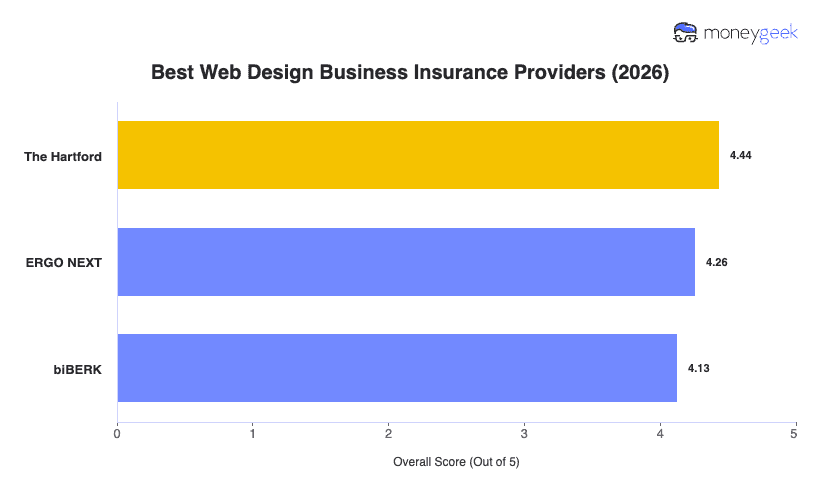
No single provider is the right fit for every web design business: the exposures a solo project-based designer carries look nothing like those of a retainer designer managing ongoing site accountability across multiple clients. The Hartford leads on both affordability and coverage breadth, which matters if your priority is broad protection across cyber and Tech E&O without paying above the sub-industry average. If you value responsive support and straightforward policy management, ERGO NEXT could be a better match. Our analysis identified three providers that hold up across price, service quality and coverage depth for web design businesses.

Progressive Commercial3.87$6876
Thimble3.88$6967
Nationwide4.04$6742
Hiscox4.06$6134
biBERK4.11$6455
ERGO NEXT4.32$6013
The Hartford4.42$2621

For our overall best web design business insurance ratings, we analyzed pricing, coverage options, and customer experience across all 50 states and Washington, D.C. Our analysis focuses on 1-to-4-person web design businesses, while weighting results to ensure broader industry and location representation. To do this, we evaluated over six million business profiles, more than 100,000 customer experience data points and performed in-depth analysis of coverage contracts and endorsements to compare insurers consistently across industries and regions. We then rated each company across categories of affordability (50% of overall score), customer experience (30% of overall score) and coverage options and terms (20% of overall score) to form an overall rating.

See our full business insurance methodology.

The Hartford
Best Overall for Web Design Businesses

The Hartford

On The Hartford's site

The Hartford ranks first overall for web design businesses nationally, leading on both affordability and coverage. If your business is past the solo stage, your premiums are likely to run around 28% below the web design sub-industry average, which adds up when you're running fixed-price projects and your insurance costs need to stay predictable. FailSafe Technology E&O is built specifically for technology businesses, bundling professional liability and first-party cyber coverage so you're not managing two separate policies for the same type of work. Before you bind, confirm with The Hartford whether your operation qualifies for FailSafe or the separate CyberChoice First Response product.

Learn More: The Hartford Business Insurance Review

ERGO NEXT
Best Customer Experience for Web Designers

ERGO NEXT

On ERGO NEXT's site

Ranking second in our analysis is ERGO NEXT, with top scores in customer experience. Its model allows you to buy coverage quickly before a project starts, pull COIs and add clients to a policy in a matter of minutes through its mobile app. It's also the second most affordable provider with premiums running about 8% below the sub-industry average. Where the experience breaks down is when claims are contested, as defense counsel and appeals both rank lower than other carriers.

Learn More: ERGO NEXT Business Insurance Review

biBerk
Best Direct-to-Consumer Option for Web Designers

biBerk

For web design businesses that want institutional-grade financial backing without paying broker fees to access it, biBERK is the only option on this page that offers both. It ranks third overall nationally, explicitly covering graphic designers and creative professionals across all 50 states with premiums about 2% below the sub-industry average. biBERK's cyber add-on covers data breach response costs but not business interruption, extortion or PCI/DSS violations, which is worth knowing before you quote on a project where any of those risks are live.

Learn More: biBerk Business Insurance Review

How to Choose the Right Web Design Business Insurance

Getting business insurance for your web design business works better as a sequence than a single decision. A project-based designer and a retainer designer can shop the same provider at the same price and end up with a policy that fits one of them well and leaves the other materially underinsured. What you need to carry has to come before which provider you choose, because your engagement model, your client type and your access obligations determine your exposure before any quote tool does. 

For your web design business, that sequence starts with your exposure profile and ends with a coverage structure that holds up when you move between engagement models, add staff or take on a contract with requirements you didn't write.

  1. 1
    Understand your risk profile and what coverage it requires

    Your exposure profile depends on how you work. If you deliver discrete project builds and hand off at completion, your liability traces back to a defined deliverable. If you manage retainers and stay accountable for live sites, your Tech E&O and cyber exposure stays open for as long as the engagement runs. 

    Before comparing policies or providers, identify where your work creates financial risk: whether that's the deliverables you produce, the client systems you access or the contracts you sign, and whether your coverage obligations come from state law, client contracts or your own operational reality.

  2. 2
    Choose the right coverage limits

    Your limits should reflect your worst-case scenario, not the minimum a provider offers or a contract requires. Your worst-case scenario as a web designer is most likely a client dispute over a failed deliverable or a breach traced to credentials you held, not a physical accident. If you work directly with small business clients, a $1 million Tech E&O limit is where most policies start, but if your work comes through agency contracts or enterprise clients, you'll likely need higher limits before work can begin.

  3. 3
    Evaluate providers who understand software development practices

    Not every insurer prices your web design risk the same way. Look for providers that offer Tech E&O and cyber coverage as core products rather than add-ons, and that have underwriting experience with businesses that hold ongoing client system access rather than general small business policies applied to a digital context. Weigh affordability, customer experience and coverage depth together as a provider that leads on price but ranks low on coverage breadth may leave gaps in exactly the exposures your work creates.

  4. 4
    Get compliance-ready

    Your clients, particularly agencies and enterprise accounts, will typically require a certificate of insurance before a project starts. Know what your contracts specify, such as the coverage type, the limit and whether the client needs to be named as an additional insured on your policy. If you work through agency subcontractor agreements, those terms are usually non-negotiable. Having your COI ready before a project kicks off means you're not delaying work while coverage catches up.

  5. 5
    Revisit your coverage as your software development practice grows

    Your coverage needs shift when your business structure changes, not just when your revenue does. If you move from project work to retainer arrangements, you're opening ongoing liability windows that don't reset the way a project handoff does. Adding your first employee or landing your first agency contract can each trigger new coverage obligations: workers' comp requirements in most states, or Tech E&O limits set by someone else's contract rather than your own risk assessment. Review your coverage at least annually and before signing any new contract that specifies coverage requirements.

Get Web Design Business Insurance Quotes

If you work on discrete project builds with defined handoffs, your quotes will look different from those of a designer whose agency contracts specify the coverage types, limits and additional insured requirements before you've assessed your own risk. The gap between those two profiles is wide enough that a quote generated for a generic small business doesn't tell you much about what you'll actually pay. Requesting business insurance quotes with your engagement model, client type and contract requirements gives you a number worth comparing.

About Connor Bolton


Connor Bolton headshot

Connor Bolton is Senior SEO and Content Manager at MoneyGeek, where he leads the business and pet insurance editorial teams. As editorial lead for both verticals, Connor sets the research framework, data standards, and content structure that his writers execute, directly authoring in-depth guides himself and reviewing all team content for accuracy and practical value before it goes live. With over four years evaluating insurance products across personal, commercial, and specialty lines, he brings cross-vertical knowledge to every guide the team produces.

Connor architected MoneyGeek's insurance research infrastructure across all major verticals including auto, home, renters, life, health, business, and pet, building systems for pricing analysis, provider-level research, customer experience evaluation, and coverage analysis with AI support. The infrastructure includes over 6 million data points for business insurance across 408 industry areas, all 50 states, and 16 vehicle types, and over 5 million pet insurance profiles across 18 major providers and hundreds of breed and age combinations. Connor's insurance cost research and his team's work has been cited by the U.S. Chamber of Commerce, Allstate, Liberty Mutual, CBS News, Forbes and LegalZoom.

Beyond the data, Connor stays connected to how the market actually operates, drawing on direct conversations with underwriters and carrier liaisons at Ethos, The Hartford, NEXT Insurance, Nationwide, and State Farm, and monitoring business and pet owner communities including Reddit, to inform how he interprets findings and frames guidance for real buyers.

He is the direct editorial contact for methodology questions at connor@moneygeek.com and can be found on LinkedIn.