Jump to what fits your needs most below:
- Get Tailored Estimates
- Find an Overall Cost Breakdown
- Learn About Factors Affecting Cost
- See How To Lower Rates
Average cyber insurance costs are between $52 to $3,398 per month for most small businesses.
Your rate varies widely depending on the size of your business, industry, the amount of data stored, and your location.
If you want quotes now, use our tool to get matched to an insurer that fits your needs.
Updated: September 10, 2026
Advertising & Editorial Disclosure
Jump to what fits your needs most below:

*MoneyGeek featured partner. Editorial rankings below are independent of this placement. Rates, rankings and savings comparisons are based on MoneyGeek's independent research and Hartford-reported data as of 2026. Figures are estimates and averages, not a guarantee of any individual quote, premium or discount.
Cyber insurance with a $1 million aggregate annual limit averages $83 per month ($999 per year) for small businesses. The national benchmark draws from an analysis of business insurance costs across over 400 industries in all 50 states and Washington, D.C.
Keep in mind that this is only an estimate, and you quote is based on your industry, the type and amount of information you store, where you operate, and how many employees have access to your systems.
We analyzed quote data from major cyber insurance providers and modeled standardized premium estimates across common business profiles.
Dataset scope:
How we calculated averages:
The national benchmark ($83/month) is the modeled premium for a one to four-employee business averaged across all industries and states. Segment averages isolate individual variables to show how premiums shift by business size, industry, or location.
Read our full methodology.
The cyber insurance cost estimate calculator below provides personalized pricing based on your industry, state and business size.
Select your state and industry to view average business insurance premiums in your area. Rates are calculated based on a business with 5 employees and $500,000 in annual revenue.
Most business insurance prices physical risk, but cyber insurance prices data risk. The more sensitive information you store, the more you pay. Three factors mainly drive your premium: industry (what data you hold), employee count (how many access points you create) and location (how much breaches cost to resolve in your state).

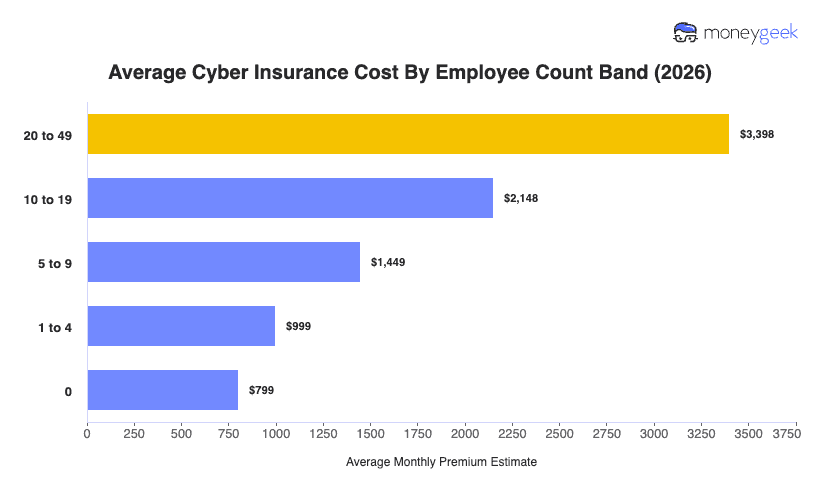
The size of your business is the most influential factor affecting cyber insurance costs at it directly determines the amount of people that have hands on sensitive data and the amount you have. 60% of breaches involve human error, and more employees means more error. This results in an exponentially increasing insurance cost as any business grows.
When comparing opposite ends of the employee count spectrum, a 20-to-49-person business has 325% higher cyber insurance costs than a sole proprietor.

Your industry is the second most influential factor that affects your cyber insurance costs due to it determining what type of digital information is at risk. For example, a small beauty salon will have less risk of losses than a retail shop due to a lower frequency of digital transactions. Tech and IT companies pay the most at around 88% above the national average and recreation/sports related businesses pay the least at 38% below average.

Your state where you operate is the least influential of the cyber insurance pricing factors and costs range anywhere from 15% lower than average (Wyoming and Alaska) to up to 24% higher (Washington D.C.) than national benchmarks. Locations with strict privacy laws, aggressive regulators, and plaintiff-friendly courts cost more to defend while those with looser regulations and lower legal costs allow insurers to charge lower premiums.
Use this table to find your size band and see how much you're paying above or below baseline. If you're between bands, budget for the higher one before you grow into it.
Unlike other coverage types, cyber insurance costs are more normally distributed across industries.
Tech companies, health care providers, and financial services firms pay 37% or more above average because their industries often involve high-value transactions and highly sensitive information. Even though these industries are especially expensive, most are not above average, and 68% are below national benchmarks.
Find your industry below to see where you fall, then review the risk tier to decide whether to prioritize security investments or shop harder for competitive rates.
| Agriculture & Natural Resources | $52 | $621 | 38% | 1 |
| Arts, Media & Entertainment | $71 | $855 | 14% | 7 |
| Beauty, Body & Wellness Services | $82 | $983 | 2% | 17 |
| Childcare Services | $73 | $881 | 12% | 10 |
| Cleaning Services | $65 | $783 | 22% | 5 |
| Construction & Contracting | $75 | $898 | 10% | 11 |
| Consulting Services | $100 | $1,197 | -20% | 21 |
| Education | $73 | $880 | 12% | 9 |
| Financial Services | $114 | $1,365 | -37% | 23 |
| Fitness Services | $76 | $914 | 9% | 12 |
| Food & Beverage | $81 | $976 | 2% | 16 |
| Healthcare & Medical | $116 | $1,395 | -40% | 24 |
| Hospitality, Travel & Tourism | $107 | $1,283 | -28% | 22 |
| Manufacturing | $72 | $862 | 14% | 8 |
| Marketing & Communications | $96 | $1,146 | -15% | 19 |
| Nonprofit & Associations | $57 | $679 | 32% | 3 |
| Other Professional Services | $97 | $1,166 | -17% | 20 |
| Pet Care Services | $77 | $922 | 8% | 14 |
| Real Estate & Property Services | $76 | $914 | 8% | 13 |
| Recreation & Sports | $56 | $675 | 32% | 2 |
| Repair and Maintenance | $79 | $952 | 5% | 15 |
| Retail & Product Rental | $89 | $1,073 | -7% | 18 |
| Tech/IT | $157 | $1,882 | -88% | 25 |
| Transportation & Logistics | $60 | $724 | 28% | 4 |
| Wholesale & Distribution | $68 | $813 | 19% | 6 |
If you want to explore business insurance costs in more detail for your industry, we've provided resources below.
Location matters less in cyber than in other business insurance, but it's still worth checking. The gap between the cheapest state Wyoming ($71) and most expensive area of Washington D.C. ($103) is only $32 a month because cyber-attack risk is not directly tied to your location.
Similar to industry, state risk is more normally distributed and cyber insurance pricing follows with an even more clear bell curve:
California and New York are the only states that sit 20% above the national average for cyber insurance costs, driven by stricter notification timelines, more aggressive attorneys and juries that award larger settlements. The vast majority of states stay close to the average, with 65% falling within 10% of national benchmarks.
| Alabama | $80 | $965 | 3% | 24 |
| Alaska | $71 | $849 | 15% | 2 |
| Arizona | $85 | $1,013 | -2% | 29 |
| Arkansas | $76 | $917 | 8% | 15 |
| California | $98 | $1,177 | -18% | 49 |
| Colorado | $90 | $1,081 | -8% | 39 |
| Connecticut | $95 | $1,139 | -14% | 45 |
| Delaware | $92 | $1,109 | -11% | 40 |
| District of Columbia | $103 | $1,235 | -24% | 51 |
| Florida | $90 | $1,080 | -8% | 37 |
| Georgia | $88 | $1,061 | -6% | 36 |
| Hawaii | $75 | $897 | 10% | 14 |
| Idaho | $72 | $868 | 13% | 5 |
| Illinois | $95 | $1,139 | -14% | 46 |
| Indiana | $83 | $994 | 1% | 25 |
| Iowa | $75 | $897 | 10% | 10 |
| Kansas | $79 | $946 | 5% | 19 |
| Kentucky | $80 | $965 | 3% | 22 |
| Louisiana | $80 | $965 | 3% | 21 |
| Maine | $75 | $897 | 10% | 12 |
| Maryland | $95 | $1,138 | -14% | 44 |
| Massachusetts | $95 | $1,139 | -14% | 47 |
| Michigan | $85 | $1,013 | -2% | 32 |
| Minnesota | $85 | $1,013 | -2% | 30 |
| Mississippi | $76 | $917 | 8% | 16 |
| Missouri | $83 | $994 | 1% | 27 |
| Montana | $71 | $849 | 15% | 4 |
| Nebraska | $75 | $897 | 10% | 8 |
| Nevada | $92 | $1,110 | -11% | 43 |
| New Hampshire | $75 | $897 | 10% | 11 |
| New Jersey | $96 | $1,158 | -16% | 48 |
| New Mexico | $76 | $917 | 8% | 17 |
| New York | $101 | $1,206 | -21% | 50 |
| North Carolina | $87 | $1,042 | -4% | 35 |
| North Dakota | $71 | $849 | 15% | 3 |
| Ohio | $85 | $1,013 | -2% | 31 |
| Oklahoma | $79 | $946 | 5% | 18 |
| Oregon | $87 | $1,042 | -4% | 34 |
| Pennsylvania | $87 | $1,042 | -4% | 33 |
| Rhode Island | $75 | $897 | 10% | 13 |
| South Carolina | $80 | $965 | 3% | 23 |
| South Dakota | $72 | $868 | 13% | 6 |
| Tennessee | $83 | $994 | 1% | 28 |
| Texas | $90 | $1,081 | -8% | 38 |
| Utah | $79 | $946 | 5% | 20 |
| Vermont | $75 | $897 | 10% | 9 |
| Virginia | $92 | $1,109 | -11% | 42 |
| Washington | $92 | $1,109 | -11% | 41 |
| West Virginia | $72 | $868 | 13% | 7 |
| Wisconsin | $83 | $994 | 1% | 26 |
| Wyoming | $71 | $849 | 15% | 1 |
California and New York carry higher premiums because breach response in those states is more expensive: stricter notification timelines, more aggressive attorneys general and juries that award larger settlements.
You can directly reduce your cyber insurance premium by improving your security. Missing basic controls like MFA or EDR can add 25% to 50% to your quote, or disqualify you from coverage entirely. Strong security lowers the risk profile and earns better rates. Required controls should be implemented first to qualify for coverage, then discount-earning controls added when the cost-benefit makes sense for the specific risk level.
Cyber insurance costs vary based on how insurers estimate your breach likelihood and potential claim size. Your premium is most influenced by industry, employee count and state. Use the $83 monthly national average as a reference point, not a prediction.
To get the most out of this data, think through three questions:
Unlike other forms of business insurance, you have direct control over cyber insurancepremiums through security investments. Strong controls can cut your quote by 20% to 30% or make the difference between approval and denial.
If you want to explore costs for other coverage types

Mark Flores is a Business Insurance Content Writer at MoneyGeek, where he focuses on commercial auto, commercial property, cyber and specialty business insurance coverage. His work simplifies coverage terms, gives business owners a strong baseline for expected costs, and narrows down policies and providers tailored to your operation, regardless of complexity.
Before joining MoneyGeek’s business insurance team, Mark worked as a Senior Content Writer at Clutch.co, where he produced structured B2B reviews and provider analyses based on client interviews, company research and service evaluation. That experience shaped his approach to business insurance content, especially when comparing insurers, explaining coverage differences and translating complex policy features into practical guidance for small business owners.
Mark also spent nearly 4 years as a digital marketing specialist serving small-business clients across industries such as home services, manufacturing and education. That background gives him practical context for how businesses evaluate vendors, manage operational needs and make purchasing decisions.
At MoneyGeek, he applies this research and evaluation experience to build guides that help transportation sectors, those with complex property-related risks (such as hotels and retail stores), and those most at risk of a cyberattack get the coverage they need at a reasonable price.
Linkedin: https://www.linkedin.com/in/mark-jason-flores-7844634a/
Contact Email: mark.flores@moneygeek.com