


Jump to the section that meets your needs best below:
Average Consulting Business Insurance Cost (2026 Report)
Consulting business insurance runs $7 to $159 monthly, driven by specialty, firm size, revenue and whether work involves vehicles or client site visits.
If you're ready to get a quote, use the tool below to get matched with the best business insurance provider for your consulting operation.
Select state
Updated: September 11, 2026
Advertising & Editorial Disclosure
Featured Partner

The Hartford
- The Hartford's professional liability rates for consulting firms run up to 46% below the industry average, one of the widest category differences in MoneyGeek's 2026 cheapest-provider analysis.
- Spanning 48 states, The Hartford's coverage footprint excludes only Alaska and Hawaii.
- Accountants, business consultants, HR consultants and safety consultants are all insured by The Hartford.
- Claims experience ranks second of eight for The Hartford in MoneyGeek's 2026 analysis, including second for settlement fairness and dispute handling.
On The Hartford's site
*MoneyGeek featured partner. Editorial rankings below are independent of this placement. Rates, rankings and savings comparisons are based on MoneyGeek's independent research and Hartford-reported data as of 2026. Figures are estimates and averages, not a guarantee of any individual quote, premium or discount.
How Much Does Consulting Business Insurance Cost?
The average cost of business insurance for consulting services range from $54 monthly ($646 annually) across six coverage types. This figure is from our analysis of estimates for businesses with one to four employees across 50 states and Washington, D.C., reflecting the full range of policies a consulting firm might carry, not the cost of any single policy.
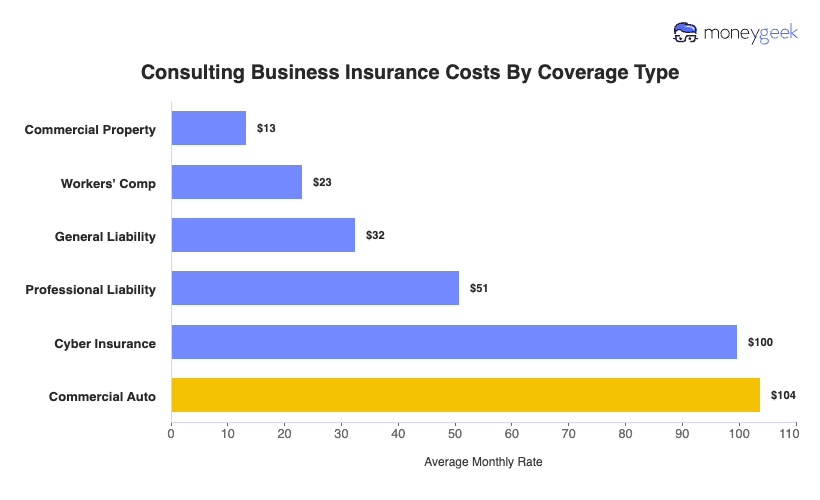
Individual coverage types range from $13 to $104 monthly, with specialty, employee count, and coverage mix all influencing what a firm pays. Commercial property sits at the low end because many consultants have limited equipment, while professional liability and cyber insurance cost more because client advice, data handling and digital workflows mean higher-risk exposures.
The table below shows average monthly and annual costs by coverage type. Use these as reference points rather than quotes, since premiums vary by business profile.
| Commercial Property | $13 | $159 | 89% | 2 |
| Workers' Comp | $23 | $278 | 79% | 4 |
| General Liability | $32 | $390 | -74% | 3 |
| Professional Liability | $51 | $610 | 10% | 11 |
| Cyber Insurance | $100 | $1,197 | -20% | 21 |
| Commercial Auto | $104 | $1,244 | 36% | 5 |
We analyzed quote data from major U.S. commercial insurance providers and modeled standardized premium estimates across business profiles representing around 95% of the market. Results are designed to provide a consistent national benchmark showing how premiums vary by key baseline factors including business size, consulting profession type, location and vehicle type for operations that use commercial vehicles.
Dataset Scope and Assumptions
Our cost modeling uses standardized inputs for consistent comparisons across businesses.
- Total estimates modeled: just over 6 million standardized pricing estimates
- Providers analyzed: 10 major insurance providers
- Professions covered: 15 consulting profession categories
- Geography: all U.S. states including Washington, D.C.
- Employee count bands: solo practitioners, one to four, five to nine, 10 to 19, and 20 to 49 employees
- Vehicle types studied: Sedans, SUVs, pickup trucks, vans, taxis, limousines, tractors, food trucks, semi-trucks (non-HAZMAT and HAZMAT), tanker trucks (non-HAZMAT and HAZMAT), buses, box trucks, dump trucks, flatbed trucks
- Policies studied: general liability, workers' comp, professional liability, commercial auto, commercial property, and cyber insurance
- General liability: $1 million per occurrence and $2 million aggregate
- Workers' comp: state required coverage
- Professional liability: $1 million per claim and $1 million aggregate
- Commercial auto: minimum coverage
- Commercial property: personal property coverage limits personalized to industry, business size and state
- Cyber insurance: $1 million per occurrence and $1 million aggregate
How We Calculated Average Consulting Business Insurance Costs
Our published averages represent modeled premiums for standardized business profiles and were aggregated in two ways.
- National benchmark average: The national average cost reflects the modeled premium for a standardized one to four employee business across all consulting profession categories and states included in our dataset for a standard professional liability policy
- Segment averages: To show how costs vary, we calculated average modeled premiums for our national base profile and isolated for variables, including:
- Employee count (business size ranges)
- Profession / industry categories
- Vehicle types (for commercial auto)
- States (including Washington, D.C.)
Segment averages were produced by aggregating modeled pricing trends across the full dataset so readers can compare how premiums shift across profession types and regions.
See our full business insurance methodology.
Get Consulting Business Insurance Cost Estimates
If you want a more personalized estimate, use our business insurance cost calculator before comparing rates.
Get Consulting Insurance Cost Estimates
Select Coverage Type
Select State
Select Employee Count
Select Vehicle Type
Average Monthly Estimate—
Select Coverage Type
Average Monthly Estimate—
Select State
Select Employee Count
Select Vehicle Type
Factors Affecting Consulting Business Insurance Costs
Several variables drive variation in consulting business insurance costs, from the size and location of the firm to the nature of the work performed, how clients structure contracts and whether consultants travel regularly for client engagements.
 Business size
Payroll, employee count and revenue all factor into how insurers assess a consulting firm's exposure. Larger firms take on more engagements simultaneously, employ more consultants delivering advice to clients, and generate larger payroll bases, pushing premiums higher across multiple coverage types.
 Location
Consulting businesses often register in one state but deliver work across multiple states, which means the registered state determines the base rate even when engagements happen elsewhere. States with higher litigation rates, denser traffic and stricter coverage requirements consistently produce higher premiums than lower-cost states.
 Consulting type and services delivered
What a consultant actually does determines how much financial risk a client could claim against them. Engineering, IT, and technical consultants carry higher exposure because errors in their work can trigger costly project failures or significant client losses, while coaching and virtual support roles carry far lower claim potential.
 Revenue and engagement size
Larger consulting engagements carry higher claim potential. A firm billing $2 million annually on strategy or technical projects faces greater exposure than one billing $80,000, even with similar employee counts. Insurers factor revenue into rates across multiple coverage types as a measure of how much a client stands to lose from a disputed outcome.
 Field vs. remote operations
Consulting spans one of the widest field-to-remote ranges of any professional services category, from virtual assistants and coaches who rarely leave a desk to agricultural, environmental, and safety consultants who spend most working hours driving to farms, field sites and client facilities. That range directly affects what a firm pays for vehicle and property coverage.
How to Lower Consulting Business Insurance Costs
Some approaches to securing affordable business insurance take effect within the current policy period, while others accumulate over time and produce savings at renewal. Both are relevant for consulting businesses managing costs across multiple coverage types.
Quick Consulting Business Insurance Cost Lowering Methods
Most of these approaches apply at the point of purchase or renewal and can produce immediate savings for consulting firms across coverage types.
 Request quotes using the same information
An environmental consultant shopping for coverage might receive one quote with a $1 million professional liability limit and another with $500,000. That price difference reflects coverage depth, not insurer competitiveness. Submit the same limits, deductibles and coverage structure to every insurer you request quotes from, so price differences reflect actual rate variation rather than differences in what each quote covers.
 Right-size your coverage
A solo HR consultant working from home carries a very different risk profile than a five-person engineering firm with leased office space and field vehicles. Review what each policy actually covers against your current operations. Remote-only consultants may carry commercial auto or commercial property coverage they no longer need, and dropping policies that don't match your current setup is the fastest way to reduce what you pay without changing your actual protection.
 Increase your deductible strategically
For a marketing consultant or education consultant with a clean claims history and stable client relationships, raising the deductible on lower-risk coverage types often produces meaningful savings with limited practical downside. The tradeoff is absorbing more out of pocket if a claim arises, so consulting businesses with predictable retainer income and no history of client disputes are generally the strongest candidates for this approach.
 Bundle policies with the same provider
Consulting businesses that lease office space and regularly host clients, including management consultants, research firms, and HR advisors, often carry both general liability and commercial property. Buying both through the same insurer as a business owner's policy typically produces a lower combined rate than purchasing each separately, and simplifies renewals to a single policy cycle.
 Pay annually instead of monthly
Most insurers apply a financing markup to monthly payment plans. A life coaching practice or virtual assistant business carrying two or three policies pays that markup on each. Switching to annual payment across the your policies removes the financing cost without changing any coverage terms, and retainer-based consulting businesses with stable monthly income are the best positioned to absorb the upfront cost comfortably.
Long-Term Consulting Business Insurance Cost Lowering Methods
These approaches take more than a single policy period to affect rates but produce more durable savings for consulting firms over time.
 Lower your risk profile
Insurers reassess risk at renewal, and a consulting firm that has tightened its engagement processes, reduced its exposure, or narrowed its service scope may qualify for lower premiums. An IT consulting firm that stops offering implementation services and moves to advisory-only work reduces the professional liability claim potential insurers price into its rate, and that narrower scope is something insurers can see and price accordingly at renewal.
 Invest in risk management practices
In consulting, risk management is primarily about how engagements are structured and documented. The contracts, scope definitions, and sign-off processes a firm uses determine whether a client dispute becomes a claim. Firms that build these protocols consistently give insurers concrete evidence of lower claim likelihood at renewal:
- Use written contracts with clearly defined scope, deliverables, and limitation of liability clauses on every client engagement, particularly important for engineering and safety consultants whose work carries measurable project risk
- Require written client approval at each project milestone to reduce scope disputes, one of the most common triggers for professional liability claims against management and strategy consulting firms
- Apply consistent data handling protocols when working with client systems, employee records, or financial data, a practical standard for HR, IT, and financial consultants who regularly access sensitive information
- Document how client complaints and project disputes are escalated and resolved internally, so insurers can see a clear record of how the firm handles professional disagreements before they become claims
Consulting Business Insurance Cost: Bottom Line
Premium variation between consulting professions comes down to what the work actually involves. While there aren't many physical hazards or inventory, the nature of the advice delivered, who the clients are and how engagements are structured impact rates greatly. The $54 monthly average across six coverage types is useful as a starting point but shaped heavily by factors like business type, employee count and location.
These three questions help put your quote in context:
- Where does the operation fall in the distribution? The consulting type and employee count can be located in the breakdowns on this page. A solo agricultural consultant and a 10-person management consulting firm both fall under consulting services, but sit in very different parts of the distribution. Knowing where a profile lands indicates whether a quote aligns with what similar businesses typically pay.
- Is the quote consistent with the risk profile? A quote that sits well above or below the benchmark for the consulting type and state is worth examining. How an insurer classifies the business affects which risk tier it falls into, and a misclassification can produce a rate that does not reflect the actual operations.
- Which cost drivers apply to the operation? Not every factor on this page carries equal weight for every consulting operation. A fully remote SEO consultant pays primarily for professional liability and cyber exposure, while a field-based environmental consultant's costs run through vehicle use, on-site physical exposure and equipment. Identifying which drivers apply reveals which benchmarks are most relevant to the specific situation.
The benchmarks on this page serve as reference points, not projections. The gap between them and a real quote comes down to a small number of factors specific to how the business actually operates, and those factors are worth examining before accepting or rejecting any quote.
About Connor Bolton

Connor Bolton is Senior SEO and Content Manager at MoneyGeek, where he leads the business and pet insurance editorial teams. He sets the research framework, data standards and content structure for his team. All content goes through his accuracy review before publication. Connor also writes in-depth guides and has spent more than four years covering insurance products across personal, commercial and specialty lines.
The research infrastructure Connor built covers auto, home, renters, life, health, business and pet insurance across pricing analysis, carrier research, customer experience and coverage evaluation. It includes over 6 million data points for business insurance across 408 industry areas, all 50 states and 16 vehicle types. The pet insurance side covers over 5 million profiles across 18 major providers, 100+ breeds and ages up to 20 years. Connor’s insurance research and his team's work have been cited by the U.S. Chamber of Commerce, Allstate, Liberty Mutual, CBS News, Forbes and LegalZoom.
Connor also talks with underwriters and carrier liaisons at Ethos, The Hartford, ERGO NEXT, Nationwide and State Farm, and monitors business and pet owner communities on Reddit. Those sources shape how his team evaluates carriers, structures rate analysis and writes content for real pet owners.
Questions about MoneyGeek's business or pet insurance content? Reach him at connor@moneygeek.com or on LinkedIn.