




South Dakota's best workers' compensation insurance provider is The Hartford, which combines strong post-purchase support with affordable premiums. On average, you'll save around $13 per month per employee since its estimated cost is 20% lower than the state average. Once you're covered, you can get tailored support from The Hartford's dedicated team of industry-focused specialists and risk management resources to help prevent claims.
Best Workers' Comp Insurance in South Dakota (2026)
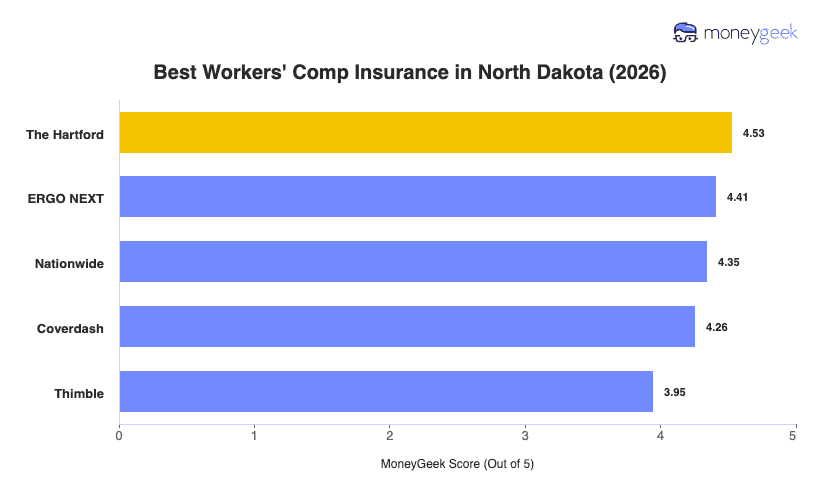
With rates starting at $9 monthly, The Hartford, ERGO NEXT and Nationwide offer the cheapest and best workers' comp insurance in South Dakota.
Get connected to top South Dakota workers' comp insurance providers and find your ideal coverage with our matching tool below.
Select state
Updated: August 27, 2026
Advertising & Editorial Disclosure
Best Workers' Comp Insurance Companies in South Dakota
| The Hartford | 4.53 | $52 | 3 | 3 |
| ERGO NEXT | 4.41 | $54 | 1 | 6 |
| Nationwide | 4.35 | $52 | 6 | 5 |
| Coverdash | 4.26 | $62 | 5 | 1 |
| Thimble | 3.95 | $61 | 8 | 9 |
MoneyGeek analyzed workers' comp insurance rates and provider performance across South Dakota using small business profiles with one to four employees spanning 408 major industries. Companies earn up to five points in each category in our scoring system. We then use a weighted average of these category scores to calculate an overall MoneyGeek score out of five.
- Affordability (55%): Based on average payroll for the most common employee code per industry and state classification, priced per employee for a one to four employee business.
- Customer Experience (35%): Evaluates buying (20%), which covers quote access, pricing accuracy and sales support; policy management (30%), which covers payroll reporting, audits, billing and loss control; and claims (50%), which covers FNOL speed, adjuster support, medical access, wage replacement and dispute handling.
- Coverage Options (10%): Assesses coverage completeness (35%), including employers' liability and wage and medical reimbursement; policy flexibility and endorsements (25%); eligibility, state and industry breadth (20%); and policy terms, limits and exclusions (20%).

The Hartford
Best Workers' Comp Insurance in South Dakota
MoneyGeek Rating
4.5/ 5
4.8/5Affordability
4.1/5Customer Experience
3.9/5Coverage
Average Monthly Cost
$52Claims Processing Score
4.1/5Policy Management Score
4/5Buying Process Score
4/5

ERGO NEXT
Best South Dakota Workers' Comp Insurance: Runner-Up
MoneyGeek Rating
4.4/ 5
4.7/5Affordability
4.2/5Customer Experience
3.6/5Coverage
Average Monthly Cost
$54Claims Processing Score
4/5Policy Management Score
4.1/5Buying Process Score
4.4/5
Cheapest Workers' Comp Insurance Companies in South Dakota
The Hartford has the cheapest workers' comp rates in 11 of the 25 industries we analyzed in South Dakota, though its wins are concentrated in lower-cost sectors where rates stay at $75 per month or less. ERGO NEXT leads in 13 industries, including all five of the highest-cost categories we reviewed.
Businesses in construction, transportation, wholesale, agriculture and cleaning will generally find the most competitive pricing with ERGO NEXT, while The Hartford has the strongest value for office-based and lower-risk industries. Coverdash leads in just one category, childcare, with rates starting at $21 per month, matching The Hartford’s pricing for hospitality and tech businesses.
| Financial Services | The Hartford | $9 | $108 |
| Beauty, Body & Wellness Services | The Hartford | $10 | $120 |
| Consulting Services | The Hartford | $10 | $120 |
| Marketing & Communications | ERGO NEXT | $10 | $120 |
| Real Estate & Property Services | The Hartford | $11 | $132 |
| Other Professional Services | The Hartford | $14 | $168 |
| Childcare Services | Coverdash | $21 | $252 |
| Hospitality, Travel & Tourism | The Hartford | $21 | $252 |
| Tech/IT | The Hartford | $21 | $252 |
| Food & Beverage | ERGO NEXT | $22 | $264 |
| Healthcare & Medical | The Hartford | $23 | $276 |
| Retail & Product Rental | The Hartford | $26 | $312 |
| Nonprofit & Associations | The Hartford | $31 | $372 |
| Pet Care Services | ERGO NEXT | $34 | $408 |
| Fitness Services | ERGO NEXT | $38 | $456 |
| Education | ERGO NEXT | $39 | $468 |
| Repair & Maintenance | ERGO NEXT | $39 | $468 |
| Arts, Media & Entertainment | ERGO NEXT | $51 | $612 |
| Recreation & Sports | ERGO NEXT | $58 | $696 |
| Cleaning Services | ERGO NEXT | $60 | $720 |
| Manufacturing | The Hartford | $75 | $900 |
| Agriculture & Natural Resources | ERGO NEXT | $86 | $1,032 |
| Wholesale & Distribution | ERGO NEXT | $101 | $1,212 |
| Construction & Contracting | ERGO NEXT | $124 | $1,488 |
| Transportation & Logistics | ERGO NEXT | $157 | $1,884 |
How to Get the Best Workers' Comp Insurance in South Dakota
You need to consider multiple items when you get workers' compensation insurance. That can include your classification code, your provider preferences and your budget. Our guide helps you keep all these considerations in check.
- 1Confirm South Dakota Coverage Requirements
South Dakota’s workers’ comp requirements are different since it doesn’t mandate that you purchase it. However, an employee injured while working for an uninsured business may sue the employer in civil court. Coverage may also be required by a client or contract, so weigh that exposure before deciding to go without a policy.
- 2Identify Your Class Codes Accurately
Insurers in South Dakota use NCCI class codes to group businesses with similar operations and risks. Describe where employees work and the duties that take up most of their time. If a code does not reflect your operation, ask how to request an NCCI review instead of letting the insurer substitute a different classification informally.
- 3Document Payroll, Employee Count, and Claims History
Your application should show payroll by class code and include loss runs, which summarize earlier workers’ compensation claims. Review anyone classified as an independent contractor before excluding their pay. South Dakota has specific certification rules for some commercial vehicle owner-operators, and the DLR explains the available arrangements on its independent contractor coverage page.
- 4Request Quotes From Multiple Licensed South Dakota Carriers
Compare business insurance quotes even though the state does not mandate coverage. Different carriers may accept different industries or apply different pricing to the same NCCI code. If regular insurers decline your business, South Dakota also has an assigned risk plan administered by NCCI for eligible employers that cannot find coverage in the voluntary market.
- 5Compare Total Value, Not Just Monthly Rate
An injured employee in South Dakota chooses their first medical provider, and an emergency room visit does not use up that choice. Changing providers later requires written approval from you or the insurer. Look for a carrier that explains this rule clearly and responds promptly when an employee requests a change or when you need a second medical opinion.
- 6Complete Purchase and Establish Payroll and Audit Reporting
Create a reporting process before an injury occurs so employees know who should receive notice. After learning about an injury, you have seven days, excluding Sundays and holidays, to complete Form 101 and send it to your insurer. Report the incident even if you question the claim because the carrier decides whether workers’ compensation covers it.
- 7Review at Annual Renewal
Compare the payroll audit with your wage records and correct employees assigned to the wrong NCCI code. Tell the carrier about ownership changes or new work that could affect your risk classification. Since coverage is voluntary in South Dakota, renewal is also a useful time to compare the policy’s cost with the lawsuit protection and contractual access it provides.
Best Workers' Compensation Insurance in South Dakota: Bottom Line
The Hartford, ERGO NEXT and Nationwide have the best workers' comp insurance in South Dakota, but the right choice depends on your business's industry, claims history and service priorities. The Hartford offers the lowest rate and strong claims support. ERGO NEXT delivers the best buying experience and solid policy management. Nationwide matches The Hartford on price with a different service profile. The strongest choice balances monthly cost against the claims and policy management support your industry requires.

LEARN MORE ABOUT SOUTH DAKOTA BUSINESS INSURANCE
You'll need more than workers' comp in your policy mix if you want the best business insurance in South Dakota. Check out the resources below to see which providers we recommend for other coverage types.
South Dakota Workers' Compensation Insurance FAQ
The Hartford is South Dakota's cheapest workers' comp provider at $52 a month and is also our top pick for the best workers' comp insurance in the state. Nationwide ties The Hartford on price at $52 a month, while ERGO NEXT follows closely at $54 a month.
- The Hartford: $52 a month
- Nationwide: $52 a month
- ERGO NEXT: $54 a month
- Thimble: $61 a month
- Coverdash: $62 a month
South Dakota requires most employers to carry workers' comp insurance once they have one or more employees. Sole proprietors with no employees are generally exempt but may elect voluntary coverage. Certain corporate officers of closely held corporations may be able to opt out under specific conditions defined in South Dakota Codified Laws Title 62. Employers who fail to carry required coverage receive fines and direct liability for injured workers' costs.
South Dakota's average workers' comp insurance cost is $65 a month per employee, based on MoneyGeek's analysis of 408 industries. The cheapest industry is Marketing and Communications at $13 a month, while Transportation and Logistics has the highest industry average at $193 a month. Individual provider rates within each industry may be lower.
South Dakota has no state workers' comp fund, so employers can get workers' compensation coverage from licensed private insurers. If no standard carrier will write coverage, the assigned risk pool provides fallback coverage as a market of last resort. Comparing at least three carriers is the most reliable way to find the best rate for your industry and payroll profile.
Workers' compensation in South Dakota covers:
- Medical expenses for workplace injuries
- Lost wage replacement during recovery periods
- Permanent disability benefits for lasting impairments
- Survivor benefits for families when work-related fatalities occur
About Connor Bolton

Connor Bolton is Senior SEO and Content Manager at MoneyGeek, where he leads the business and pet insurance editorial teams. He sets the research framework, data standards and content structure for his team. All content goes through his accuracy review before publication. Connor also writes in-depth guides and has spent more than four years covering insurance products across personal, commercial and specialty lines.
The research infrastructure Connor built covers auto, home, renters, life, health, business and pet insurance across pricing analysis, carrier research, customer experience and coverage evaluation. It includes over 6 million data points for business insurance across 408 industry areas, all 50 states and 16 vehicle types. The pet insurance side covers over 5 million profiles across 18 major providers, 100+ breeds and ages up to 20 years. Connor’s insurance research and his team's work have been cited by the U.S. Chamber of Commerce, Allstate, Liberty Mutual, CBS News, Forbes and LegalZoom.
Connor also talks with underwriters and carrier liaisons at Ethos, The Hartford, ERGO NEXT, Nationwide and State Farm, and monitors business and pet owner communities on Reddit. Those sources shape how his team evaluates carriers, structures rate analysis and writes content for real pet owners.
Questions about MoneyGeek's business or pet insurance content? Reach him at connor@moneygeek.com or on LinkedIn.