

Drunk driving remains a serious problem throughout the country. But certain days are more dangerous on the roads than others. MoneyGeek analyzed historical data from the U.S. Department of Transportation and the National Highway Traffic Safety Administration (NHTSA) to identify the deadliest days, weeks and holidays for driving under the influence (DUI) in the United States from 2019 to 2023.
2026’s Most Dangerous Days for DUIs
Updated: July 8, 2026
Edited by Aaron D. Weems

Featured Expert:
Advertising & Editorial Disclosure

KEY TAKEAWAYS
- The first week of July, which includes Independence Day, was the deadliest week from 2019 to 2023, with 1,439 DUI fatalities. It edged out Labor Day week, which had 1,424, reversing the prior ranking.
- Summer weekends carry an outsized share of the risk. Saturday and Sunday together accounted for 43% of summer DUI fatalities from 2019 to 2023, with Saturday alone responsible for nearly one in four.
- Alcohol-impaired-driving fatalities reached 12,382 in 2023. That is 21% above the 2019 total, though down 9% from the 2021 peak.
- DUI fatalities topped 13,000 in both 2021 and 2022 before easing in 2023.
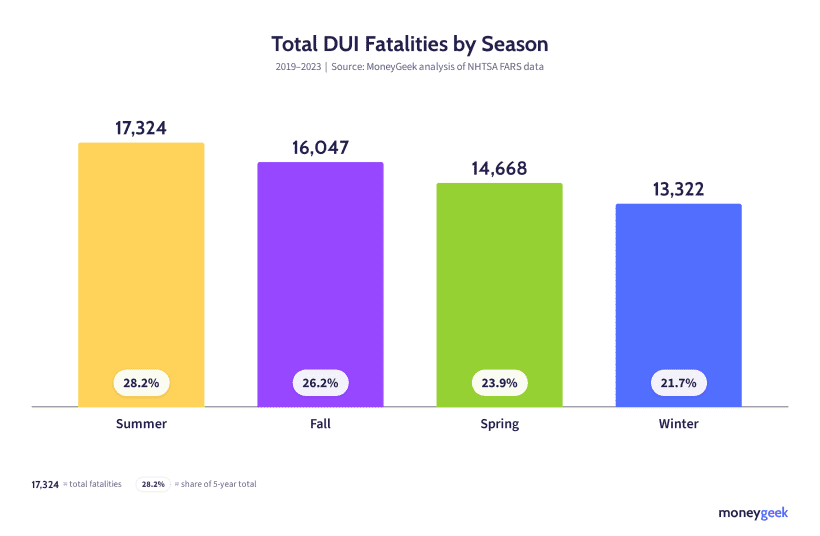
- Summer was the deadliest season for drunk-driving-related fatalities from 2019 to 2023, accounting for 28% of deaths.
- New Year’s Day drunk-driving-related deaths ran 95% above the daily baseline, the highest of any holiday.
- 58% of drunk-driving-related fatalities occurred on the weekends (Friday through Sunday).
DUI Fatalities by Season
Drunk driving occurs year-round, but certain seasons see higher rates of intoxicated drivers. Summer is the most dangerous time to drive. According to MoneyGeek’s analysis, 28% of DUI-related deaths from 2019 to 2023 happened in the summer.
Fall is close behind summer in DUI fatalities per season, accounting for 26% of DUI-related deaths. Twenty-four percent of DUI deaths occurred in the spring. At 22%, winter had the fewest DUI-related fatal accidents of any season from 2019 to 2023.
Most Dangerous Holidays for DUIs
New Year’s Day was the deadliest day of the year for drunk driving. Fatal accidents involving intoxicated drivers ran 95% above baseline levels on this holiday. Unlike other holidays where celebrations span several days, New Year’s parties concentrate into a single night. Drivers head home in the early morning hours of January 1, when impaired-driving risk peaks.
Labor Day ranked second, with fatal DUI crashes 54% above the typical trend during the holiday weekend. Memorial Day weekend came in third at 48% above baseline, while Independence Day ranked fourth at 45% above baseline.

Most Dangerous Days of the Week for DUIs
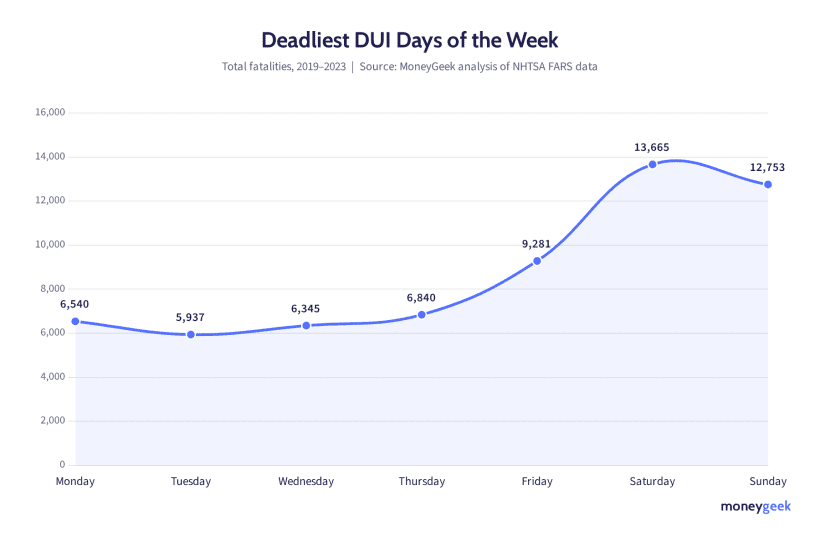
Saturday was the most dangerous day of the week to drive, with more than 22% of all DUI-related accidents from 2019 to 2023 occurring on this day. Sunday ranked second at 21%. Many Sunday fatalities happened after midnight. These were early-Sunday crashes that followed Saturday night celebrations.
Tuesday saw the fewest drunk drivers on the road. The data below shows total DUI fatalities from 2019 to 2023 and their percentage distribution by day of the week.
Most Dangerous Summer Days of the Week for DUIs
The weekend carries even more of the DUI burden in summer than it does across the rest of the year. From June through August, 2019 to 2023, 17,324 people died in alcohol-impaired-driving crashes, 28% of all DUI fatalities in the five-year window, in a season that covers only about a quarter of the calendar.
Within that summer window, Saturday and Sunday together accounted for 7,514 deaths, or 43% of all summer DUI fatalities. Adding Friday brings the Friday-through-Sunday total to 10,085 deaths, about 58% of the summer total.

Saturday | 3,919 | 22.6% | 22.3% | +0.4 pts |
Sunday | 3,595 | 20.8% | 20.8% | 0.0 pts |
Friday | 2,571 | 14.8% | 15.1% | -0.3 pts |
Thursday | 1,875 | 10.8% | 11.1% | -0.3 pts |
Monday | 1,833 | 10.6% | 10.7% | -0.1 pts |
Wednesday | 1,782 | 10.3% | 10.3% | -0.1 pts |
Tuesday | 1,750 | 10.1% | 9.7% | +0.4 pts |
Summer total | 17,324 | 100.0% | — | — |
The order of the days matches the full-year pattern, but the weekend share grows in summer. Saturday alone makes up nearly 23% of summer DUI deaths, and Sunday adds another 21%. Many of these are early-Sunday-morning crashes that follow Saturday night gatherings, a pattern the full-year data shows as well.
The summer weekend concentration held in every year studied. Saturday and Sunday combined never fell below 41% of a season’s DUI fatalities, and Saturday was the deadliest summer day in all five years. The timing tracks the summer holiday calendar: Memorial Day weekend, Independence Day and Labor Day all fall on or next to these high-risk days.
Most Dangerous Weeks of the Year for DUIs
The first week of July was the most dangerous week for drunk driving from 2019 to 2023, with 1,439 DUI fatalities during the Independence Day period. It narrowly edged out the first week of September, which includes Labor Day, at 1,424 fatalities, a margin of about 1%. The third week of July ranked third with 1,343 deaths. Summer road traffic is near its annual high during this stretch.
The fourth week of August, the pre-Labor Day stretch, claimed 1,338 lives, ranking fourth. Eight of the 10 deadliest weeks fall between June and early September, the stretch that drives summer’s standing as the most dangerous season.
7 | 1 | 1,439 | Independence Day |
9 | 1 | 1,424 | Labor Day |
7 | 3 | 1,343 | Mid-July |
8 | 4 | 1,338 | Pre-Labor Day weekend |
6 | 3 | 1,324 | Mid-June |
6 | 2 | 1,323 | Father's Day, graduations |
6 | 1 | 1,308 | Early June |
6 | 4 | 1,308 | End of June |
8 | 2 | 1,302 | Mid-August |
8 | 3 | 1,302 | Late August |
Note: Yearly figures are rounded from NHTSA’s multiple-imputation replicates and may not sum exactly to the five-year total of 61,361.
Ways to Stay Safe on the Road
On the most dangerous nights of the year, New Year’s Eve, Independence Day and Labor Day weekend, drunk drivers are most active in the hours after midnight. The four steps below lower your risk if you’re out late on those dates.
- 1Have a designated driver
If you’re drinking with friends, make sure whoever is behind the wheel hasn’t been drinking.
- 2Create a return home plan
If everyone you're with will be drinking and there's no designated driver, know ahead of time who you’ll be calling for a ride home, whether that’s a family member or an Uber driver.
- 3Make sure you’re strapped in
Always wear your seatbelt, no matter how short the drive. Heather Geronemus, former national chair of Mothers Against Drunk Driving (MADD), says, “The best defense against drunk drivers is to always wear your seatbelt and make sure children are properly restrained.”
- 4Drive without distractions
Whether you’re sober or not, stay off the phone and keep your eyes on the road, especially at night. Distracted driving is a leading cause of fatal crashes, according to NHTSA. You can’t always tell when an impaired driver is nearby, so staying alert gives you more time to react.
Consequences of Getting a DUI
Heather Geronemus knows the consequences of drunk driving firsthand. In 2009, her father, Dr. Robert Geronemus, a prominent kidney specialist in Fort Lauderdale, was walking in downtown Miami after a medical conference dinner when he was struck by a car that went through a red light.
“Think about what DUIs cost families,” she says. “For a victim like me, you can’t put a price on a lifetime of memories that you’ll never make with a loved one.” But Geronemus says there’s definitely a monetary cost. The CDC estimates that crash deaths involving alcohol-impaired drivers cost the United States about $143 billion in 2022, counting medical costs and the value of lives lost. “Much of these costs are borne by taxpayers, not the drunk driver,” she says. “This issue affects us all, and it makes financial sense to try to eliminate drunk driving.”
NHTSA estimates that a first-time drunk driver can pay as much as $10,000 in fines, legal fees and higher car insurance costs.
Insurance rates often rise steeply after a DUI, and you may no longer qualify for the lowest rates. To see what coverage costs once a conviction is on your record, compare quotes for cheapest car insurance after a DUI. You may also be required to file an SR-22 insurance form, which you can’t do on your own. Your insurer must file it on your behalf, and not all carriers offer this option.
How much rates climb depends on your state. MoneyGeek’s guide to how a DUI affects your premium in Illinois shows the size of the increase one state applies. Whether or not you need an SR-22, shop around to see if your current insurer still offers a lower rate. Another company might save you money.
If you’ve been drinking but don’t feel impaired, call a ride. A rideshare fare is a fraction of what a DUI arrest costs, and it keeps everyone on the road safer.
An End to Drunk Driving
MADD’s Heather Geronemus says the technology to stop drunk driving is coming, but it hasn’t arrived yet.
“MADD believes that technology will ultimately solve the problem of drunk driving. We are working on Capitol Hill to support legislation such as the RIDE Act and HALT Act, which would direct the Department of Transportation to require new cars to have advanced technology to detect and stop drunk drivers.”
“The technology would be passive, so drivers wouldn’t know it’s in the car unless they were impaired.”
Until passive detection technology reaches new cars, defensive driving and a zero-tolerance approach are the best tools available. Drivers looking to lower their costs can compare car insurance rates across insurers, or start with MoneyGeek’s list of the cheapest car insurance companies.
Methodology
MoneyGeek analyzed the five most recent years of DUI crash fatalities from NHTSA’s Fatality Analysis Reporting System (FARS) database (2019 to 2023). We compared average fatalities during specific holiday periods to the five-year daily average of 33.6 fatalities.
This analysis uses 2019 through 2023, the most recent five-year span for which all years are finalized in FARS. NHTSA released 2024 figures in April 2026, showing total traffic fatalities fell 4.3% to 39,254 and alcohol-impaired-driving deaths of 11,904. The 2024 file remains an Annual Report File subject to revision when finalized, so it is not included in this day-level analysis.
To identify the most dangerous holidays for drunk driving, we examined the following holidays and time periods:
- New Year’s Day: the calendar day only
- Memorial Day: the holiday and the three days before
- Independence Day: the holiday, the day before and the day after
- Labor Day: the holiday and the three days before
- Veterans Day: the calendar day only
- Thanksgiving: the holiday and the day before
- Christmas Day: Christmas Day and Christmas Eve
For the weekly analysis, each week ran from Monday through Sunday. We used the same grouping to define seasons: spring (March to May), summer (June to August), fall (September to November) and winter (December to February). For the summer weekday analysis, we filtered the 2019 to 2023 dataset to fatal crashes in June, July or August and grouped them by FARS day-of-week code, applying the same alcohol-impaired-driving classifier used elsewhere in the study.
Metrics Used
MoneyGeek studied NHTSA data on fatal motor vehicle crashes from 2019 to 2023 involving a driver with a blood alcohol concentration of 0.08 g/dL or more. For drivers who were not tested, NHTSA’s multiple-imputation values estimate blood alcohol concentration. This approach matches NHTSA’s official method for counting alcohol-impaired-driving fatalities. MoneyGeek’s computed yearly totals fall within about 1.6% of NHTSA’s published figures (for example, 13,458 for 2022 versus NHTSA’s 13,524), confirming the method.
About Geoff Williams

Geoff Williams has been a professional writer for more than three decades and a personal finance journalist for more than 15 years. His work appears in publications including The Wall Street Journal, The Washington Post and CNNMoney. He covers personal finance, real estate, entrepreneurship, credit cards and loans for MoneyGeek and has authored several books, including "Living Well with Bad Credit."
Williams earned his creative writing degree from Indiana University Bloomington.
Sources
- National Highway Traffic Safety Administration. "Fatality Analysis Reporting System (FARS)." Accessed June 5, 2026.
- National Highway Traffic Safety Administration. "2022 Data: Alcohol-Impaired Driving." Accessed June 5, 2026.
- National Highway Traffic Safety Administration. "2023 Data: Alcohol-Impaired Driving." Accessed June 5, 2026.
- National Highway Traffic Safety Administration. "Drunk Driving." Accessed June 5, 2026.
- Centers for Disease Control and Prevention. "Impaired Driving Facts." Accessed October 13, 2026.
- Mothers Against Drunk Driving. "MADD Board of Directors." Accessed October 13, 2026.