



Choose where to jump to next based on your needs:
Average General Liability Insurance Cost in South Carolina (2026 Report)
General liability insurance in South Carolina generally costs $25 to $339 per month, with your industry and employee count having the greatest impact on where your premium falls within that range.
If you're ready for a quote, get matched to the right general liability carrier for your South Carolina business with our tool below.
Select state
Updated: September 8, 2026
Advertising & Editorial Disclosure
How Much Does General Liability Insurance Cost in South Carolina?
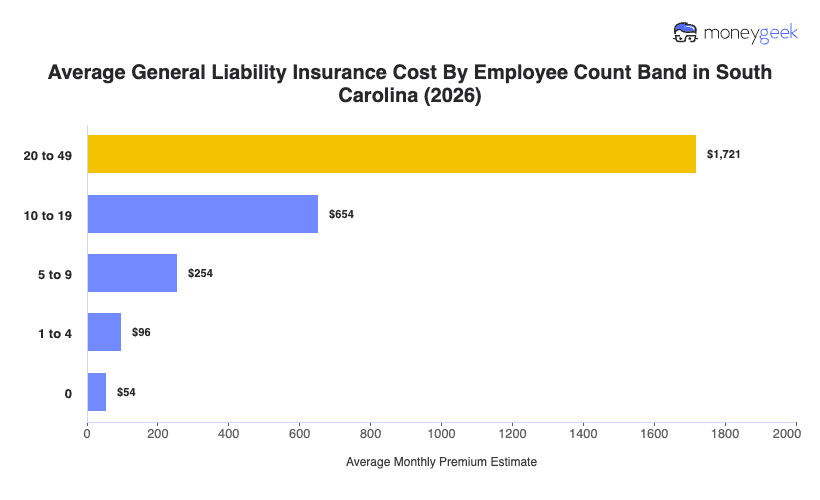
The average cost of general liability insurance in South Carolina is $96 monthly ($1,154 annually) for small businesses with one to four employees, placing the state as the sixth most affordable nationally, $27 per month below the typical U.S. business. Adjacent states run higher, with North Carolina at $112 monthly and Georgia at $121, while only West Virginia ($87) posts lower costs in the Southeast.
Use South Carolina's below-average position as a starting benchmark, but recognize that your actual cost depends on industry risk level, revenue exposure and claims history. These factors can move you well above or below the state average.
To estimate average general liability insurance costs in South Carolina, we analyzed quote data from 10 major U.S. small business insurance providers and modeled over 20,000 standardized premium estimates across 25 general industry categories and five employee count bands (zero through 20 to 49). All estimates assume a standard $1 million per occurrence and $2 million aggregate policy, with modeled revenue and payroll inputs calibrated to South Carolina regions, industries and employee counts.
The South Carolina state average reflects the modeled premium for a standardized one-to-four-employee small business across all included industries. Segment averages isolate variables like employee count and general industry category to show how costs shift within the state. These figures serve as benchmarks for comparison, not personalized quotes. Read full methodology.
What Factors Affect General Liability Insurance Costs in South Carolina?
General liability insurance in South Carolina follows nationwide pricing patterns, but state-level conditions shape what you actually pay. The factors below split into universal pricing drivers that apply in every state and South Carolina-specific variables tied to the state's regulatory environment and geographic risk.
South Carolina Agnostic General Liability Insurance Cost Factors
Several factors affect premiums universally, regardless of where a business operates or which carrier writes the policy.
 Business size
Larger payrolls drive higher premiums because insurers tie employee count to claim frequency potential. Each additional worker expands the business's reach through more job sites, client interactions and opportunities for covered incidents. Mid-size businesses in South Carolina with 20 to 49 employees pay 1,737% more than the state average, while sole operators pay 46% less.
 Industry classification
Claim probability varies sharply by industry based on how work gets done. Operations involving physical labor, customer premises or equipment carry higher liability exposure than knowledge work in controlled office environments.
In South Carolina, businesses in tech and IT pay 74% below the state average given their low-hazard, desk-based operations, while construction and contracting costs 159% above average due to worksite injuries and property damage risk. Reviewing your industry classification ensures your business isn't overcharged for risks that don't match your actual operations.
South Carolina-Specific General Liability Insurance Cost Factors
South Carolina's regulatory environment, coastal geography and legal framework add cost variables beyond the universal factors that apply everywhere. Insurers weigh these state-level conditions when setting premiums for in-state operations.

South Carolina's Coastal Hurricane Exposure
Coastal businesses in Charleston, Myrtle Beach and Beaufort deal with hurricane and tropical storm risk every year. Wind, flooding and storm surge damage drive up property damage liability claims in these areas. Insurers charge higher premiums for coastal operations than inland businesses because claim frequency and severity rise during hurricane season.

South Carolina's Modified Comparative Fault System
South Carolina follows a modified comparative fault rule where plaintiffs recover damages only if they are 50% or less at fault, with awards reduced by their fault percentage. This caps insurer payouts more than pure joint and several liability states, which can moderate premiums. However, South Carolina sets no damage caps, so severe cases can still produce unlimited awards.

South Carolina's Selective GL Insurance Requirements
The state does not mandate general liability coverage for all businesses statewide, unlike workers' compensation requirements. Certain industries carry strict mandates. Fire sprinkler contractors need a minimum of $100,000 coverage per the Contractor's Licensing Board, and Charleston city projects require $1 million per occurrence. This uneven enforcement creates inconsistent market demand, and insurers price risk differently depending on industry licensing rules and municipal contract standards.

South Carolina's Inland Flooding and Severe Weather Patterns
Businesses statewide deal with more than coastal hurricanes. Heavy rains overwhelm storm drains, tornadoes strike in spring and summer, and ice storms hit Upstate regions like Spartanburg. These events trigger slip-and-fall claims and property damage liability. Premiums rise for businesses in flood-prone or severe weather zones regardless of distance from the coast.

South Carolina's Humid Subtropical Climate
Year-round humidity and heat create mold growth in older or poorly ventilated buildings, especially in coastal and Lowcountry areas. Mold-related property damage can trigger third-party liability claims when it affects client spaces or leased properties. Insurers factor building age, ventilation quality and climate-related deterioration into liability pricing as a result.

South Carolina's Urban Claim Frequency Patterns
Slip-and-fall incidents drive most general liability claims statewide. Urban retail districts in Columbia, Charleston and Greenville post higher rates because of heavier foot traffic. Downtown commercial areas add theft and vandalism exposure on top of that. Urban business premiums end up above rural rates even when industry and revenue stay the same.
Get a SC General Liability Insurance Cost Estimate
Estimate your general liability insurance costs using the general liability insurance calculator below, which uses your industry and employee count to calculate an estimate. All estimates assume a standard policy with $1 million in coverage per occurrence and a $2 million aggregate limit. You can also click Get Quotes to be matched with insurers that may suit your business based on the information you enter.
South Carolina General Liability Cost Estimate Calculator
Select your state and industry to view average business insurance premiums in your area. Rates are calculated based on a business with 5 employees and $500,000 in annual revenue.
Select General Industry
Select Employee Count
Monthly rate estimate—
Select General Industry
Monthly rate estimate—
Select Employee Count
How to Lower General Liability Insurance Costs Without Sacrificing Coverage
Lowering general liability costs in South Carolina doesn't require sacrificing the protection your business needs. The right combination of purchasing decisions and operational improvements can reduce premiums starting with your next renewal.
For businesses focused on finding affordable general liability coverage in South Carolina, the methods below cover both immediate savings and longer-term strategies that build insurer confidence over time.
Quick General Liability Cost Lowering Methods
Several cost reduction methods work through purchasing decisions rather than business changes. These approaches deliver savings within one policy cycle by adjusting coverage structure, payment terms and how you share information with carriers.
 Provide clean, accurate underwriting information
Insurers price your general liability quote based on your exact business setup, including revenue, employee count, square footage and what work you actually do. A Grand Strand surf shop that mistakenly selects "sporting goods retail" instead of "surf equipment rental and instruction" gets incorrectly priced because rental operations and teaching lessons carry different liability exposure than selling merchandise. If you run a Pee Dee tobacco farm with seasonal harvest crews, report your actual peak payroll during July and August since understating temporary worker counts triggers audit adjustments when carriers verify your records. Answer classification questions precisely the first time to avoid mid-term premium increases and coverage gaps during claims.
 Compare multiple insurers
An Upstate automotive parts supplier serving BMW's Spartanburg plant might receive a $140 monthly quote from one insurer familiar with the I-85 corridor supply chain and $220 from another pricing manufacturing more conservatively. Request quotes from at least three carriers to see these pricing differences firsthand. Insurers build different appetites based on their South Carolina claims experience, and a carrier that has paid multiple slip-and-fall settlements at Charleston restaurants may price hospitality higher than a competitor with better Lowcountry results. Comparing business insurance quotes reveals which insurer understands your specific operations and prices them competitively.
- Bundle general liability into a business owner's policy (BOP)
Packaging general liability with commercial property and business interruption coverage through a BOP typically costs 20% to 30% less than buying policies separately. A Georgetown shrimp boat operation with dock facilities, processing equipment and customer sales areas benefits from combined coverage, as one policy handles slip-and-fall claims, hurricane damage to boats and buildings and lost income when storms force harbor closures. BOPs work best for businesses under 100 employees with physical locations, and Spartanburg retail shops, Columbia professional offices and King Street restaurants in Charleston get streamlined protection at lower total cost through bundling.
 Pay annually instead of monthly
Monthly payment plans add installment fees that increase your total cost 5% to 10%. A Lowcountry landscaping company paying $1,400 annually spends $1,540 through monthly billing, and that extra $140 buys nothing but convenience. Businesses with steady year-round cash flow eliminate these fees by paying upfront. Seasonal operations like Grand Strand vacation rental managers or Upstate peach orchards should weigh whether paying the full premium during slow winter months outweighs fee savings, especially when most revenue concentrates in June through August. Match payment timing to your actual cash flow patterns.
 Increase your deductible (if you can afford it)
Raising your deductible from $500 to $2,500 lowers premiums 15% to 25%, but only makes sense if you can cover that amount when claims occur. A Columbia software consulting firm with minimal public interaction and three office-based employees faces few liability risks, making higher deductibles reasonable. A Myrtle Beach mini-golf course with thousands of summer visitors monthly should keep lower deductibles because slip-and-fall incidents happen frequently enough that saving $35 monthly isn't worth paying an extra $2,000 each time someone gets hurt. Match deductible amounts to your actual claim frequency and available cash reserves.
 Adjust your coverage limits
Review your actual contract requirements instead of over-insuring based on assumptions. A Florence hardware store serving retail customers doesn't need the same $2 million coverage as a Charleston contractor building peninsula townhomes. Check your commercial leases, vendor contracts and client agreements to identify how much coverage you actually need. Port of Charleston logistics companies may need higher GL limits due to cargo liability exposure and shipper requirements, while Greenville graphic designers working from home need less.
Read More: How Much General Liability Insurance Do You Need?
Long-Term General Liability Cost Lowering Methods
Reducing general liability costs over multiple policy periods requires building a track record insurers reward. These two approaches lower premiums gradually over three to five years.
General Liability Insurance Cost in South Carolina: Bottom Line
South Carolina ranks as the sixth most affordable state for general liability insurance, but the $96 monthly average works better as a starting reference than a rate prediction. Three questions pinpoint what drives your rate:
- Where does your business sit in the cost distribution? Match your employee count and industry against the tables above. Most South Carolina businesses fall well below the state average, landing between $25 and $80 monthly. If you operate in construction or healthcare, expect premiums significantly above the benchmark.
- What sets your baseline cost, and what can you actually control? Industry classification and business size decide your starting premium. Coverage limits, deductibles and policy structure shape your final rate from there.
- Which factors can you adjust right now? Bundling into a BOP, switching to annual payment and right-sizing your limits are all worth a second look. Check whether each one fits your actual exposure and cash flow.
Your individual rate reflects the interaction of multiple cost factors, not a single benchmark. Knowing which ones apply to your operation matters more than comparing yourself to one number.
About Angelique Palenzuela-Cruz

Angelique Palenzuela-Cruz is a Business Insurance Content Writer at MoneyGeek, where she specializes in general liability, workers’ compensation and professional liability insurance. Her work helps small business owners understand how these policies apply to coverage, including risks like customer injuries, employee injuries, professional mistakes, client contract terms and industry-specific coverage requirements.
She primarily covers service-based businesses where liability and employee coverage decisions are especially important, including cleaning, consulting, beauty and wellness, childcare, education, fitness, food service, pet care, repair and maintenance, and other professional services.
Before joining MoneyGeek, Angelique spent nearly 12 years at Guthrie-Jensen Consultants, one of Southeast Asia’s largest management training firms, where she advanced from Training Consultant to Managing Consultant. In that role, she worked with business clients to assess operational needs, develop training programs and present performance analyses to executive decision-makers. She also helped establish Gladwin Training Consultancy, where she served in learning solutions and client service roles.
Her background gives her practical context for writing about how businesses operate, manage client expectations, structure teams and make risk decisions. At MoneyGeek, she applies that experience to business insurance content, connecting coverage to actual business needs.
LinkedIn: linkedin.com/in/ma-angela-cruz
Email Contact: angelique.palenzuela@moneygeek.com
Sources
- City of Charleston. "Insurance Requirements." Accessed October 10, 2026.
- South Carolina Contractor's Licensing Board. "Fire Sprinkler Contractor Applications." Accessed October 10, 2026.
- South Carolina Department of Commerce. "Tourism Economy Creates Long-Term Impact, Opportunities." Accessed October 10, 2026.
- South Carolina Legislature. "South Carolina Contribution Among Tortfeasors Act." Accessed October 10, 2026.