


Jump to the section that meets your needs best below:
Average Food Business Insurance Cost (2026 Report)
Food business insurance costs $30 to $259 per month, shaped by business size, location, size and whether you serve alcohol or operate a food truck.
If you're ready to get quotes, MoneyGeek can connect you to your top food & beverage business insurer using our matching tool below.
Select state
Updated: September 13, 2026
Advertising & Editorial Disclosure
How Much Does Food Business Insurance Cost?
Food and beverage insurance costs range widely because a vending machine service and a full-service catering company carry very different risk profiles. The average cost of business insurance for food and beverage businesses is $101 monthly, or $1,209 annually. Those figures reflect 26 subindustries across 50 states and Washington, D.C. The analysis used quotes from the five most common coverage types for businesses with one to four employees, and the numbers are best read as benchmarks rather than quotes.
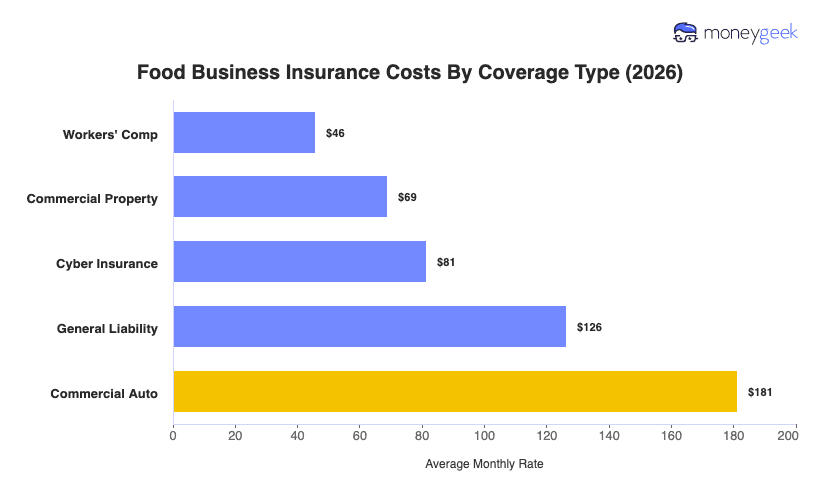
The spread across coverage types runs from $46 monthly for workers' comp to $181 monthly for commercial auto. Workers' comp prices on payroll, which keeps those rates low for small kitchen and counter crews. Commercial auto lands highest because vehicle use in this industry is intensive. Food trucks run daily service, caterers haul equipment to events and pizza or meal delivery puts drivers on the road repeatedly. The breakdowns below show how costs shift by coverage type:
| Workers' Comp | $46 | $550 | 59% | 8 |
| Commercial Property | $69 | $826 | 45% | 18 |
| Cyber Insurance | $81 | $976 | 2% | 16 |
| General Liability | $126 | $1,516 | 3% | 22 |
| Commercial Auto | $181 | $2,175 | -11% | 19 |
We analyzed quote data from major U.S. commercial insurance providers and modeled standardized premium estimates across business profiles representing around 95% of the market. Results are designed to provide a consistent national benchmark showing how premiums vary by key baseline factors including business size, cleaning profession type, location and vehicle type for operations that use commercial vehicles.
Dataset Scope and Assumptions
Our cost modeling uses standardized inputs for consistent comparisons across businesses.
- Total estimates modeled: just over 6 million standardized pricing estimates
- Providers analyzed: 10 major insurance providers
- Professions covered: 26 food and beverage profession categories
- Geography: all U.S. states including Washington, D.C.
- Employee count bands: solo practitioners, one to four, five to nine, 10 to 19, and 20 to 49 employees
- Vehicle types studied: Sedans, SUVs, pickup trucks, vans, taxis, limousines, tractors, food trucks, semi-trucks (non-HAZMAT and HAZMAT), tanker trucks (non-HAZMAT and HAZMAT), buses, box trucks, dump trucks, flatbed trucks
- Policies studied: general liability, workers' comp, commercial auto, commercial property, and cyber insurance
- General liability: $1 million per occurrence and $2 million aggregate
- Workers' comp: state required coverage
- Commercial auto: minimum coverage
- Commercial property: personal property coverage limits personalized to industry, business size and state
- Cyber insurance: $1 million per occurrence and $1 million aggregate
How We Calculated Average Food & Beverage Business Insurance Costs
Our published averages represent modeled premiums for standardized business profiles and were aggregated in two ways.
- National benchmark average: The national average cost reflects the modeled premium for a standardized one to four employee business across all cleaning profession categories and states included in our dataset for a standard professional liability policy
- Segment averages: To show how costs vary, we calculated average modeled premiums for our national base profile and isolated for variables, including:
- Employee count (business size ranges)
- Profession / industry categories
- Vehicle types (for commercial auto)
- States (including Washington, D.C.)
Segment averages were produced by aggregating modeled pricing trends across the full dataset so readers can compare how premiums shift across profession types and regions.
See our full business insurance methodology.
If you want to see business insurance costs for specific food and beverage subindustries, these pages provide more information:

Get Food Business Insurance Cost Estimates
Use the small business insurance calculator below to get an estimate built around your food & beverage company.
Get Food Insurance Cost Estimates
Select Coverage Type
Select State
Select Employee Count
Select Vehicle Type
Average Monthly Estimate—
Select Coverage Type
Average Monthly Estimate—
Select State
Select Employee Count
Select Vehicle Type
Factors Affecting Food Business Insurance Costs
Several variables shape the cost of food and beverage business insurance, and they don't all carry equal weight. A food truck and a full-service restaurant carry the same coverage types but pay very different rates. The factors below explain why:
 Business size
Kitchen and counter staff carry real injury risk from hot surfaces, sharp tools and wet floors, and every new hire raises the workers' comp exposure. More front-of-house staff means more customer interactions and a higher chance of slip-and-fall claims. Larger operations also own more commercial equipment, perishable stock and fixtures, which pushes property costs higher.
 Location
State workers' comp rates for food service roles vary widely, and so do liquor liability laws, minimum wage levels and commercial property replacement costs. A full-service bar in California pays more across nearly every coverage type than the same concept in Indiana, not because the operation is different but because the state environment is.
 Type of operation
Whether a business runs a food truck, operates a bar or manages a commercial kitchen affects nearly every coverage type it carries. A wine bar has alcohol liability exposure that a coffee shop does not. A pizza delivery operation needs commercial auto coverage that a vending machine service may not.
 Alcohol service
Food and beverage businesses that serve alcohol carry higher liability exposure than those that don't. Liquor liability claims, assault and battery incidents and dram shop laws create additional legal risk for bars, sports bars, wine bars and restaurants with full bar service.
 Vehicle use
Food trucks, ice cream trucks and mobile caterers use their vehicle to generate revenue, not just for transport. The vehicle earns on every service day rather than sitting idle between runs. Both need commercial auto coverage, but the rate reflects how much of the business runs from the road.
 On-premises customer activity
A restaurant with a full dining room, bar seating and weekend foot traffic carries far more premises liability than a ghost kitchen or delivery-only operation. The more customers a food business hosts on-site, the more exposure it creates for slip-and-fall incidents, property damage and service-related claims. A pickup-only counter cuts that exposure considerably.
How to Lower Food Business Insurance Costs
Some methods for finding affordable business insurance take effect within the current policy period. Others take a full renewal cycle or longer to change rates for food and beverage operations.
 Compare quotes using the same coverage limits
Insurance pricing for food and beverage businesses varies more than most owners expect. Two policies with the same label can carry different limits, exclusions and sublimits that make a direct price comparison meaningless. Compare business insurance quotes using identical limits, deductibles and coverage types, including any endorsements a food service operation may need, such as liquor liability or hired and non-owned auto.
 Right-size your coverage
Overpaying often comes from carrying coverage built for a larger or higher-risk operation than the one actually running. A ghost kitchen with no public dining room does not need the same premises liability limits as a 100-seat restaurant. Audit each policy against the actual risk profile of the business, and scale back where the exposure does not warrant the premium.
 Increase your deductible strategically
Raising the deductible on commercial property coverage cuts premiums for food businesses with heavy commercial equipment. A year-round diner can absorb a large claim more easily than a catering company in a slow month, when cash runs thin. Avoid applying this to workers' comp, where claim frequency in kitchens runs high.
 Bundle policies with the same provider
A bar running general liability, commercial property, workers' comp and liquor liability with one carrier pays less than one that splits them across providers. Food and beverage businesses stack more policy types than most small operations, so the discount adds up faster. Food trucks that add commercial auto to the mix see the same benefit.
 Pay annually instead of monthly
Farmers market vendors, event caterers and other seasonal food operations often have a natural revenue window where paying the full annual premium is more manageable. Annual payment eliminates the installment fees that monthly plans add to the total cost and, in many cases, earns a modest upfront discount from the carrier.
 Invest in risk management practices
Risk management investments lower claims frequency over time, which directly affects renewal pricing across general liability, workers' comp and commercial property. Food businesses that document and act on risk have something concrete to show a carrier at renewal.
- Schedule regular health and food safety inspections and document corrective actions. A clean inspection record reduces the likelihood of foodborne illness claims.
- Train kitchen staff on burn prevention, knife handling and wet floor protocols. Workers' comp claims from kitchens are among the most frequent in the industry.
- Implement ID verification and cut-off protocols for alcohol service. Dram shop liability claims are one of the most costly exposures for bars and full-service restaurants.
- Use encrypted payment processing and limit POS access by role. Reducing data breach risk lowers cyber insurance costs over time.
Food Business Insurance Cost: Bottom Line
Food and beverage businesses average $101 monthly across five coverage types, but when you request for quotes, individual premiums vary widely based on trade type, employee count and state. These three questions can help put figures in context:
- Where do you fall in the distribution? Food and beverage covers a wider range of operations than most industries. Use the breakdowns on this page to find your closest match in the data.
- Is your quote consistent with your risk profile? Alcohol service, foot traffic and vehicles push premiums above the average for many F&B operations. If a quote looks low, check whether it accounts for the exposures that come with your concept.
- Which cost drivers apply to your business? Vehicle use and alcohol service matter a great deal for some operations and barely register for others. A food truck and a coffee shop can pay similar premiums for entirely different reasons.
The difference between the industry benchmark and your quoted rate is a matter of a few operation-specific variables. Most food businesses find that two or three drivers account for the bulk of the distance. Use the benchmarks to calibrate your insurance costs, not as a prediction.
About Angelique Palenzuela-Cruz

Angelique Palenzuela-Cruz is a Business Insurance Content Writer at MoneyGeek, where she specializes in general liability, workers’ compensation and professional liability insurance. Her work helps small business owners understand how these policies apply to coverage, including risks like customer injuries, employee injuries, professional mistakes, client contract terms and industry-specific coverage requirements.
She primarily covers service-based businesses where liability and employee coverage decisions are especially important, including cleaning, consulting, beauty and wellness, childcare, education, fitness, food service, pet care, repair and maintenance, and other professional services.
Before joining MoneyGeek, Angelique spent nearly 12 years at Guthrie-Jensen Consultants, one of Southeast Asia’s largest management training firms, where she advanced from Training Consultant to Managing Consultant. In that role, she worked with business clients to assess operational needs, develop training programs and present performance analyses to executive decision-makers. She also helped establish Gladwin Training Consultancy, where she served in learning solutions and client service roles.
Her background gives her practical context for writing about how businesses operate, manage client expectations, structure teams and make risk decisions. At MoneyGeek, she applies that experience to business insurance content, connecting coverage to actual business needs.
LinkedIn: linkedin.com/in/ma-angela-cruz
Email Contact: angelique.palenzuela@moneygeek.com