
Best Food & Beverage Business Insurance Companies

What works for a coffee shop rarely works for a banquet hall, and no single provider is the best fit for every food and beverage business. Our analysis of the best business insurance options across 26 food and beverage subindustries identified five providers that hold up well on price, service and coverage for food and beverage businesses:

  1. ERGO NEXT: Best Overall, Best for On-the-Go Food Operators
  2. Thimble: Best for Short-Term and Event-Based Food Coverage
  3. biBERK: Best for Owner-Operated Food Businesses
  4. The Hartford: Best for Coverage Options
  5. Hiscox: Best for Food Businesses in the Northeastern Region

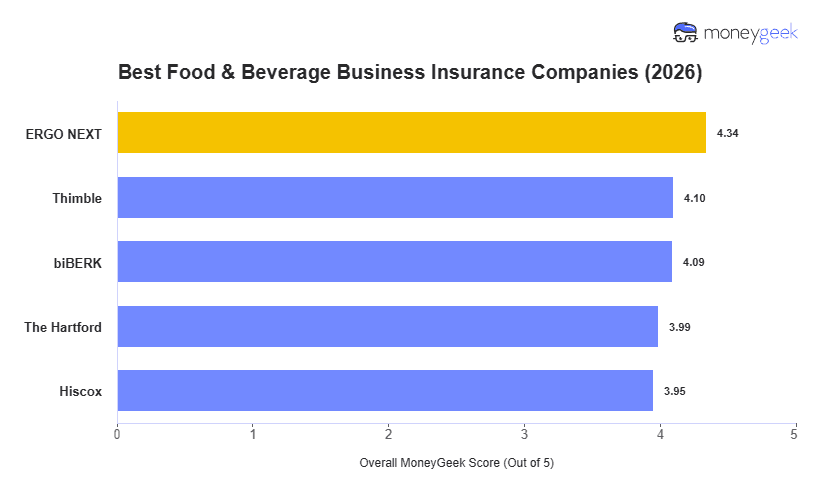
All five earned high scores by balancing what food and beverage businesses actually need: pricing that stays competitive as payroll and headcount grow, a service experience that doesn't slow operations during busy seasons or after a claim, and coverage options broad enough for businesses that sell, serve or handle food. The table below shows individual scores, ranks and overall pricing for our top picks.

ERGO NEXT4.34$8313
Thimble4.10$9137
biBERK4.09$10076
The Hartford3.99$11021
Hiscox3.95$10155

For our overall best food & beverage business insurance ratings, we analyzed pricing, coverage options, and customer experience across 26 sub-industries and all 50 states and Washington, D.C. Our analysis focuses on 1-to-4-person businesses, which represent nearly half of U.S. small businesses, while weighting results to ensure broader industry and location representation. To do this, we evaluated over one million business profiles, more than 100,000 customer experience data points and performed in-depth analysis of coverage contracts and endorsements to compare insurers consistently across industries and regions. We then rated each company across categories of affordability (50% of overall score), customer experience (30% of overall score) and coverage options and terms (20% of overall score) to form an overall rating.

See our full methodology.

95%

% of Small Businesses Covered

Over 235,294

Business Profiles Studied

23,529

Customer Experiences Analyzed

Company Image
Best Overall, Best for On-the-Go Food Operators

ERGO NEXT

ERGO NEXT tops the overall rankings for the food and beverage businesses, and is the only provider to lead across all 26 sub-industries, from full-service restaurants and food trucks to catering operations and bars. Competitive premiums and a strong buying-through-claims experience put it there. The fully online model means food operators can get covered and update policies without agent involvement. Certificates of insurance are available on demand, which are useful when a caterer needs proof of coverage for a venue or a food truck owner is setting up at a new event. The experience weakens during claims handling as defense counsel quality trails the field, which matters for any food business carrying real liquor liability or foodborne illness exposure.

Food businesses pay about 16% less than the industry benchmark on average. Mobile and event-based operators usually see the largest savings: mobile catering (24%), food trucks (24%) and catering services (23%), while wine bars and farmers market vendors save closer to 11% to 15%. That cost advantage holds for smaller teams of five to nine employees but narrows once you have 10 or more staff as payroll-driven premiums rise. For most food operators, the policy lineup covers what they need: general liability with product liability included, a BOP option, commercial property with food spoilage coverage and commercial auto for mobile work, though fit and availability depend on your state and operation. Liquor liability isn't included by default, so operators serving alcohol need to add it deliberately.

Where ERGO NEXT Performs Best

  • Food truck owners and mobile caterers who need the lowest rates and fast COI access
  • Solo operators and small cafes looking for affordable digital management
  • Fixed-location restaurants with straightforward coverage needs and low liquor liability exposure
  • Food business owners who want to quote, bind and update coverage entirely online without an agent

Where ERGO NEXT Performs Less Competitively

  • Bars and full-service restaurants with substantial liquor liability exposure
  • Growing food operations with 10 or more staff that prioritize affordability
  • Operators who want agent guidance through underwriting, coverage customization or dispute resolution

Learn More: ERGO NEXT Business Insurance Review

Company Image
Best for Short-Term and Event-Based Food Coverage

Thimble

Thimble's on-demand model lands it in second place, letting food operators buy coverage by the job, the month or the year, so a pop-up vendor or seasonal caterer doesn't pay for a full annual policy they don't need. You can purchase your coverage entirely online and require no agent involvement. When it comes to claims, filing is easy enough, but assignment lags, communication thins out, and legal defense support for contested liability rank lower. That means a food business dealing with a foodborne illness complaint or a slip-and-fall will find the process slows considerably once that claim is in.

While most food businesses save around 7% on average compared to the industry benchmark, with premiums for different subindustires land roughly 5% to 12% lower than the benchmark, depending on business type. Wedding venues, catering operations and full-service restaurants see the largest reductions, while bartenders and personal chefs save closer to the lower end. Those savings hold better for very small teams than for growing operations. Coverage is functional but bounded: food operators get general liability with product liability included, a BOP option, food spoilage coverage and short-term policies for event work. Higher limits require an umbrella, workers' comp isn't available in every state, and operators serving alcohol need to add liquor liability separately.

Where Thimble Performs Best

  • Pop-up vendors and seasonal caterers who need short-term coverage without a full annual commitment
  • Event-based food operators buying coverage for a single job or weekend booking
  • Very small cafes and counter-service spots will less than five employees that want affordable rates
  • Food business owners who want to quote, bind and manage coverage entirely online without an agent

Where Thimble Performs Less Competitively

  • Restaurants and bars with ongoing liquor liability exposure that may need strong claims defense
  • Food operations growing beyond a handful of employees that prioritizes cost
  • Operators who need higher liability limits for large venues, banquet events or high-traffic locations

Learn More: Thimble Business Insurance Review

Company Image
Best for Owner-Operated Food Businesses

biBerk

Ranked third overall, biBerk performs most consistently for smaller food operations, being the second-best option for teams with up to nine employees. Juice bars (12.5% below the sub-industry average), personal chefs (12.0%) see the most savings, though most food businesses only pay around 2% below the industry average. Wine bars, which often pay more for coverage than most food businesses given their liquor liability exposure, see 10% savings.

Coverage depth and customer experience follow a similar split: stronger at entry level, thinner as complexity grows. Food operators can get GL with product liability, a BOP option, workers' comp available in most states and an umbrella to extend liability limits, though operators serving alcohol still need to add liquor liability separately. When buying, biBerk gives food operators genuine guidance on what their policy covers and what gaps remain, which matters most for owners buying without a broker. Claims handling tells a different story since defense counsel quality and dispute handling both score low, so a bar owner working through an alcohol-related liability claim or a caterer disputing a foodborne illness settlement may find the process slower and less supported.

Where biBerk Performs Best

  • Juice bars, wine bars and personal chefs looking for lower rates
  • Small food businesses with less than 10 employees that want a financially strong direct carrier
  • Counter-service and deli operators in the South and Midwest 
  • First-time buyers who want clear online guidance on coverage without going through a broker

Where biBerk Performs Less Competitively

  • High-volume operations like food trucks and full-service restaurants that want affordable coverage
  • Bars and event caterers that need responsive claims defense if a liability dispute escalates
  • Operators who need quick policy adjustments mid-term and expect responsive support doing it

Learn More: biBerk Business Insurance Review

Company Image
Best for Coverage Options

The Hartford

The Hartford strong performance in coverage depth puts it in fourth place despite higher premiums. Its coverage menu addresses common risks encountered by food operators: food contamination endorsements for product recall and illness events, equipment breakdown for commercial kitchen failures, business income protection when a covered closure stops a restaurant from trading and higher base liability limits. Liquor liability still needs to be added separately, but for food businesses with genuine exposure across multiple risk areas, the gaps that appear elsewhere largely don't show up here.

Getting a quote takes more time, since the underwriting process asks more questions upfront, particularly for operations with liquor liability, catering services or staff on payroll. Once covered, operators can reach support quickly when adjusting coverage or handling a billing question. Food businesses with active liability exposure, from bars managing alcohol-related incidents to caterers disputing illness claims, get more support through the resolution process here than with most alternatives. Most food businesses pay about 6% above the industry average. The same pattern shows with most subindustries, except for full-service restaurants, wine bars and ice cream trucks, which actually pay slightly less than average. The cost picture changes substantially for larger operations: at 10 or more employees, The Hartford becomes the most affordable option, making it a good fit for growing food and beverage businesses.

Where The Hartford Performs Best

  • Bars, banquet halls and wedding venues that put premium on coverage depth and claims support
  • Full-service restaurants and sports bars with slip-and-fall, foodborne illness or liquor liability exposure
  • Growing food operations that want affordable coverage as coverage complexity increases
  • Operators who want loss prevention resources and responsive support throughout the policy term

Where The Hartford Performs Less Competitively

  • Solo operators and very small food businesses that want competitive premiums
  • Operators who need a fast, fully online quote-to-bind process without additional underwriting steps

Learn More: The Hartford Business Insurance Review

Company Image
Best for Food Businesses in the Northeastern Region

Hiscox

While Hiscox ranks fifth overall for food businesses, it’s the next best option in New York, New Jersey, Connecticut, Maine, New Hampshire and Maryland. It scores well in customer experience, with an accessible buying process and works well for standard policies. Operators may not always get a clear picture of what's driving their premium, though, since pricing transparency ranks lower. Users also score day-to-day policy management, such as COI handling, endorsement changes and billing low, which can become a real concern for caterers and event operators who need proof of coverage on short notice or adjust coverage frequently. Claims follow a similar pattern, with customer reviews reflecting complaints about slow assignment speeds and settlement fairness.

Premiums run close to the industry average: most food businesses pay about 4% of the benchmark, though bartenders and personal chefs pay around 7% to 8% more than their subindutry averages. Hiscox is the most affordable option for micro-operations but offers less competitive pricing as their businesses grow. It offers basic coverage types, like GL with product liability, a BOP option for fixed-location operators, with professional liability available for personal chefs. Hiscox doesn’t write workers' comp policies directly, and liquor liability availability varies by state and classification.

Where Hiscox Performs Best

  • Food businesses in New York, New Jersey, Connecticut and neighboring Northeastern states
  • Personal chefs who want professional liability coverage alongside standard GL protection
  • Fixed-location micro-operators with simple coverage needs and no liquor liability exposure
  • Operators in lower-risk food categories who need basic GL and BOP without complex endorsements

Where Hiscox Performs Less Competitively

  • Bars, restaurants and caterers that need liquor liability coverage available through a single provider
  • Food businesses with employees that want workers' comp without going through a separate partner

Learn More: Hiscox Business Insurance Review

Best Food & Beverage Business Insurance by Business Size

ERGO NEXT ranks first for food and beverage businesses up to 19 employees, from solo food cart vendors to small restaurant teams. For mid-sized food businesses, The Hartford takes the top spot, where its coverage score leads the dataset, a shift that aligns with hiring kitchen crews or expanding catering operations.

The table below shows the top provider for different employee bands:

0
ERGO NEXT
$49
1
4
1 to 4
ERGO NEXT
$68
1
3
5 to 9
ERGO NEXT
$147
1
3
10 to 19
ERGO NEXT
$317
1
3
20 to 49
The Hartford
$674
3
1

Best Food & Beverage Business Insurance by Subindustry

ERGO NEXT leads across all 26 food and beverage sub-industries. While the ranking is consistent, the pricing isn't. Monthly rates for the top-ranked provider run from $61 for personal chef services to $112 for bakeries, with most food businesses paying between $70 and $100 for coverage.

BakeryERGO NEXT$11213
Banquet HallERGO NEXT$8213
Bar/TavernERGO NEXT$9413
BartenderERGO NEXT$6313
Butcher ShopERGO NEXT$8913
Catering ServiceERGO NEXT$9513
Coffee Shop/CafeERGO NEXT$7913
Commercial KitchenERGO NEXT$9113
Deli/Sandwich ShopERGO NEXT$8113
Farmers Market/VendorERGO NEXT$7513
Fast Food RestaurantERGO NEXT$8113
Food Cart/StandERGO NEXT$6713
Food TruckERGO NEXT$8513
Food VendorERGO NEXT$6813
Ice Cream ShopERGO NEXT$7713
Ice Cream Truck (Mobile)ERGO NEXT$8213
Juice Bar/Smoothie ShopERGO NEXT$8013
Mobile BartendingERGO NEXT$7113
Mobile CateringERGO NEXT$7613
Personal Chef ServicesERGO NEXT$6113
Pizza Restaurant/DeliveryERGO NEXT$9213
Restaurant (Full-Service)ERGO NEXT$10013
Sports BarERGO NEXT$9413
Vending Machine ServiceERGO NEXT$6413
Wedding VenueERGO NEXT$9813
Wine BarERGO NEXT$9813

Each subindustry page below highlights the providers that best fit your type of food & beverage operation.

Best Food & Beverage Business Insurance by State

ERGO NEXT ranks first in our analysis for food and beverage businesses across all 50 states and Washington, D.C., so a commercial kitchen in Ohio and one in Oregon get the same top-ranked insurer. State affects pricing rather than provider selection, and the table below lets food businesses see what that looks like for their location.

Alabama
ERGO NEXT
$70
1
3
Alaska
ERGO NEXT
$107
1
3
Arizona
ERGO NEXT
$76
1
3
Arkansas
ERGO NEXT
$71
1
3
California
ERGO NEXT
$109
1
3
Colorado
ERGO NEXT
$82
1
3
Connecticut
ERGO NEXT
$102
1
3
Delaware
ERGO NEXT
$83
1
3
Florida
ERGO NEXT
$102
1
3
Georgia
ERGO NEXT
$83
1
3
Hawaii
ERGO NEXT
$66
1
3
Idaho
ERGO NEXT
$59
1
3
Illinois
ERGO NEXT
$90
1
3
Indiana
ERGO NEXT
$72
1
3
Iowa
ERGO NEXT
$57
1
3
Kansas
ERGO NEXT
$69
1
3
Kentucky
ERGO NEXT
$74
1
3
Louisiana
ERGO NEXT
$84
1
3
Maine
ERGO NEXT
$84
1
3
Maryland
ERGO NEXT
$98
1
3
Massachusetts
ERGO NEXT
$102
1
3
Michigan
ERGO NEXT
$112
1
3
Minnesota
ERGO NEXT
$81
1
3
Mississippi
ERGO NEXT
$72
1
3
Missouri
ERGO NEXT
$81
1
3
Montana
ERGO NEXT
$66
1
3
Nebraska
ERGO NEXT
$66
1
3
Nevada
ERGO NEXT
$83
1
3
New Hampshire
ERGO NEXT
$70
1
3
New Jersey
ERGO NEXT
$104
1
3
New Mexico
ERGO NEXT
$69
1
3
New York
ERGO NEXT
$114
1
3
North Carolina
ERGO NEXT
$81
1
3
North Dakota
ERGO NEXT
$76
1
3
Ohio
ERGO NEXT
$91
1
3
Oklahoma
ERGO NEXT
$72
1
3
Oregon
ERGO NEXT
$81
1
3
Pennsylvania
ERGO NEXT
$70
1
3
Rhode Island
ERGO NEXT
$93
1
3
South Carolina
ERGO NEXT
$81
1
3
South Dakota
ERGO NEXT
$75
1
3
Tennessee
ERGO NEXT
$74
1
3
Texas
ERGO NEXT
$92
1
3
Utah
ERGO NEXT
$72
1
3
Vermont
ERGO NEXT
$64
1
3
Virginia
ERGO NEXT
$85
1
3
Washington
ERGO NEXT
$99
1
3
Washington D.C.
ERGO NEXT
$115
1
3
West Virginia
ERGO NEXT
$75
1
3
Wisconsin
ERGO NEXT
$68
1
3
Wyoming
ERGO NEXT
$82
1
3

What Determines the Best Food & Beverage Business Insurance For You

The best food and beverage business insurance isn't the cheapest option available. It's the one that fits how the business actually operates, what it serves, how many people it employs and what clients, landlords or regulators require before the doors open or a contract gets signed.

Three factors and one test separate a well-matched policy from one that falls short.

    barChart icon
    Price stability matters more than the initial quote

    The concern isn't that rates go up. It's that they go up by more than the business can absorb without notice. Workers' comp and general liability both adjust based on actual payroll, and a sports bar that adds staff mid-season or a banquet hall that has a strong event run can see an audit bill well above what the budget assumed.

    talk icon
    Service that holds up when you actually need it

    A bar filing a liquor liability claim on a Friday night needs a carrier that responds quickly. Slow claims handling, hard-to-reach service teams and drawn-out audit processes all create real disruption during a food business's busiest periods.

    The service moments that matter most for food and beverage businesses are:

    • Getting a certificate of insurance before a catering event, farmers market permit or venue contract
    • Fast claims response after a kitchen injury, customer slip-and-fall or food contamination incident
    • Audit support for restaurants and bars with tipped employees and variable payroll structures
    financialPlanning icon
    Coverage that matches the work you actually do

    General liability is the starting point, but food and beverage operations routinely need coverage the base policy doesn't include. A business serving alcohol needs liquor liability. One storing perishable goods needs food spoilage coverage. Mobile operations need hired and non-owned auto. Beyond the current policy, the provider needs to accommodate growth, whether that means a second location, a catering arm or a delivery service down the line.

    trustSeal icon
    Reliable across the board, not just in one area

    Performing well in one area doesn't make up for gaps in the others. Take a pizza delivery operation with good coverage fit and a responsive carrier. A sharp renewal spike after a busy year still blindsides the budget. And if the policy excludes hired and non-owned auto, a driver accident still isn't covered. Each gap creates a different problem for the same business.

How to Choose the Best Food & Beverage Business Insurance

A food truck and a full-service restaurant both need business insurance, but the coverage structures differ enough that the evaluation has to start with the specific operation. Getting business insurance in the right order makes the decision cleaner.

  1. 1
    Map your food coverage needs to your operations

    Food and beverage businesses all start with general liability, but the rest of the coverage map depends on the operation. Alcohol service adds liquor liability. Employees add workers' comp. Perishable inventory adds food spoilage coverage. Delivery or catering vehicles add hired and non-owned auto. A butcher shop selling packaged goods adds product liability. Not every food business needs every coverage type, but identifying which ones apply to the specific operation is the step that prevents gaps later.

  2. 2
    Optimize your coverage and payment structure

    Set limits based on actual exposure, not the minimum a client requires. A food business with a dining room full of customers and kitchen staff on payroll needs more coverage than a personal chef working solo out of client homes.

    Annual payment often costs less than monthly installments, but monthly works better for seasonal operations like ice cream shops or event caterers. Match the payment structure to how the business actually gets paid.

  3. 3
    Choose your primary priority

    Different food businesses are in different situations, and that situation should drive which factor matters most when comparing providers. That priority breaks the tie when two providers are otherwise close.

    • Affordability: Prioritize if the business is on tight margins, recently had an audit come in above budget, or is looking at options after a renewal increase that felt out of proportion to how the year actually went.
    • Customer experience: Prioritize if the business regularly needs certificates of insurance on short notice for events, venues or clients, or if a previous carrier was slow during a claim or audit and that disruption had a real operational cost.
    • Coverage options: Prioritize if the business is growing or changing, such as launching a catering arm, adding delivery or opening a second location, and needs a provider that can write those changes into the policy without starting over.
  4. 4
    Shortlist providers that write policies for food businesses

    Not every carrier writes food and beverage coverage. Some that write general small business policies won't touch bars, catering operations or liquor-adjacent businesses. Shortlist carriers with active appetite for food service specifically.

    Two or three providers that fit the operation produce a more useful comparison than ten that need screening. The next step covers the actual filters, but the shortlist should begin with carriers that write food service coverage.

  5. 5
    Double-check dealbreakers early

    Before building a shortlist, run a quick pass on the non-negotiables. Any provider that fails these checks is off the list.

    • No liquor liability available for bars, restaurants or any operation that serves alcohol
    • Workers' comp not available for tipped workers, seasonal staff or the business's specific employee mix
    • No hired and non-owned auto coverage available for delivery or catering
    • Not licensed to write policies in the business's state
    • No food spoilage or contamination coverage available for operations storing perishable inventory
  6. 6
    Compare your finalists across all three areas

    Food business risks cut across all three areas. A bar evaluating providers can't afford a gap in pricing predictability, claims responsiveness or coverage depth. When providers score similarly, the Step 3 priority breaks the tie.

    • Affordability: Look at renewal predictability and whether payroll adjustments come with advance notice. A catering operation that adds seasonal staff shouldn't learn the cost at audit time. Review food and beverage business insurance costs before comparing quotes.
    • Customer experience: Evaluate how fast the carrier turns around certificates of insurance. Food businesses need them quickly for permits and venue contracts, and a slow turnaround creates real friction. Also ask how annual workers' comp audits work for operations with tipped employees.
    • Coverage options: Evaluate endorsement availability: liquor liability, food spoilage coverage and hired and non-owned auto are the gaps most food businesses hit beyond the baseline. A provider that can't add them, or adjust coverage as the business grows, creates a repurchase problem.
  7. 7
    Use quotes as the final confirmation step

    A quote confirms whether the pricing holds up against real business details and whether the policy structure fits. By this point there's a coverage baseline, a shortlist and a clear sense of what matters most. Use the quote to verify that F&B-specific coverage, such as event liability, food spoilage or hired auto, is included beyond the general liability baseline. Compare business insurance quotes to see how providers price the specific operation.

Best Food & Beverage Business Insurance: Bottom Line

ERGO NEXT, Thimble and biBERK perform consistently well across food and beverage businesses in our analysis. The more useful frame isn't which provider leads overall, but whether a given provider holds up on pricing, service and coverage for the specific operation. A wine bar and a food truck can both find ERGO NEXT at the top and still have different coverage needs from the same provider.

Best Food & Beverage Business Insurance: Next Steps

If you're still evaluating providers or comparing quotes that don't quite match on coverage, step back and check whether the policies cover the same risks at the same limits. Food businesses often find the price difference between two quotes narrows or disappears once the coverage is properly aligned.

If you've narrowed the provider list and know what coverage your operation needs, get a quote and check the policy details before buying. Catering companies, food trucks and restaurant operators often need a certificate of insurance quickly for permits or venue contracts, and getting covered without delay matters.

If your operation serves alcohol occasionally, not as a primary focus

If your business operates as both a food truck and a catering company

If you're comparing two quotes but one is missing a coverage type you need

If you're deciding between a business owner's policy and standalone policies

How We Chose the Best Food & Beverage Business Insurance Companies

To identify the best food & beverage business insurance companies, we evaluated insurers across pricing, customer experience and coverage options using a standardized, data-driven approach. Our goal was not to identify the cheapest option in every scenario, but to determine which providers deliver the most consistent overall value across common food business profiles.

Our best recommendations reflect insurers that perform well across multiple dimensions and remain competitive across food sub-industries and business sizes.

Data and Analysis Scope

Our analysis is based on standardized estimates designed to represent the majority of food businesses:

  • Providers analyzed: 7 major insurers
  • Subindustries covered: 26 food subindustries
  • Employee counts: Zero to 49 employees
  • Policy baseline: $1 million per occurrence/$2 million aggregate for liability coverages; workers' comp limits set to meet state mandates
  • Pricing modeled: 196,000 standardized estimates across food business profiles

Modeled average revenues and payrolls were incorporated to improve pricing accuracy for food business profiles.

Our Scoring Model

Each insurer received a composite score based on the weighted categories below.

  • Affordability (50%): Affordability reflects how competitively and consistently an insurer prices coverage across all food business profiles studied.
  • Customer experience (30%): Customer experience measures how well insurers support food businesses throughout the policy lifecycle from purchase to claims. We also studied at each level of buying, policy management and claims sub-parts of the process that make it easier and more reliable within each as well for accuracy and comprehensive understanding.
  • Coverage options (20%): Coverage options reflect how well insurers support common food business risks and allow for flexibility as businesses grow or change.

About Connor Bolton


Connor Bolton headshot

Connor Bolton is Senior SEO and Content Manager at MoneyGeek, where he leads the business and pet insurance editorial teams. As editorial lead for both verticals, Connor sets the research framework, data standards, and content structure that his writers execute, directly authoring in-depth guides himself and reviewing all team content for accuracy and practical value before it goes live. With over four years evaluating insurance products across personal, commercial, and specialty lines, he brings cross-vertical knowledge to every guide the team produces.

Connor architected MoneyGeek's insurance research infrastructure across all major verticals including auto, home, renters, life, health, business, and pet, building systems for pricing analysis, provider-level research, customer experience evaluation, and coverage analysis with AI support. The infrastructure includes over 6 million data points for business insurance across 408 industry areas, all 50 states, and 16 vehicle types, and over 5 million pet insurance profiles across 18 major providers and hundreds of breed and age combinations. Connor's insurance cost research and his team's work has been cited by the U.S. Chamber of Commerce, Allstate, Liberty Mutual, CBS News, Forbes and LegalZoom.

Beyond the data, Connor stays connected to how the market actually operates, drawing on direct conversations with underwriters and carrier liaisons at Ethos, The Hartford, NEXT Insurance, Nationwide, and State Farm, and monitoring business and pet owner communities including Reddit, to inform how he interprets findings and frames guidance for real buyers.

He is the direct editorial contact for methodology questions at connor@moneygeek.com and can be found on LinkedIn.