Best Catering Business Insurance Companies

The best food business insurance provider varies across food service business types, and catering is a good example of why. A caterer works in venues it doesn't own, transports equipment and staff across locations, serves food prepared off-site and often provides alcohol service under contracts that specify exactly what coverage the business must carry. Those conditions shape which providers perform well, and our analysis identified five that hold up across different situations, from drop-off corporate lunch operations to full-service caterers staffing plated dinners at rented event spaces.

  1. ERGO NEXT: Best Overall, Best for Small Catering Businesses
  2. Thimble: Best for Event-Based Caterers
  3. biBERK: Best for Agent-Supported Catering Coverage
  4. The Hartford: Best for Coverage Options
  5. Hiscox: Best for Multi-Location Catering Coverage

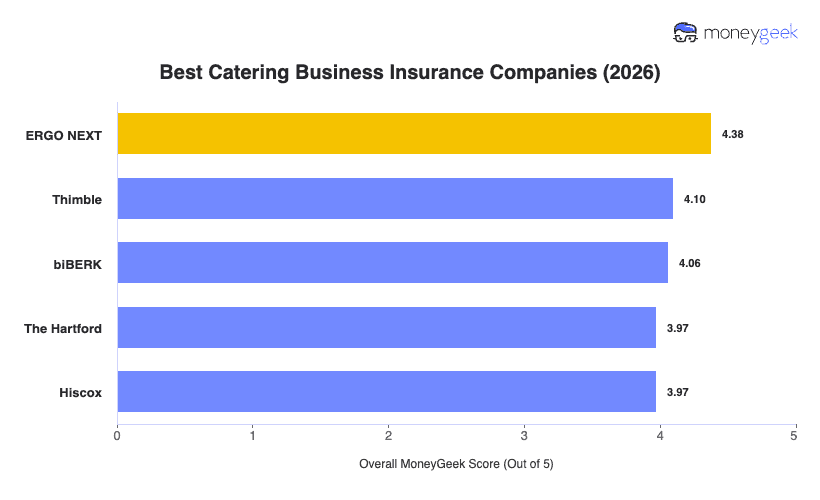
These five carriers hold up across what catering businesses actually deal with: foodborne illness claims after an event, property damage at a client venue, liquor liability from staffed bar service and workers' comp for the crew running the event. Each balances premium cost, claims handling and policy depth rather than leaning on price or coverage depth alone. The table below breaks in short how they all stack up against each other overall in terms of cost, customer experience and coverage.

ERGO NEXT4.38$9513
Thimble4.1$10627
Hiscox3.97$11935
biBERK4.06$13266
The Hartford3.97$14751

For our overall best catering business insurance ratings, we analyzed pricing, coverage options, and customer experience across all 50 states and Washington, D.C. Our analysis focuses on 1-to-4-person catering businesses, while weighting results to ensure broader industry and location representation. To do this, we evaluated over one million business profiles, more than 100,000 customer experience data points and performed in-depth analysis of coverage contracts and endorsements to compare insurers consistently across industries and regions. We then rated each company across categories of affordability (50% of overall score), customer experience (30% of overall score) and coverage options and terms (20% of overall score) to form an overall rating.

See our full methodology.

95%

% of Small Businesses Covered

Over 235,294

Business Profiles Studied

23,529

Customer Experiences Analyzed

Company Image
Best Overall, Best for Small Catering Businesses

ERGO NEXT

ERGO NEXT is the best business insurance company for caterers, with the top scores for both customer experience and affordability. Caterers get covered in about 10 minutes, issue unlimited COIs via app, add venues or event planners as additional insureds and share proof of coverage at no extra cost. For a caterer waiting on a venue coordinator to confirm a booking, getting that certificate out immediately can be the difference between landing the event and losing it.

Rates run below the catering average across every employee band, with savings from 30% to 38% by business size, which is a consistent pricing advantage for caterers watching margins across events. Coverage includes general liability with product liability, commercial property with food spoilage, workers' comp, commercial auto and a BOP option, though caterers with more complex setups may find greater flexibility elsewhere. Claims handling ranks third, and the support model is fully digital with no 24/7 access. Caterers who need to report an injury or food-related illness claim on a weekend event will reach support the next business day.

Where ERGO NEXT Performs Best

  • Solo caterers and small operations that want fast, self-service coverage
  • Caterers who regularly need COIs for venues, event planners or corporate clients on short notice
  • Small catering businesses with less than 10 employees that want to save on rates

Where ERGO NEXT Performs Less Competitively

  • Larger catering operations with complex coverage needs or multi-location kitchen setups
  • Caterers who want stronger claims support or prefer working with a dedicated agent

Learn More: ERGO NEXT Business Insurance Review

Company Image
Best for Event-Based Caterers

Thimble

At second place is Thimble, with a flexible-term model that works for caterers who work event-by-event. Coverage by the hour, day or month means a caterer taking on a Saturday wedding pays only for that window, not a full year. Additional insureds are added through the app at no extra cost, and a COI arrives the moment the policy is purchased. 

Coverage depth is where Thimble is less competitive as it doesn’t offer commercial auto, which is a real gap for caterers who load vans with chafing dishes and equipment to every job. Caterers serving alcohol or transporting expensive gear can add liquor liability and equipment protection, but both are separate purchases on top of the base policy. Thimble routes claims to a third-party administrator rather than handling them directly, with no phone support at any stage. Caterers dealing with a disputed claim will work through email only. COI access, endorsements and billing are all self-service through the app.

Where Thimble Performs Best

  • Operations that work seasonally or event-by-event and want to pay only for active coverage
  • Solo caterers comfortable with a fully digital, self-service experience and no agent involvement
  • Businesses that need event-specific coverage without a year-round commitment
  • Small catering businesses that want competitive rates and flexible payment terms

Where Thimble Performs Less Competitively

  • Caterers who own or operate vehicles to transport food and equipment to events
  • Catering operations that want phone support or hands-on help when filing a claim

Learn More: Thimble Business Insurance Review

Company Image
Best for Agent-Supported Catering Coverage

biBerk

As the best option for catering businesses of all sizes, biBERK lands on third place. With a coverage menu that includes general liability, commercial auto, workers' comp, a BOP with business interruption and umbrella coverage, it gives caterers a complete stack from kitchen prep to on-site service. Commercial auto is also available, covering the van loaded with chafing dishes and equipment heading to a venue. Berkshire Hathaway backing adds financial strength that matters when a claim is large enough to test a carrier.

Licensed advisors are available by phone during business hours, making it one of the more agent-supported options. Adding an additional insured takes up to two days, a slower turnaround that creates real friction for caterers confirming venue requirements close to an event. Claims can be filed online or by phone, though some policyholders report rate increases at renewal without clear advance notice. Rates run about 5% above the catering average, so buying directly through biBERK does not translate to lower pricing for catering businesses despite its direct-to-business carrier model.

Where biBERK Performs Best

  • Catering businesses that need commercial auto alongside general liability and workers' comp
  • Operations with 10 or more employees that prioritize affordability
  • Caterers that want phone support when buying a policy or filing a claim
  • Businesses that want Berkshire Hathaway's financial strength behind their catering coverage

Where biBERK Performs Less Competitively

  • Caterers who need to add a venue as additional insured immediately before an event
  • Smaller, price-sensitive operations that want to save on premiums

Learn More: biBerk Business Insurance Review

Company Image
Best for Coverage Options

The Hartford

The Hartford ranks fourth overall but leads the study on coverage for catering businesses. Its BOP bundles general liability, commercial property and business interruption, with EPLI and data breach coverage available as add-ons. Liquor liability comes as a GL endorsement, and commercial auto covers catering vehicles and delivery runs. For a caterer running events with hired staff, alcohol service and business-owned vehicles, that breadth addresses risks the narrower policies leave open.

Some policy types require a phone call to complete, which matters for caterers who need coverage confirmed before a weekend event. The Hartford draws 22% fewer regulatory complaints than expected for a carrier of its size, which translates to more predictable claims handling for caterers dealing with a contested food-poisoning allegation or event injury. That reliability comes at a cost: catering business insurance from The Hartford costs 14% above the industry average, and the policy isn't available in Alaska, Hawaii or Michigan.

Where The Hartford Performs Best

  • Caterers with employees, vehicles and alcohol service that need deeper coverage in one policy
  • Established caterers that want EPLI included with their BOP
  • Businesses prioritizing claims quality and carrier stability over rate
  • Growing catering businesses whose coverage needs have outpaced simpler policy structures

Where The Hartford Performs Less Competitively

  • Caterers who want a fully digital buying experience or instant coverage
  • Price-sensitive operations looking for affordable rates
  • Catering businesses operating in Alaska, Hawaii or Michigan

Learn More: The Hartford Business Insurance Review

Company Image
Best for Multi-Location Catering Coverage

Hiscox

Hiscox finishes fifth overall, with affordability as its strongest pillar, with rates running about 4% below the industry average, a consistent margin across most states. Caterers bundling two or more policies, such as general liability with workers' comp or commercial auto, get an additional 5% off. Workers' comp through Hiscox is underwritten jointly with The Hartford, and caterers buying that coverage are covered under a Hartford-backed policy.

Phone support runs Monday through Friday 7am to 10pm ET and Saturday through Sunday 8am to 5pm ET, broader hours than most providers in this study. COIs are self-service and generated instantly with a client or venue name added at no extra cost. Trustpilot reviews are mixed: positive feedback centers on the buying experience, while recurring complaints point to slow claims response times and denied property damage claims. The full coverage suite is available, including commercial auto and EPLI, though Hiscox's BOP is designed for businesses with 10 or fewer employees, so larger catering operations may need to purchase general liability and commercial property as separate policies.

Where Hiscox Performs Best

  • Smaller catering operations that want competitive rates and a broad policy suite
  • Caterers bundling multiple policies who want to save an additional 5% on premiums
  • Catering businesses that need extended phone support beyond standard business hours
  • Smaller catering businesses with fewer than 10 employees that want a self-service buying experience

Where Hiscox Performs Less Competitively

  • Caterers who need specialized endorsements like EPLI or liquor liability included by default
  • Operations with a complex or contested claim that requires responsive adjuster support

Learn More: Hiscox Business Insurance Review

Best Catering Business Insurance by Coverage Type

ERGO NEXT is the top provider for general liability, commercial property and workers' compensation, the three coverage types most tied to how catering businesses operate: third-party claims at client events, protection for kitchen equipment and coverage for event-day staff. If you use vehicles for catering events, Progressive Commercial offers the best financial protection, and Chubb rates highest for cyber insurance among caterers storing client payment and booking data.

The table below shows how much each one costs on average and how each provider performs for customer experience and coverage breadth:

Commercial AutoProgressive Commercial$15614
Commercial PropertyERGO NEXT$8626
Cyber InsuranceChubb$8411
General LiabilityERGO NEXT$9017
Workers' CompensationERGO NEXT$2616

If you want to know which carriers are best for different coverage types, our resources provide more detail:

Best Catering Business Insurance by State

ERGO NEXT ranks first across all 50 states and Washington D.C. with consistent scores on affordability, customer experience and coverage, a pattern that matters for caterers working destination weddings, festival circuits or corporate events in multiple states. Premiums still vary since insurers assess workers' comp exposure and event size differently across states, even when the provider's coverage quality remains the same.

The table below shows how ERGO NEXT scores and what catering businesses pay on average in each state.

AlabamaERGO NEXT$8813
AlaskaERGO NEXT$13213
ArizonaERGO NEXT$9813
ArkansasERGO NEXT$8913
CaliforniaERGO NEXT$12813
ColoradoERGO NEXT$10413
ConnecticutERGO NEXT$12313
DelawareERGO NEXT$10113
FloridaERGO NEXT$12013
GeorgiaERGO NEXT$10013
HawaiiERGO NEXT$9413
IdahoERGO NEXT$7413
IllinoisERGO NEXT$11013
IndianaERGO NEXT$9213
IowaERGO NEXT$7413
KansasERGO NEXT$8613
KentuckyERGO NEXT$9213
LouisianaERGO NEXT$10213
MaineERGO NEXT$10313
MarylandERGO NEXT$12413
MassachusettsERGO NEXT$13113
MichiganERGO NEXT$13213
MinnesotaERGO NEXT$10213
MississippiERGO NEXT$8713
MissouriERGO NEXT$9913
MontanaERGO NEXT$8313
NebraskaERGO NEXT$8313
NevadaERGO NEXT$9813
New HampshireERGO NEXT$9113
New JerseyERGO NEXT$12613
New MexicoERGO NEXT$8013
New YorkERGO NEXT$13313
North CarolinaERGO NEXT$10013
North DakotaERGO NEXT$9713
OhioERGO NEXT$11213
OklahomaERGO NEXT$8913
OregonERGO NEXT$10013
PennsylvaniaERGO NEXT$8813
Rhode IslandERGO NEXT$11313
South CarolinaERGO NEXT$9613
South DakotaERGO NEXT$9113
TennesseeERGO NEXT$9113
TexasERGO NEXT$11113
UtahERGO NEXT$8613
VermontERGO NEXT$8313
VirginiaERGO NEXT$10513
WashingtonERGO NEXT$13213
Washington D.C.ERGO NEXT$13913
West VirginiaERGO NEXT$8613
WisconsinERGO NEXT$8613
WyomingERGO NEXT$9713

Best Catering Business Insurance by Business Size

ERGO NEXT ranks first overall at every staffing level, from one-person catering operations handling private dinners to mid-size full-service companies running multiple events. Affordability and customer experience scores carry the overall lead at every size, even where coverage depth ranks lower at smaller staffing levels.

The table below shows how ERGO NEXT scores across our three core areas for each employee band:

0ERGO NEXT$4314
1 to 4ERGO NEXT$6613
10 to 19ERGO NEXT$28813
20 to 49ERGO NEXT$71413
5 to 9ERGO NEXT$16113

What Determines the Best Catering Business Insurance For You

The right catering business insurance isn't the one with the lowest premium. It's the one that holds up when a guest files a foodborne illness claim, a venue needs a COI by morning or a busy event season triggers a workers' comp audit at renewal.

Four areas separate reliable catering coverage from policies that fall short under pressure.

    barChart icon
    Price stability matters more than the initial quote

    Catering businesses price their event season months in advance, so a large rate increase at renewal doesn't just affect the insurance budget. It hits margins on jobs already sold. Workers' comp audits are one of the main ways this happens: premiums are estimated at policy start and reconciled against actual payroll at renewal. A caterer who staffed heavily for a busy wedding season can walk into an audit bill they didn't budget for. Predictable pricing matters more here than a low opening quote.

    talk icon
    Service that holds up when you actually need it

    Catering businesses don't operate on a predictable schedule, and their insurance service needs reflect that. A COI request from a venue can come in the night before an event. A new van added to the fleet mid-season needs to be on the policy before the next job. When a guest is injured at a corporate gala, the claim needs to move quickly before the client relationship suffers more damage than the incident itself caused. 

    An insurer that handles these moments well becomes part of how the business runs. One that doesn't creates a separate problem on top of the original one.

    financialPlanning icon
    Coverage that matches the work you actually do

    A catering business that starts with drop-off corporate lunches and later adds staffed bar service, off-premise events at rented venues or a second vehicle has different coverage needs at each stage. A carrier that can't add liquor liability, increase general liability limits for larger events or extend commercial auto to a growing fleet means the business eventually outgrows its policy. Switching carriers mid-growth means new underwriting and a gap in coverage history that can affect future pricing.

    trustSeal icon
    Reliable across the board, not just in one area

    An insurer that prices well but issues COIs slowly puts a caterer at risk with venues that require proof of coverage before setup begins. One that handles claims efficiently but excludes liquor liability leaves a catering company exposed every time it staffs a bar at a private event. And one that offers broad coverage at a competitive price but spikes rates unpredictably at renewal forces a business to reprice its entire upcoming event calendar. Each gap creates a different kind of damage, so the most reliable option holds across all three areas, not just the one that looked strongest during the quote process.

How to Choose the Best Catering Business Insurance

Getting business insurance as a caterer involves more decisions than picking a provider from a list. These seven steps guides you through the process, from mapping your coverage needs to validating your final choice with quotes.

  1. 1
    Map your catering coverage needs to your operations

    Catering businesses draw from a wider coverage set than most food service operations. The core policies include general liability for third-party claims at client venues, workers' comp for event-day staff and commercial auto for vehicles transporting food and equipment. Caterers providing bar service need liquor liability separately, since general liability doesn't cover alcohol-related claims. Those transporting gear between a commissary kitchen and venues also need inland marine coverage.

  2. 2
    Optimize your coverage and payment structure

    Venue contracts often specify minimum general liability limits, and larger clients sometimes require more than a base policy provides. Similarly, a caterer serving hotel banquets or university events needs higher limits than one running intimate private dinners. Match limits to the events you actually book.

    Most catering insurers offer monthly or annual payment. Annual payment typically costs less overall, but monthly payments help manage cash flow during slower booking periods. Caterers whose revenue peaks in spring wedding season or around the holidays often find monthly payments easier to manage in slower months.

  3. 3
    Choose your primary priority

    Where to focus when comparing catering insurance depends on the current state of the business, not an insurer's marketing. A caterer just starting out is in a different situation than one renewing after a claims year. Three priorities worth weighing:

    • Prioritize affordability if your premium has grown faster than revenue, or you're a newer operation managing tight margins. More affordable options exist, but confirm that lower premiums don't come with exclusions that affect your event types or bar service.
    • Prioritize customer experience if you regularly need COIs on short notice or have had claims move slowly with a previous insurer. Caterers working large venue contracts or multi-day events can't afford service delays when something goes wrong on-site.
    • Prioritize coverage options if your business is growing into new service types, adding alcohol service, off-premise events at rented venues or a second vehicle. A carrier that can't extend coverage as the operation grows creates a switching cost that compounds over time.
  4. 4
    Shortlist providers that write catering coverage

    Not every commercial insurer writes catering coverage, and those that do vary in appetite. Some are comfortable with alcohol service and multi-state operations, while others prefer smaller accounts. Comparing every available option makes the decision harder, not easier. Two to three providers is a workable shortlist, enough to compare pricing, coverage terms and service quality without spreading the evaluation too thin.

  5. 5
    Double-check dealbreakers early

    Before comparing in depth, run each shortlisted provider through a quick pass/fail check. A single dealbreaker eliminates a provider faster than a full comparison would. These questions can help you narrow your list:

    • Does the provider write coverage for your catering sub-type (staffed events, food truck, drop-off, alcohol service)?
    • Does the policy include or allow a liquor liability endorsement if you serve or bartend at events?
    • Does the provider write commercial auto for catering vehicles, including hired and non-owned auto?
    • Is coverage available in all the states where you work or have events?
    • Does the policy exclude product liability or foodborne illness claims?
  6. 6
    Compare your finalists across all three areas

    All three areas affect whether a catering policy holds when needed, so the comparison covers each one. Three lenses to apply:

    • Evaluate pricing stability: look at renewal pricing patterns, how workers' comp audits are handled and whether rate changes are communicated in advance. Catering business insurance cost varies by payroll, event type and alcohol service, so understand what drives pricing before committing.
    • Evaluate service responsiveness: assess how quickly the provider issues COIs, how policy changes are handled mid-season and how claims are managed after an event incident. Caterers working under venue contracts need a provider that responds on the same timeline the business operates on.
    • Evaluate coverage depth: check whether general liability limits can scale to larger events, whether liquor liability is available as an endorsement and how the carrier handles a growing catering operation. A provider that extends coverage as the business adds alcohol service, vehicles or new event types is worth more than one that only prices well at one size.
  7. 7
    Use quotes as the final confirmation step

    A quote confirms whether the pricing matches what was presented and whether the policy terms align with the actual details of the catering operation: event types, staffing levels, alcohol service and vehicle use. Compare business insurance quotes using the same coverage specifications across all finalists, and review exclusions before committing to a policy.

Best Catering Business Insurance: Bottom Line

ERGO NEXT leads the overall rankings for catering businesses on consistent affordability and customer experience scores across every staffing level and state. That makes it a strong starting point for most operations, from drop-off service to staffed events. But overall rankings measure balance, not strength in any one area. Rather than asking who ranked first, ask which provider performs best on the dimension that matters most for how the catering operation actually runs: pricing stability, service model or coverage depth.

Best Catering Business Insurance: Next Steps

If you're still weighing cost before committing, reviewing the cheapest catering insurance options shows whether a lower premium requires giving up coverage your operation actually needs: liquor liability, higher general liability limits or commercial auto for catering vehicles.

If you're ready to move forward, the next step is getting quotes using the actual details of your operation: your staffing level, the types of events you run, whether you provide bar service and the states where you work. Having those details ready before requesting quotes makes the comparison more accurate and the decision faster.

If your venue contracts specify coverage types or minimum liability limits

If you're deciding whether to renew with your current provider or switch

If you're adding staff or bar service in the next season

If providers are quoting different coverage structures

How We Chose the Best Catering Business Insurance Companies

To identify the best catering business insurance companies, we evaluated insurers across pricing, customer experience and coverage options using a standardized, data-driven approach. Our goal was not to identify the cheapest option in every scenario, but to determine which providers deliver the most consistent overall value across common catering business profiles.

Our best recommendations reflect insurers that perform well across multiple dimensions and remain competitive across catering sub-industries and business sizes.

Data and Analysis Scope

Our analysis is based on standardized estimates designed to represent the majority of catering businesses:

  • Providers analyzed: 7 major insurers
  • Employee counts: Zero to 49 employees
  • Policy baseline: $1 million per occurrence/$2 million aggregate for liability coverages; workers' comp limits set to meet state mandates
  • Pricing modeled: 196,000 standardized estimates across catering business profiles

Modeled average revenues and payrolls were incorporated to improve pricing accuracy for catering business profiles.

Our Scoring Model

Each insurer received a composite score based on the weighted categories below.

  • Affordability (50%): Affordability reflects how competitively and consistently an insurer prices coverage across all catering business profiles studied.
  • Customer experience (30%): Customer experience measures how well insurers support catering businesses throughout the policy lifecycle from purchase to claims. We also studied at each level of buying, policy management and claims sub-parts of the process that make it easier and more reliable within each as well for accuracy and comprehensive understanding.
  • Coverage options (20%): Coverage options reflect how well insurers support common catering business risks and allow for flexibility as businesses grow or change.

About Connor Bolton


Connor Bolton headshot

Connor Bolton is Senior SEO and Content Manager at MoneyGeek, where he leads the business and pet insurance editorial teams. As editorial lead for both verticals, Connor sets the research framework, data standards, and content structure that his writers execute, directly authoring in-depth guides himself and reviewing all team content for accuracy and practical value before it goes live. With over four years evaluating insurance products across personal, commercial, and specialty lines, he brings cross-vertical knowledge to every guide the team produces.

Connor architected MoneyGeek's insurance research infrastructure across all major verticals including auto, home, renters, life, health, business, and pet, building systems for pricing analysis, provider-level research, customer experience evaluation, and coverage analysis with AI support. The infrastructure includes over 6 million data points for business insurance across 408 industry areas, all 50 states, and 16 vehicle types, and over 5 million pet insurance profiles across 18 major providers and hundreds of breed and age combinations. Connor's insurance cost research and his team's work has been cited by the U.S. Chamber of Commerce, Allstate, Liberty Mutual, CBS News, Forbes and LegalZoom.

Beyond the data, Connor stays connected to how the market actually operates, drawing on direct conversations with underwriters and carrier liaisons at Ethos, The Hartford, NEXT Insurance, Nationwide, and State Farm, and monitoring business and pet owner communities including Reddit, to inform how he interprets findings and frames guidance for real buyers.

He is the direct editorial contact for methodology questions at connor@moneygeek.com and can be found on LinkedIn.