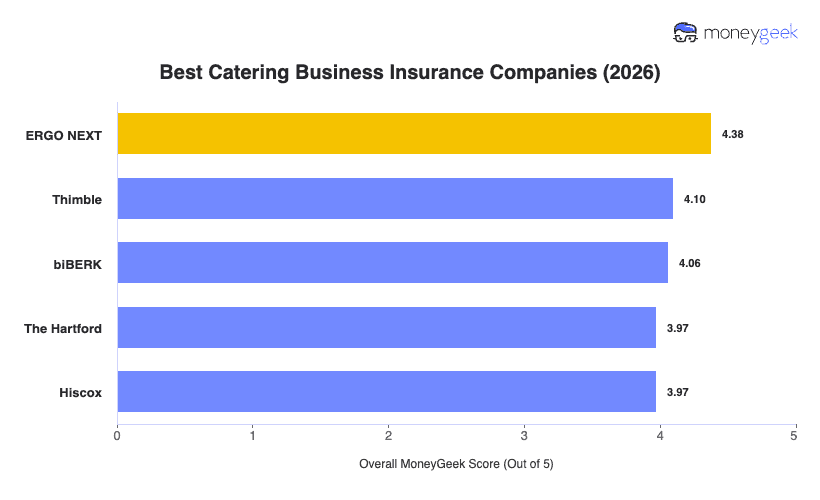

What Is Catering Business Insurance?

Catering business insurance is a bundle of policies covering the risks catering businesses face from kitchen prep through event service. You're handling food for large groups, managing crews in temporary spaces, overseeing alcohol service and transporting equipment on public roads. Common risks include:

  • A staff member spilling hot food on a guest or dropping a tray that damages venue property
  • A vehicle accident while a crew member drives a catering van to a wedding reception
  • A guest injured after being served alcohol at a catered event, leading to a dram shop liability claim
  • A commercial kitchen fire damaging ovens, refrigeration units and food inventory before a contracted event
  • A crew member injured lifting heavy equipment during setup at an off-site venue

A solo caterer operating out of a home kitchen under a cottage food permit carries a different risk profile than a full-service company running 20-person crews at corporate galas. The first may need only general liability. The second typically adds commercial auto, workers' comp and liquor liability, coverage needs that reflect where food business insurance requirements tend to expand as operations grow.

What Types of Insurance Do Catering Businesses Need?

Most catering businesses need general liability as a baseline, and most venues and private clients require proof of it before signing a contract. Workers' comp is legally mandated in most states once you have employees on payroll, regardless of what any client requires. From there, your coverage mix follows your operation: whether you serve alcohol, whether you run owned vehicles to events and whether you work out of a dedicated kitchen or commissary with equipment worth protecting.

A caterer working solo out of a licensed commissary with no employees and no alcohol service has a narrower coverage need than a company running multi-crew events with owned vehicles, a stocked bar program and a dedicated prep facility. The dropdowns below cover each coverage type relevant to catering businesses.

How Much Does Catering Business Insurance Cost?

Most catering businesses don't carry just one policy. A typical operation running events with a crew, owned vehicles and a bar program could carry general liability, commercial auto, workers' comp and liquor liability at minimum, and the combined premiums for that mix can reach several hundred dollars a month. Catering business insurance costs also shift based on where your business operates and how many employees you carry, so the figures below reflect averages rather than a fixed price.

Among the policies catering businesses commonly carry, commercial auto runs highest since the accident and cargo loss exposure of transporting prepared food and equipment to event sites pushes premiums well above the rest. General liability costs less than half that and is usually where catering businesses start. MoneyGeek's analysis of premiums for catering operations with one to four employees found the following averages:

How did we determine business insurance rates for catering businesses?

A caterer working out of a rented commissary kitchen with two employees and a handful of annual events pays differently than one running a full-service operation with a fleet of vehicles, a year-round event schedule and a licensed bar program. Whether you serve alcohol, how many vehicles you run and the size of your crew all affect your premium. If you want a figure closer to your actual situation, the small business insurance calculator can build one around your specific operation.

Estimate Your Monthly Catering Insurance Cost

Enter your coverage type, state, number of employees and type of vehicle (if you need commercial auto coverage) to get a pricing estimate that fits your business. We do not collect any personal information, and all rates are aggregated for all 50 states and Washington D.C. Workers' comp rate estimates are provided on a per employee basis and all coverage types assume standard industry limit recommendations for most businesses.

Select Coverage Type
Select State
Select Employee Count
Select Vehicle Type
Average Monthly Cost

How to Choose the Right Catering Business Insurance

Choosing the right insurance for a catering business isn't a single decision. It's a series of choices that build on each other, from identifying your exposures to reviewing your coverage as your operation changes. Working through them in order makes each step easier than the one before it.

  1. 1
    Understand your catering business's risk profile

    Catering businesses carry exposure across multiple operational areas: food preparation and service, alcohol oversight, vehicle transport and crew management. A solo caterer running drop-off lunch deliveries faces a narrower risk profile than a full-service operation managing multi-crew wedding receptions with an open bar. 

    Start by mapping what your business actually does. Where you work, how many people you employ, whether you serve alcohol and whether you own vehicles all shape which coverages are relevant to your operation.

  2. 2
    Determine required vs. recommended coverage types

    Some coverages are legally required and others are contractually expected. Workers' comp is mandated in most states once you have employees on payroll. General liability isn't typically required by law for caterers, but most venues and corporate clients require proof of it before they'll confirm a booking. Liquor liability may be required by your venue contract or your state's dram shop laws if you serve alcohol. 

    Starting with legally mandated coverages first, then layering in contract requirements, gives you a clearer picture of what's non-negotiable before you compare options.

  3. 3
    Choose the right coverage limits

    Limits should reflect your worst realistic loss scenario, not just the minimum a venue requires. A caterer regularly serving events with 300-plus guests faces a different exposure ceiling than one doing private dinners for 20. Think through what a serious bodily injury claim at one of your largest events could cost: medical bills, legal fees and any damages awarded. 

    Set your general liability limits around that scenario, and size your commercial auto limits to match the value of your vehicles and how often they're on the road for event runs.

  4. 4
    Evaluate providers who understand catering businesses

    Not every insurer prices catering risk the same way, and some don't offer the coverage flexibility catering operations need. Liquor liability as a standalone add-on and inland marine coverage for equipment in transit to event sites are not standard offerings across all providers. Look for insurers with experience in food service or hospitality. They're more likely to have handled dram shop suits from weddings, food-borne illness claims from corporate lunches and property damage during kitchen setup at a venue. A provider that competes on price but has no experience with those claim types may cost you more in the long run.

    Learn more about the best: Best Catering Business Insurance

  5. 5
    Get compliance-ready

    Before your first event, make sure you can produce a certificate of insurance quickly. Venues and corporate clients often request one days before an event, not weeks. If your state requires a food handler's license or a catering permit, confirm that your insurance documentation aligns with what regulators or clients expect to see. Some venues will also require you to add them as an additional insured on your general liability policy before granting kitchen access.

  6. 6
    Revisit your coverage as your catering business grows

    A policy that fit your operation when you were running five events a year may not be adequate when you're running 50, adding employees or purchasing a vehicle fleet. Review your coverage at least once a year and before any major contract renewals. Adding alcohol service, hiring your first full-time employee or leasing a commissary kitchen each signal a coverage review is overdue.

Catering Business Insurance: Next Steps

Two catering businesses with identical coverage requirements can end up paying very different premiums depending on which insurer they choose and how that insurer rates their specific risk profile. A small caterer doing drop-off corporate lunches with no alcohol service may find competitive general liability pricing through a regional insurer. A full-service company managing open bar programs at weekend weddings with a ten-person crew and a van fleet needs a provider that understands the full scope of that exposure. The wrong provider fit means either overpaying or ending up with coverage that doesn't match how your operation actually runs.

Not every catering business is at the same point in this process. Some are buying coverage for the first time. Others are growing into a different risk profile or reacting to a specific business change. The scenarios below are a good place to pick up wherever you are.

If you're signing your first venue contract and need proof of coverage fast

If you serve alcohol at events and aren't sure whether you need liquor liability

If you're comparing providers and aren't sure what to look for beyond price

If you're adding a service that changes your risk profile

If your current policy is renewing and you're not sure it still fits

Get Catering Business Insurance Quotes

Catering insurance pricing varies by insurer and by how each one rates exposures like alcohol service and event transport. A solo caterer doing private dinners with no alcohol service and no owned vehicles prices very differently from a full-service operation running weekend weddings with a bar program, a van fleet and a seasonal crew of twelve. Because providers differ in how they handle food-borne illness claims, liquor liability and equipment in transit, requesting business insurance quotes from several at once gives you a real basis for comparison.

About Connor Bolton


Connor Bolton headshot

Connor Bolton is Senior SEO and Content Manager at MoneyGeek, where he leads the business and pet insurance editorial teams. As editorial lead for both verticals, Connor sets the research framework, data standards, and content structure that his writers execute, directly authoring in-depth guides himself and reviewing all team content for accuracy and practical value before it goes live. With over four years evaluating insurance products across personal, commercial, and specialty lines, he brings cross-vertical knowledge to every guide the team produces.

Connor architected MoneyGeek's insurance research infrastructure across all major verticals including auto, home, renters, life, health, business, and pet, building systems for pricing analysis, provider-level research, customer experience evaluation, and coverage analysis with AI support. The infrastructure includes over 6 million data points for business insurance across 408 industry areas, all 50 states, and 16 vehicle types, and over 5 million pet insurance profiles across 18 major providers and hundreds of breed and age combinations. Connor's insurance cost research and his team's work has been cited by the U.S. Chamber of Commerce, Allstate, Liberty Mutual, CBS News, Forbes and LegalZoom.

Beyond the data, Connor stays connected to how the market actually operates, drawing on direct conversations with underwriters and carrier liaisons at Ethos, The Hartford, NEXT Insurance, Nationwide, and State Farm, and monitoring business and pet owner communities including Reddit, to inform how he interprets findings and frames guidance for real buyers.

He is the direct editorial contact for methodology questions at connor@moneygeek.com and can be found on LinkedIn.