



Jump to the section that fits your needs best:
Average Commercial Auto Insurance Cost (2026 Report)
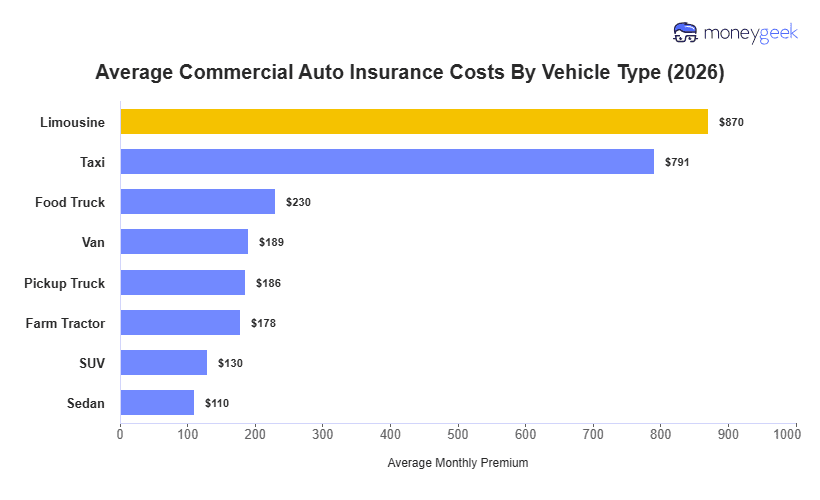
Average commercial auto insurance costs range from $79 to $870 monthly and your rate will vary based on your vehicle type, industry and state.
If you want quotes now, we can match you to your best commercial auto insurer below.
Select state
Updated: September 9, 2026
Advertising & Editorial Disclosure
Featured Partner

The Hartford
- Ethisphere named The Hartford a World's Most Ethical Company for the 17th time in 2026, one of only two honorees in property and casualty insurance.
- The Hartford ranks third overall for commercial auto in MoneyGeek's 2026 study and wins the Coverage Depth category.
- Cars, cargo vans, pickup trucks, box trucks and service utility trucks all fall under The Hartford's commercial auto coverage.
- Hired and non-owned auto liability from The Hartford covers employees who drive personal vehicles for work.
On The Hartford's site
*MoneyGeek featured partner. Editorial rankings below are independent of this placement. Rates, rankings and savings comparisons are based on MoneyGeek's independent research and Hartford-reported data as of 2026. Figures are estimates and averages, not a guarantee of any individual quote, premium or discount.
How Much Does Commercial Auto Insurance Cost?
Commercial auto insurance costs $163 per month ($1,959 per year) for minimum coverage. This is a national benchmark derived from eight vehicle types across 25 general industry categories (including 400+ sub-industries) and all 50 states (including D.C.) to reflect the range of commercial fleet profiles.
However, your small business insurance rates will vary heavily depending on your vehicle's details, your drivers, and details surrounding your business's operations and location. This also does not represent commercial truck insurance costs, which we consider a completely separate category inclusive of larger cargo and livery vehicles like box trucks, semis, tankers and dump trucks.
To estimate average commercial auto insurance costs, MoneyGeek analyzed pricing estimates from five major commercial auto providers and modeled standardized premium estimates across common business vehicle profiles. These modeled results give a consistent national benchmark and show how premiums shift by vehicle type, industry and location.
Dataset Scope and Assumptions
Our cost modeling uses standardized inputs for comparable results across businesses.
- Providers analyzed: five major commercial auto providers
- Vehicle types covered: eight (Sedan, SUV, Pickup Truck, Van, Food Truck, Farm Tractor, Taxi, Limousine). Vehicles were only analyzed where they would realistically be used widely for commercial purposes within industry areas for accuracy.
- Industries covered: 25 general industry categories
- Location: all 50 states plus Washington, D.C.
- Coverage baseline: minimum coverage commercial auto policy (the market standard for benchmark comparisons)
How We Calculated Average Commercial Auto Insurance Costs
MoneyGeek's published averages represent modeled premiums for standardized business profiles, aggregated two ways. Each figure isolates one variable at a time so you can see where your costs land relative to the national benchmark of $163 per month.
- National Benchmark Average: The national average reflects the modeled premium for a minimum coverage policy across all vehicle types, industries and states in the dataset. This single figure covers all 51 states and territories, and gives you a starting reference point before accounting for your specific business profile.
- Segment Averages: To show how costs shift, MoneyGeek calculated average modeled premiums isolated by one variable at a time, covering vehicle type, general industry category and state. Segment averages aggregate modeled pricing trends across the full dataset so you can compare how premiums change across business types and regions. A sedan operator in Pennsylvania will see a very different number than a limousine service in Michigan.
Read our full methodology for more details.
Get Commercial Auto Insurance Cost Estimates
For more tailored estimates, we provide commercial auto insurance calculator below to build costs around your profile.
Commercial Auto Insurance Cost Estimate Calculator
Select State
Select General Industry
Select Vehicle Type
Average monthly rate—
Select State
Average monthly rate—
Select General Industry
Select Vehicle Type
What Factors Affect Commercial Auto Insurance Costs?
Commercial auto insurance pricing varies based on four core factors: coverage level, vehicle type, industry classification and geographic location. These variables explain most premium differences across small business fleets because they capture how insurers estimate claim frequency, severity and total exposure. Review MoneyGeek's commercial auto insurance cost data to see how each factor shifts your rate in dollar terms.
 Vehicle Type
Vehicle type is the most influential pricing factor for commercial auto insurance because it determines an insurer's exposure to physical damage, bodily injury liability and the vehicle's replacement cost. It also often informs a business insurance provider of likelihood of accident based on likely use cases and driving statistics associated. According to our research, the differences are staggering with the low end of the spectrum for sedans being 32% below average while limousines sit 433% higher than national benchmarks.
 Industry Classification
Industry classification is the second most influential pricing factor for commercial auto insurance because it directly determines how much driving commercial vehicles do, what cargo they carry and the environments they operate in. Rates across 25 general industry categories range from 45% lower than average for marketing and communications businesses towards 114% higher for those in the transportation and logistics industry.
 Geographic Location
Geographic location is the has the third greatest effect on commercial auto insurance costs because state regulations, litigation patterns, medical costs and claim settlement practices vary considerably by market. The same vehicle doing the same work costs range from 52% lower on average in Pennsylvania and 91% higher in Michigan.
 Coverage Level
Coverage level is lowest strength core pricing driver for commercial auto insurance, and shifts rate directly by setting the actual investment an insurer is agreeing to if a covered event happens. Moving from minimum to high limits/broader coverage more than doubles the monthly premium.
How to Lower Commercial Auto Insurance Costs Without Sacrificing Coverage
Adjusting the inputs insurers use to price your policy is the most direct way to reduce commercial auto premiums without cutting coverage. Taking into account long-term methods also ensure you get the lowest price, even as your business grows.
Below, we'll guide you through all of the methods available to you, so you pay the lowest commercial auto insurance costs possible today and in the future.
Quick Commercial Auto Cost-Lowering Methods
We've ranked these immediate actions by lowest financial risk and highest effectiveness in order below.
 Provide accurate underwriting information from the start
Small differences in how your vehicles and business are described change your rating class and premium. Use accurate annual mileage estimates, the correct vehicle use code (commercial vs. business vs. pleasure) and clear descriptions of the work your drivers do. Insurers price your policy using worst-case assumptions when information is unclear or inconsistent.
 Compare quotes using identical coverage terms
A lower monthly quote means nothing if the policy carries a lower liability limit or excludes hired and non-owned auto coverage. Compare business insurance quotes across at least three providers using matching liability limits, deductibles and endorsements before choosing based on price.
- Bundle commercial auto with your general liability or BOP policy
Many insurers discount commercial auto when you combine it with a business owner's policy or general liability coverage. Ask for a bundled quote before comparing standalone commercial auto rates. Use our commercial auto insurance cost benchmarks to verify whether your bundled quote reflects a genuine discount against the $163 per month national average.
 Pay annually instead of monthly
Annual payments eliminate installment fees and often carry small discounts since the insurer receives the full premium upfront. This saves roughly 5% to 10% compared to monthly payment plans, though you'll need the full annual amount available at policy inception.
 Raise deductibles on physical damage coverage if your fleet has a clean history
Increasing comprehensive and collision deductibles from $500 to $1,000 reduces the physical damage portion of your premium by 15% to 25% on average. This works best for fleets with no claims in two or more years and enough cash reserves to cover the higher out-of-pocket cost after an incident.
Long-Term Commercial Auto Cost-Lowering Methods
Changing how insurers assess your fleet's risk at each annual renewal is where long-term cost reductions come from. These strategies take longer to produce results than immediate adjustments, but they generate compounding savings across multiple policy terms as your claims history and driver data improve.
Commercial Auto Insurance Cost: Bottom Line
Insurers price your specific fleet risk, not a generic vehicle category, which is why commercial auto insurance costs vary widely. Coverage level, vehicle type, industry classification and state affect your premium most. The $163 a month figure is a market-wide starting point for minimum coverage, not a quote for your specific fleet.
Work through these three questions before evaluating quotes:
- Where do you fall compared to the national average? Consider vehicle type, industry and state together. A different cost baseline applies to a sedan-based marketing business in Pennsylvania than to a van-based cleaning service in Michigan.
- What's behind your cost? Separate baseline risk factors (vehicle type, industry, state) from coverage design choices (liability limits, deductibles, endorsements). Knowing which is which shows where you have room to adjust.
- What would change your price? Coverage level is the single largest controllable factor. Bundling, telematics enrollment and accurate underwriting details each produce measurable reductions when conditions are right.
Evaluate quotes against your actual fleet risk profile, not just the national average, by framing your premium this way.
If you want to learn about costs from other coverage types
About Mark Flores

Mark Flores is a Business Insurance Content Writer at MoneyGeek, where he focuses on commercial auto, commercial property, cyber and specialty business insurance coverage. His work simplifies coverage terms, gives business owners a strong baseline for expected costs, and narrows down policies and providers tailored to your operation, regardless of complexity.
Before joining MoneyGeek’s business insurance team, Mark worked as a Senior Content Writer at Clutch.co, where he produced structured B2B reviews and provider analyses based on client interviews, company research and service evaluation. That experience shaped his approach to business insurance content, especially when comparing insurers, explaining coverage differences and translating complex policy features into practical guidance for small business owners.
Mark also spent nearly 4 years as a digital marketing specialist serving small-business clients across industries such as home services, manufacturing and education. That background gives him practical context for how businesses evaluate vendors, manage operational needs and make purchasing decisions.
At MoneyGeek, he applies this research and evaluation experience to build guides that help transportation sectors, those with complex property-related risks (such as hotels and retail stores), and those most at risk of a cyberattack get the coverage they need at a reasonable price.
Linkedin: https://www.linkedin.com/in/mark-jason-flores-7844634a/
Contact Email: mark.flores@moneygeek.com