How Much Does Commercial Auto Insurance Cost in Illinois?

Illinois businesses pay an average of $179 per month ($2,153 per year) for minimum coverage commercial auto insurance, based on MoneyGeek's analysis of eight vehicle types across 25 general industry categories. That puts Illinois 10% above the average commercial auto insurance cost nationally at $163 per month and above most states in the region, ranking 36th out of 51 for affordability.

Missouri, at $185 per month, is the only neighboring state that runs above Illinois. Indiana ($157 per month) and Kentucky ($155 per month) come in below it, while Wisconsin ($119 per month) and Iowa ($97 per month) sit well under the Illinois average. Michigan is the regional outlier at $312 per month, nearly double what Illinois businesses pay.

Illinois commercial auto rates are pushed above the national average by Chicago's traffic density, above-average vehicle repair and medical costs, and the state's tort system, which increases litigation frequency after accidents. Your commercial auto insurance rates will differ from that state benchmark depending on your vehicle, your drivers and what your business does.


Commercial Auto Insurance in Illinois Calculator

Get a profile-specific estimate using the commercial auto insurance calculator below. Keep in mind that this calculator covers personal vehicles used for business and excludes commercial trucks (ex. semis, box trucks and tankers). For those vehicle types, run your numbers through our commercial truck insurance calculator instead.

IL Commercial Auto Insurance Cost Estimate Calculator

Select your general industry category and vehicle type to get an average commercial auto insurance cost estimate for your business. Rates reflect minimum coverage as the base comparison. Once you're satisfied, you can click Get Quotes to get matched to providers that best suit your profile.

Select General Industry
Select Vehicle Type
Average monthly rate in IL

To estimate average commercial auto insurance costs, MoneyGeek analyzed pricing estimates from five major commercial auto providers and modeled standardized premium estimates across common business vehicle profiles. These modeled results give a consistent national benchmark and show how premiums shift by vehicle type, industry and location.

Dataset Scope and Assumptions

Our cost modeling uses standardized inputs for comparable results across businesses.

  • Providers analyzed: five major commercial auto providers
  • Vehicle types covered: eight (Sedan, SUV, Pickup Truck, Van, Food Truck, Farm Tractor, Taxi, Limousine). Vehicles were only analyzed where they would realistically be used widely for commercial purposes within industry areas for accuracy.
  • Industries covered: 25 general industry categories
  • Location: Illinois
  • Coverage baseline: minimum coverage commercial auto policy (the market standard for benchmark comparisons)

How We Calculated Average Commercial Auto Insurance Costs

MoneyGeek's published averages represent modeled premiums for standardized business profiles, aggregated two ways. Each figure isolates one variable at a time so you can see where your costs land relative to the national benchmark of $163 per month.

  • National Benchmark Average: The national average reflects the modeled premium for a minimum coverage policy across all vehicle types, industries and states in the dataset. This single figure covers all 51 states and territories, and gives you a starting reference point before accounting for your specific business profile.
  • Segment Averages: To show how costs shift, MoneyGeek calculated average modeled premiums isolated by one variable at a time, covering vehicle type, general industry category and state. Segment averages aggregate modeled pricing trends across the full dataset so you can compare how premiums change across business types and regions. A sedan operator in Pennsylvania will see a very different number than a limousine service in Michigan.

What Factors Affect Commercial Auto Insurance Costs in Illinois?

Four factors drive commercial auto insurance pricing in Illinois: vehicle type, general industry classification, geographic location and coverage level. Each one shapes how insurers estimate claim frequency, severity and total exposure for your business.

    car2 icon
    Vehicle Type

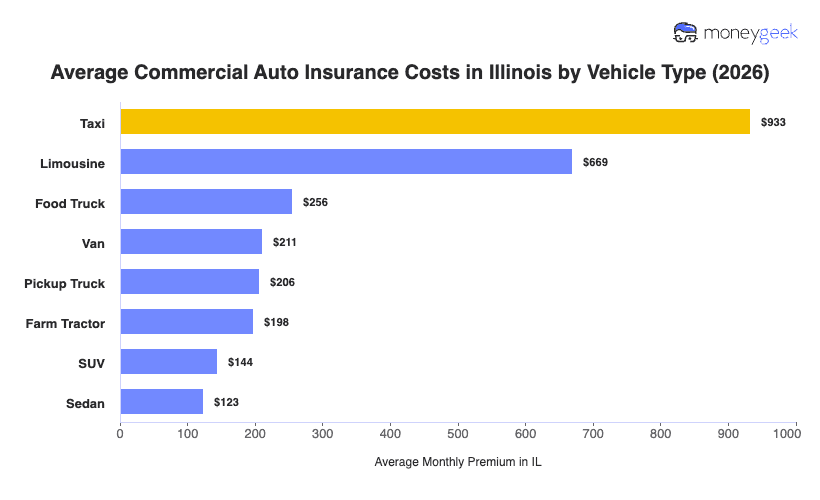
    Vehicle type carries the heaviest weight. It determines physical damage exposure, bodily injury liability and replacement cost. In Illinois, sedans sit 32% below the state average at $123 per month, while limousines run 273% above it at $669 per month. That spread reflects how differently insurers price passenger-carrying vehicles with higher daily mileage and liability exposure against standard business sedans.

    building icon
    General Industry Category

    General industry classification is the second biggest pricing factor. Rates in Illinois range from 45% below the state average for Marketing and Communications to 95% above it for Transportation and Logistics. Illinois's position as one of the country's largest freight and distribution hubs means businesses in that top category are pricing in significantly higher annual mileage and cargo liability.

    pin icon
    Geographic Location

    Geographic location also moves rates. Businesses in dense urban markets like Chicago or Rockford pay more than those in smaller Illinois cities, driven by higher claim frequency, heavier traffic and more litigation activity. Chicago logged 112,000 accidents in 2024 and reclaimed the title of worst traffic congestion in the country, with drivers averaging 112 hours in peak traffic annually.

    shield icon
    Coverage Level

    Coverage level is the single largest controllable factor. It sets the maximum the insurer pays per occurrence. Higher limits mean more risk per claim, and your premium reflects that. Illinois's tort system, which allows lawsuits after accidents without a no-fault threshold, makes carrying adequate limits especially important for businesses operating commercial vehicles in the state.

Average Commercial Auto Insurance Costs in IL by Vehicle Type

Sedans are the most affordable vehicle to insure commercially in Illinois at $123 per month, while taxis sit at the opposite end of the spectrum at $933 per month. For the majority of Illinois businesses running sedans, SUVs or pickup trucks, monthly costs fall between $123 and $206.

The gap widens sharply for passenger-carrying vehicles. Chicago's ride-share and livery market means taxis and limousines are common on Illinois roads, but they come with a significant rate premium: taxis average $933 per month (420% above the state average) and limousines average $669 per month (273% above it). Stricter minimum coverage requirements for vehicles that carry paying passengers, combined with higher daily mileage and greater liability exposure, account for most of that difference.

Sedan$123$1,4751
SUV$144$1,7322
Farm Tractor$198$2,3753
Pickup Truck$206$2,4774
Van$211$2,5275
Food Truck$256$3,0706
Limousine$669$8,0257
Taxi$933$11,1908

For commercial auto insurance costs broken down by vehicle type, check the guides below.

Average Illinois Commercial Auto Insurance Costs by Industry

What your business does is one of the strongest predictors of what you'll pay. Across 25 general industry categories in Illinois, monthly rates run from $99 for Marketing and Communications to $350 for Transportation and Logistics. That $251 per month spread comes down to one thing: how much driving a business does and the liability exposure that goes with it.

Not every Illinois business starts from the same rate baseline. Here's how the 25 general industry categories break down relative to the state average:

  • Lower-Cost Industries (20%+ Below Illinois Average): Marketing and Communications, Financial Services, Beauty, Body and Wellness Services, Fitness Services, Consulting Services, Tech/IT, Education, Arts, Media and Entertainment, Real Estate and Property Services
  • Mid-Cost Industries (Within 20% of Illinois Average): Healthcare and Medical, Pet Care Services, Childcare Services, Nonprofit and Associations, Agriculture and Natural Resources, Recreation and Sports, Retail and Product Rental, Repair and Maintenance, Wholesale and Distribution, Food and Beverage, Cleaning Services, Other Professional Services, Manufacturing, Hospitality, Travel and Tourism, Construction and Contracting
  • Higher-Cost Industries (More Than 20% Above Illinois Average): Transportation and Logistics

Transportation and Logistics stands alone in the higher-cost tier at $350 per month. Illinois is home to more than 21,300 transportation, distribution, and logistics (TDL) companies, and 25% of all U.S. freight passes through Chicago. That volume of commercial driving on congested urban and interstate corridors translates directly into higher claim frequency, cargo liability exposure and premium costs, putting it $135 per month above Construction and Contracting, the next most expensive category. 60% of all general industry categories in Illinois fall at or below the state average.

Data filtered by:
Agriculture & Natural Resources
Agriculture & Natural Resources$177$2,12114

For detailed costs by specific general industry categories, refer to the guides below.

How to Lower Commercial Auto Insurance Costs in Illinois Without Sacrificing Coverage

Lowering commercial auto costs in Illinois means addressing three distinct pressures at once: litigation exposure, accident frequency and weather-related physical damage. Cook County ranks among the top 10 "Judicial Hellholes" nationally and generated 79% of Illinois's state court nuclear verdicts, Chicago logged 112,000 accidents in 2024, and Illinois ranked second in the country for hail damage claims that same year. The strategies below target each of those drivers, not just the line items on your renewal quote.

Quick Commercial Auto Cost-Lowering Methods

These methods take effect at your next quote or renewal. Most require nothing more than a phone call or a policy review.

    insurance2 icon
    Get Your Underwriting Details Right From the Start

    Annual mileage, vehicle use classification and driver job descriptions all feed directly into your rate calculation. Illinois underwriters pricing policies against Chicago's congestion and Cook County's litigation environment default to worst-case assumptions when any of those inputs are vague or missing. Getting them right at application costs nothing and can prevent overpaying from day one.

    shoppingCart icon
    Compare Quotes on Identical Coverage Terms

    The Illinois Department of Insurance's 2025 Cost Containment Report confirms the market remains highly competitive, with a low and stable Herfindahl-Hirschman Index for commercial auto liability. That competition only works in your favor when you compare quotes on identical terms: same liability limits, same deductibles and the same endorsements, including hired and non-owned auto coverage.

    building icon
    Bundle Commercial Auto With Your GL or BOP Policy

    Multi-policy discounts won't show up on a standalone commercial auto quote. In Illinois, where commercial auto rates already run 10% above the national benchmark, stacking a bundling discount against an above-average base produces more dollar savings than the same discount would in a cheaper state.

    coins2 icon
    Pay Annually Instead of Monthly

    Paying annually instead of monthly cuts 5% to 10% off your premium and eliminates installment fees. Progressive, the top-ranked commercial auto insurer in Illinois per MoneyGeek's analysis, advertises savings of 13% or more for annual payment on commercial policies.

    money2 icon
    Raise Deductibles if Your Fleet Has a Clean History

    Raise your comprehensive and collision deductibles if your fleet's loss history is clean. Illinois ranked second in the country for hail damage claims in 2024. Moving from $500 to $1,000 deductibles on physical damage coverage can reduce those premiums by 15% to 25%. For fleets with no recent weather claims, that tradeoff is worth running before your next renewal.

Long-Term Commercial Auto Cost-Lowering Methods

These strategies don't show up in your rate overnight. Build them into how you run your fleet and they compound across every renewal cycle.

Commercial Auto Insurance Cost in Illinois: Bottom Line

Illinois businesses pay above the national average, and Cook County's litigation environment means a single serious claim can cost far more than the premium savings from carrying minimum limits. What you actually pay depends almost entirely on your specific fleet. Before comparing quotes, it helps to get clear on three things.

  1. What does your fleet actually look like? Vehicle type, how your drivers use those vehicles and what general industry category you operate in all set your baseline rate. A consulting firm running two sedans in Peoria and a logistics company running vans through Chicago start from completely different positions even if they're paying for the same coverage type.
  2. How much risk are you willing to carry? Coverage level is the biggest controllable variable in your premium. In Cook County, where 79% of Illinois's state court nuclear verdicts originate, carrying limits close to the state minimum of 25/50/20 leaves a meaningful gap between what your policy pays and what a serious claim could actually cost your business.
  3. What's your timeline? Some levers work immediately: accurate underwriting details, bundling and annual payment. Others, like building a clean loss history or installing telematics, take one to three renewal cycles to show up in your rate.

Commercial auto insurance in Illinois rewards businesses that manage risk deliberately. The rate you pay reflects your fleet's actual exposure, not just the state average.

Commercial Auto Insurance Cost in IL: Next Steps

Progressive and GEICO rank as the most affordable options in Illinois among the providers MoneyGeek analyzed, but the right carrier for your fleet depends on more than price. The cheapest and best pages below break down your options by cost and quality so you can build a shortlist that fits how your business actually operates.

Recommended: If You're Ready to Compare Providers

Progressive and GEICO rank as the most affordable options in Illinois among the providers MoneyGeek analyzed, but the right carrier for your fleet depends on more than price. The cheapest and best pages below break down your options by cost and quality so you can build a shortlist that fits how your business actually operates.

If You Want to Learn About Costs From Other Coverage Types

If You Want to Learn More About Commercial Auto Insurance Coverage

About Connor Bolton


Connor Bolton headshot

Connor Bolton is Senior SEO and Content Manager at MoneyGeek, where he leads the business and pet insurance editorial teams. As editorial lead for both verticals, Connor sets the research framework, data standards, and content structure that his writers execute, directly authoring in-depth guides himself and reviewing all team content for accuracy and practical value before it goes live. With over four years evaluating insurance products across personal, commercial, and specialty lines, he brings cross-vertical knowledge to every guide the team produces.

Connor architected MoneyGeek's insurance research infrastructure across all major verticals including auto, home, renters, life, health, business, and pet, building systems for pricing analysis, provider-level research, customer experience evaluation, and coverage analysis with AI support. The infrastructure includes over 6 million data points for business insurance across 408 industry areas, all 50 states, and 16 vehicle types, and over 5 million pet insurance profiles across 18 major providers and hundreds of breed and age combinations. Connor's insurance cost research and his team's work has been cited by the U.S. Chamber of Commerce, Allstate, Liberty Mutual, CBS News, Forbes and LegalZoom.

Beyond the data, Connor stays connected to how the market actually operates, drawing on direct conversations with underwriters and carrier liaisons at Ethos, The Hartford, NEXT Insurance, Nationwide, and State Farm, and monitoring business and pet owner communities including Reddit, to inform how he interprets findings and frames guidance for real buyers.

He is the direct editorial contact for methodology questions at connor@moneygeek.com and can be found on LinkedIn.