




Choose where to jump to next based on your needs:
Average General Liability Insurance Cost in Illinois (2026 Report)
Monthly general liability premiums in Illinois range from $29 to $402, shaped primarily by your industry classification and how many employees your business carries.
If you're ready for a quote, get matched to the right general liability carrier for your Illinois business with our tool below.
Select state
Updated: September 8, 2026
Advertising & Editorial Disclosure
How Much Does General Liability Insurance Cost in Illinois?
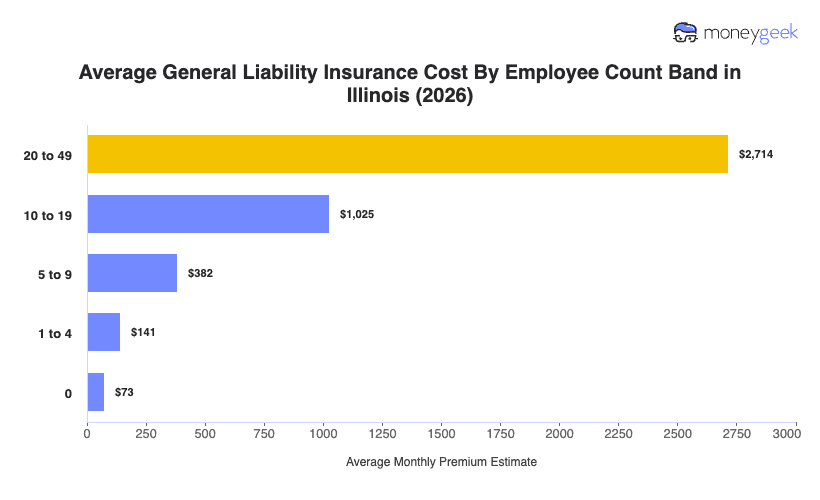
Small businesses in Illinois with one to four employees pay an average of $141 per month, or $1,692 annually, for general liability coverage. Illinois ranks 39th nationally for affordability, though its average falls 11% below the national figure, a gap explained more by expensive coastal markets inflating the national benchmark than by competitive pricing within the state.
These figures represent modeled averages across standardized business profiles, so your actual premium will differ based on industry, claims history and operational risk. The breakdowns below by general liability costs across industry and business size show where Illinois businesses typically land.
To estimate average general liability insurance costs in Illinois, MoneyGeek analyzed quote data from 10 major U.S. small business insurance providers, modeling over 20,000 standardized pricing estimates across 25 industry categories and five employee count bands (zero through 20 to 49 employees). All estimates use a standard $1 million per occurrence and $2 million aggregate policy baseline. Modeled average revenue and payroll were personalized across Illinois regions, industries and employee counts using CBP, QCEW and Economic Census data calibrated against private compensation databases and IRS SOI totals.
The Illinois state average reflects the modeled premium for a standardized one-to-four-employee small business across all industries in the dataset. Segment averages isolate individual variables, such as employee count or general industry category, so readers can compare how premiums shift across business types within Illinois. These are benchmarks for planning, not personalized quotes. Read full methodology.
What Factors Affect General Liability Insurance Costs in Illinois?
General liability pricing in Illinois reflects two layers of cost drivers. Business size and industry classification set your baseline premium nationally, while Illinois-specific conditions explain why premiums here run higher than in neighboring Midwest states.
Illinois Agnostic General Liability Insurance Cost Factors
Two factors establish your general liability baseline regardless of where your business operates.
 Business size
A business with 20 workers interacts with more customers, manages more contracts and oversees more job sites than a solo operator, and each interaction carries liability exposure. Illinois sole proprietors pay $878 annually, roughly half the cost of businesses employing one to four people. Operations with 20 to 49 employees average $32,570 annually, nearly 19 times that small-team baseline.
 Industry classification
Insurers assess claim likelihood based on the work itself. Desk-based operations with minimal public interaction carry far less liability exposure than hands-on services involving physical installations or worksite management. Tech and IT firms in Illinois pay 79% below the state average since digital work in controlled environments generates few third-party claims. Construction and contracting operations run 186% above that benchmark, driven by on-site physical risks, equipment use and potential for injury across multiple active job locations. Reviewing your industry's position in Illinois cost data helps set realistic premium expectations before requesting quotes.
Illinois-Specific General Liability Insurance Cost Factors
After accounting for business size and industry type, Illinois general liability costs still exceed neighboring Midwest states. Five state-specific factors explain why Illinois businesses pay higher premiums than other states in the region.

Illinois' Severe Weather Risk
Illinois experienced 121 tornadoes in 2023 and 142 in 2024, reflecting intense severe weather that includes Mississippi River flooding and Lake Michigan winter storms. These conditions increase general liability exposure through slip-and-fall accidents on ice-covered walkways, customer injuries from wind-damaged property and third-party claims when weather compromises premises safety. Insurers price policies higher in tornado-prone central and southern counties.

Illinois' Litigation Climate
Cook, Madison and St. Clair counties ranked seventh on the American Tort Reform Foundation's 2024–2025 "Judicial Hellholes" list, driven by nuclear verdict frequency and plaintiff-friendly juries. This concentrated litigation activity and elevated settlement values push general liability premiums higher as insurers price for increased claim costs and verdict unpredictability across the state.

Illinois' Modified Joint and Several Liability Law
Illinois holds defendants with 25% or more fault jointly and severally liable for all damages, meaning one defendant may pay the full judgment if others cannot. Defendants below 25% fault remain jointly liable for medical expenses. This unpredictable exposure in multi-party claims drives insurers to price general liability policies higher to account for worst-case payment scenarios.

Illinois' Medical Costs Compared to Regional Neighbors
Illinois hospitals charge higher rates than neighboring Midwest states. Nonprofit hospitals, which handle most general liability bodily injury claims, cost $3,086 per inpatient day in Illinois compared to $1,884 in Iowa and $2,862 in Wisconsin. These elevated medical expenses translate directly to higher claim settlements, as hospital bills form the foundation of bodily injury damage calculations.

Illinois' Biometric Information Privacy Act (BIPA)
Illinois' Biometric Information Privacy Act creates unique general liability exposure for businesses using fingerprint timeclocks, facial recognition systems or voice biometrics. BIPA violations trigger coverage under commercial general liability policies' personal injury provisions, driving more than 1,500 lawsuits since 2019 with settlements reaching $650 million. Insurers price Illinois GL policies higher to account for BIPA risk, with added impact on businesses in retail, hospitality and manufacturing sectors that commonly use biometric timekeeping.
Get a IL General Liability Insurance Cost Estimate
Using your industry and employee count, you can estimate your costs with the general liability insurance calculator below. All estimates assume a standard policy with $1 million in coverage per occurrence and a $2 million aggregate limit. You can also click Get Quotes to be matched with insurers that may be a good fit based on the details you enter.
Illinois General Liability Cost Estimate Calculator
Select your state and industry to view average business insurance premiums in your area. Rates are calculated based on a business with 5 employees and $500,000 in annual revenue.
Select General Industry
Select Employee Count
Monthly rate estimate—
Select General Industry
Monthly rate estimate—
Select Employee Count
How to Lower General Liability Insurance Costs Without Sacrificing Coverage
Reducing general liability premiums in Illinois does not require downgrading your protection. The right combination of policy adjustments and long-term risk management can lower costs while maintaining the coverage your business needs.
For context on which carriers offer the most competitive rates, review affordable general liability coverage in Illinois before shopping.
Quick General Liability Cost Lowering Methods
These six adjustments lower premiums through policy structure and insurer selection. They require no changes to your business operations and take effect at your next renewal.
 Provide clean, accurate underwriting information
Misreporting employee counts or revenue triggers mid-term rate adjustments. Peoria manufacturers with precise headcount documentation avoid premium increases that punish underreporting. Illinois' modified joint and several liability law makes accurate classification critical, because a manufacturer rated as light assembly instead of heavy machinery production gets hit with premium corrections when multi-party claims reveal the error during liability determination.
 Compare multiple insurers
Request proposals from four to five insurers to identify competitive tornado exposure pricing. Construction contractors in Rockford see wide rate variation because carriers price Illinois' severe weather risk differently. Northern Illinois experienced 142 tornadoes in 2024, creating divergent jobsite wind damage and debris liability assessments. Regional insurers often price local tornado patterns more accurately than national carriers, making comparing business insurance quotes especially valuable in this state.
 Bundle general liability into a business owner's policy (BOP)
Business owner's policies combine general liability with commercial property coverage, reducing total BOP costs 15% to 25% compared to separate policies. Southern Illinois property managers handling agricultural land gain dual protection for both flood-vulnerable buildings along the Mississippi River and tenant injury liability. Bundling removes duplicate underwriting fees and simplifies claims when weather events cause both property damage and tenant injuries.
 Pay annually instead of monthly
When you can cover the full year's premium upfront (usually $1,824 annually for a Chicago restaurant), annual payment saves 5% to 10% compared to monthly billing. A River North restaurant paying $152 monthly saves $91 to $182 annually by prepaying, while eliminating monthly transaction fees. High-volume operations with predictable cash flow benefit most from locking rates for 12 months.
 Increase your deductible (if you can afford it)
Weigh premium savings against out-of-pocket claim costs before raising deductibles from $500 to $2,500. Springfield medical practices with operating reserves can absorb higher per-claim expenses while reducing monthly premiums 20% to 30%. Illinois' Cook County litigation climate creates large verdict exposure, making deductible strategy essential for balancing predictable premium costs against major claim risk in plaintiff-friendly courts.
 Adjust your coverage limits
Illinois' Biometric Information Privacy Act creates $1,000 to $5,000 per-violation exposure for businesses using fingerprint timeclocks or facial recognition. Champaign-Urbana tech startups and consulting firms should evaluate personal injury limits above the standard $1 million per occurrence given BIPA's settlement history. BIPA claims trigger general liability personal injury coverage, requiring contract requirements review and limit reassessment for any business collecting biometric data.
Read More: How Much General Liability Insurance Do You Need?
Long-Term General Liability Cost Lowering Methods
These two strategies reduce premiums by changing how insurers evaluate your business over 12 to 36 months.
General Liability Insurance Cost in Illinois: Bottom Line
Illinois' position as the Midwest's most expensive general liability market reflects real risk factors, not arbitrary pricing. Your actual premium depends on how insurers weigh your specific combination of location, claims history and operational controls.
Three questions pinpoint what drives your rate:
- Where does your industry fall in Illinois' cost spectrum? Tech and IT firms pay as little as $29 monthly while construction contractors face $402, a gap of more than 1,200%. Most Illinois businesses land in lower-cost categories, with 15 of 25 tracked industries falling below the state average.
- Which state-specific factors shape your baseline? Cook County's litigation climate, BIPA exposure, severe weather frequency and elevated hospital costs all push Illinois premiums above neighboring states. A business in Springfield faces different risk pricing than one in downtown Chicago.
- What can you actually control? Claims history, safety documentation, accurate underwriting information and insurer selection are within your hands. Two Rockford manufacturers with the same headcount can see rate differences of around 30% based on their safety programs, equipment records and claims activity over three years.
Get quotes from at least four Illinois carriers. Comparing proposals reveals which factors drive your rate up or down and whether your premium reflects your actual risk profile or broad industry assumptions.
About Angelique Palenzuela-Cruz

Angelique Palenzuela-Cruz is a Business Insurance Content Writer at MoneyGeek, where she specializes in general liability, workers’ compensation and professional liability insurance. Her work helps small business owners understand how these policies apply to coverage, including risks like customer injuries, employee injuries, professional mistakes, client contract terms and industry-specific coverage requirements.
She primarily covers service-based businesses where liability and employee coverage decisions are especially important, including cleaning, consulting, beauty and wellness, childcare, education, fitness, food service, pet care, repair and maintenance, and other professional services.
Before joining MoneyGeek, Angelique spent nearly 12 years at Guthrie-Jensen Consultants, one of Southeast Asia’s largest management training firms, where she advanced from Training Consultant to Managing Consultant. In that role, she worked with business clients to assess operational needs, develop training programs and present performance analyses to executive decision-makers. She also helped establish Gladwin Training Consultancy, where she served in learning solutions and client service roles.
Her background gives her practical context for writing about how businesses operate, manage client expectations, structure teams and make risk decisions. At MoneyGeek, she applies that experience to business insurance content, connecting coverage to actual business needs.
LinkedIn: linkedin.com/in/ma-angela-cruz
Email Contact: angelique.palenzuela@moneygeek.com
Sources
- American Tort Reform Foundation. "Judicial Hellholes 2024/2025." Accessed September 26, 2026.
- Illinois General Assembly. "Biometric Information Privacy Act." Accessed September 26, 2026.
- Illinois General Assembly. "Illinois Compiled Statutes Chapter 735, Civil Procedure § 5/2-1117." Accessed September 26, 2026.
- Illinois State Climatologist. "2024 Weather Was Very Warm and Wild." Accessed September 26, 2026.
- Kaiser Family Foundation. "Hospital Expenses per Adjusted Inpatient Day by Ownership Type." Accessed September 26, 2026.