
How Much Does Pet Care Business Insurance Cost?

The average cost of business insurance for pet care services runs around $72 per month or $859 per year, averaged across the six most common coverage types. We modeled premiums for pet care services with one to four employees at standard $1 million per occurrence limits across all 50 states and DC.

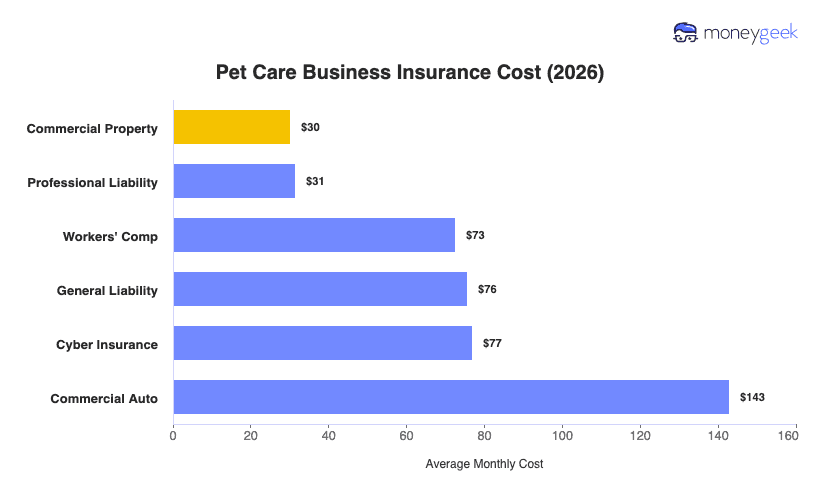
Your individual policy costs range from around $30 to $143 per month depending on coverage type. You'll pay the least for commercial property coverage because your fixed-location equipment, from grooming tables and kennel runs to dryers, covers equipment with a clear replacement value rather than the unpredictable claim costs that push liability premiums higher. In comparison, commercial auto costs the most since a grooming van costs more to insure than a standard work truck because it travels to client locations, carries live animals and operates as both a vehicle and a workspace. 

Use the figures below as benchmarks, not quotes since your actual rate depends on your business profile.

Commercial Property$30$36276%9
Professional Liability$31$37744%3
Workers' Comp$73$87236%14
General Liability$76$908-38%11
Cyber Insurance$77$9228%14
Commercial Auto$143$1,71512%11

We analyzed quote data from major U.S. commercial insurance providers and modeled standardized premium estimates across business profiles representing around 95% of the market. Results are designed to provide a consistent national benchmark showing how premiums vary by key baseline factors including business size, restaurant profession type, location and vehicle type for operations that use commercial vehicles.

Dataset Scope and Assumptions

Our cost modeling uses standardized inputs for consistent comparisons across businesses.

  • Total estimates modeled: just over 6 million standardized pricing estimates
  • Providers analyzed: 10 major insurance providers
  • Professions covered: 8 real estate profession categories
  • Geography: all U.S. states including Washington, D.C.
  • Employee count bands: solo practitioners, one to four, five to nine, 10 to 19, and 20 to 49 employees
  • Vehicle types studied: Sedans, SUVs, pickup trucks, vans, taxis, limousines, tractors, food trucks, semi-trucks (non-HAZMAT and HAZMAT), tanker trucks (non-HAZMAT and HAZMAT), buses, box trucks, dump trucks, flatbed trucks
  • Policies studied: general liability, workers' comp, professional liability, commercial auto, commercial property, and cyber insurance
    • General liability: $1 million per occurrence and $2 million aggregate
    • Workers' comp: state required coverage
    • Professional liability: $1 million per claim and $1 million aggregate
    • Commercial auto: minimum coverage
    • Commercial property: personal property coverage limits personalized to industry, business size and state
    • Cyber insurance: $1 million per occurrence and $1 million aggregate

How We Calculated Average Pet Care Service Business Insurance Costs

Our published averages represent modeled premiums for standardized business profiles and were aggregated in two ways.

  • National benchmark average: The national average cost reflects the modeled premium for a standardized one to four employee business across all and states included in our dataset for a standard policies
  • Segment averages: To show how costs vary, we calculated average modeled premiums for our national base profile and isolated for variables, including:
    • Employee count (business size ranges)
    • Profession / industry categories
    • Vehicle types (for commercial auto)
    • States (including Washington, D.C.)

Segment averages were produced by aggregating modeled pricing trends across the full dataset so readers can compare how premiums shift across coverage types and regions.
See our full business insurance methodology.

Use our pet care business insurance cost calculator below for more personalized estimates and to compare rates.

Estimate Average Business Insurance Costs for Your Pet Care Business

Plug in your coverage type, state, employee count and vehicle type (if you need commercial auto coverage) to get a cost estimate built around your operation. No personal information is required, and workers' comp estimates are calculated per employee.

Select Coverage Type
Select State
Select Employee Count
Select Vehicle Type
Monthly Rate Estimate

Business insurance costs can vary between business types within pet care services. If you want to know costs for your unique sub-industry, we've build a library of resources that provides detailed cost information:

How Much Does General Liability Insurance Cost for Pet Care Businesses?

General liability costs for pet care businesses depend on local litigation patterns and court award levels. Iowa averages around $63 per month while New York runs about 46% higher at around $92, and that gap is caused by how often animal-related liability claims get disputed in court and what those disputes cost. If your business operates in a high-density coastal market, expect your GL rate to sit above the national midpoint even with a clean claims record.

Alabama$75$903
Alaska$77$922
Arizona$74$882
Arkansas$69$823
California$87$1,048
Colorado$83$996
Connecticut$87$1,047
Delaware$72$860
District of Columbia$90$1,076
Florida$79$950
Georgia$71$856
Hawaii$78$934
Idaho$71$854
Illinois$80$960
Indiana$69$834
Iowa$63$759
Kansas$66$788
Kentucky$64$766
Louisiana$68$812
Maine$73$879
Maryland$79$947
Massachusetts$91$1,092
Michigan$71$852
Minnesota$74$890
Mississippi$70$842
Missouri$76$910
Montana$67$807
Nebraska$71$855
Nevada$74$892
New Hampshire$78$940
New Jersey$89$1,063
New Mexico$74$884
New York$92$1,109
North Carolina$75$895
North Dakota$66$790
Ohio$77$929
Oklahoma$66$791
Oregon$85$1,017
Pennsylvania$80$964
Rhode Island$74$893
South Carolina$80$955
South Dakota$69$828
Tennessee$75$905
Texas$89$1,073
Utah$72$863
Vermont$76$907
Virginia$81$971
Washington$80$962
West Virginia$69$822
Wisconsin$74$889
Wyoming$66$791

How Much Does Professional Liability Insurance Cost for Pet Care Businesses?

Professional liability costs cover the legal and settlement exposure that general liability won't touch, including claims that follow from a care decision, an animal injury or a client dispute over how you handled their pet. Stricter state licensing frameworks for groomers, trainers and veterinary professionals mean more formally defined standards of care, which gives insurers a clearer basis for pricing your exposure. Washington DC averages around $37 per month while Maine and North Carolina come in around $27, and the more your state regulates your profession, the more your rate tends to reflect it

Alabama$31$368
Alaska$28$338
Arizona$30$357
Arkansas$30$357
California$35$421
Colorado$31$372
Connecticut$34$410
Delaware$34$402
Florida$34$406
Georgia$32$383
Hawaii$33$391
Idaho$30$357
Illinois$34$414
Indiana$30$365
Iowa$30$357
Kansas$30$365
Kentucky$29$350
Louisiana$35$425
Maine$27$327
Maryland$30$357
Massachusetts$33$395
Michigan$29$353
Minnesota$29$353
Mississippi$31$376
Missouri$31$372
Montana$31$372
Nebraska$29$353
Nevada$36$429
New Hampshire$31$372
New Jersey$35$425
New Mexico$32$380
New York$36$436
North Carolina$27$327
North Dakota$27$327
Ohio$29$350
Oklahoma$29$353
Oregon$29$350
Pennsylvania$36$432
Rhode Island$34$414
South Carolina$32$387
South Dakota$29$353
Tennessee$30$365
Texas$32$380
Utah$30$357
Vermont$30$361
Virginia$29$342
Washington$36$429
Washington DC$37$444
West Virginia$33$395
Wisconsin$31$368
Wyoming$29$350

How Much Does Commercial Property Insurance Cost for Pet Care Businesses?

It's your exposure to local catastrophe that affects commercial property insurance costs for your grooming equipment, kennels and facility rather than asset value alone. North Dakota averages around $26 per month, roughly $10 less than New York at around $36, because there's less that can go wrong with your building in a low-hazard state. If your facility sits in a hurricane corridor, wildfire zone or flood-prone area, where you're located is probably driving your premium more than what your equipment is worth.

Alabama$28$338
Alaska$33$401
Arizona$30$362
Arkansas$27$327
California$35$419
Colorado$31$376
Connecticut$34$403
Delaware$32$379
District of Columbia$35$421
Florida$34$408
Georgia$30$359
Hawaii$36$426
Idaho$29$345
Illinois$31$374
Indiana$28$335
Iowa$27$324
Kansas$27$324
Kentucky$28$334
Louisiana$31$375
Maine$29$344
Maryland$32$389
Massachusetts$34$410
Michigan$29$346
Minnesota$30$356
Mississippi$28$330
Missouri$28$331
Montana$28$335
Nebraska$27$321
Nevada$31$369
New Hampshire$30$357
New Jersey$35$419
New Mexico$28$337
New York$36$431
North Carolina$30$361
North Dakota$26$317
Ohio$29$345
Oklahoma$28$332
Oregon$32$380
Pennsylvania$32$382
Rhode Island$33$393
South Carolina$30$355
South Dakota$27$320
Tennessee$29$344
Texas$32$384
Utah$30$355
Vermont$29$347
Virginia$31$368
Washington$33$391
West Virginia$27$327
Wisconsin$28$341
Wyoming$27$328

How Much Does Workers’ Comp Insurance Cost for Pet Care Businesses?

Workers' comp costs are state-regulated, so your base rate is set before your insurer considers the nature of your work. For pet care businesses, where groomers, kennel staff and handlers risk physical injury, that base rate has a direct impact on your total payroll cost. Indiana averages around $40 per month per employee while California runs nearly four times higher at around $151, driven by California's independent rate system, higher medical benchmarks and a claims environment that produces more contested cases. In high-rate states, reducing claim frequency through documented handling protocols is more effective than shopping carriers, because your baseline is largely outside your control.

Alabama$46$554
Alaska$115$1,374
Arizona$56$678
Arkansas$41$495
California$151$1,814
Colorado$72$860
Connecticut$128$1,535
Delaware$126$1,514
District of Columbia$148$1,782
Florida$65$778
Georgia$63$755
Hawaii$88$1,056
Idaho$44$531
Illinois$91$1,092
Indiana$40$484
Iowa$43$514
Kansas$47$560
Kentucky$49$591
Louisiana$66$793
Maine$63$751
Maryland$75$902
Massachusetts$118$1,413
Michigan$73$877
Minnesota$71$850
Mississippi$45$541
Missouri$57$686
Montana$60$716
Nebraska$46$555
Nevada$61$726
New Hampshire$74$886
New Jersey$132$1,586
New Mexico$52$621
New York$146$1,750
North Carolina$55$664
Oklahoma$59$712
Oregon$66$786
Pennsylvania$132$1,586
Rhode Island$76$918
South Carolina$65$776
South Dakota$41$492
Tennessee$51$606
Texas$48$577
Utah$46$548
Vermont$67$808
Virginia$53$639
West Virginia$62$744
Wisconsin$60$724

How Much Does Commercial Auto Insurance Cost for Pet Care Businesses?

If you run a grooming van or transport animals between locations, your commercial auto cost depend heavily on your state's liability framework, including minimum coverage requirements, no-fault rules and local accident rates. Michigan's unlimited personal injury protection system pushes rates to around $273 per month, while Pennsylvania averages around $71. That nearly four-to-one spread means your state's insurance structure can matter more than your vehicle type or how many miles you drive for work.

Alabama
Alaska
Arizona
Arkansas
California
Colorado
Connecticut
Delaware
Florida
Georgia
Hawaii
Idaho
Illinois
Indiana
Iowa
Kansas
Kentucky
Louisiana
Maine
Maryland
Massachusetts
Michigan
Minnesota
Mississippi
Missouri
Montana
Nebraska
Nevada
New Hampshire
New Jersey
New Mexico
New York
North Carolina
North Dakota
Ohio
Oklahoma
Oregon
Pennsylvania
Rhode Island
South Carolina
South Dakota
Tennessee
Texas
Utah
Vermont
Virginia
Washington
Washington DC
West Virginia
Wisconsin
Wyoming

How Much Does Cyber Insurance Cost for Pet Cares Businesses?

Even small pet care businesses store enough client data, including payment records, contact details and booking histories, to face real breach liability, and the average cost of cyber insurance reflects where that exposure is most likely to turn into a valid claim. Alaska and Montana average around $65 per month while Washington DC runs about $30 higher at around $95, with DC's concentration of high-value commercial targets and active data breach enforcement driving the gap. Outside major metro markets, cyber coverage is one of the more predictable line items in your insurance budget, though your state's enforcement posture still affects where your quote lands.

Alabama$74$891
Alaska$65$784
Arizona$78$935
Arkansas$70$845
California$90$1,085
Colorado$83$997
Connecticut$88$1,051
Delaware$85$1,024
District of Columbia$95$1,139
Florida$83$997
Georgia$82$980
Hawaii$69$828
Idaho$67$801
Illinois$88$1,051
Indiana$77$918
Iowa$69$828
Kansas$73$873
Kentucky$74$890
Louisiana$74$891
Maine$69$828
Maryland$88$1,051
Massachusetts$88$1,050
Michigan$78$935
Minnesota$78$935
Mississippi$71$847
Missouri$76$917
Montana$65$783
Nebraska$69$829
Nevada$85$1,024
New Hampshire$69$828
New Jersey$89$1,068
New Mexico$70$845
New York$93$1,113
North Carolina$80$962
North Dakota$65$784
Ohio$78$936
Oklahoma$73$872
Oregon$80$963
Pennsylvania$80$962
Rhode Island$69$828
South Carolina$74$891
South Dakota$67$800
Tennessee$76$917
Texas$83$998
Utah$73$872
Vermont$69$828
Virginia$85$1,023
Washington$85$1,023
West Virginia$67$801
Wisconsin$76$917
Wyoming$65$783

Factors Affecting Pet Care Business Insurance Costs

How you deliver your services affects the cost of pet care business insurance more than location or business size. A van-based operation carries vehicle, transit and animal-in-care exposures that a fixed-location shop avoids entirely, regardless of crew size. These factors affect your business the most:

  • dogHouse icon
    Services you offer

    The type of work you do places you in a specific risk class. Grooming, boarding, veterinary care, training and pet sitting each carry different liability and professional exposure profiles. If you offer behavioral modification or administer client medications, insurers treat that work differently when calculating your rate.

  • rideshare icon
    Whether you operate a vehicle

    If your business involves driving, whether you run a mobile grooming van, transport dogs between locations or offer daycare pickup and drop-off, your insurer treats that as a separate pricing layer. Personal auto policies exclude regular business use, so your vehicle type, how often you drive for work and whether animals travel with you all factor into your premium.

  • dog9 icon
    Type and value of animals you handle

    The species and individual value of animals in your care directly affect your claim exposure. Boarding horses worth $50,000 or more, or working with exotic animals, means your insurer is pricing a meaningfully different level of potential loss than it would for a dog walker or cat sitter, and your premiums reflect that gap.

  • userProfile icon
    Use of subcontractors

    If you use independent contractors for overflow walks, grooming or boarding, their work can result in claims your business is named in. Whether they carry their own coverage matters, and gaps in contractor insurance affect how your policy is structured and what you pay for it.

  • house2 icon
    Client property access

    If you work inside client homes and hold keys, alarm codes or responsibility for administering medications, you carry risks beyond the animals themselves. Insurers factor in property damage, theft and medication errors when pricing coverage for businesses that operate inside client residences.

How to Lower Pet Care Business Insurance Costs

Pet care businesses pay around 35% more than the national average across the six most common coverage types, and our analysis shows that gap isn't random. Those higher costs trace back to specific exposures you can actually do something about, and a mix of short- and long-term methods can meaningfully reduce what you pay.

If you're looking for affordable business insurance as a pet care operator, these five methods are the most relevant to your cost profile.

  • vsDocuments icon
    Compare quotes using the same coverage limits

    Getting multiple quotes only works if you're comparing the same thing. Request quotes at identical per-occurrence limits across providers and confirm each quote includes the same coverage types. Pet care insurance pricing varies more across providers than in many industries, so an apples-to-apples comparison shows you where the real price differences are, not just gaps in what's covered.

  • uninsured icon
    Right-Size Your Coverage

    Pet care businesses often carry mismatched coverage, over-insuring risks they don't encounter while leaving genuine exposures unaddressed. A dog walker operating solo doesn't need the same commercial property limits as a boarding facility, and a grooming shop with no vehicle exposure shouldn't be paying for commercial auto. Audit what your operation actually does, then align your coverage to that reality rather than defaulting to the broadest available option.

  • shoppingBag icon
    Bundle policies with the same provider

    If your business needs more than one policy, like general liability plus professional liability, or general liability plus commercial auto, placing them with the same provider typically lowers your total premium. Most pet care businesses need at least two coverage types, which makes bundling an easy cost reduction to make at renewal.

  • calendarV2 icon
    Pay annually instead of monthly

    Most insurers charge installment fees when you pay monthly, which adds to your total cost without adding coverage. If your cash flow allows it, paying your full annual premium upfront removes that markup from your bill.

  • stackOfBooks icon
    Invest in risk management practices

    Animal injury and care, custody and control claims are the exposures that drive pet care premiums above the national average, and your claims history directly affects what you pay at renewal. Reducing claim frequency over time is the most lasting way to lower your long-term cost.

    • Your intake forms should document pre-existing conditions, behavioral history and owner-authorized treatment limits for every animal you accept
    • Written handling and restraint protocols for grooming, boarding and training reduce your exposure to bite, injury and escape claims
    • For every client animal in your care, maintain a medication log that records dosage, timing and which staff member administered it
    • Regular documented facility inspections help you catch slip, fall and containment hazards before they become claims on your record

Pet Care Business Insurance Cost: Bottom Line

Pet care business insurance averages around $72 per month across the six most common coverage types, but your actual premium depends on a narrower set of factors unique to your pet care service.

Three questions help you put any quote you receive in context:

  1. Where do you fall in the distribution? Your trade, employee count and state each place you at a particular point in the cost distribution. A boarding facility in a high-density metro, for example, starts from a different baseline than a mobile groomer operating in a rural area. Locate your profile against the benchmarks before treating any quote as high or low.
  2. Is your quote consistent with your risk profile? If your quote sits well above or below the benchmark for your trade and state, examine why before you accept or reject it. The gap usually traces back to how your insurer is classifying your operations, which include the services you offer, the animals you handle and whether your work involves a vehicle or client property access all affect classification.
  3. Which cost drivers apply to your business? Not every factor we covered factor covered applies equally to every pet care business. Animal value and vehicle use carry real weight for some businesses but not so much for others. For example, a dog trainer working out of a rented facility sees a totally different rate than an equestrian boarding operation where individual animals may be worth tens of thousands of dollars.

Knowing which of business-specific factors apply to your operation tells you more than knowing whether your quote lands above or below the average. Treat the benchmarks as a frame of reference for understanding your quote, not a number to match.

Pet Care Business Insurance Cost Chart

Pet Care Business Insurance Cost: Next Steps

If you're still working out whether a specific coverage type applies to your operation, what your actual exposure looks like, whether coverage is legally required or contractually expected, or how much protection makes sense given your services, start there before focusing on price. Once you understand what applies and in what amounts, cost comparisons become more useful.

If you're ready to focus on value, the next step is understanding which providers price competitively for your specific profile and how to get quotes that reflect your actual operation rather than a generic pet care business.

If you're finishing this page with questions still open, these are the most frequently asked questions about next steps:

About Angelique Palenzuela-Cruz


Angelique Palenzuela-Cruz, Business Insurance Writer, MoneyGeek

Angelique Palenzuela-Cruz is a Business Insurance Content Writer at MoneyGeek, where she specializes in general liability, workers’ compensation and professional liability insurance. Her work helps small business owners understand how these policies apply to coverage, including risks like customer injuries, employee injuries, professional mistakes, client contract terms and industry-specific coverage requirements.
She primarily covers service-based businesses where liability and employee coverage decisions are especially important, including cleaning, consulting, beauty and wellness, childcare, education, fitness, food service, pet care, repair and maintenance, and other professional services.
Before joining MoneyGeek, Angelique spent nearly 12 years at Guthrie-Jensen Consultants, one of Southeast Asia’s largest management training firms, where she advanced from Training Consultant to Managing Consultant. In that role, she worked with business clients to assess operational needs, develop training programs and present performance analyses to executive decision-makers. She also helped establish Gladwin Training Consultancy, where she served in learning solutions and client service roles.
Her background gives her practical context for writing about how businesses operate, manage client expectations, structure teams and make risk decisions. At MoneyGeek, she applies that experience to business insurance content, connecting coverage to actual business needs.

LinkedIn: linkedin.com/in/ma-angela-cruz

Email Contact: angelique.palenzuela@moneygeek.com