
What Is Pet Care Business Insurance?

Running a pet care operation means carrying business insurance for claims that arise when you groom, board or care for animals in client homes, kennels and your own facility. The exposures are specific to how your pet care work operates:

  • A grooming dryer overheats, and a dog dies from heat stress in your salon
  • A client's cat escapes through an unsecured door in your kennel and is struck by a car
  • One of your daycare employees is bitten while breaking up a dog fight and files a workers' comp claim
  • A horse in your boarding facility colics overnight, and the owner holds you responsible
  • Your vehicle is rear-ended on a dog walking route with two client dogs inside

Pet care claims follow a consistent pattern: the risk centers on animals in your custody, not your premises or your personal safety. This is why pet care insurance is structured differently from a standard small business policy.

For guidance specific to your pet care business type, see the sections below.

What Types of Insurance Do Pet Care Businesses Need?

Your pet care business carries several coverage types because the work creates layered exposures at once. You handle animals belonging to other people and employ staff who physically restrain and groom them. On top of that, you drive to client locations or run facilities with real equipment on the line. No single policy covers all of that. What applies to your business depends on how you operate:

  • General liability (since your business has third-party exposure from handling animals in client homes, kennels or public spaces)
  • Workers' comp (if you employ groomers, daycare attendants or kennel staff who face bite and lifting injuries)
  • Commercial auto (if you drive to client homes, transport animals or operate a mobile grooming van)
  • Commercial property (if you run a grooming salon, boarding kennel, daycare or veterinary practice with equipment on site)
  • Professional liability (if you make clinical or behavioral judgments about animals, as a veterinarian, trainer or pet sitter who administers medication)
  • Cyber insurance (if you store client payment data, use online booking platforms or maintain digital animal health records)

We consistently find that general liability and workers' comp apply to almost every pet care operation, but the rest of the picture shifts based on how your business runs. If you were a solo dog walker, your coverage profile would be different from that of a boarding kennel or a veterinary practice. The profiles below reflect those differences

How Much Does Pet Care Business Insurance Cost?

Pet care business insurance costs an average of $72 per month or $860 per year, but what you pay varies by how your operation runs. If you use a mobile grooming van or transport animals, commercial auto is your highest-cost coverage at $143 per month: your van is a vehicle, a capital asset worth $30,000 to $100,000 and an active workspace. If your operation is fixed or at a client location, general liability and cyber run closer to $76 and $77 per month.

For most pet care operators, general liability is where your coverage starts because handling animals in client spaces creates immediate third-party exposure. Our data suggests that your delivery model drives your costs more than the species you work with. Mobile van operators carry a $143 per month commercial auto exposure that fixed-facility operators don't face. Dog walkers and pet sitters need hired and non-owned auto (HNOA) and care, custody and control coverage that facility operators typically don't require.

These are the average costs you can expect per coverage type for your pet service business:

How did we determine business insurance rates for pet care businesses?

What you pay for pet care business insurance depends on more than which coverage types you carry. Whether you run a fixed facility, a mobile van or an at-client-location service changes your premium meaningfully, as does the number of animals in your care at once. If you hold client house keys or access codes, a dishonesty bond typically factors in as well. A pet care business insurance calculator builds a more personalized estimate based on how your operation runs.

Estimate Your Monthly Pet Care Insurance Cost

Enter your coverage type, state, number of employees and type of vehicle (if you need commercial auto coverage) to get a pricing estimate that fits your business. We do not collect any personal information, and all rates are aggregated for all 50 states and Washington D.C. Workers' comp rate estimates are provided on a per employee basis and all coverage types assume standard industry limit recommendations for most businesses.

Select Coverage Type
Select State
Select Employee Count
Select Vehicle Type
Average Monthly Cost

Best Pet Care Business Insurance Companies

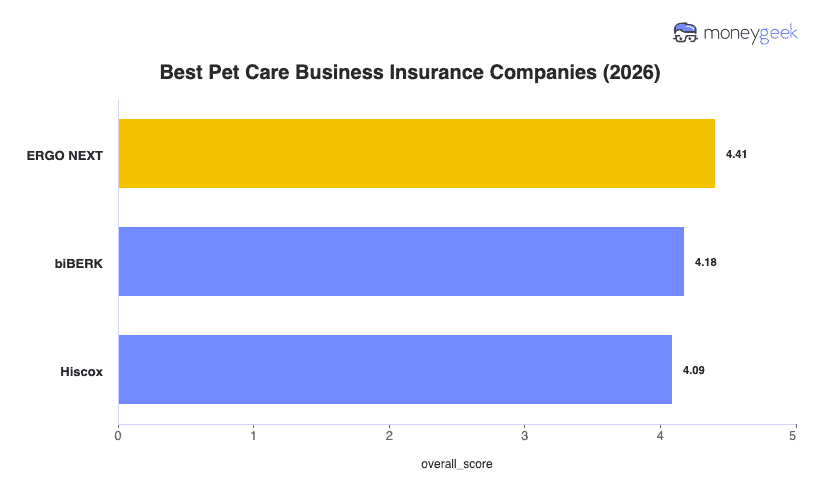
The carrier that fits your grooming salon may not be the right fit for a mobile van operation, and no single provider covers every pet care business equally well. Our analysis of pet care providers identified ERGO NEXT, Hiscox and biBERK as the three worth your attention, each striking a strong balance across price, service quality and coverage range. 

Our data shows that ERGO NEXT leads on both affordability and customer experience, so you can get covered in as little as 10 minutes, manage your policy and pull a COI through an app without an agent. If you want coverage in place before your next client drop-off, that buying experience matters as much as the premium.

ERGO NEXT4.41$6213
biBERK4.18$7075
Hiscox4.09$6847
The Hartford4.06$7721
Thimble4.00$7066
Progressive Commercial3.93$7354
Nationwide3.90$7732

How to Choose the Right Pet Care Business Insurance

Choosing the right pet care business insurance means matching your coverage to how your operation runs, not just buying the minimum. What we find is that skipping that process puts you at risk of finding out your coverage falls short when it matters most. Getting business insurance right takes deliberate thought, and the steps below walk you through it.

  1. 1
    Understand your risk profile and what coverage it requires

    Your risk profile depends on how you deliver your service. A fixed salon concentrates exposure on your premises: equipment, animals in your care and visiting clients. A mobile van adds vehicle liability and equipment-in-transit risk, while working as a walker or sitter means handling animals in spaces you don't own or control. Identify which risks apply to your situation, then separate what is legally required from what is practically essential.

  2. 2
    Choose the right coverage limits

    Coverage limits should reflect what a worst-case claim would actually cost, not the minimum a policy allows. In pet care, worst-case claims involve an animal that dies in your care, a serious bite injury or a vehicle accident with a client's animal on board. Start at $1 million per occurrence for general liability and professional liability, and consider higher limits if you run a high-volume facility or regularly handle high-value animals.

  3. 3
    Evaluate providers who understand pet care businesses

    Not every carrier writes pet care insurance, and those that do vary in how well they cover the exposures you actually face. Look for policy forms that include care, custody and control coverage rather than requiring it as a separate add-on. Weigh affordability, claims responsiveness and coverage breadth together: a carrier that is cheap but slow on claims or thin on coverage leaves you with a gap you only discover when you need it.

  4. 4
    Get compliance-ready

    Once your policy is in place, pull your certificate of insurance (COI) and confirm it reflects the limits your clients, landlord or platform requires. If you hold client keys, add a dishonesty bond: that is what clients mean when they ask if you are bonded. Depending on where you operate, you may also need a kennel or boarding license or to grant additional insured status before work begins.

  5. 5
    Revisit your coverage as your pet care business grows

    Coverage needs shift as your operation changes. Hiring your first employee triggers workers' compensation requirements, adding a mobile van means adding commercial auto and inland marine coverage, and expanding from walking to boarding changes your premises exposure. Review your coverage at least once a year and before any significant change, including new services, new staff or a commercial lease. Coverage that fit when you started may leave gaps as you grow.

Get Pet Care Business Insurance Quotes

Pricing for pet care business insurance varies by insurer, and the right fit depends on how your operation runs. If you walk dogs solo, you need portable coverage built around GL, a dishonesty bond and CCC protection. If you run a boarding kennel, your stack extends to workers comp, commercial property and higher liability limits scaled to your animal volume. Requesting business insurance quotes from multiple providers is the fastest way to find the right match for your operation.

About Connor Bolton


Connor Bolton, Senior SEO and Content Manager (Business & Pet), MoneyGeek

Connor Bolton is Senior SEO and Content Manager at MoneyGeek, where he leads the business and pet insurance editorial teams. He sets the research framework, data standards and content structure for his team. All content goes through his accuracy review before publication. Connor also writes in-depth guides and has spent more than four years covering insurance products across personal, commercial and specialty lines.

The research infrastructure Connor built covers auto, home, renters, life, health, business and pet insurance across pricing analysis, carrier research, customer experience and coverage evaluation. It includes over 6 million data points for business insurance across 408 industry areas, all 50 states and 16 vehicle types. The pet insurance side covers over 5 million profiles across 18 major providers, 100+ breeds and ages up to 20 years. Connor’s insurance research and his team's work has been cited by the U.S. Chamber of Commerce, Allstate, Liberty Mutual, CBS News, Forbes and LegalZoom.

Connor also talks with underwriters and carrier liaisons at Ethos, The Hartford, ERGO NEXT, Nationwide and State Farm, and monitors business and pet owner communities on Reddit. Those sources shape how his team evaluates carriers, structures rate analysis and writes for human buyers rather than search engines.

For questions about MoneyGeek's business and pet insurance content, contact him at connor@moneygeek.com or on LinkedIn.