
What Is Dog Walker Business Insurance?

Dog walker business insurance is a set of policies covering you against risks your work creates. These include handling other people's dogs in public spaces, entering client homes with a key and driving between stops as part of daily work.

Your work puts you in situations where something can quickly go wrong:

  • A leash snaps mid-walk and the dog darts into traffic
  • A dog bites a child at a neighborhood park during your afternoon route
  • A client's dog slips on wet trail steps and is injured in your care
  • A gate you closed at a client's property doesn't latch and another pet escapes
  • Your group walk turns into a fight between dogs from different households

We've found that standard small business policies often leave out the most common dog walker claim because of a built-in exclusion for animals in your care that you don't own. Pet care services business insurance written specifically for dog walkers addresses that gap, so you're not personally liable when a client's dog is hurt in your care.

What Types of Insurance Do Dog Walkers Need?

Dog walking puts you in front of several kinds of liability at once, and they don't all connect to each other. A dog bite, a fender-bender between client stops and an employee injury each route to a different policy, which is why dog walker insurance isn't a single coverage but a set built around how your business actually runs.

The coverages you'll most likely need:

  • General liability (since every walker faces third-party injury, property damage and animal-related claims the moment a dog is in your care)
  • Commercial auto (if you drive between client homes, because your personal auto policy likely excludes regular business use)
  • Workers' compensation (if you employ other walkers, since most states require it from your first hire)
  • Commercial property (if you operate a physical check-in space or board dogs at a dedicated location)
  • Cyber insurance (if you use scheduling software or store client payment and contact data digitally)

We've found that two walkers running similar routes can end up with very different coverage needs once you factor in whether they employ staff, drive between clients or offer services beyond basic walks. Use the profiles below to match your coverage to how your business actually runs, not just how big it is.

How Much Does Dog Walking Business Insurance Cost?

The average cost of dog walker business insurance is $56 a month ($673 a year), though what you actually pay depends on which coverage types you carry and how your business operates. Commercial auto is the most expensive single coverage, reflecting the daily vehicle exposure from driving your route between client homes. General liability, the first policy you're likely to buy, runs just below the overall average, because pet-care specific GL is a well-defined risk that insurers price predictably.

The gap between what two dog walking businesses pay can be wide. A solo walker carrying only general liability pays around $52 a month, while a small team where employees also drive between client stops and carry general liability, workers' comp and commercial auto pays around $198 a month combined, nearly four times as much. 

We find that your coverage mix affects your total cost more than your business size alone, and adding vehicles to the picture is the single biggest factor that moves the number. The average dog walker business insurance costs by coverage type are:

How did we determine business insurance rates for dog walkers?

The averages above reflect a fixed business size and coverage set, and your actual estimate depends on how your operation runs. If you handle group walks of four or more dogs at once, your GL premium is higher because each additional dog in your care adds per-walk exposure. If you drive between client stops, commercial auto costs apply that a stationary business doesn't carry. Add overnight boarding and animal liability applies too. A dog walker business insurance calculator gives you a figure built around your specifics.

Estimate Your Monthly Dog Walking Insurance Cost

Enter your coverage type, state, number of employees and type of vehicle (if you need commercial auto coverage) to get a pricing estimate that fits your business. We do not collect any personal information, and all rates are aggregated for all 50 states and Washington D.C. Workers' comp rate estimates are provided on a per employee basis and all coverage types assume standard industry limit recommendations for most businesses.

Select Coverage Type
Select State
Select Employee Count
Select Vehicle Type
Average Monthly Cost—

Best Dog Walking Business Insurance Companies

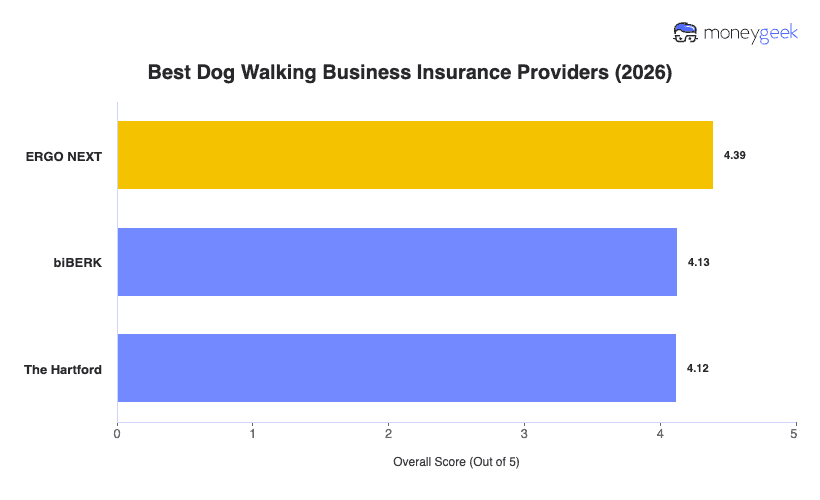
ERGO NEXT leads our overall dog walking business insurance rankings, with its top customer experience score driven by a fully digital buying process that requires no agent and delivers certificates of insurance on demand through the app. biBERK ranks second overall, and performs best in affordability, while customer experience and coverage depth are less competitive. We find that dog walkers who need low cost and fast access to proof of coverage will find ERGO NEXT the stronger fit.

Affordability, customer experience and coverage depth each carry different weight depending on how your business runs.

ERGO NEXT4.36$9213
Thimble4.24$9357
The Hartford4.20$9121
biBERK4.04$9776
Hiscox4.01$10534
Nationwide3.93$10562
Progressive Commercial3.89$10945

For our dog walking business insurance ratings, we analyzed pricing, coverage options, and customer experience across all 50 states and Washington, D.C. Our analysis focuses on 1-to-4-massage dog walking businesses, while weighting results to ensure broader industry and location representation. To do this, we evaluated over six million business profiles, more than 100,000 customer experience data points and performed in-depth analysis of coverage contracts and endorsements to compare insurers consistently across industries and regions. We then rated each company across categories of affordability (50% of overall score), customer experience (30% of overall score) and coverage options and terms (20% of overall score) to form an overall rating.

See our full business insurance methodology.

How to Choose the Right Dog Walking Business Insurance

Getting your dog walking business insurance right is not a single purchase decision. We find that the most common gap, which is buying a standard GL policy that excludes animals in your care, comes from moving too quickly without matching coverage to how your business runs. Getting business insurance correctly the first time starts with understanding what your operation requires.

  1. 1
    Understand your risk profile and what coverage it requires

    Your dog walking work creates several separate exposures that don't overlap: animal liability from handling client dogs, vehicle liability from driving between stops and employer liability the moment you hire. Each routes to a different policy, so start by mapping how your business runs then identify which exposures are legally required to cover, which clients will contractually expect and which are practical necessities given your daily work.

  2. 2
    Choose the right coverage limits

    Your limits should reflect your worst-case scenario, not the minimum needed to get a certificate of insurance issued. A single group walk that ends in a multi-dog bite incident can generate claims from several owners at once, pushing against a $1 million per occurrence limit faster than you might expect. If you have employees who drive between client stops, your auto liability exposure multiplies with each person on the road. Size your limits to the scenario you'd struggle to absorb financially, not the one you think is most likely.

  3. 3
    Evaluate providers who understand architecture firms

    Look for balanced performance across affordability, customer experience and coverage depth, not just the lowest premium. For your dog walking business specifically, customer experience matters beyond cost because it determines how quickly you can get covered, access your policy and pull a certificate of insurance when a client asks. A provider that scores well on price but poorly on accessibility leaves you waiting for proof of coverage at the moment you need it most.

  4. 4
    Get compliance-ready

    Buying your policy is the start, not the finish. Before you begin work for any client, you'll typically need to provide a certificate of insurance meeting their specified limits. A dishonesty bond is a separate product, not part of your insurance policy, that clients commonly request alongside your COI if you hold keys or door codes for their home. Check whether your state or locality requires a business license for pet care services, as these requirements vary by city and county.

  5. 5
    Revisit your coverage as your architecture firm grows

    Your coverage needs shift as your business changes, and buying once is rarely enough. Hiring your first employee triggers workers' compensation requirements you're now legally responsible for meeting in most states, and adding a dedicated business vehicle means your hired and non-owned auto coverage no longer fits the situation. If you expand into boarding or training, those services introduce exposures a walking-only policy likely doesn't cover. Review your coverage at least once a year and before any contract renewal, and reassess whenever your services, headcount or vehicle situation changes.

Get Dog Walking Business Insurance Quotes

What you pay for dog walking business insurance varies by provider, and the carrier that prices your coverage mix competitively may not be the same one that works for another dog walking business. A solo walker looking for general liability and a dishonesty bond has different requirements than a small team that also carries workers' comp and commercial auto, and providers price those combinations differently. Requesting business insurance quotes from multiple carriers gives you a direct comparison for what your operation needs.

About Angelique Palenzuela-Cruz


Angelique Palenzuela-Cruz, Business Insurance Writer, MoneyGeek

Angelique Palenzuela-Cruz is a Business Insurance Content Writer at MoneyGeek, where she specializes in general liability, workers' compensation and professional liability. Her writing helps small business owners understand what a policy covers and how it applies to their business.

Before financial content writing, Angelique spent nearly 12 years at Guthrie-Jensen Consultants, one of Southeast Asia's largest management training firms, where she rose from Training Consultant to Management Consultant. She worked directly with business clients across industries, assessed operational needs, designed training programs and presented performance analysis to executive decision-makers. She also helped establish Gladwin Training Consultancy, where she served as Learning Solutions Architect and Client Services Manager. That work put her on the business side of the decisions that insurance is built around, and she writes about coverage from that angle rather than from the policy terms.

She took that experience into financial content writing and has spent nearly four years at MoneyGeek covering insurance and lending content.

LinkedIn: linkedin.com/in/ma-angela-cruz

Email Contact: angelique.palenzuela@moneygeek.com