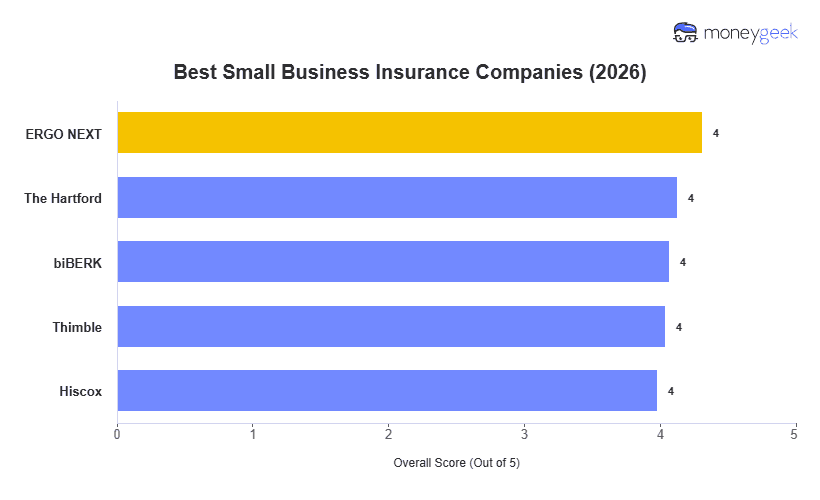
ERGO NEXT leads as the best small business insurer overall, but the right provider depends on three things specific to your situation: what your work exposes you to, how much you can spend without cutting corners on protection, and how much support you need when something goes wrong. Those factors play out differently for every company and the type of work you do, where you live and how large of an operation you have all come into play when determining who is ideal.

Each of the providers below earned a spot on my top five small business insurers for a specific grouping of company profiles:

  1. ERGO NEXT: Best Overall, Best For Hands-on Work Industries
  2. The Hartford: Best For White Collar and Larger Businesses
  3. biBERK: Best For Simple, Niche Businesses
  4. Thimble: Best For Gig and High-Risk Work
  5. Hiscox: Best For Tailored Professional Liability Coverage

You can also see an overview of how they ranked overall in my analysis in the summary table below for a more side-by-side view of my overall findings to ground your initial comparison.

ERGO NEXT4.31112
The Hartford4.13321
biBERK4.07476
Thimble4.04265
Hiscox3.98647

Beyond this summary, I've laid out exactly who each one fits and who should look elsewhere, because overall scores and rankings mean nothing if a company doesn't meet your specific needs.

ERGO NEXT

ERGO NEXT: Best For Hands-On Work Industries

On ERGO NEXT's site
COMPANY HIGHLIGHTS

ERGO NEXT wins as our best overall business insurance provider by being the proportional winner for affordability and customer experience for most business profiles. In my experience its buying process and policy management tools were superb, and you get quotes in under 6 minutes, have an instant COI at any time on their app or website portal, and make simple policy changes, all without an agent. Though, the key word here is simple, and they are most suited for small companies who are less at risk of a claim while businesses dealing with higher claim risk and have more complex better off elsewhere.

Read Our Review: ERGO NEXT Business Insurance Review

The Hartford

The Hartford: Best For White Collar

On The Hartford's site
COMPANY HIGHLIGHTS

The Hartford ranks second overall in our study, and its main selling point is its experience with over 200+ years in the insurance industry and tailored industry focused teams that make for a top-notch service experience. A majority of customers report that settlements are fair, and communication is stellar with many testimonials (Mueller and Company accounting and Jenny and Marc Seguinot’s law firm for example) to back them up. They are the best value for white-collar businesses and larger companies, where they offer the lowest rates and most tailored coverage, while those in hands-on work industries will seldom find them the ideal option.

Read Our Review: The Hartford Business Insurance Review

biBerk

biBERK: Best For Simple, Niche Businesses

COMPANY HIGHLIGHTS

biBerk earned my third-place spot overall for its consistently good performance across affordability and customer experience. It is Berkshire Hathaway's direct-to-business insurance arm, and that backing allows industry specific representatives to be available for support. It sells directly without brokers, the entire process from quote to binding happens online, the company prices most competitively for sole proprietors running straightforward operations. Where it falls short is claims handling and underwriting appetite. If your work is complex or comes with higher financial risk, you may not qualify, and if a claim gets disputed, you'll have less recourse than with other competition.

Read Our Review: biBerk Business Insurance Review

Thimble

Thimble: Best For Gig or High-Risk Work

COMPANY HIGHLIGHTS

Generally speaking, Thimble carves out its fourth-place spot on our list due to its flexible policy term lengths, it's specialty experience in high-risk contracting and gig industries and broad coverage for general liability plans. While the company only offers general liability, BOP, and workers' comp plans, that's often all most contractors need, and like many digital insurers you get can instant COIs to show to clients easily online. The main problem with Thimble's services is their customer support, which can only be reached through email. While the company generally receives good reviews, if you're in a pinch and need to make a complex claim, it is difficult for problems to be resolved quickly and it can be easy to have communication issues.

Read Our Review: Thimble Business Insurance Review

Hiscox

Hiscox: Best For Tailored Professional Liability Coverage

COMPANY HIGHLIGHTS

Hiscox has focused almost solely business insurance for over 120 years, and its professional liability (E&O) terms reflect that depth in a way that generalist carriers do not match. In my analysis it consistently priced below subindustry averages for specialty trades like air duct, chimney, and hood cleaning operations, and produced the strongest professional liability terms of any provider I studied for advice-based and consulting businesses. Seven-day licensed agent access is also a large perk that allows you to get real coverage questions answered before you commit, not after something goes wrong. It is not the most affordable option overall, but for businesses where the financial risk of a professional error or negligence claim is high, the policy terms justify the premium difference in a way that cheaper alternatives can't.

Read Our Review: Hiscox Business Insurance Review

What Are The Best Small Business Insurers For Your Industry?

Industry is the single biggest variable in who the best small business insurance provider is for your company. It shapes your coverage needs, which carriers are willing to write your risk, and how competitively they price it. I've broken down my recommendations across the most generalized work areas based on my analysis of insurer offerings across 400+ industries.

For more detailed guidance on who is the best insurer for your industry, I've left dedicated resources below for you to learn more.

Best Small Business Insurance Companies By Coverage Type

The coverage type that matters most to your business determines which carrier should lead your shortlist, and the rankings shift meaningfully depending on what you are buying. ERGO NEXT has the best small business insurance offerings across general liability, workers' comp, professional liability and commercial property, but not because it has the deepest coverage in any of those categories. It wins because its pricing and customer experience are strong enough across all four to outperform carriers that lead on coverage depth alone.

The clearest exceptions are commercial auto, where Progressive Commercial prices 13% below the national benchmark and leads for the majority of industries, and cyber insurance, where Chubb leads across every dimension, affordability, customer experience, and coverage which is rare for any product. If commercial auto or cyber is your primary coverage need, your best provider is not ERGO NEXT.

ERGO NEXT
2
1
8
ERGO NEXT
1
1
6
ERGO NEXT
2
1
3
Progressive Commercial
1
1
4
ERGO NEXT
3
2
6
Chubb
1
1
1

How Does Your Best Small Business Insurer Differ By State?

In short, your location is not a primary mover of who your best small business insurance fit, and only functions as a differentiator for price. While it can be easy to think it is important since other policy types like auto insurance and property insurance are highly location specific, it mostly sets the environment for claims risk an insurer will take on in reality, not their coverage or service reputation. Due to this, when isolating for who is the best overall provider by state, my answer is the same for all areas (ERGO NEXT).

However, in conjunction with other factors like your industry the answer can change. If you'd like to dig into more detail on your location specific fit, I have provided state guides below.

What Types of Small Business Insurance Are Best For My Company?

At the end of the day, your best provider really depends on your small business's coverage needs. Most businesses start with general liability insurance when starting out as a baseline since it protects you from a large proportion of the risks you face and is a common contractual requirement. Workers' comp becomes required once you have employees and commercial auto is needed once you use vehicles for your work.

To give you a generalized starting point, I've broken down my core coverage type recommendations that I think are best by the type of work you do, before any requirements are applied:

  • You work with your hands: General liability, workers' comp, tools & equipment
  • You sell advice or expertise: General liability, professional liability, cyber liability
  • You have a physical location: BOP, workers' comp
  • You sell or ship physical products: BOP, cyber liability

Past this, your contractual and state mandated coverage will fill in the rest. If you're more unsure and want more justification and/or coverage amount recommendations, I've provided a coverage type breakdown for you below to give you a framework to decide for yourself.

General liability protects you financially when you cause or have been claimed to have caused bodily injury to a third party, damage to someone else's property and reputational harm. Legal defense costs also covered if you're sued over any of these items.
All businesses
Workers' comp gives reimburses you for medical costs and lost wages when an employee is injured on the job. It covers injuries from accidents, repetitive motion, and occupational illness.
Required once you have employees in most states
Any bodily injuries caused by you in an accident and property damage to your vehicle or another's can be covered by this policy type.
Anyone driving to jobs, clients or hauling equipment (Required by law)
You would be covered for financial losses a client claims to suffer because of your advice, a professional error, or a failure to deliver on contractual obligations.
Advice-based, consulting, and service businesses
All physical assets your business owns or leases, including equipment, inventory, furniture, and the build-out of your space is covered at a stationary physical location. It also causes loss from fire, theft, vandalism, and certain weather events, often with the inclusion of business interruption coverage.
Businesses with significant equipment or inventory
A bundled policy combining general liability and commercial property at a lower combined premium than buying each separately.
Any small businesses with a physical location
Cyber insurance reimburses you for costs from a data breach, ransomware attack, or unauthorized access to client data, including forensic investigation, regulatory notification requirements, legal defense, and settlements.
Businesses handling client data or processing payments
This add-on policy financially covers you for repair or replacement of your own tools and equipment lost to theft, damage, or destruction on a job site or in transit.
Trades and solo operators
Additional liability coverage that kicks in when a claim exceeds the limits of anotherq policy. A single large claim in a high-risk trade or on a high-value commercial property can exhaust base limits before legal defense costs are factored in.
Higher-risk trades, those entering into commercial contracts, larger operations

Most small businesses are covered by the policies in the table above. However, there are coverages that fall outside of the standard array that you may need depending on your industry area. If your work involves physical or chemical risk, regulated activities, transporting goods, or managing other people's dependents or property, check out these coverage types below to see if you need them.

Best Small Business Insurance: The Bottom Line

You now know which providers belong on your shortlist and what coverage your business actually needs from them. When you start comparing quotes, the premium is not the whole picture. Two policies at the same price can have very different coverage terms, exclusion language, and claims handling behind them. The best policy is the one that covers what you actually do, at limits that reflect your real exposure, from a carrier that will show up when a claim happens.

And as a reminder before you compare, these are my top 5 picks overall.

Best Small Business Insurance Companies Chart

Questions To Ask Yourself Before Comparing Business Insurance Providers

These are the questions worth having answered before you compare quotes so you can find the best provider now when comparing and in the future.

Does matching my client's coverage requirement mean I have enough insurance?

Can I switch insurance carriers before my policy expires?

What should I do if my preferred carrier will not insure my business?

How do I choose between two carriers offering the same price?

Do I need a broker to get small business insurance?

When should I reassess my business insurance coverage?

How I Built These Best Small Business Insurer Rankings

My best small business insurance rankings are built on three things: what you'll actually pay, what happens when you need help, and whether the coverage holds up when it counts. I scored each provider across affordability (50%), customer experience (30%), and coverage options (20%) which are weighted that way because price is where most small businesses start, but it's rarely where the decision should end. 

This is what made up my analysis of popular insurers, which was assisted (not run) by AI:

About Connor Bolton


Connor Bolton, Senior SEO and Content Manager (Business & Pet), MoneyGeek

Connor Bolton is Senior SEO and Content Manager at MoneyGeek, where he leads the business and pet insurance editorial teams. He sets the research framework, data standards and content structure his writers work from, and reviews all team content for accuracy before it goes live. Connor also authors in-depth guides himself and has spent over four years covering insurance products across personal, commercial and specialty lines.

The research infrastructure Connor built covers auto, home, renters, life, health, business and pet insurance, from pricing analysis and carrier research to customer experience and coverage evaluation. It includes over 6 million data points for business insurance across 408 industry areas, all 50 states and 16 vehicle types, and over 5 million pet insurance profiles across 18 major providers, 100+ breeds and pet ages up to 20 years. Connor’s insurance research and his team's work has been cited by the U.S. Chamber of Commerce, Allstate, Liberty Mutual, CBS News, Forbes and LegalZoom.

Connor also talks directly with underwriters and carrier liaisons at Ethos, The Hartford, ERGO NEXT, Nationwide and State Farm, and monitors business and pet owner communities on Reddit. Both keep him current on how the market operates and what buyers need.

For questions about MoneyGeek's business and pet insurance content, contact him at connor@moneygeek.com or on LinkedIn.