
Best Retail Business Insurance Companies

No single carrier is the best business insurance fit for every retail business. A clothing boutique dealing with slip-and-fall claims on a busy sales floor and a hardware store managing product liability exposure from items sold both need providers that understand retail risk, price inventory-heavy accounts competitively and can process a claim without forcing the storefront to go dark during peak season. These five providers consistently topped our analysis:

  1. ERGO NEXT: Best Overall, Best Buying Experience
  2. The Hartford: Best for Coverage
  3. biBERK: Best Direct-to-Retailer Option
  4. Thimble: Best for Pop-Up and Seasonal Retailers
  5. Progressive Commercial: Best for Retailers with Vehicles

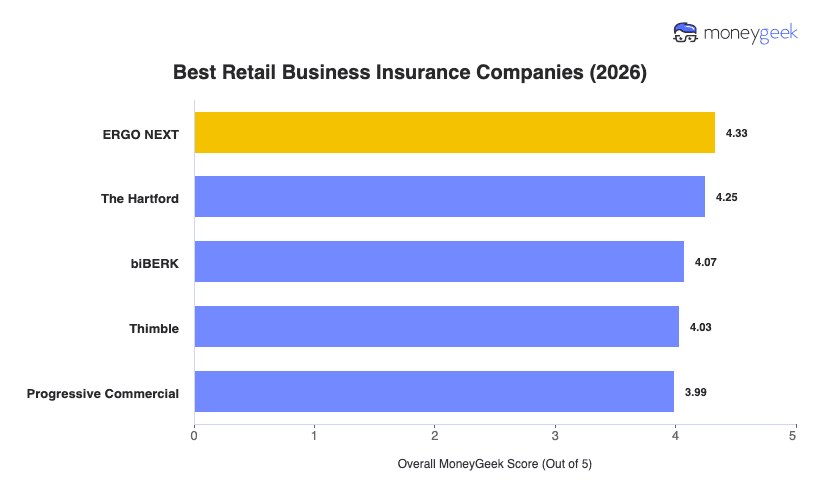
All five earned high marks across the three areas retail owners weigh most heavily: pricing that stays predictable through renewals even as inventory values shift seasonally, coverage options that address the full retail risk profile from product liability to commercial property and responsive claims handling when a storefront loss or merchandise theft puts operations on hold. The table below breaks down what sets each one apart for retailers.


ERGO NEXT
4.33
Ranks first overall and first for affordability across all retail sub-industries, saving retailers an average of 13% against the benchmark. The strongest buying and policy management scores in the field make it the most consistent fit for small storefronts and online sellers that need fast, app-managed coverage.
The Hartford
4.25
Leads every retail sub-industry and business size on coverage, with a Spectrum BOP built specifically for retail needs. Peak season inventory protection, built-in EPLI and equipment breakdown coverage give brick-and-mortar retailers more standard protection than any other provider in this ranking.
biBERK
4.07
Sells directly to retailers without brokers, with advisors trained on retail-specific risks like product liability and slip-and-fall exposure. No middleman means a faster buying process and no broker fees, which works well for retailers who want straightforward coverage without waiting on an agent.
Thimble
4.03
Offers coverage by the job, month or year, making it a natural fit for pop-up vendors, market sellers and seasonal storefronts that need proof of coverage without an annual commitment. No other provider in this ranking lets retailers buy coverage for a single job, event or season and cancel when it ends.
Progressive Commercial
3.99
The largest commercial auto insurer in the country, with coverage for delivery vans, box trucks and specialty vehicles most competitors are less equipped to write. For retail businesses running fleets or making deliveries, no other provider in this ranking matches that vehicle coverage depth.

For our overall best retail business insurance ratings, we analyzed pricing, coverage options, and customer experience across 39 sub-industries and all 50 states and Washington, D.C. Our analysis focuses on 1-to-4-person businesses, which represent nearly half of U.S. small businesses, while weighting results to ensure broader industry and location representation. To do this, we evaluated over one million business profiles, more than 100,000 customer experience data points and performed in-depth analysis of coverage contracts and endorsements to compare insurers consistently across industries and regions. We then rated each company across categories of affordability (50% of overall score), customer experience (30% of overall score) and coverage options and terms (20% of overall score) to form an overall rating.

See our full methodology.

95%

% of Small Businesses Covered

Over 235,294

Business Profiles Studied

23,529

Customer Experiences Analyzed

Company Image
Best Overall, Best Buying Experience

ERGO NEXT

ERGO NEXT ranks first overall for retail businesses, leading on both affordability and customer experience, with Munich Re's financial strength behind a fully digital platform. Retailers save an average of 13%, though three subindustries save around 20% to 21%: inflatable and bounce house rentals, independent groceries and hardware stores. Of 39 business types within retail, ERGO NEXT is the best option for 10 outright, especially among online and product-based sellers, llike Amazon sellers, e-commerce operators and craft vendors.

For retailers that need to buy fast, manage COIs for landlords or marketplace accounts, or keep policy admin off their plate, ERGO NEXT delivers where it counts. Customers score dispute handling and defense counsel lower, which means if a product injury or slip-and-fall claim gets contested or moves toward litigation, retailers may get less assertive legal support and a harder appeals process. Regarding coverage, the BOP caps business personal property at $500K, which works for most small storefronts but leaves furniture stores, electronics retailers and other high-inventory operations underinsured if a fire or theft wipes out the location. Multi-location retailers face a similar gap since coverage across more than one storefront gets structurally complicated.

Where ERGO NEXT Performs Best

  • Solo operators and micro-retailers that prioritize fast buying and low-friction policy management
  • Online sellers and marketplace vendors that need instant COI delivery and product liability coverage
  • Rental businesses and independent storefronts that want to save on rates
  • Smaller retailers looking for competitive rates without coverage complexity

Where ERGO NEXT Performs Less Competitively

  • Retailers with high-value inventory or multiple locations that need broader property coverage
  • Businesses where claims support quality and dispute resolution are a priority
  • Higher-risk retail operations that require specialty coverage structures or more hands-on underwriting

Learn More: ERGO NEXT Business Insurance Review

Company Image
Best for Coverage

The Hartford

Second overall for retail, The Hartford offers the best coverage options across 39 retail sub-industries and business sizes. Its Spectrum BOP is built for retail specifically: peak season inventory coverage that can increase limits during high-volume periods, EPLI included at no extra cost, equipment breakdown coverage included as well. The Hartford is the top option for nearly three-fourths of sub-industries, but it performs most reliably for brick-and-mortar specialty retail: clothing stores, electronics retailers, shoe stores, sporting goods stores and liquor stores.

Art vendors, clothing stores, electronics retailers and office supply stores see the most competitive rates, with savings ranging between 15% and 21%. Buying involves a slower application and quoting process. Top scores in billing accuracy, support responsiveness and loss prevention resources give retailers support for seasonal staffing changes, mid-year coverage updates and reducing slip-and-fall exposure. Policyholders score The Hartford well for claims handling, so for a retailer working through a contested product liability or slip-and-fall claim, that translates to more assertive legal support and fewer stalled resolutions.

Where The Hartford Performs Best

  • Brick-and-mortar retailers that need deeper property coverage and seasonal inventory protection
  • Retailers with employees who want EPLI included without paying for a separate policy
  • Established retail operations where claims support quality and dispute resolution matter most
  • Growing retailers whose coverage needs have outpaced simpler policy structures

Where The Hartford Performs Less Competitively

  • Equipment rental businesses and online sellers that want to save on cost
  • Retailers that prioritize a fast, fully digital buying and policy management experience
  • Businesses in Alaska or Hawaii, where The Hartford does not write coverage

Learn More: The Hartford Business Insurance Review

Company Image
Best Direct-to-Retailer Option

biBerk

With its direct-to-business model, biBERK ranks third in our retail business insurance study. It sells directly to retailers without brokers, cutting out agent callbacks and quoting cycles. Instead, you work with advisors who understand retail-specific risks like product liability and slip-and-fall exposure, and can get coverage terms clarified before purchase rather than discovering gaps at claim time. That advantage, however, narrows after the sale. Adding an additional insured requires a form submission and up to a two-day wait, which creates a real problem for retailers who need to add a landlord, marketplace platform or event venue before they can open, list or operate. Claims handling rank lower, and for a retailer working through a contested product liability suit or a disputed slip-and-fall settlement, that means below-average support at every stage: filing, communication, dispute handling and defense counsel.

biBERK runs marginally above the industry benchmark on average, but some subindusties still see competitive pricing: bicycle shops (4.2% savings), music stores (6.6%) and craft vendors (5.5%). For coverage, general liability is available in only 28 states. In covered states, the BOP, workers' comp and umbrella structure covers the policies most small retailers need, but there are no retail-specific endorsements: no peak season inventory option, no built-in EPLI, no equipment breakdown coverage. 

Where biBERK Performs Best

  • Independent retailers in covered states that want fast online buying without a broker
  • Cost-conscious bicycle shops, music stores and craft vendors
  • Retailers with straightforward coverage needs who value a guided, advisor-supported process
  • Small retail operations don’t need complex coverage structures

Where biBERK Performs Less Competitively

  • Retailers in states where biBERK does not offer general liability coverage
  • Businesses that need fast additional insured processing for landlords, marketplaces or event venues
  • Retailers with contested or complex claims where defense counsel quality and dispute support matter

Learn More: biBerk Business Insurance Review

Company Image
Best for Pop-Up and Seasonal Retailers

Thimble

Thimble, with its flexibility policy structure, ranks fourth overall. Pop-up vendors, market sellers and seasonal storefronts will find value in the possibility of getting coverage by the job, month or year, instant COI delivery and unlimited additional insureds through the app, with no annual commitment required. The buying experience includes clear pricing and clean underwriting questions, though there is no phone support. If a billing issue or coverage question comes up before a busy weekend, the only options are chat or email, and customers report waiting days for responses. Customers rank claims handling lower since while filing is straightforward, what comes after is not. When a claim gets complicated, policy holders sometimes find Thimble's support thin since the provider doesn't handle claims directly.

The coverage picture reflects the tradeoffs of a newer, flexible-first insurer. Starting limits run lower than most competitors: general liability at $300,000 and business contents at $50,000, which may fall short for a retailer with high-value inventory or a busy storefront. It doesn’t offer commercial auto coverage, cyber insurance isn’t available in California, Florida and New York, and you can’t adjust deductibles in the online quoting flow. Thimble ranks third overall for affordability. While it isn’t the cheapest provider for any subindustry, it’s an affordable option for specialty food stores, garden centers and rental operations.

Where Thimble Performs Best

  • Small retail operations and pop-up vendors that need coverage without long-term commitment
  • Retailers who need instant COI delivery for landlords, markets or short-term venue requirements
  • Specialty food stores, garden centers and rental operations prioritizing competitive pricing
  • New or part-time retailers testing a concept before committing to a full annual policy

Where Thimble Performs Less Competitively

  • Businesses in California, Florida or New York that need cyber insurance coverage
  • Retailers with contested or complex claims who need strong dispute handling and defense counsel support

Learn More: Thimble Business Insurance Review

Company Image
Best for Retailers with Vehicles

Hiscox

As the largest commercial auto insurer in the country, Progressive Commercial offers real depth to retail businesses that run vehicles: delivery vans, box trucks and specialty vehicles that most other providers in this ranking are less equipped to cover. Coverage ranks fourth overall, though the advantage sits mainly in commercial auto and select endorsements. Liquor liability as a standalone policy or BOP endorsement benefits liquor stores, convenience stores and specialty food retailers, while inland marine covers inventory moving between locations. Retailers without vehicles or alcohol-related exposure will find the BOP and GL structure serviceable — but no practical reason to choose Progressive over a higher-ranked option.

Buying ranks eighth, with a slower and less guided quote process than most alternatives here. Policy management is seventh. External reviews show a consistent pattern of billing disputes and communication delays, and the buying and policy management scores reflect that. GL, BOP and workers' comp policies are underwritten by partner insurers, not Progressive directly, so if those claims get disputed, the retailer is dealing with a carrier they did not choose and whose responsiveness Progressive does not control. Claims are fifth overall — appeals and dispute handling rank third, which gives retailers in a contested product liability or slip-and-fall dispute more recourse than the overall CX rank would suggest. At 3.1% above the industry benchmark on average, Progressive is among the more expensive choices in this ranking for most retailers. Auto parts shops, furniture stores, liquor stores and specialty food retailers see savings of roughly 3% to 5%, but clothing stores, electronics retailers and sporting goods stores pay the least competitive rates in this group. The insurer is not available in Hawaii for non-auto products.

Where Progressive Commercial Performs Best

  • Retailers with delivery vehicles or business fleets that need commercial auto coverage with their BOP
  • Liquor stores, convenience stores and specialty food retailers that need liquor liability coverage
  • Mid-size retail operations with 10 or more employees where overall performance improves
  • Retailers with contested liability claims who need stronger appeals and dispute support

Where Progressive Commercial Performs Less Competitively

  • Retailers focused on price, where Progressive runs above benchmark across most sub-industries
  • Clothing stores, electronics retailers and sporting goods stores with the least competitive rates
  • Retailers in Hawaii, where non-auto business insurance products are not available

Learn More: Progressive Business Insurance Review

Best Retail Business Insurance by Business Size

Solo store owners and micro-retailers with up to four employees tend to carry lighter payrolls and more predictable inventory levels, and ERGO NEXT leads those size bands on customer experience and overall score. At five employees and above, the calculus shifts: more staff on the floor means higher workers' compensation exposure, busier storefronts generate more general liability risk and growing inventory requires higher commercial property limits. The Hartford leads at every staffing band from five to 49 employees, where coverage depth and policy breadth carry more weight than rate alone.

The table below shows the top-rated retail business insurance provider at each staffing level.

0
ERGO NEXT
$62
1
4
1 to 4
ERGO NEXT
$106
1
3
5 to 9
The Hartford
$163
2
1
10 to 19
The Hartford
$217
2
1
20 to 49
The Hartford
$319
2
1

Best Retail Business Insurance by Subindustry

The Hartford leads in 28 of 39 retail sub-industries, covering most brick-and-mortar formats from shoe stores and gift shops to liquor stores and cannabis dispensaries. ERGO NEXT leads in the remaining 11, which cluster around rental operations, vehicle-adjacent businesses and online or vendor-based retail formats like e-commerce warehouses, car dealerships and craft vendors.

The table below shows the top-rated provider and average monthly rate for each retail sub-industry.

Amazon SellersERGO NEXT$11713
Antique StoreThe Hartford$10251
Art VendorThe Hartford$7051
Auto Parts ShopThe Hartford$14061
Bicycle ShopThe Hartford$11361
Book StoreThe Hartford$9351
Candy StoreThe Hartford$10961
Cannabis DispensaryThe Hartford$15361
Car DealershipERGO NEXT$13913
Car RentalERGO NEXT$12913
Clothing StoreThe Hartford$10761
Convenience Store (No Gas)The Hartford$12161
Craft VendorERGO NEXT$11413
Craft Vendors/CraftersERGO NEXT$9913
E-commerce (With Warehouse)ERGO NEXT$14313
Electronics StoreThe Hartford$13251
Florist ShopThe Hartford$11461
Furniture StoreThe Hartford$12761
Garden CenterThe Hartford$14261
Gas Station/Convenience StoreThe Hartford$12761
Gift ShopThe Hartford$9451
Grocery Store (Small/Independent)The Hartford$13661
Hardware StoreERGO NEXT$11413
Inflatable/Bounce House RentalERGO NEXT$10713
Jewelry StoreThe Hartford$11051
Liquor StoreThe Hartford$14161
Music StoreThe Hartford$11351
Office Stationery/Supply StoreThe Hartford$11161
Party Rental EquipmentERGO NEXT$12513
Pawn ShopThe Hartford$12561
Pet Supply StoreThe Hartford$11451
Shoe StoreThe Hartford$10751
Specialty Food StoreThe Hartford$12361
Sporting Goods StoreThe Hartford$13251
Thrift StoreThe Hartford$12261
Toy StoreThe Hartford$11651
Vape/Smoke ShopThe Hartford$10161
VendorERGO NEXT$10813
Window Treatment StoreThe Hartford$11561

Each subindustry page below highlights the providers that best fit your type of retail establishment.

Best Retail Business Insurance by State

ERGO NEXT leads in 45 states and Washington D.C., with its customer experience ranking first across retail markets that range from neighborhood storefronts and pop-up vendors to e-commerce warehouse operations. In New Jersey, North Dakota, Ohio, Washington, Wisconsin and Wyoming, The Hartford ranks first, with its coverage depth giving it an edge over ERGO NEXT for retailers running larger or more complex operations in those markets.

The table below shows the top-rated retail business insurance provider and average monthly rate for each state.

Alabama
ERGO NEXT
$108
1
3
Alaska
ERGO NEXT
$168
1
3
Arizona
ERGO NEXT
$124
1
3
Arkansas
ERGO NEXT
$108
1
3
California
ERGO NEXT
$169
1
3
Colorado
ERGO NEXT
$134
1
3
Connecticut
ERGO NEXT
$154
1
3
Delaware
ERGO NEXT
$130
1
3
Florida
ERGO NEXT
$149
1
3
Georgia
ERGO NEXT
$122
1
3
Hawaii
ERGO NEXT
$119
1
3
Idaho
ERGO NEXT
$103
1
3
Illinois
ERGO NEXT
$142
1
3
Indiana
ERGO NEXT
$116
1
3
Iowa
ERGO NEXT
$97
1
3
Kansas
ERGO NEXT
$111
1
3
Kentucky
ERGO NEXT
$113
1
3
Louisiana
ERGO NEXT
$126
1
3
Maine
ERGO NEXT
$131
1
3
Maryland
ERGO NEXT
$149
1
3
Massachusetts
ERGO NEXT
$157
1
3
Michigan
ERGO NEXT
$165
1
3
Minnesota
ERGO NEXT
$128
1
3
Mississippi
ERGO NEXT
$110
1
3
Missouri
ERGO NEXT
$127
1
3
Montana
ERGO NEXT
$111
1
3
Nebraska
ERGO NEXT
$109
1
3
Nevada
ERGO NEXT
$132
1
3
New Hampshire
ERGO NEXT
$115
1
3
New Jersey
The Hartford
$179
3
1
New Mexico
ERGO NEXT
$112
1
3
New York
ERGO NEXT
$166
1
3
North Carolina
ERGO NEXT
$121
1
3
North Dakota
The Hartford
$129
6
1
Ohio
The Hartford
$150
6
1
Oklahoma
ERGO NEXT
$118
1
3
Oregon
ERGO NEXT
$131
1
3
Pennsylvania
ERGO NEXT
$117
1
3
Rhode Island
ERGO NEXT
$144
1
3
South Carolina
ERGO NEXT
$120
1
3
South Dakota
ERGO NEXT
$119
1
3
Tennessee
ERGO NEXT
$112
1
3
Texas
ERGO NEXT
$147
1
3
Utah
ERGO NEXT
$119
1
3
Vermont
ERGO NEXT
$105
1
3
Virginia
ERGO NEXT
$126
1
3
Washington
The Hartford
$157
4
1
Washington D.C.
ERGO NEXT
$173
1
3
West Virginia
ERGO NEXT
$112
1
3
Wisconsin
The Hartford
$113
3
1
Wyoming
The Hartford
$135
6
1

What Determines the Best Retail Business Insurance For You

The right retail business insurance isn't determined by the lowest quoted premium. It's the policy that holds up when a customer slips on a wet floor, a delivery damages your inventory or a landlord requests proof of coverage before your lease renews. Four factors separate providers that fit retail businesses from those that fall short.

    barChart icon
    Price stability matters more than the initial quote

    Retail margins are thin enough that a large premium increase at renewal can force real budget decisions: cutting staff hours, delaying a restock or absorbing the cost elsewhere in the budget. Carriers that compete on low initial quotes but reprice aggressively at renewal are a poor fit for stores running on predictable monthly budgets. Look for carriers with a track record of stable renewal pricing for retail accounts. Three things to check before committing:

    • How consistently the carrier's renewal rates track to the original quote for comparable retail businesses
    • Whether the carrier's audit methodology for workers' compensation uses payroll, revenue or both, and how that applies to a store with seasonal staffing
    • What payment structure options exist for businesses with uneven monthly cash flow
    talk icon
    Service that holds up when you actually need it

    Retail businesses deal with landlords requiring certificates of insurance at lease signing and renewal, seasonal staffing changes and routine policy management questions that come up outside of claims. A carrier that makes it easy to add an employee, update a location or pull a COI on short notice removes friction from the interactions retailers deal with most often, not just when something goes wrong.

    financialPlanning icon
    Coverage that matches the work you actually do

    A boutique adding an online store, a garden center stocking landscaping equipment or a gift shop shipping nationally can quickly outgrow the limits on their original policy. Carriers that offer flexible limit options let retailers right-size coverage without switching providers as the business scales.

    Beyond limits, the right carrier should offer access to coverage types the business may need later. A specialty food retailer adding prepared items may need product liability endorsements not included in a standard BOP. Clothing stores opening a second location need a provider that can extend commercial property coverage without requiring a separate policy. Retailers grow in directions that aren't always predictable, and a carrier with a narrow appetite for retail sub-industries creates a ceiling on how far the relationship can go.

    trustSeal icon
    Reliable across the board, not just in one area

    A jewelry store owner dealing with a slow COI request risks breaching a lease requirement. A carrier that reprices aggressively at renewal forces a choice between adequate protection and budget stability. Retailers need a provider that holds up across all three areas, because a gap in any one tends to surface at the worst possible time.

How to Choose the Best Retail Business Insurance

The right coverage for a sporting goods store won't necessarily fit a florist or a pawn shop. These seven steps put choosing business insurance in logical order so the final policy reflects how your store actually runs.

  1. 1
    Map your retail coverage needs to your operations

    Identify which coverage types match your store's risk profile before comparing providers. A bicycle shop needs product liability for equipment that could injure a customer. A florist making deliveries needs commercial auto. Thrift stores still need commercial property even if individual items have low value.

    Retail coverage types to map include general liability, workers' compensation and commercial property as the baseline. Add cyber insurance if the store handles customer payment data and liquor liability if it sells alcohol. Match coverage to how the store operates before shortlisting providers.

  2. 2
    Optimize your coverage and payment structure

    Retail property limits should reflect replacement cost, not depreciated value. A furniture store carrying $400,000 in display inventory that insures to $200,000 is underinsured from the moment a loss occurs. General liability limits should also account for foot traffic volume and the type of merchandise sold.

    Annual payment typically costs less than monthly installments since many carriers charge a financing fee for payment plans. A toy store that generates most of its revenue in Q4 may find monthly payments easier to manage through slower months.

  3. 3
    Choose your primary priority

    A retail business's current situation drives which evaluation area matters most: its growth stage, claims history and how the current policy is performing. Pick the one that fits and use it as the tiebreaker in Step 6.

    • Prioritize affordability if newer stores like a gift shop or boutique in their first year need pricing stability more than broad coverage menus or add-on endorsements. Compare cheap retail business insurance options to find providers that price competitively for your retail sub-industry and size.
    • Prioritize customer experience if the business has frequent routine insurance interactions that create operational friction when they go wrong. A convenience store that needs updated certificates for multiple vendors and a landlord, or a toy store working through a product recall claim, needs a carrier that handles these without delays that ripple into store operations.
    • Prioritize coverage options if the store carries high-value inventory or is growing into new channels or locations where the current policy structure may no longer be adequate. An antique store with items valued at thousands of dollars each needs a carrier that can write the right commercial property limits and endorsements.
  4. 4
    Shortlist providers that write policies for retail businesses

    Retail is a broad industry and carrier appetite varies across sub-industries. A carrier that writes standard brick-and-mortar retail well may have limited appetite for cannabis dispensaries, car rentals or e-commerce with warehouse inventory. Comparing a carrier that doesn't actively write your sub-industry produces a quote that won't be competitive.

    Two to three providers is enough for a meaningful comparison, keeping the focus on carriers that are actually competing for your retail account rather than surface-level differences between options unlikely to win your business.

  5. 5
    Double-check dealbreakers early

    A quick pass/fail check on each shortlisted provider prevents wasted time on detailed comparisons that fall apart on a basic eligibility or coverage issue. Drop any provider that fails on the following:

    • No appetite for your specific retail sub-industry, such as carriers that exclude cannabis dispensaries, pawn shops or vape and smoke shops
    • Unable to write the coverage mix your operation needs, such as a BOP paired with liquor liability or inland marine
    • Policy exclusions that eliminate coverage for your primary exposure, such as excluding theft from a jewelry store's commercial property policy
    • COI turnaround that doesn't meet your commercial lease or vendor requirements
  6. 6
    Compare your finalists across all three areas

    Retailers who skip directly to price comparisons often miss coverage gaps or service limitations that only surface after a claim. Run each shortlisted provider through all three evaluation areas before making a final call, using your Step 3 priority as the tiebreaker only when two providers are otherwise close.

    • Look at affordability by checking how providers communicate rate changes at renewal and how audit processes work for retail payroll. A garden center with seasonal staff needs a workers' comp audit that won't produce a year-end surprise. Compare against retail business insurance cost benchmarks for your sub-industry.
    • Evaluate customer experience by checking COI turnaround times, mid-term policy change processing and how the carrier handles retail-specific requests. A music store adding a consignment instrument or an auto parts shop managing a commercial auto claim needs a carrier that responds without delays affecting daily operations.
    • Assess coverage options by confirming each provider can write the limits and endorsements your store needs. A grocery store needs spoilage coverage and slip-and-fall limits for a high-traffic environment. A sporting goods store needs product liability limits that reflect the risk of the equipment it sells. Verify the policy structure can accommodate new locations or sales channels without a carrier switch.
  7. 7
    Use quotes as the final confirmation step

    At this point the shortlist is built, the priority is set and the coverage baseline is clear. A quote confirms whether pricing matches expectations and whether policy terms hold up against the store's actual details. A vape shop, a furniture store and an e-commerce warehouse will each get different quotes from the same carrier. Review exclusions and inventory limits carefully, then compare business insurance quotes using the same coverage parameters across all finalists.

Best Retail Business Insurance: Bottom Line

For most retail businesses, ERGO NEXT, The Hartford and biBERK deliver the strongest combination of pricing, service and coverage across retail's core risks. ERGO NEXT leads on overall score and in most states, but The Hartford's coverage depth makes it the better fit for larger storefronts and established brick-and-mortar formats. 

The most useful frame for evaluating any retail insurer is whether the policy was built for businesses that sell physical goods, carry inventory and manage customer foot traffic liability. Providers that understand that profile price it, cover it and service it differently than those treating retail as a generic small business category.

Best Retail Business Insurance: Next Steps

If you're still comparing options and want to see whether a lower-cost provider can meet your store's coverage needs without meaningful tradeoffs, reviewing the cheapest retail options gives you a clearer sense of where retail pricing typically lands for your store type before you commit.

If you're ready to move forward, request quotes from your shortlisted carriers using your store's actual details: sub-industry, employee count, inventory value and location. The quote you get from those inputs reflects your real retail profile, not a generic industry average.

If you're comparing two providers and price and coverage point in different directions

If your landlord or a vendor just raised their COI requirements

If your renewal quote came in higher than last year

If you're opening a second location or adding online sales

How We Chose the Best Retail Business Insurance Companies

To identify the best retail business insurance companies, we evaluated insurers across pricing, customer experience and coverage options using a standardized, data-driven approach. Our goal was not to identify the cheapest option in every scenario, but to determine which providers deliver the most consistent overall value across common food business profiles.

Our best recommendations reflect insurers that perform well across multiple dimensions and remain competitive across food sub-industries and business sizes.

Data and Analysis Scope

Our analysis is based on standardized estimates designed to represent the majority of food businesses:

  • Providers analyzed: 7 major insurers
  • Subindustries covered: 39 food subindustries
  • Employee counts: Zero to 49 employees
  • Policy baseline: $1 million per occurrence/$2 million aggregate for liability coverages; workers' comp limits set to meet state mandates
  • Pricing modeled: 196,000 standardized estimates across food business profiles

Modeled average revenues and payrolls were incorporated to improve pricing accuracy for food business profiles.

Our Scoring Model

Each insurer received a composite score based on the weighted categories below.

  • Affordability (50%): Affordability reflects how competitively and consistently an insurer prices coverage across all food business profiles studied.
  • Customer experience (30%): Customer experience measures how well insurers support food businesses throughout the policy lifecycle from purchase to claims. We also studied at each level of buying, policy management and claims sub-parts of the process that make it easier and more reliable within each as well for accuracy and comprehensive understanding.
  • Coverage options (20%): Coverage options reflect how well insurers support common food business risks and allow for flexibility as businesses grow or change.

About Connor Bolton


Connor Bolton headshot

Connor Bolton is Senior SEO and Content Manager at MoneyGeek, where he leads the business and pet insurance editorial teams. As editorial lead for both verticals, Connor sets the research framework, data standards, and content structure that his writers execute, directly authoring in-depth guides himself and reviewing all team content for accuracy and practical value before it goes live. With over four years evaluating insurance products across personal, commercial, and specialty lines, he brings cross-vertical knowledge to every guide the team produces.

Connor architected MoneyGeek's insurance research infrastructure across all major verticals including auto, home, renters, life, health, business, and pet, building systems for pricing analysis, provider-level research, customer experience evaluation, and coverage analysis with AI support. The infrastructure includes over 6 million data points for business insurance across 408 industry areas, all 50 states, and 16 vehicle types, and over 5 million pet insurance profiles across 18 major providers and hundreds of breed and age combinations. Connor's insurance cost research and his team's work has been cited by the U.S. Chamber of Commerce, Allstate, Liberty Mutual, CBS News, Forbes and LegalZoom.

Beyond the data, Connor stays connected to how the market actually operates, drawing on direct conversations with underwriters and carrier liaisons at Ethos, The Hartford, NEXT Insurance, Nationwide, and State Farm, and monitoring business and pet owner communities including Reddit, to inform how he interprets findings and frames guidance for real buyers.

He is the direct editorial contact for methodology questions at connor@moneygeek.com and can be found on LinkedIn.