
Key Takeaways
blueCheck icon

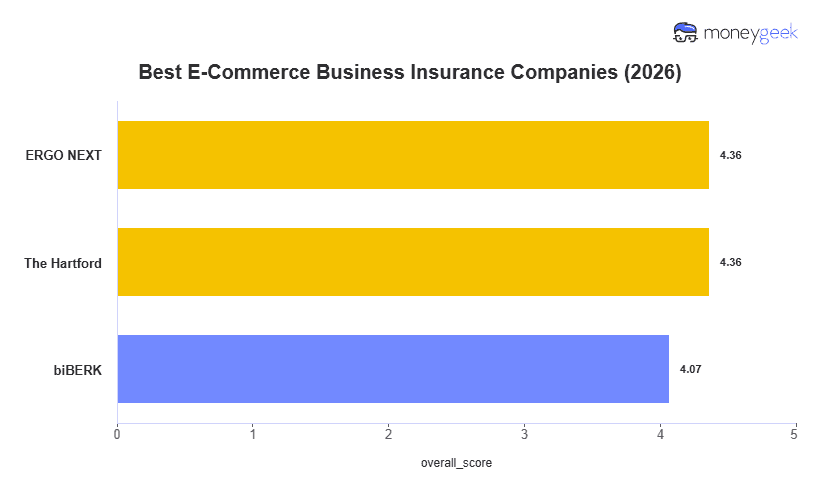
ERGO NEXT, The Hartford and biBERK top our rankings for best e-commerce business insurance, with rates starting at $143 per month. Use these as your starting point when comparing providers. (Jump to Top Providers)

blueCheck icon

The coverages your e-commerce store most needs are general liability with product liability for what you sell, cyber insurance for the customer data and payment details you hold, plus commercial property once you're storing inventory. (Jump to Types You Need)

blueCheck icon

Your e-commerce insurance costs can range from $137 to $262 per month. What you sell, how you fulfill orders and how much inventory you hold all affect where your premium lands. (Jump to Costs)

blueCheck icon

The right e-commerce coverage starts with matching policies to your actual risks, then setting limits that reflect what a product claim or data breach could cost your business. (Jump to Choosing Process)

Best E-Commerce Business Insurance Companies

ERGO NEXT leads our rankings for best e-commerce business insurance on affordability and customer experience, averaging $143 per month, the lowest rate we found in this category. The Hartford ranks second with the top coverage score, a stronger fit if your operation needs deeper product liability protection across multiple selling channels. The choice between these two comes down to what your business needs most: lower cost or broader coverage.

Rates and scores in the table below reflect MoneyGeek's analysis of e-commerce businesses with warehouses:

ERGO NEXT4.36$14313
The Hartford4.36$15961
biBERK4.07$17256
Thimble4.03$16327
Progressive Commercial4.00$17244
Nationwide3.97$18372
Hiscox3.95$17935

For our overall best e-commerce business insurance ratings, we analyzed pricing, coverage options, and customer experience across all 50 states and Washington, D.C. Our analysis focuses on 1-to-4-person e-commerce businesses, while weighting results to ensure broader industry and location representation. To do this, we evaluated over six million business profiles, more than 100,000 customer experience data points and performed in-depth analysis of coverage contracts and endorsements to compare insurers consistently across industries and regions. We then rated each company across categories of affordability (50% of overall score), customer experience (30% of overall score) and coverage options and terms (20% of overall score) to form an overall rating.

See our full business insurance methodology.

The rankings are a starting point, not a final answer for your operation. If you're dropshipping and need basic general liability to satisfy a 3PL contract, your priorities look different from a multi-channel brand storing $200,000 in inventory at a leased warehouse and selling on Amazon at scale. ERGO NEXT is the right choice if your priority is affordable coverage with responsive service. The Hartford is the better fit if coverage breadth matters more, particularly if you're managing product liability requirements from enterprise wholesale buyers.

Each profile below shows exactly who each provider suits and where the fit breaks down for your e-commerce operation:

ERGO NEXT

ERGO NEXT

Best Overall for E-Commerce Businesses
On ERGO NEXT's site

ERGO NEXT leads the e-commerce rankings, earning the top spot on both affordability and customer experience. Its average monthly premium runs 19% below the sub-industry average, and the fully self-serve platform lets you quote, bind, get your COI and add platform additional insureds entirely online in about 10 minutes. ERGO NEXT has a dedicated Amazon seller program with policies structured to meet platform compliance requirements from the start. The claims experience is entirely digital, which works well for routine needs but matters if your situation is complex.

Learn More: ERGO NEXT Business Insurance Review

The Hartford

The Hartford

Best for Flexible, On-Demand E-Commerce Coverage
On The Hartford's site

The Hartford ranks second overall with the top coverage score across every employee tier and all 50 states, and its average monthly premium runs 13% below the sub-industry average. If your e-commerce business has grown past basic GL and property coverage, the program includes product recall, inland marine and cyber protection, filling the gaps that tend to emerge as operations scale. Some policy types require agent involvement to quote, so it's not a same-day bind.

Learn More: The Hartford Business Insurance Review

What Types of Insurance Do E-Commerce Businesses Need?

E-commerce businesses rarely carry just one type of insurance because the risks don't concentrate in one place. Your exposure is spread across the products you sell, the customer data you handle, your stored inventory and anyone you bring on to help fulfill orders. Most sellers end up building a coverage program rather than relying on a single policy. The types most relevant to your operation depend on how you're structured:

  • General liability (since product liability claims follow every sale you make, and Amazon, Walmart and most 3PLs require proof of it before doing business with you)
  • Commercial property (if you hold inventory at a home workspace, leased warehouse or 3PL facility)
  • Cyber insurance (since every transaction stores customer data, including names, addresses and payment details, that creates breach notification obligations if it's compromised)
  • Workers' comp (if you have even one part-time employee packing, shipping or managing orders)
  • Commercial auto (if you or your employees drive to drop off shipments, pick up inventory or visit a fulfillment partner)

We see most sellers start with general liability and commercial property, then add cyber coverage as their customer database grows. What changes at each tier isn't just how many policies you carry: it's which ones become non-negotiable for your operation. Each profile below maps that shift to your specific headcount.

How Much Does E-Commerce Business Insurance Cost?

E-commerce business insurance costs $173 per month on average, or $2,080 per year, based on MoneyGeek's analysis, which puts you $63 per month below the industry average. What drives your cost is which policies you carry: general liability is typically the first policy you'll need since Amazon, Walmart and most 3PLs require it before your account goes live. Commercial property is your highest-cost coverage at $262 per month, reflecting the risk of holding inventory in warehouses or 3PL facilities. 

We see costs diverge based on what your operation actually needs: a home-based seller carrying only general liability pays around $137 per month, while a small DTC brand running general liability, commercial property, workers' comp and cyber insurance together pays closer to $684 per month.

Monthly and annual estimates by coverage types are as follows:

How did we determine business insurance rates for e-commerce businesses?

What your e-commerce business pays depends on more than coverage type. Your product category is the biggest single variable: supplements, electronics and children's products carry higher liability rates than apparel or home goods. Your inventory value and storage setup affect commercial property costs, and your sales channels determine which coverage limits you're required to carry. Use the e-commerce business insurance calculator to get a cost estimate built around how your operation actually runs.

Estimate Your Monthly E-Commerce Insurance Cost

Enter your coverage type, state, number of employees and type of vehicle (if you need commercial auto coverage) to get a pricing estimate that fits your business.

We do not collect any personal information, and all rates are aggregated for all 50 states and Washington D.C. Workers' comp rate estimates are provided on a per employee basis and all coverage types assume standard industry limit recommendations for most businesses.

Select Coverage Type
Select State
Select Employee Cand
Select Vehicle Type
Average Monthly Cost—

How to Choose the Right E-Commerce Business Insurance

Getting your e-commerce business insurance right is a process, and we see most sellers skip it. When a marketplace flags a gap or a 3PL contract surfaces a requirement you didn't anticipate, you often end up patching coverage instead of building it. Working through the steps below before that happens lets you get business insurance that actually fits your operation.

  1. 1
    Understand your risk profile and what coverage it requires

    Your e-commerce operation carries product liability exposure on every item you sell, regardless of whether you manufactured it. Most e-commerce sellers carry more risk categories than they realize: property and cyber exposure from inventory and customer data, plus a workers' comp obligation the moment you have employees. Start by mapping these to your actual setup: which risks exist now, which are contractually required by your platforms or warehouse partners and which you're taking on uninsured.

  2. 2
    Choose the right coverage limits

    Platform minimums set by Amazon, Walmart or a 3PL are a floor, not a limit that reflects your actual exposure. Your $1 million GL limit satisfies most requirements but may not cover a product liability judgment or enterprise indemnification clause at your sales volume. Set your limits around your realistic worst-case scenario: the value of your inventory, the size of your customer database and the obligations in your largest partner contracts.

  3. 3
    Evaluate providers who understand e-commerce businesses

    Your product category and sales channels affect who will write your policy and at what rate, so provider selection is worth treating as carefully as coverage selection. Prioritize balanced performance across affordability, claims responsiveness and coverage flexibility: an insurer that leads on price but falls short on claims creates real exposure for your e-commerce business if a product recall or breach escalates.

  4. 4
    Get compliance-ready

    Buying coverage is only step one, but the compliance work starts when you pull your certificate of insurance and confirm it meets each platform's additional insured requirements. Amazon and Walmart both require their entities named on your policy, and your 3PL or commercial landlord may add their own requirements on top. Keep your COI current and accessible because platforms can suspend your account if proof of coverage lapses or falls out of compliance.

  5. 5
    Revisit your coverage as your e-commerce business grows

    Coverage that fit your e-commerce operation six months ago may not fit it now. Crossing Amazon's $10,000 monthly threshold, adding your first employee or expanding into a new product category each shifts what your coverage needs to cover, often in ways that aren't obvious until a claim surfaces. Review your coverage annually and whenever a new channel, hire or fulfillment agreement is in the works.

Get E-Commerce Business Insurance Quotes

The right e-commerce business insurance provider depends on how your operation is built, not just what coverage you need. If you're a solo Etsy seller with a small product line, affordability and fast proof of coverage are your priorities. If you're managing Amazon, a 3PL and a growing team, you need a provider experienced in product liability across multiple channels and enterprise contract requirements. Request business insurance quotes to get matched with the provider that fits your setup.

About Connor Bolton


Connor Bolton, Senior SEO and Content Manager (Business & Pet), MoneyGeek

Connor Bolton is Senior SEO and Content Manager at MoneyGeek, where he leads the business and pet insurance editorial teams. He sets the research framework, data standards and content structure for his team. All content goes through his accuracy review before publication. Connor also writes in-depth guides and has spent more than four years covering insurance products across personal, commercial and specialty lines.

The research infrastructure Connor built covers auto, home, renters, life, health, business and pet insurance across pricing analysis, carrier research, customer experience and coverage evaluation. It includes over 6 million data points for business insurance across 408 industry areas, all 50 states and 16 vehicle types. The pet insurance side covers over 5 million profiles across 18 major providers, 100+ breeds and ages up to 20 years. Connor’s insurance research and his team's work has been cited by the U.S. Chamber of Commerce, Allstate, Liberty Mutual, CBS News, Forbes and LegalZoom.

Connor also talks with underwriters and carrier liaisons at Ethos, The Hartford, ERGO NEXT, Nationwide and State Farm, and monitors business and pet owner communities on Reddit. Those sources shape how his team evaluates carriers, structures rate analysis and writes for human buyers rather than search engines.

For questions about MoneyGeek's business and pet insurance content, contact him at connor@moneygeek.com or on LinkedIn.