
Top Picks: Best Commercial Auto Insurance Companies

Based on our research, most businesses can find the best commercial auto insurance with these providers:

  1. Progressive Commercial: Best Overall, Best For Transportation and Complex Logistics
  2. GEICO: Best For Low-Risk Business Areas
  3. The Hartford: Best For Coverage Depth
  4. Nationwide: Best for Coverage Value
  5. biBerk: Best for Small Businesses Going Digital

Featured Partner
The Hartford
The Hartford
  • Cars, cargo vans, pickup trucks, box trucks and service utility trucks are all covered by The Hartford's commercial auto policies.
  • The Hartford ranks third overall in MoneyGeek's 2026 best commercial auto study, at 4.03 out of 5, and wins best for Coverage Depth.
  • Employees who use personal vehicles for work are covered under The Hartford's hired and non-owned auto liability.
  • AM Best assigns The Hartford an A+ (Superior) financial strength rating.

*MoneyGeek featured partner. Editorial rankings below are independent of this placement. Rates, rankings and savings comparisons are based on MoneyGeek's independent research and Hartford-reported data as of 2026. Figures are estimates and averages, not a guarantee of any individual quote, premium or discount.

These insurers balance competitive pricing, strong post-purchase support and coverage options built for the most common commercial auto needs businesses encounter. Though they are just a starting point, and your best commercial auto insurance company depends on your business's unique details like vehicle type, industry and state.

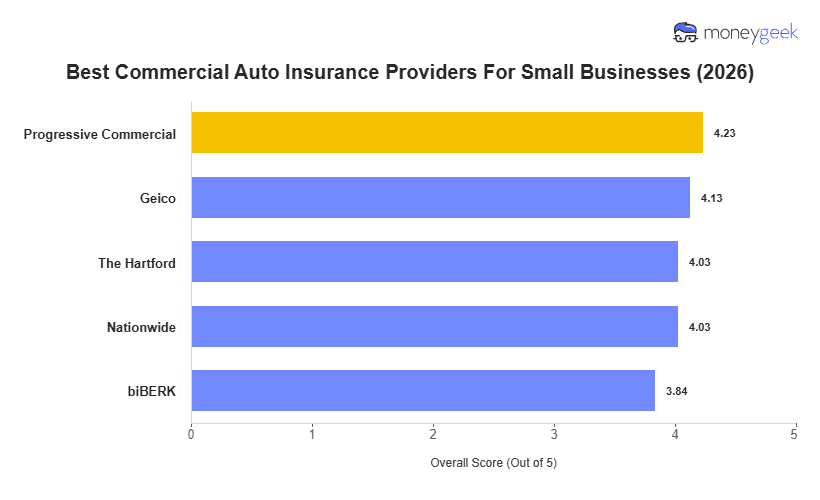
Progressive Commercial
4.23

Most affordable rates with the strongest customer experience to back it up along with the most up-to-date coverage for modern risks, discount incentives and digital experience on the market.

GEICO
4.13

Geico is a strong runner-up as a major competitor for first place, best suited to those in non-transportation heavy industries for the best value.

The Hartford
4.03

With the backing of over 200+ years of experience in insurance, The Hartford offers a great claims experience and broad inclusions coverage wise most insurers shy away from.

Nationwide
4.03

Particularly good value for those in the agricultural service industry with tailored coverage and the most experience in the work area, Nationwide has a good service experience and affordability, making them a balanced option to consider.

biBerk
3.84

Their fully digital buying experience suited to small businesses entering commercial coverage for the first time with easy-to-use interfaces for firms under 10 employees without hard to understand coverage terms.

For our commercial auto insurance ratings, we analyzed pricing, coverage options and customer experience across 5 providers, 385 industries, 8 vehicle types and all 51 states. Our analysis covers 92% of U.S. small businesses, with coverage levels personalized to vehicle type, industry and state to reflect the real cost conditions facing most business operators.

To build our ratings, we evaluated rate data across more than 700,000 business profiles and over 180,000 customer experience data points. We also performed anin-depth analysis of coverage contracts and endorsements across minimum, mid-level and high-level coverage tiers to compare insurers consistently. We then rated each provider across affordability (50% of overall score), customer experience (30%) and coverage options (20%) to produce an overall rating out of 5. For a detailed breakdown of our scoring methodology, see our full methodology.

92%

% of Small Businesses Covered

Over 700,000

Business Profiles Studied

Over 180,000

Customer Experiences Analyzed

Progressive

Progressive

Best Overall, Best For Transportation and Complex Logistics

Progressive Commercial is both the largest commercial auto insurer in the United States and our top pick. You'll enjoy the lowest rates across most vehicle types that are commercially focused, a unique telematics program for larger fleets, and the best customer support system designed for both simple and complex operations. While it is a great starting point, it may not be the ideal choice from a pure coverage perspective and has some restrictions for broad form coverage that larger transport operations may need.

Where Progressive Commercial performs best:

  • Most companies in complex and higher risk industries
  • Larger fleet operations wanting to have the highest discount opportunities
  • Vehicles focused on cargo, contracting work or frequent passenger transport

Where Progressive Commercial performs less competitively:

  • You need the deepest commercial auto coverage customization
  • You use mostly personal vehicles like sedans and SUVs

Learn More: Progressive Business Insurance Review

GEICO

GEICO

Best For Low-Risk Business Areas

GEICO ranks second overall in our commercial auto insurance analysis across all metrics, serving as the most balanced provider on our list. If your business is in consulting, financial services or marketing, GEICO is the cheapest provider in our study, with average monthly rates running 17% to 21% below the national average. Its coverage ranks third, adequate for most service-sector fleets that are in low-risk industries.

Where GEICO performs best:

  • You are in a low-risk business area like marketing, beauty (if offering mobile services), and finance.
  • Most affordable rates for sedans and SUVs involved primarily for business activities, not frequent passenger transport
  • Great service experience

Where GEICO performs less competitively:

  • You have HAZMAT or high-risk cargo (not able to be covered)
  • Passenger vehicles focused on frequent transport like taxis and limousines
  • Drivers needing coverage for tools and equipment and heavy machinery
The Hartford

The Hartford

Best for Coverage Depth
On The Hartford's site

The Hartford places third overall primarily due to its broad form coverage inclusions, extensive customization ability, and personalized service experiences available with their industry focused departments. While you'll have to speak on the phone with an agent, if you prefer a more personal touch and top-notch coverage, they are an ideal option.

Where The Hartford performs best:

  • Your business operates in a highly regulated industry (healthcare, financial services, construction)
  • You run a high-liability risk fleet with high-risk exposure needing broad coverage
  • Strong endorsement options and the ability to tailor coverage terms

Where The Hartford performs less competitively:

  • Overall affordability is lacking, ranking last on our list
  • Operators of lower-risk vehicles like sedans or SUVs in service industries
  • You're at an early stage and prioritizing cash flow over coverage depth

Learn More: The Hartford Business Insurance Review

Nationwide

Nationwide

Best for Coverage Value

With the second-highest coverage rating and mid-range pricing, Nationwide ranks fourth overall. It offers strong policy depth and endorsement flexibility at a more accessible price point. Nationwide is best suited for businesses that prioritize coverage breadth over service speed and high-tech buying and policy management experiences.

Where Nationwide performs best:

  • Businesses that need strong coverage depth at a lower price point
  • Fleets requiring flexible liability sublimits and a wide endorsement selection
  • Operations that can manage a slower buying process in exchange for stronger policy terms
  • Businesses with stable fleets that make infrequent mid-term policy changes

Where Nationwide performs less competitively:

  • Businesses that expect frequent certificate requests, fleet adjustments or mid-term changes
  • Operators who need the fastest digital onboarding and self-service policy management tools

Learn More: Nationwide Commercial Auto Insurance Review

biBerk

biBerk

Best for Simple Coverage Needs

biBerk ranks fifth overall, delivering fast digital quotes and a simple buying process suited for single-vehicle or low-complexity fleets. It is the 2nd most expensive provider in our study and coverage ranks last, with limited endorsement availability, restricted hired and non-owned auto options and lack of included coverages. biBerk is best suited for businesses that need simple, fast coverage and don't require policy customization or complex claims coordination.

Where biBerk performs best:

  • Single-vehicle operators or very small fleets with standard coverage needs
  • Businesses that need fast digital quotes and same-day coverage without agent involvement
  • Low-complexity operations that are unlikely to file frequent claims
  • Operators comfortable managing their policy entirely through a digital platform

Where biBerk performs less competitively:

  • Businesses that need hired and non-owned auto coverage, which biBerk restricts or excludes
  • Fleets requiring endorsements, high liability sublimits or complex policy customization
  • Operations with high claims likelihood where post-purchase support depth matters

Learn More: biBerk Business Insurance Review

Best Commercial Auto Insurance by State

Commercial auto insurance options vary by state based on local regulations, litigation trends, and operating costs. Use our state guides to find the best providers for your business.

What Determines the Best Commercial Auto Insurance for You

The best commercial auto insurance isn't defined by a single factor. The most ideal providers balance affordability, customer experience and coverage across a wide range of fleets and industries. 

Three areas matter most when evaluating which insurer fits your business.

  • money2 icon

    Affordability Across Your Vehicle Type and Industry

    Commercial auto insurance pricing varies more by vehicle type than almost any other business coverage. The most affordable provider overall won't always be cheapest for your specific fleet. Providers that price competitively across vehicle types, industries and states offer more stability as your business grows.

  • insurance2 icon

    Coverage That Matches Your Fleet's Risks

    Take into account the following when comparing policy terms side by side when getting quotes and researching providers:

    • Liability limits offered: Especially if you are in a high-risk industry, looking for providers with a high enough liability coverage ceiling allows you to not have gaps for the most likely claim triggers.
    • Breadth of vehicles covered: Some providers cover a wide range including cars, semis, food trucks, snowplows, and service utility vehicles, while others may exclude specialty or heavy vehicles entirely.
    • Standard vs. endorsement coverage: One provider may include roadside assistance and rental reimbursement standard while another charges extra for both.
    • Hired & non-owned auto coverage: Whether employee-owned or rented vehicles used for business are covered varies significantly by carrier and policy.
    • Cargo & equipment protection: Some policies include tools and cargo coverage; others treat it as a separate inland marine policy entirely.
    • Exclusions & policy language: The fine print on what voids a claim (driver eligibility rules, vehicle use restrictions, geographic limits) differs meaningfully between carriers.
    • Deductible flexibility: Features like diminishing deductibles or waived deductibles on a total loss are carrier-specific and can have real financial impact at claim time.
    • Coverage for fleet growth: Some policies make it easy to add vehicles mid-term while others require policy rewrites, which creates gaps.
  • talk icon

    Customer Experience and Claims Support

    Look at how a provider handles claims specifically for commercial policies. not just their general consumer ratings. Key things to evaluate are how accessible their claims team is (24/7 vs. business hours only), whether they assign dedicated commercial adjusters or route you through a general call center, average claims resolution time, and whether you'll have a consistent and industry specialized agent or rep managing your account. NAIC complaint ratios are also a reliable unbiased benchmark to reference alongside any reviews.

How to Choose the Best Commercial Auto Insurance

Selecting the right commercial auto insurance policy requires more than comparing premiums. Follow these steps to make the most informed decision.

  1. 1
    Determine Your Coverage Requirements

    With your risk profile in hand, identify which coverage types your operations actually require beyond basic liability. For example:

    • Businesses transporting goods need cargo protection.
    • Financed or leased vehicles require collision and comprehensive coverage.
    • Operations relying on employee-owned vehicles need hired and non-owned auto coverage.

    Match coverage types to real operational needs rather than assumptions.

    Read More: Commercial Auto Insurance Requirements

  2. 2
    Define Your Risk Profile

    Start by documenting the full scope of your exposure. Catalog every vehicle in operation including owned, leased, and employee-owned vehicles used for business along with their primary use, how frequently they are on the road, and the driving records of everyone behind the wheel. This forms the foundation of every coverage and pricing decision that follows.

    Read More: How Much Commercial Auto Insurance Do I Need?

  3. 3
    Research Providers by Industry and Vehicle Type

    Not all carriers price every risk the same way. Some specialize in high-risk or heavy vehicle operations while others are better suited to standard light-commercial fleets. Identify which carriers have demonstrated expertise in your industry and vehicle category before comparing them on price.

  4. 4
    Evaluate Coverage Quality and Policy Terms

    Compare what each shortlisted provider actually includes, not just the premium. Review standard versus endorsement-only coverages, liability limit ceilings, exclusions that could void a claim, and how easily the policy accommodates fleet changes over time. Price means little if the policy does not respond when you need it to.

  5. 5
    Get Quotes to Confirm

    Compare business insurance quotes only after you have narrowed your options through research. A quote should validate whether a provider's pricing holds for your specific fleet, location, and coverage requirements rather than serve as the primary basis for deciding who to consider.

Best Commercial Auto Insurance: Bottom Line

Progressive Commercial is the best commercial auto insurance company for most businesses, but Geico and The Hartford are serviceable options that should be a part of your provider shortlist. While these are our recommendations, we encourage you to compare options on your own focusing on core areas of customer experience, coverage, and affordability in this order to avoid pricing bias. Narrow down what is most important to you and decide based on the value specific to your business's financial situation and actual needs based on risk and requirements.

Best Commercial Auto Insurance For Small Business Chart

About Mark Flores


Mark Flores, Business Insurance Writer, MoneyGeek

Mark Flores is a Business Insurance Content Writer at MoneyGeek, where he focuses on commercial auto, commercial property, cyber and specialty business insurance coverage. His work simplifies coverage terms, gives business owners a strong baseline for expected costs, and narrows down policies and providers tailored to your operation, regardless of complexity.

Before joining MoneyGeek’s business insurance team, Mark worked as a Senior Content Writer at Clutch.co, where he produced structured B2B reviews and provider analyses based on client interviews, company research and service evaluation. That experience shaped his approach to business insurance content, especially when comparing insurers, explaining coverage differences and translating complex policy features into practical guidance for small business owners.

Mark also spent nearly 4 years as a digital marketing specialist serving small-business clients across industries such as home services, manufacturing and education. That background gives him practical context for how businesses evaluate vendors, manage operational needs and make purchasing decisions.

At MoneyGeek, he applies this research and evaluation experience to build guides that help transportation sectors, those with complex property-related risks (such as hotels and retail stores), and those most at risk of a cyberattack get the coverage they need at a reasonable price.

Linkedin: https://www.linkedin.com/in/mark-jason-flores-7844634a/

Contact Email: mark.flores@moneygeek.com