
Top Picks: Best Commercial Auto Insurance Companies in Illinois

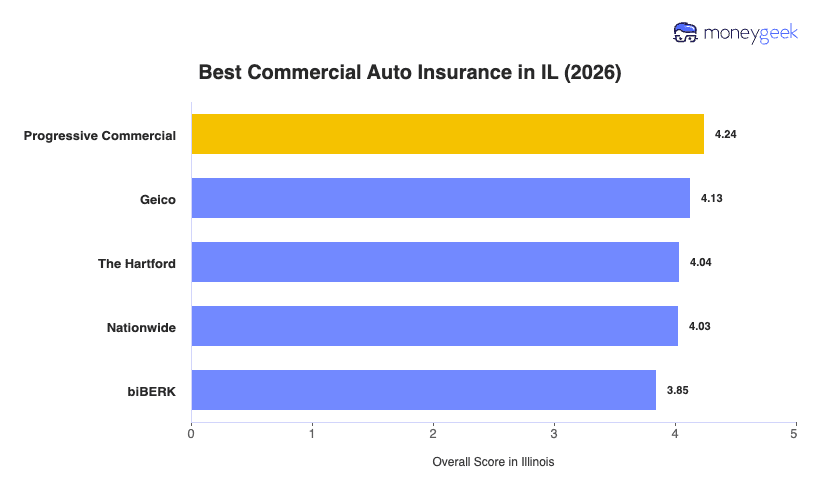
MoneyGeek evaluated Illinois commercial auto insurers on pricing across eight vehicle types and 25 industry categories, along with coverage breadth and flexibility, to identify the best commercial auto insurance options in the state. Rates and customer experience, from quoting through claims, varied widely across all five providers.

  1. Progressive Commercial: Best Overall, Best for Fleet Operations
  2. GEICO: Best for Low-Risk Business Areas
  3. The Hartford: Best for Coverage Depth
  4. Nationwide: Best for Agricultural and Specialty Fleets
  5. biBerk: Best for Simple Coverage Needs

The table below sets all five providers side by side so you can compare how each one scored across the analysis.

Progressive Commercial4.24114
Geico4.13223
The Hartford4.04521
Nationwide4.03352
biBERK3.85445

The write-ups below spell out who each provider fits best and who should look elsewhere, since the overall ranking matters far less than the match to your specific vehicle type, industry or operational need.

Progressive

Progressive

Best Overall, Best for Fleet Operations

Progressive Commercial built its commercial auto business around fleet operators and for-hire truckers, and that foundation shows in how it prices and services Illinois accounts. It ranks first across all eight vehicle types in Illinois, with its strongest rate advantages on limousines and taxis, where its rates run 31% below the Illinois average. Snapshot ProView, its fleet telematics program, goes beyond basic tracking, monitoring driver behavior, providing GPS and route history, and giving fleet managers a centralized dashboard they can use to identify high-risk drivers before a claim happens. Its rates in tech and IT run 37% above the Illinois average, making it a poor fit for that industry. Illinois owner-operators, delivery fleets and multi-vehicle contractors will get the most out of it.

Learn More: Progressive Business Insurance Review

GEICO

GEICO

Best for Low-Risk Business Areas

Backed by Berkshire Hathaway's A++ financial strength, GEICO brings a fully digital commercial auto experience to Illinois small and mid-size fleets, with one of the most streamlined online quote processes of any provider reviewed. Its clearest rate advantage in Illinois falls in professional services, where consulting businesses run 18% below the Illinois average, financial services 20% below and marketing and communications 27% below, making it the price leader in those three industries. DriveEasy Pro, its fleet telematics tool, pairs an OBD-II device with an optional dashcam and a real-time fleet dashboard, giving Illinois fleet managers GPS tracking, driver scoring and safety alerts without requiring broker involvement. Its specialty trucking depth is thinner than Progressive Commercial's, which limits its fit for Illinois heavy haulers and for-hire carriers. Illinois professional services firms, consulting businesses and light-commercial fleets that want full digital policy management are the strongest fit for GEICO.

The Hartford

The Hartford

Best for Coverage Depth
On The Hartford's site

With roots going back to 1810, The Hartford brings more than two centuries of commercial insurance experience to Illinois fleets, and its coverage ranking reflects that depth, ranking first for coverage options among all five Illinois providers across every vehicle type in the state. FleetAhead, its fleet risk management program, pairs telematics with dedicated risk engineering consultants who work directly with Illinois fleet managers to set loss-reduction targets and coach high-risk drivers based on actual data, not general guidance. Its rates run 22% above the Illinois average overall, making it the least affordable of the five providers, which puts it out of reach for Illinois businesses where price is the primary decision factor. Illinois mid-size fleets and established businesses that need the deepest coverage structure and the strongest claims support are the strongest fit for The Hartford.

Learn More: The Hartford Business Insurance Review

Nationwide

Nationwide

Best for Agricultural and Specialty Fleets

Nationwide built its commercial auto program around light-to-medium fleets and trade operations, and two structural advantages set it apart for those businesses in Illinois. Its upfitted vehicle coverage is stronger than most standard carriers, covering permanently installed equipment like lift gates, shelving systems and mounted service tools with clearer total loss valuation, which matters for Illinois plumbers, electricians and HVAC contractors whose upfitted work vehicles are worth considerably more than the base vehicle alone. Vantage 360 Fleet, its telematics program, adds driver scoring, route tracking and a rewards structure where drivers earn points for safe behavior redeemable for gift cards, giving Illinois fleet managers a practical engagement tool alongside the standard discount of up to 10% at renewal. Nationwide ranks last for customer experience among the five Illinois providers, and its online quote process requires agent involvement to complete rather than binding fully online. Illinois trade contractors, delivery fleets and agribusiness operations running light-to-medium vehicles are the strongest fit for Nationwide.

Learn More: Nationwide Commercial Auto Insurance Review

biBerk

biBerk

Best for Simple Coverage Needs

Founded in 2015 as part of the Berkshire Hathaway Insurance Group, biBerk was built so business owners can buy commercial auto insurance entirely online, without a broker, in under 10 minutes. A full policy can be purchased, and a certificate of insurance issued, before a comparable quote is even returned from other providers. Its strongest Illinois rate advantages are in low-exposure industries, where fitness services and beauty and wellness businesses price 27% and 26% below the Illinois average respectively, and agriculture and financial services come in 22% and 21% below. Its coverage ranks last among the five Illinois providers, and its automated underwriting system declines applications outside its eligibility rules without a manual review path, which cuts off Illinois businesses with complex fleets or prior claims before they can make a case. Illinois sole proprietors and small owner-operators in light-commercial, service and wellness industries who need coverage fast and want no broker involvement are the strongest fit for biBerk.

Learn More: biBerk Business Insurance Review

What Determines the Best Commercial Auto Insurance in Illinois for You

The best commercial auto insurance in Illinois isn't a single policy or a single provider. The right fit depends on what your business operates, what industry you're in and what your specific coverage needs look like. Three areas matter most when evaluating which insurer works for your Illinois operation.

  • money2 icon

    Affordability Across Your Vehicle Type and Industry

    Illinois commercial auto rates shift considerably by vehicle type and industry. Taxi and limousine operators see the widest pricing gaps between providers, up to 31% in MoneyGeek's Illinois analysis, while sedans and SUVs show tighter spreads. Illinois businesses in wholesale distribution, transportation and logistics and manufacturing tend to see the strongest savings from shopping around, so it's worth pinpointing the cheapest commercial auto providers in IL for your specific category. A statewide average rate tells you very little about what your specific fleet will cost.

  • insurance2 icon

    Coverage That Matches Your Fleet's Risks

    Illinois's commercial auto insurance requirements set minimum liability of $25,000 per person, $50,000 per occurrence and $20,000 in property damage for smaller commercial vehicles. Illinois commercial trucks over 8,000 lbs are subject to higher state mandates, and operations crossing state lines must meet FMCSA minimums, which start at $300,000 for non-hazardous freight and scale up based on cargo type and vehicle weight. Beyond the legal minimums, the coverage decisions that matter most for Illinois businesses include:

    • Liability limits: State minimums leave most Illinois operations underinsured. A single serious accident involving a commercial vehicle can produce liability claims well above $1 million.
    • Breadth of vehicles covered: Eligibility varies by carrier. Confirm that food trucks, limousines, upfitted work vehicles and specialty equipment are covered before binding.
    • Hired and non-owned auto: Illinois cleaning services, healthcare businesses and consulting firms where employees use personal vehicles for client work need this coverage confirmed on the commercial auto policy, not just the general liability policy.
    • Cargo and equipment: Illinois agriculture, wholesale distribution and food and beverage businesses should verify whether cargo coverage is included or requires a separate inland marine placement.
    • Standard vs. endorsement coverage: Roadside assistance, rental reimbursement and gap coverage are standard with some Illinois providers and cost extra with others.
    • Mid-term fleet changes: Adding vehicles during a policy period creates temporary coverage gaps with some carriers. Confirm how each provider handles mid-term additions before committing.
  • talk icon

    Customer Experience and Claims Support

    Illinois is an at-fault state, meaning the driver responsible for an accident is liable for the other party's injuries and damages through their bodily injury liability coverage. That makes claims handling quality a direct financial concern, not just a convenience factor. Check whether a provider assigns dedicated commercial adjusters or routes claims through a general call center, whether 24/7 claims reporting is available, and whether the policy management tools let you generate certificates of insurance without agent contact. NAIC complaint ratios provide an objective benchmark for comparing provider performance across the Illinois market.

How to Choose the Best Commercial Auto Insurance in IL

Choosing the right commercial auto insurance in Illinois takes more than pulling quotes from a few providers. Your vehicle type, industry and operational profile each narrow the field before price becomes the deciding factor. Here's how to work through the decision.

  1. 1
    Define Your Risk Profile

    Catalog every vehicle your business operates in Illinois, including owned, leased and employee-owned vehicles used for business, and note weight, primary use and annual mileage for each. An Illinois contractor running upfitted pickups across multiple job sites carries a different risk profile than a Chicago consulting firm using sedans for client meetings, and that difference shows up in pricing and carrier eligibility before you request a single quote.

  2. 2
    Determine Your Coverage Requirements

    Illinois sets minimum commercial auto liability at $25,000 per person, $50,000 per occurrence and $20,000 in property damage for smaller commercial vehicles, with higher mandates for trucks over 8,000 lbs. If your operation crosses state lines, FMCSA minimums apply separately, starting at $300,000 for non-hazardous freight and rising with vehicle weight and cargo type. Beyond the legal floor, match coverage to what your operation actually does, remembering that financed or leased vehicles need collision and comprehensive coverage and that many Illinois operations need cargo or hired and non-owned auto confirmed explicitly. Confirm which coverage types your operations actually require before requesting quotes.

  3. 3
    Research Providers by Industry and Vehicle Type

    Illinois rate differences between providers are wide enough to make provider selection a real financial decision before you ever negotiate on price. Progressive Commercial leads on affordability across most Illinois vehicle types and industries, GEICO prices consulting, financial services and marketing operations more competitively, and The Hartford ranks first overall for tech and IT. Identify the providers with a clear advantage in your specific category before requesting quotes.

  4. 4
    Evaluate Coverage Quality and Policy Terms

    Two Illinois providers may quote similar premiums while offering materially different coverage, so check what is standard versus endorsement-only, what liability limits are available above Illinois minimums and what exclusions apply to your vehicle type or business use. Illinois is an at-fault state with no PIP requirement, so your bodily injury liability coverage is the primary financial protection for third-party injury claims. Also confirm how each provider handles mid-term vehicle additions, since some Illinois carriers require policy rewrites that create temporary gaps when fleet size changes.

  5. 5
    Get Quotes to Confirm

    Request commercial auto quotes only after completing steps one through four. An Illinois limousine or taxi operator can see rate differences of up to 31% between providers in this analysis, while a sedan operator will see much narrower spreads. Quotes confirm whether the pricing holds for your specific fleet, drivers and coverage requirements, so compare policy terms alongside the premium before deciding.

  6. 6
    Confirm Illinois Filing Requirements

    Illinois businesses operating commercial motor vehicles over 10,001 lbs in interstate commerce must obtain a USDOT Number and file a Form MCS-90 endorsement with the FMCSA. For-hire passenger carriers transporting 6 to 15 passengers must carry $1,500,000 in liability, and carriers with 16 or more passengers need $5,000,000. Not every provider processes these filings automatically at policy inception, so confirm filing timelines with your carrier before purchasing, particularly if your Illinois operation requires active FMCSA authority to operate.

Best Commercial Auto Insurance in Illinois: Bottom Line

Three questions narrow the commercial auto decision faster than any rate comparison. What vehicles does your business operate in Illinois, what industry are you in, and what would a serious at-fault accident cost your business if your liability limits came up short? Your answers point toward a short list of providers before a single quote is requested, because pricing and coverage depth in Illinois vary more by vehicle type and industry than most businesses expect going in.

Not every provider is built for every operation, and the least expensive policy isn't always the strongest financial decision if it leaves gaps your Illinois business would actually feel at claim time. Think about whether your operation needs a fully digital, self-service experience or a carrier with agent-supported guidance and dedicated commercial claims handling, since that distinction shapes which providers are worth your time. From there, getting two or three quotes confirms whether the right fit on paper holds up for your specific fleet, drivers and coverage requirements in Illinois.

Best Commercial Auto Insurance in IL Chart
mglogo icon
LOOKING FOR THE BEST INSURERS FOR OTHER COVERAGE TYPES?

Commercial auto insurance is only one piece of your best Illinois business insurance bundle, and you'll likely need more coverage to satisfy requirements and protect your company financially. Below, explore more state-specific guides to top insurers for other commonly needed business insurance types.

How We Built These Best Commercial Auto Insurer Rankings

Our Illinois commercial auto rankings come down to three things: what businesses in Illinois actually pay for coverage, what happens when they need support and whether the policy holds up when a claim is filed. Five providers made the cut for our Illinois analysis: Progressive Commercial, GEICO, The Hartford, Nationwide and biBerk. Each was rated across affordability (50%), customer experience (30%) and coverage options (20%). Affordability carries the most weight because price is where most Illinois businesses start the search, even though it is rarely where the decision should end. For a full breakdown, see our methodology.

About Mark Flores


Mark Flores, Business Insurance Writer, MoneyGeek

Mark Flores is a Business Insurance Content Writer at MoneyGeek, where he focuses on commercial auto, commercial property, cyber and specialty business insurance coverage. His work simplifies coverage terms, gives business owners a strong baseline for expected costs, and narrows down policies and providers tailored to your operation, regardless of complexity.

Before joining MoneyGeek’s business insurance team, Mark worked as a Senior Content Writer at Clutch.co, where he produced structured B2B reviews and provider analyses based on client interviews, company research and service evaluation. That experience shaped his approach to business insurance content, especially when comparing insurers, explaining coverage differences and translating complex policy features into practical guidance for small business owners.

Mark also spent nearly 4 years as a digital marketing specialist serving small-business clients across industries such as home services, manufacturing and education. That background gives him practical context for how businesses evaluate vendors, manage operational needs and make purchasing decisions.

At MoneyGeek, he applies this research and evaluation experience to build guides that help transportation sectors, those with complex property-related risks (such as hotels and retail stores), and those most at risk of a cyberattack get the coverage they need at a reasonable price.

Linkedin: https://www.linkedin.com/in/mark-jason-flores-7844634a/

Contact Email: mark.flores@moneygeek.com