




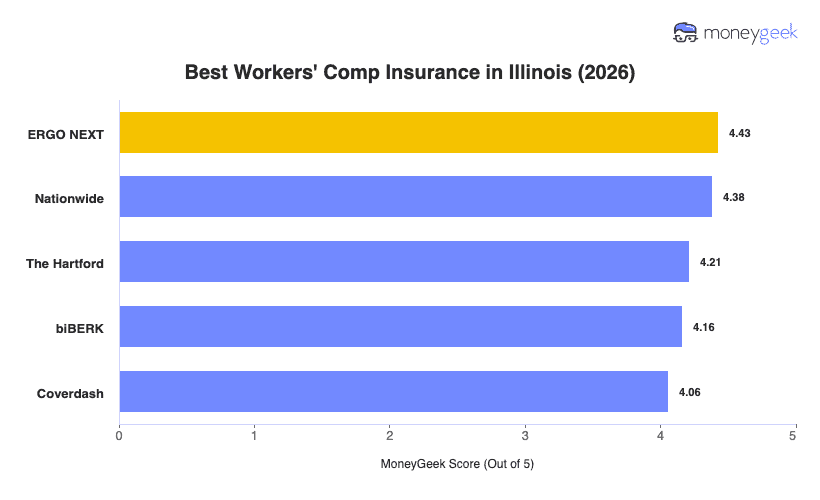
ERGO NEXT is the best workers' comp insurance provider in Illinois, with premiums that are around 23% lower than the state average. You'll save $33 each month per employee or $395 per year per employee. That's a considerable amount if you're in a higher-risk industry, where workers' comp tend to be more expensive. ERGO NEXT also makes buying and managing coverage more convenient. You can get quoted and covered in around 10 minutes and, after purchase, you can make changes to your policy 24/7 using its app.
Best Workers' Comp Insurance in Illinois (2026)
With rates as low as $11 per month, ERGO NEXT, Nationwide and The Hartford are the cheapest and best workers' comp insurance in Illinois.
Get matched to top Illinois workers' comp insurance providers and find your ideal coverage using our tool below.
Select state
Updated: August 27, 2026
Advertising & Editorial Disclosure
Best Workers' Comp Insurance Companies in Illinois
| ERGO NEXT | 4.43 | $110 | 1 | 6 |
| Nationwide | 4.38 | $109 | 6 | 5 |
| The Hartford | 4.21 | $141 | 3 | 3 |
| biBERK | 4.16 | $127 | 8 | 8 |
| Coverdash | 4.06 | $147 | 5 | 1 |
MoneyGeek analyzed workers' comp insurance rates and provider performance across Illinois using small business profiles with one to four employees spanning 408 major industries. Companies earn up to five points in each category in our scoring system. We then use a weighted average of these category scores to calculate a MoneyGeek score out of five.
- Affordability (55%): Based on average payroll for the most common employee code per industry and state classification, priced per employee for a one to four employee business.
- Customer Experience (35%): Evaluates buying (20%), which covers quote access, pricing accuracy and sales support; policy management (30%), which covers payroll reporting, audits, billing and loss control; and claims (50%), which covers FNOL speed, adjuster support, medical access, wage replacement and dispute handling.
- Coverage Options (10%): Assesses coverage completeness (35%), including employers' liability and wage and medical reimbursement; policy flexibility and endorsements (25%); eligibility, state and industry breadth (20%); and policy terms, limits and exclusions (20%).

ERGO NEXT
Best Workers' Comp Insurance in Illinois
MoneyGeek Rating
4.4/ 5
4.8/5Affordability
4.1/5Customer Experience
4.1/5Coverage
Average Monthly Cost
$110Claims Processing Score
4/5Policy Management Score
4.1/5Buying Process Score
4.4/5

Nationwide
Best Illinois Workers' Comp Insurance: Runner-Up
MoneyGeek Rating
4.4/ 5
4.8/5Affordability
3.9/5Customer Experience
4.2/5Coverage
Average Monthly Cost
$109Claims Processing Score
4/5Policy Management Score
3.9/5Buying Process Score
3.8/5
Cheapest Workers' Comp Insurance in Illinois
ERGO NEXT is the most affordable insurance company for workers' comp in 15 of 27 industries, especially in physical-labor categories from agriculture to repair and maintenance. The Hartford counters that by leading in nine white-collar and service categories, including financial services ($11 a month), consulting ($20 a month) and real estate ($21 a month). biBerk claims the remaining three industries in our analysis, including childcare, fitness and wholesale distribution.
Transportation and logistics is the most expensive industry for workers' comp insurance in Illinois, averaging $335 per month. That's more than construction's $264 average rate and more than 20 times what financial services costs at $11. That spread reflects how differently Illinois carriers price physical risk versus desk-based work.
| Agriculture & Natural Resources | ERGO NEXT | $181 | $2,172 |
| Arts, Media & Entertainment | ERGO NEXT | $106 | $1,272 |
| Beauty, Body & Wellness Services | ERGO NEXT | $14 | $168 |
| Childcare Services | biBERK | $40 | $480 |
| Cleaning Services | ERGO NEXT | $127 | $1,524 |
| Construction & Contracting | ERGO NEXT | $264 | $3,168 |
| Consulting Services | The Hartford | $20 | $240 |
| Education | ERGO NEXT | $75 | $900 |
| Financial Services | The Hartford | $11 | $132 |
| Fitness Services | biBERK | $74 | $888 |
| Food & Beverage | ERGO NEXT | $47 | $564 |
| Healthcare & Medical | The Hartford | $51 | $612 |
| Hospitality, Travel & Tourism | The Hartford | $49 | $588 |
| Manufacturing | ERGO NEXT | $167 | $2,004 |
| Marketing & Communications | ERGO NEXT | $15 | $180 |
| Nonprofit & Associations | ERGO NEXT | $67 | $804 |
| Other Professional Services | The Hartford | $24 | $288 |
| Pet Care Services | biBERK | $72 | $864 |
| Real Estate & Property Services | The Hartford | $21 | $252 |
| Recreation & Sports | ERGO NEXT | $124 | $1,488 |
| Repair & Maintenance | ERGO NEXT | $84 | $1,008 |
| Retail & Product Rental | The Hartford | $61 | $732 |
| Tech/IT | The Hartford | $39 | $468 |
| Transportation & Logistics | ERGO NEXT | $335 | $4,020 |
| Wholesale & Distribution | biBERK | $213 | $2,556 |
How to Get the Best Workers' Comp Insurance in Illinois
Use this guide when you're ready to get workers' compensation insurance. The steps I've detailed tells you what you need to check before, during and after you get quotes from different insurance providers.
- 1
Confirm Illinois Coverage Requirements
In Illinois, workers’ comp requirements apply as soon as you hire one employee, including someone working part time. Coverage begins on that employee’s first day. If you’re a sole proprietor, partner, corporate officer or LLC member, you may exclude yourself, but you’ll need to notify your insurer in writing.
- 2
Identify Your NCCI Class Codes
Illinois uses NCCI class codes to connect your business activities with an expected level of injury risk. Describe your operations accurately instead of assigning codes based only on employee titles. This distinction matters if, for example, your office staff work separately from the hazards of a construction site or production floor.
- 3
Document Payroll, Owner Elections and Claims History
Tell each insurer which owners have elected coverage and which have formally opted out under Illinois law. Then provide your estimated payroll under the correct class codes. Include loss runs, which are reports from your previous insurer showing earlier claims and how much they cost.
- 4
Compare Quotes From Illinois Insurers
Two carriers can quote different prices for the same NCCI class code because Illinois operates a competitive market and requires insurers to file their own rates. Compare business insurance quotes and pay attention to the full premium calculation, not just the starting rate. If private insurers decline you, the Illinois assigned-risk plan provides another route to coverage.
- 5
Check How the Insurer Handles Medical Care
Illinois usually gives an injured employee two choices of medical provider. An insurer may also support an approved Preferred Provider Program (PPP), a workers’ comp medical network that counts as one of those choices. Check whether the network reaches your employees and how quickly the carrier reviews treatment requests.
- 6
Bind Coverage and Set Up Illinois Reporting
Once your policy starts, post the required notice showing your insurer and explaining employee rights. Keep a record of every workplace injury. If an employee misses more than three workdays, you or your insurer must report the accident electronically to the Illinois Workers’ Compensation Commission within one month.
- 7
Review the Audit and Confirm Renewal Coverage
Your insurer will compare your estimated payroll and class codes with what your business actually reported during the policy term. Review any audit adjustment before renewing, especially if your staffing or operations changed. After the renewal takes effect, confirm that your policy appears in Illinois’ employer coverage database.
Best Workers' Compensation Insurance in Illinois: Bottom Line
ERGO NEXT, Nationwide, and The Hartford are the strongest workers' comp insurance providers for most Illinois employers. The right choice depends on your industry, payroll size, and whether rate or coverage depth matters more to your business.

LEARN MORE ABOUT ILLINOIS BUSINESS INSURANCE
Including workers' comp in your Illinois business insurance bundle is usually a non-negotiable once you have employees. But beyond this, you'll likely need other coverages in your mix. I've prepared resources that recommends top providers for other coverage types below.
Illinois Workers' Compensation Insurance FAQ
ERGO NEXT is the best workers' compensation insurance provider in Illinois, based on MoneyGeek's analysis of pricing, customer experience and coverage options. Nationwide is the cheapest provider, with an average monthly rate of $109 per employee across all industries.
- Nationwide: $109 a month
- ERGO NEXT: $110 a month
- biBERK: $127 a month
- Thimble: $139 a month
- The Hartford: $141 a month
Illinois requires workers' comp coverage for employers with one or more employees. The Illinois Workers' Compensation Commission oversees compliance and enforcement across the state. Employers who fail to carry required coverage may face civil fines, stop-work orders, and personal liability for all injury costs.
The Illinois state average is $143 per employee per month, well above the $74 national average, but rates vary widely by industry. Workers' comp costs range from $17 a month for Financial Services employers to $437 a month for Transportation & Logistics.
Illinois operates a competitive private market with no state fund, so employers can get coverage directly from licensed carriers. Employers who cannot obtain voluntary market coverage can access the Illinois Workers' Compensation Assigned Risk Pool through NCCI as a fallback option.
Illinois workers' comp covers four main benefit categories:
- Medical expenses: Covers all necessary medical treatment for work-related injuries; the Illinois Workers' Compensation Commission administers the fee schedule.
- Wage loss benefits: Pays temporary total disability at 66⅔% of the employee's average weekly wage.
- Vocational rehabilitation: Provides retraining and placement services for workers unable to return to their pre-injury occupation.
- Death benefits: Pays burial expenses and compensation to qualifying dependents based on the deceased's average weekly wage.
About Angelique Palenzuela-Cruz

Angelique Palenzuela-Cruz is a Business Insurance Content Writer at MoneyGeek, where she specializes in general liability, workers’ compensation and professional liability insurance. Her work helps small business owners understand how these policies apply to coverage, including risks like customer injuries, employee injuries, professional mistakes, client contract terms and industry-specific coverage requirements.
She primarily covers service-based businesses where liability and employee coverage decisions are especially important, including cleaning, consulting, beauty and wellness, childcare, education, fitness, food service, pet care, repair and maintenance, and other professional services.
Before joining MoneyGeek, Angelique spent nearly 12 years at Guthrie-Jensen Consultants, one of Southeast Asia’s largest management training firms, where she advanced from Training Consultant to Managing Consultant. In that role, she worked with business clients to assess operational needs, develop training programs and present performance analyses to executive decision-makers. She also helped establish Gladwin Training Consultancy, where she served in learning solutions and client service roles.
Her background gives her practical context for writing about how businesses operate, manage client expectations, structure teams and make risk decisions. At MoneyGeek, she applies that experience to business insurance content, connecting coverage to actual business needs.
LinkedIn: linkedin.com/in/ma-angela-cruz
Email Contact: angelique.palenzuela@moneygeek.com