



Jump to the section that meets your needs best below:
Average Electrical Business Insurance Cost (2026 Report)
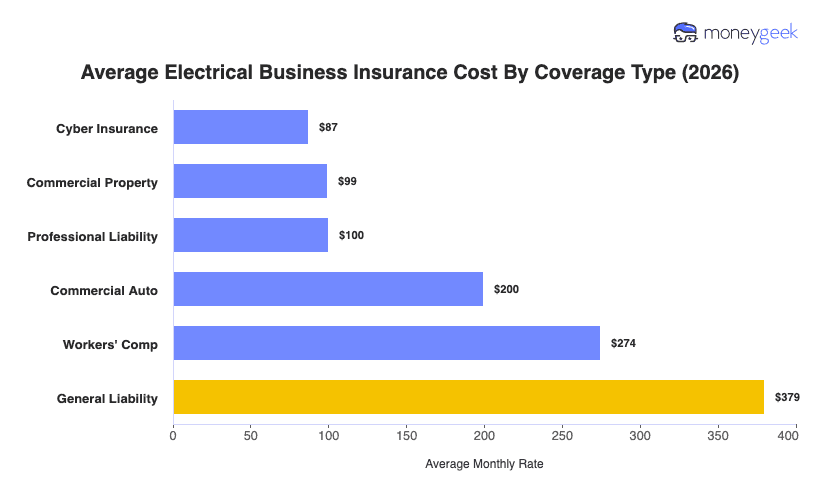
A recommended bundle for electrical contractors costs an average of $606 per month, and includes general liability, tools and equipment and commercial auto. Monthly estimates for individual coverages range from $9 and $379 on average and the ideal policy mix depends on factors like the work you do, your clients and whether you have a crew.
If you're ready to get a quote, use the tool below to get matched with the best business insurance provider for your electrical contracting operations.
Select state
Updated: September 11, 2026
Advertising & Editorial Disclosure
How Much Does Electrical Contractor Insurance Cost?
The monthly cost for electrical contractor insurance ranges from an average of $579 on average for a starting bundle to $1,258 for a bundle for expanded operations. The bundle your operations need depends on your services and business size. The more complex your business becomes, the more coverages you'll likely need, which affect your total cost. For example, you'll need professional liability only if design electrical systems your clients, and cyber insurance if you accept digital or online payments and store customer information electronically.
The bundle costs use national averages, so don't expect the exact figure when you request quotes. I've put the table below so you can see which one fits your business best:
Starting Bundle | General liability, commercial auto | $579 | $6,948 | Solo electricians or start up electrical operations using a business-owned vehicle |
Recommended Bundle | General liability, commercial auto, tools and equipment | $606 | $7,272 | Independent electricians with higher-value tools |
Growing Business Bundle | General liability, commercial auto, tools and equipment, workers' compensation | $881 | $10,565 | Electrical contractors with employees or apprentices |
Expanded Operations Bundle | General liability, commercial auto, tools and equipment, workers' compensation, commercial property, umbrella liability, professional liability, cyber liability | $1,258 | $15,101 | Established electrical contractors with larger operations |
To estimate electrical contractor insurance costs, we modeled premiums using quotes from 10 major U.S. commercial insurance providers. The profiles reflect how electrical businesses commonly operate, from solo electricians doing service work to contractors with employees, apprentices, work vehicles, tools and job-site exposure.
The figures are modeled estimates, not live quotes. We used the data to create three cost views:
- National benchmark average: This gives readers a broad cost reference for electrical contractor insurance. It is based on standardized electrical contractor profiles with one to four employees, industry-recommended policy limits and modeled premiums from all 50 states and Washington, D.C.
- State averages: We compared the same base electrical contractor profile across every state and Washington, D.C. Keeping the business profile consistent helps isolate the effect of location, instead of mixing state differences with changes in crew size, job type, vehicle use, tools or project scope.
- Bundle averages: We built bundle costs from the modeled prices of individual policies and added external estimates for specialized coverages not included in our core dataset. The bundles reflect how coverage often builds as an electrical business grows: liability for job-site and completed-work claims, vehicles, tools, employees, stored property, larger contracts and design-related work.
Some coverages fall outside the modeled dataset because they depend on specific parts of an electrical business. Installation floaters may apply when materials are purchased or staged before installation. Surety bonds may be needed for licenses, permits, bids or contracts. Umbrella liability may matter when larger projects require higher limits, while tools and equipment coverage depends on the value of portable gear carried between jobs. For those coverages, we used external research to give readers a practical cost estimate when the coverage applies.
See our full business insurance methodology.
Get Electrical Contractor Business Insurance Cost Estimates
Use our business insurance cost calculator below for more personalized estimates. Once you have a figure, click on get quotes and MoneyGeek connects you to the insurers that matches your coverage needs. You can then request for quotes from their website.
Get Electrical Contractor Insurance Cost Estimates
Select your state and industry to view average business insurance premiums in your area. Rates are calculated based on a business with 5 employees and $500,000 in annual revenue.
Select Coverage Type
Select State
Select Employee Count
Select vehicle_type
Monthly Rate Estimate—
Select Coverage Type
Monthly Rate Estimate—
Select State
Select Employee Count
Select vehicle_type
Factors Affecting Electrical Contractor Insurance Costs
Electricians in the same state can pay different premiums if their work, job sites and crew setup create different levels of risk. These factors are most likely to affect your rate:
 Type of electrical jobs you take
Insurers look at how much damage a mistake could create, so electricians doing outlet repairs and fixture installs usually pays less because the work is limited to a smaller part of the electrical system. If you’re wiring new construction or replacing service panels, you’ll spend more in coverage since faulty work can damage larger systems or delay an entire project.
 Project size and contract value
A solo electrician handling small repair tickets pays less than a contractor taking a $75,000 commercial buildout since one electrical issue can lead to delays or contract disputes. A larger contract usually gives the insurer more to price for because it involves more materials, labor hours and coordination. It could also lead to bigger financial loss if the work has to be redone.
 Worksite environment
Some jobsites open you to exposure more than others. Residential service work is easier to insure because the job usually happens in one home, with fewer workers. But if you work in restaurants, factories or rooftops, expect a higher premium because an accident typically involves employees, customers, machinery, inventory or harder-to-access work areas.
 System complexity
If you usually install switches, outlets and light fixtures, coverage is more affordable. Even if you make mistakes, these are usually limited to a smaller part of the property. An electrical contractor working on generators, fire alarm systems, control panels or smart building controls see higher rates because errors can disrupt business operations or multiple connected components.
 Crew size and supervision setup
Insurance premiums increase when your business depends on more people to get the job done. If you’re licensed but work alone, your risk is mostly tied to your own electrical work, driving, tools and completed jobs. Once you hire apprentices or subcontractors and send them to different job sites, you aren’t there with them all the time. Insurers quote higher rates because they also have to account for employee or customer injuries, property damage and workmanship issues.
How to Lower Electrical Contractor Insurance Costs
Electricians pay higher premiums on average than almost half of the professions in our contractor study. More affordable business insurance rates involve applying methods that affect your rates within the same policy cycle and putting practices in place that lower your premiums in the long-term. I listed strategies that cover both timelines.
 Compare quotes using the same coverage limits
Make sure every quote uses the same information, including your revenue, payroll, job types, vehicles, tool values, coverage limits and deductibles. This keeps the comparison fair. A quote may look cheaper only because it uses lower limits, excludes a coverage you need or leaves out risks tied to your electrical work.
 Right-size your coverage
Match your coverage to the work you actually do. A solo electrician handling residential repairs may not need the same policy mix as a contractor wiring commercial buildouts, storing materials or offering design-build services. Removing coverage you do not need can lower costs, but don't let go of those tied to your core jobs.
 Bundle policies with the same provider
Most insurers offer a discount if you buy multiple policies from them. Bundling can also make your coverage easier to manage because you have one provider for certificates, renewals, billing and policy updates as your business changes.
 Lower your risk profile
Your insurance costs tend to increase as your business becomes more complex, but you don’t have to avoid larger jobs to keep your rates manageable. Instead, make higher-value work easier to insure. A contractor moving into commercial projects will still pay more than a solo residential electrician, but clean contracts, insured subcontractors and documented inspections can help prevent disputes and avoid claims that raise future premiums.
 Invest in risk management practices
Stronger safety and documentation habits can reduce claims. Over time, fewer losses can help your business look cleaner to insurers at renewal. Look at these safety measures for your operations:
- Keep permits, inspection records and change orders in one place so you can back up your work if a client questions the completed job.
- Use lockout/tagout before panel work or equipment repairs so your crew is less likely to face shock or burn injuries.
- Lock up testers and specialty tools between jobs to reduce theft from vans, trailers and job sites.
- Check your employees' work before closeout so mistakes are caught before the customer signs off.
Electrical Contractor Insurance Cost: Bottom Line
Our recommended electrical contractor insurance bundle costs an average of $606 per month. Treat that figure as a reference point, not a target, since your actual premium can change based on your job mix, crew size, location and coverage needs.
The questions below can help you put your electrical contractor insurance quote in context.
- Where do you fall in the distribution? Compare your quote with the benchmarks that match your trade, state and employee count. A solo residential electrician and a larger contractor with crews may sit in different parts of the range for valid reasons.
- Is your quote consistent with your risk profile? A quote far above or below the benchmarks deserves a closer look. The gap may reflect limits, exclusions, payroll assumptions, job types or missing coverages rather than a true price difference.
- Which cost drivers apply to your business? Not every factor carries the same weight. A service electrician may be shaped more by vehicles and tools, while a design-build contractor may see more pressure from professional liability and contract requirements.
It helps you see whether the policies inside the bundle match what your business actually needs, not just whether the rates are above or below the average. Use the benchmark to understand what's driving the total cost, which coverages belong in your bundle and whether the quote reflects the business being insured.
About Connor Bolton

Connor Bolton is Senior SEO and Content Manager at MoneyGeek, where he leads the business and pet insurance editorial teams. He sets the research framework, data standards and content structure for his team. All content goes through his accuracy review before publication. Connor also writes in-depth guides and has spent more than four years covering insurance products across personal, commercial and specialty lines.
The research infrastructure Connor built covers auto, home, renters, life, health, business and pet insurance across pricing analysis, carrier research, customer experience and coverage evaluation. It includes over 6 million data points for business insurance across 408 industry areas, all 50 states and 16 vehicle types. The pet insurance side covers over 5 million profiles across 18 major providers, 100+ breeds and ages up to 20 years. Connor’s insurance research and his team's work have been cited by the U.S. Chamber of Commerce, Allstate, Liberty Mutual, CBS News, Forbes and LegalZoom.
Connor also talks with underwriters and carrier liaisons at Ethos, The Hartford, ERGO NEXT, Nationwide and State Farm, and monitors business and pet owner communities on Reddit. Those sources shape how his team evaluates carriers, structures rate analysis and writes content for real pet owners.
Questions about MoneyGeek's business or pet insurance content? Reach him at connor@moneygeek.com or on LinkedIn.