
Key Takeaways
blueCheck icon

ERGO NEXT, Thimble and The Hartford are the best electrical business insurers, with the best balance of pricing, coverage breadth and service quality. (Jump to Top Providers)

blueCheck icon

ERGO NEXT is the most affordable option for electrical contractors, averaging $147 per month, which is 24% below industry average and saves you about $45 every month. (Jump to Cheapest Providers)

blueCheck icon

General liability, workers' comp and commercial auto are the coverages most electrical contractors need, so if you work commercial jobs or subcontract for GCs, all three are typically required before work begins. (Jump to Types You Need)

blueCheck icon

Electrical contractor insurance costs vary widely by coverage type, ranging from $87 to $379 per month depending on what your business needs. (Jump to Costs)

blueCheck icon

Choosing the best electrical contractor insurance means matching coverage to your business size, your client requirements and the type of electrical work you do, not just buying the cheapest policy available. (Jump to How to Choose)

Best Electrical Business Insurance Companies

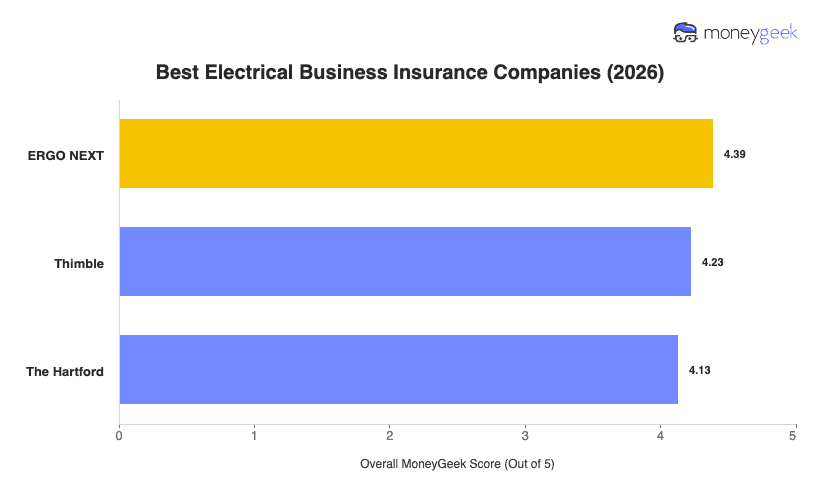
ERGO NEXT and Thimble top our rankings for best electrical business insurance. ERGO NEXT leads on affordability and customer experience, since you can get covered in under 10 minutes, pull a COI from your phone and manage your policy without calling an agent. Thimble follows closely on affordability with a structure that suits contractors whose project mix shifts throughout the year. We found that on-demand proof of insurance matters as much as price when jobs run on tight timelines.

See how all seven providers compare in the table below.

ERGO NEXT4.39113
Thimble4.23256
The Hartford4.13731
biBERK4.01475
Hiscox3.95327
Nationwide3.92562
Progressive Commercial3.88644

For our overall best electrical business insurance ratings, we analyzed pricing, coverage options, and customer experience across all 50 states and Washington, D.C. Our analysis focuses on 1-to-4-person electrical businesses, while weighting results to ensure broader industry and location representation. To do this, we evaluated over six million business profiles, more than 100,000 customer experience data points and performed in-depth analysis of coverage contracts and endorsements to compare insurers consistently across industries and regions. We then rated each company across categories of affordability (50% of overall score), customer experience (30% of overall score) and coverage options and terms (20% of overall score) to form an overall rating.

See our full business insurance methodology.

These rankings are a starting point, since the provider that's best for your business depends on how you work. An electrician handling residential service calls and panel upgrades, where getting covered fast and producing a COI on the spot is a real daily need, will find ERGO NEXT's instant digital experience a natural fit. A contractor with seasonal commercial work, project-by-project engagements or jobs that start and stop throughout the year, may find Thimble's flexible coverage structure a better match for how the work actually flows.

Each provider breakdown below identifies the electrical contractor profiles each carrier fits and the ones it doesn't.

ERGO NEXT

ERGO NEXT

Best Overall for Electrical Businesses
On ERGO NEXT's site

ERGO NEXT tops our rankings for electrical contractors, driven by the strongest combination of affordability and policy management in our study. Electrical businesses save an average of 24%, or around $45 per month, compared to the sub-industry benchmark. Munich Re's backing adds financial stability to a fully self-service platform. GL and workers' comp coverage depth rank in the bottom half of providers. Contractors doing design-build or specialty electrical scopes should verify coverage fits before buying.

Learn More: ERGO NEXT Business Insurance Review

Thimble

Thimble

Best for On-Demand Coverage for Electricians

Among the providers in our study, Thimble is the only one that lets you buy coverage by the job, by the month or by the year. Electrical businesses save an average of 17%, or around $33 per month, compared to the sub-industry benchmark. When you add a certificate holder, the blanket additional insured and waiver of subrogation endorsement generates automatically behind the COI, with no extra steps and no added cost. Professional liability, inland marine and cyber are not available for electrical work. Claims run through third-party administrators with no in-house team.

Learn More: Thimble Business Insurance Review

Cheapest Electrical Business Insurance

ERGO NEXT, Thimble and Hiscox are your best options for cheap electrical business insurance, with ERGO NEXT giving the most saving of 24%, or $45 per month. We've found that the lowest rate doesn't always mean the best fit, since a policy that can't meet your GC subcontract's coverage limits or additional insured requirements costs you the job regardless of what it costs per month.The right choice balances a rate you can sustain with coverage that holds up when a claim arrives.

See how all seven providers stack up on cost below.

ERGO NEXT$147$1,758
Thimble$159$1,905
Hiscox$193$2,322
biBERK$194$2,328
Nationwide$199$2,382
Progressive Commercial$199$2,383
The Hartford$207$2,485

What Types of Insurance Do Electrical Businesses Need?

Electrical work creates liability exposure that doesn't end when the job does as it starts from the moment your crew arrives on site to years after your completed wiring is inside a client's walls. That exposure range is why most electrical businesses carry more than one coverage type, with the right mix depending on how you operate.

The core coverage types for electrical contractors are:

  • General liability (since every job puts you on someone else's property, where a third-party injury or property damage claim can follow any visit)
  • Workers' comp (if you have employees, since electrical work ranks among the highest trades for electrocution and fall injuries)
  • Commercial auto (since your vehicle moves tools, materials and crew between jobs daily)
  • Commercial property (if you run a shop or warehouse where you store equipment or materials)
  • Professional liability (if you provide design-build work or system specifications where a planning error produces a separate claim from the physical installation)
  • Cyber insurance (if you store client project data or manage permits and job documentation digitally)

We've found that no two electrical businesses carry the same coverage stack. If you don't have employees and work on residential service calls, you have narrower exposure than a firm running commercial jobs with a crew and company vehicles. The profiles below show what coverage typically looks like at different stages.

How Much Does Electrical Business Insurance Cost?

Electrical contractor business insurance averages $190 per month, or $2,279 per year, with general liability costing the most because electrical work carries a completed-operations tail. A wiring defect can surface months after the job is done, and the claim still names your policy. Workers' comp follows, driven by the electrocution and fall injury rates that put electricians in elevated NCCI classification codes.

General liability is where most electrical businesses start, because GC subcontracts and commercial clients require proof before work begins. A solo electrician carrying only general liability pays around $379 per month, or $4,553 per year. Add workers' comp and commercial auto for your firm running crews and company vehicles, and the total runs roughly $853 per month, or $10,241 per year. We find coverage decisions at each stage shape your cost more than any single factor.

The coverage type averages for your electrical business are as follows:

How did we determine business insurance rates for electical contractors?

What your electrical business pays depends on more than coverage type alone. The work you do carries the most weight: residential service calls, commercial new construction and industrial high-voltage work each price differently. Your payroll and crew size drive workers' comp cost directly, since electrician classification codes are rated per dollar of payroll. Contract GL requirements set a floor on what you need to carry. Our electrical business insurance calculator builds a more personalized estimate from your actual operation.

Estimate Your Monthly Electrical Insurance Cost

Enter your coverage type, state, number of employees and type of vehicle (if you need commercial auto coverage) to get a pricing estimate that fits your business.

We do not collect any personal information, and all rates are aggregated for all 50 states and Washington D.C. Workers' comp rate estimates are provided on a per employee basis and all coverage types assume standard industry limit recommendations for most businesses.

Select Coverage Type
Select State
Select Employee Cand
Select Vehicle Type
Average Monthly Cost—

How to Choose the Right Electrical Business Insurance

Getting business insurance for your electrical business starts with how your work creates risk and ends with coverage that holds up when a claim arrives. We find electrical contractors most often encounter coverage gaps after purchase because their policy didn't match what their contracts actually required.

These five steps will help you build a coverage approach that fits your electrical business.

  1. 1
    Understand your risk profile and what coverage it requires

    Your electrical work creates exposure at every stage. Your crew is on a client's property from day one, and your liability for completed work can follow you for years. Workers' comp is legally required the moment you hire, general liability is contractually required on most GC subcontracts, and commercial auto and tools are practically essential once you're running a vehicle between jobs. Understanding which combination applies to your operation is where coverage decisions start.

  2. 2
    Choose the right coverage limits

    Your contract sets a floor on coverage, not a ceiling on what a claim can cost. A completed-operations claim from an electrical fire in a commercial building can involve structural damage, equipment loss and business interruption for your client, and the total can reach well beyond a standard $1 million per occurrence limit. Choose limits based on your project scale and who you're working for, not just what your current contract requires.

  3. 3
    Evaluate providers who understand electrical businesses

    Look for carriers with genuine appetite for electrical contractor work, fast turnaround when you need a COI and claims handling built for completed-operations losses, which often surface long after a policy term ends. Not every insurer is structured to handle that kind of long-tail claim, and a carrier that's slow to respond on a completed-ops loss can cost your business more than it saves on premium.

  4. 4
    Get compliance-ready

    Once your policy is in place, your compliance work isn't done. In most states, you'll need a valid electrical contractor license and a separate license bond before you can legally operate. Your GC subcontracts will also require you to name the general contractor as an additional insured and provide a COI before work starts. Keep your COI current, verify your bond meets your state's requirement and confirm your license is active before any job begins.

  5. 5
    Revisit your coverage as your electrical business grows

    Your coverage needs change as your business does. Your first hire creates a workers' comp requirement, and your first company vehicle means your personal auto policy no longer applies. As your work expands into GC subcontracts or commercial and industrial projects, your required GL limits, classification codes and premium all shift with it. Review your coverage annually and before you move into any new contract category or type of work.

Get Electrical Business Insurance Quotes

Which carrier fits your electrical business best depends on how you operate, not just what coverage you carry. If you're a solo electrician running residential service calls, your carrier needs look nothing like those of a commercial firm managing crews, vehicles and GC subcontracts that require umbrella limits and additional insured status. Request business insurance quotes and get matched to providers suited to your coverage stack, your contracts and your budget.

About Connor Bolton


Connor Bolton, Senior SEO and Content Manager (Business & Pet), MoneyGeek

Connor Bolton is Senior SEO and Content Manager at MoneyGeek, where he leads the business and pet insurance editorial teams. He sets the research framework, data standards and content structure for his team. All content goes through his accuracy review before publication. Connor also writes in-depth guides and has spent more than four years covering insurance products across personal, commercial and specialty lines.

The research infrastructure Connor built covers auto, home, renters, life, health, business and pet insurance across pricing analysis, carrier research, customer experience and coverage evaluation. It includes over 6 million data points for business insurance across 408 industry areas, all 50 states and 16 vehicle types. The pet insurance side covers over 5 million profiles across 18 major providers, 100+ breeds and ages up to 20 years. Connor’s insurance research and his team's work has been cited by the U.S. Chamber of Commerce, Allstate, Liberty Mutual, CBS News, Forbes and LegalZoom.

Connor also talks with underwriters and carrier liaisons at Ethos, The Hartford, ERGO NEXT, Nationwide and State Farm, and monitors business and pet owner communities on Reddit. Those sources shape how his team evaluates carriers, structures rate analysis and writes for human buyers rather than search engines.

For questions about MoneyGeek's business and pet insurance content, contact him at connor@moneygeek.com or on LinkedIn.