
How Much Does General Liability Insurance Cost in Montana?

The average cost of general liability insurance in Montana is approximately $95 monthly, or $1,139 annually, for businesses with one to four employees. This sits about 23% below the national average, placing Montana among the five most affordable states for this coverage.

Among Mountain West states, Montana anchors the low end of a $51 monthly spread that runs up to $146 in Colorado. Idaho ($97), North Dakota ($96) and New Mexico ($102) cluster near Montana, while Wyoming ($106) and Utah ($110) sit mid-range. Only Nevada ($131) and Colorado exceed the national average. This pattern likely reflects differences in litigation environment, population density and commercial claim frequency, with Montana's lower claim activity helping explain its position at the affordable end of the region.

If your quote falls near the state average, you're tracking with typical Montana pricing. A quote well above that range raises a question: which factors, such as industry classification, coverage limits or claims history, are driving the difference? The Montana general liability insurance cost calculator below provides an estimate based on your specific business inputs.

To estimate average general liability insurance costs in Montana, we analyzed quote data from major U.S. small business insurance providers and modeled standardized premium estimates across common business profiles. These modeled results are designed to provide a consistent state benchmark and show how premiums vary by key baseline factors including business size, industry and location within Montana.

Dataset Scope and Assumptions

Our cost modeling uses standardized inputs for consistent comparisons across Montana businesses.

  • Providers analyzed: 10 major insurance providers
  • Industries covered: 25 general industry categories relevant to Montana's business market
  • Employee count bands: zero, one to four, five to nine, 10 to 19 and 20 to 49 employees
  • Policy baseline: standard general liability policy with $1 million per occurrence / $2 million aggregate limits
  • Total estimates modeled: over 20,000 standardized pricing estimates across Montana industry and employee count combinations

We also incorporated modeled average revenue and payroll personalized across all combinations of Montana regions, industry and employee counts to improve the accuracy of pricing. To model these assumptions against our cost factors, we used data from these sources:

  • CBP (for employee size class density in Montana by NAICS)
  • QCEW (for wage/payroll intensity by industry in Montana)
  • Economic Census / SUSB (for receipts/output intensity by industry)
  • Calibrated against:
    • Private comp databases
    • IRS SOI totals

How We Calculated Average General Liability Costs in Montana

Our published averages represent modeled premiums for standardized business profiles and were aggregated in two ways:

  • Montana state average: The Montana average cost reflects the modeled premium for a standardized one to four-employee small business across all industries included in our dataset for a standard general liability policy.
  • Segment averages: To show how costs vary within Montana, we calculated average modeled premiums for our state base profile and isolated for variables, including:
    • Employee count (business size ranges)
    • General industry categories

Segment averages were produced by aggregating modeled pricing trends across the full dataset so readers can compare how premiums shift across business types and regions within Montana.

Read our full business insurance methodology.

Business Insurance Rates by State and Industry

Select your general industry and employee count for a personalized general liability insurance cost estimate for your Montana business. Estimates are based for a $1 million per occurrence and $2 million aggregate policy.

Select Industry
Select Employee Count
Average Monthly Rate

What Factors Affect General Liability Insurance Costs in Montana?

General liability coverage in Montana scales with employee count. Solo operators pay about 44% below the state average, while businesses with 20 to 49 employees see costs climb more than 1,600% higher. Insurers price headcount as exposure: more employees mean more potential liability events.

Industry classification creates a wider spread. Tech and IT businesses pay around 74% below typical general liability rates in Montana, tied to lower physical risk and fewer on-site client interactions. Construction and contracting companies run 149% above average due to higher injury frequency and property damage exposure on job sites.

Beyond these universal pricing drivers, Montana's regulatory environment and local market conditions also shape what businesses pay:

    driverLicense icon
    Montana's Decentralized Insurance Requirements

    Montana has no statewide general liability mandate for most businesses. The Montana Board of Plumbers requires licensed plumbers to carry $300,000 per occurrence for property damage, making it one of the few state-level coverage requirements. Cities and counties set their own rules for contractors, and businesses operating across multiple jurisdictions may need policies that meet the highest local threshold, increasing premium costs.

    fire icon
    Montana's Wildfire Exposure

    The state ranks second nationally for the percentage of homes at risk of catastrophic wildfire damage, behind only Wyoming. Seasonal hailstorms and high animal-vehicle collision rates add to property damage and injury exposure. Insurers price these environmental hazards into general liability premiums, especially for businesses with outdoor operations or storefronts.

    pin icon
    Montana's Rural Geography and Claim Severity

    Remote business locations mean extended emergency response times in rural areas. Delayed medical care tends to worsen injury outcomes, which increases the severity of bodily injury claims. This geographic factor raises average claim payouts and, in turn, premium costs. Insurers build this exposure into bodily injury pricing for Montana businesses.

    money2 icon
    Montana's Litigation Environment

    Personal injury filings in federal courts nationwide increased 78% in 2024, driven by mass tort litigation. Montana requires disclosure of third-party litigation funding, but these broader litigation trends raise insurer loss expectations and push premiums higher statewide.

    firstAidKit icon
    Montana's Health Care Cost Growth

    Health care represents about 11.5% of Montana's GDP and is expected to exceed 12% by 2030. The sector is the state's largest and fastest-growing employment industry. Since general liability policies cover medical expenses for bodily injury claims, rising healthcare costs directly increase claim payouts and push premiums higher.

    congress icon
    Montana's Regulatory Uncertainty (HJ 61)

    The Legislature passed House Joint Resolution 61 in 2025 to study rising property insurance rates, ranking it the highest-priority interim study for the 2025–2026 session. The study must report findings to the 70th Legislature by September 2026. Insurers may build expected regulatory changes into current rates, which adds uncertainty to how they price policies statewide.

Average General Liability Insurance Costs in Montana by Business Size

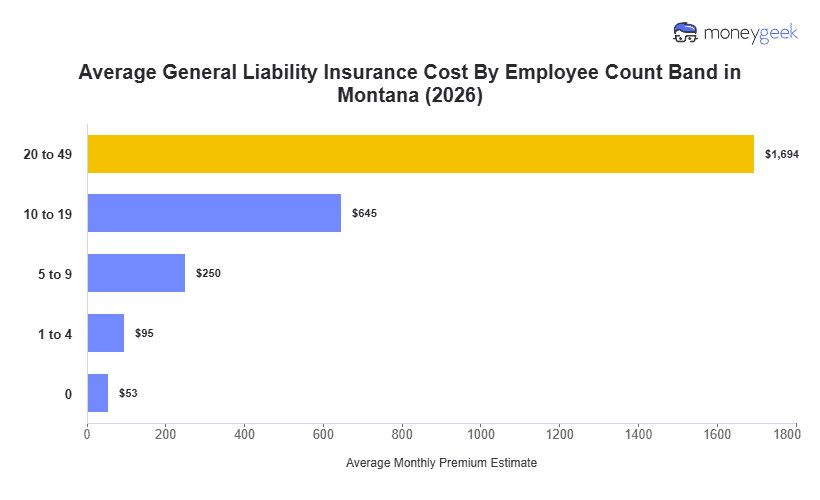
General liability premiums in Montana scale with employee count, ranging from $53 per month for solo operators to $1,694 for businesses with 20 to 49 employees, roughly 32 times higher. The steepest jump occurs between the fourth and fifth employees, where costs increase by 163%

Insurers treat headcount as a direct measure of exposure: more employees mean more potential third-party interactions and liability events. The table breaks out monthly and annual estimates by employee band.

Montana General Liability Insurance Cost Chart

Average General Liability Insurance Costs in Montana by Industry

Industry classification drives the widest premium variation in Montana's general liability market, with businesses in tech and IT paying $25 monthly and construction and contracting operations pays $236, nearly 10 times higher. The sharpest jump occurs between retail and healthcare, where costs increase by 62% as bodily injury exposure rises. Insurers assign classification codes based on core operations, leading to businesses with higher-risk activities paying higher rates. The table lists monthly and annual estimates by industry.

Data filtered by:
Agriculture & Natural Resources
Agriculture & Natural Resources$81$97714%

Use these resources to explore costs for your industry.

How to Lower General Liability Insurance Costs Without Sacrificing Coverage

Montana's general liability rates vary widely, but businesses can find lower rates for general liability insurance in Montana without cutting important protection. The following strategies can reduce costs during the buying phase or over multiple policy cycles.

    insurance2 icon
    Provide clean, accurate underwriting information

    Insurers base quotes on the details you provide, including payroll, job duties and the geographic area you serve. A Billings HVAC contractor who also does light plumbing work should report both activities upfront, since omitting details can trigger reclassification and a surprise premium increase at audit. Submitting accurate information from the start keeps your rate predictable and prevents mid-policy surcharges that cut into margins.

    shoppingCart icon
    Compare multiple insurers

    Requesting general liability quotes from several carriers helps you see how each one prices your specific risk profile. A Whitefish fly-fishing outfitter may receive a competitive rate from a carrier that specializes in recreation and guide services, while a generalist insurer quotes 25% higher for identical coverage. Review general liability exclusions closely, since a lower premium sometimes means narrower protection for guided trips or watercraft operations.

    building icon
    Bundle general liability into a business owner's policy (BOP)

    A BOP combines general liability with commercial property coverage in a single policy, at a lower total price than purchasing each separately. A Bozeman brewery with taproom equipment and on-site inventory can protect both its physical assets and its liability exposure in one package. Compare the cost of a BOP against standalone policies to determine whether bundling produces savings for your situation.

    calendarV2 icon
    Pay annually instead of monthly

    Insurers typically add installment fees to monthly payment plans, which can raise your total cost by 5% to 10% over the policy term, so a Helena wedding photographer who books most clients between June and September can use peak-season income to pay the full premium upfront and avoid those charges. Businesses that need general liability coverage year-round but experience uneven cash flow should weigh the annual payment discount against the flexibility that monthly billing provides.

    graph icon
    Improve your loss profile over time

    Insurers review your claims history when calculating renewal rates. A Missoula landscaping crew that completes two or three seasons without a slip-and-fall claim builds a cleaner loss profile, which qualifies the business for reduced premiums at renewal.

    Even in higher-risk trades, a sustained claims-free record signals that your safety practices and client protocols function as intended. Over multiple policy cycles, this track record can shift your business into a more favorable rating tier and lower what you pay each year.

General Liability Insurance Cost in Montana: Bottom Line

General liability pricing in Montana turns on three variables: how many people work for the business, what industry it operates in and how Montana's market conditions shape insurer risk calculations. 

Three questions help frame whether a quote aligns with the underlying risk:

  1. Does the quote reflect accurate classification? A misfiled industry code or understated payroll figure can push premiums higher than the actual exposure warrants, and corrections at audit cost more than accurate reporting upfront.
  2. Which cost drivers are fixed, and which respond to business decisions? Industry and employee count set the baseline, while claims history, coverage structure and payment timing influence the final premium.
  3. How does local market position affect available rates? Carriers that specialize in a business's sector price more competitively than generalists quoting the same coverage.

These questions matter more than matching a statewide average. Montana's economy leans heavily on agriculture, tourism, and extraction industries, each carrying distinct liability profiles. A quote that diverges from Montana's average may reflect that operational reality rather than signal a pricing problem. Knowing which drivers apply to a specific operation makes it easier to compare quotes and spot where adjustments are possible.

General Liability Insurance Cost in Montana: Next Steps

Understanding how Montana's general liability costs break down by business size and industry sets up the next phase: comparing actual quotes. Businesses looking for cheaper options can start by requesting quotes from carriers that specialize in their industry classification, since pricing varies widely between generalist insurers and niche providers. 

To make those comparisons meaningful, use the same employee count, revenue figures, coverage limits and deductible across each quote, isolating where carriers differ on price rather than inputs. Requesting quotes from three to five insurers gives enough range to identify outliers and spot which factors are driving any premium differences.

Get Personalized General Liability Insurance Quotes in Montana

Select your industry and state to get a customized Montana general liability quote.

Industry
State

Answer 2 questions and see your top insurer in seconds. 100% free.

About Angelique Palenzuela-Cruz


Angelique Palenzuela-Cruz headshot

Angelique Palenzuela-Cruz is a Content Writer at MoneyGeek specializing in business insurance. She focuses on general liability, workers' compensation and professional liability coverage, helping small business owners cut through policy jargon and understand what they're actually buying.

Angelique has spent over five years reporting on personal finance, with deep experience in both insurance and lending markets. Her psychology background also gives her a unique understanding of how people actually process difficult financial decisions, allowing her to meet readers where they are, simplify complex concepts and build decision making frameworks that give them confidence. Whether you're learning about policies, comparing providers or trying to figure out requirements, Angelique does the legwork, digging into regulations, analyzing policy language and testing her explanations against agent-level standards so you get straight answers without fluff.


sources