
Key Takeaways
blueCheck icon

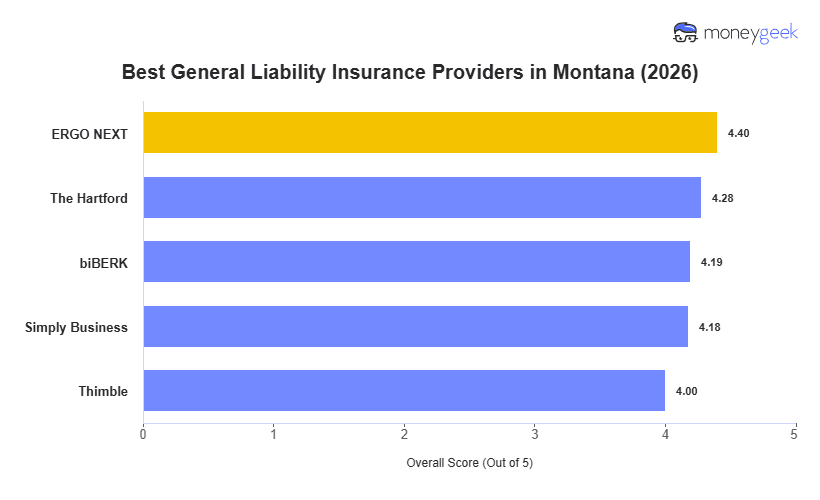
ERGO NEXT offers the best general liability insurance for small businesses in Montana, ranking first for affordability and second for customer experience.

blueCheck icon

The Hartford's average monthly rate of $80 is the cheapest general liability insurance premium in Montana, saving businesses (15%) $14 per month.

blueCheck icon

Look for a provider that offers rate stability, responsive customer service and flexible coverage options, as the best companies perform consistently across all three.

Best General Liability Insurance Companies for Small Businesses in Montana

Not every general liability provider fits every Montana business as risks, coverage needs and budgets vary. We evaluated 10 insurers at $1 million per occurrence/$2 million aggregate limits to find the best and cheapest options available. The five providers below rose to the top across a wide range of business types, so start your comparison here.

  1. ERGO NEXT: Best Overall, Best for Hands-On Industries
  2. The Hartford: Best Cheap General Liability Insurance
  3. biBerk: Best for Fitness and Recreation Businesses
  4. Simply Business: Best for Comparing Carriers
  5. Thimble: Best for Short-Term and Seasonal Coverage

See each provider's rates and rankings in the table below. A fishing outfitter near the Yellowstone River and a ranch supply store in Great Falls have different liability exposures. Compare costs side by side to find coverage that fits your operation and budget.


ERGO NEXT4.4$8118
The Hartford4.28$8082
biBERK4.19$8747
Simply Business4.18$9324
Thimble4$89610
Coverdash3.99$9992
Progressive Commercial3.91$10179
Chubb3.86$10751
Hiscox3.85$10636
Nationwide3.77$105105

For our Montana general liability insurance ratings, we analyzed pricing, coverage options and customer experience across 408 industries within the state. Our analysis focuses on one-to-four-person businesses, which represent a large share of Montana's small business market, while weighting results to ensure broader industry and location representation across Yellowstone County, Gallatin County, Flathead County and rural markets across the state.

To do this, we evaluated over 20,000 business profiles, more than 300 customer experience data points and performed in-depth analysis of coverage contracts and endorsements to compare how insurers serve Montana businesses consistently across different industries and regions. We then rated each company across categories of affordability (50%), customer experience (30%) and coverage options and terms (20%) to form an overall rating. For a detailed breakdown of the metrics, scoring methodology and pricing analysis specific to Montana, see our full methodology.

95%

% of Small Businesses Covered

Over 20,000

Business Profiles Studied

336

Customer Experiences Analyzed

ERGO NEXT

ERGO NEXT

Best Overall, Best for Hands-On Industries
On ERGO NEXT's site

ERGO NEXT earns the top overall score in Montana among the providers in our general liability study, posting the highest marks in both customer experience and affordability. Hands-on industries get the biggest rate advantage: hospitality operations save 37%, manufacturing saves 36% and repair and maintenance businesses save 32%. ERGO NEXT is the best fit for 14 of 25 general industries in the state, with the strongest results for solo operators and teams under 10 employees.

Quotes take about 10 minutes online with no agent required. The portal lets users generate COIs instantly and push through endorsement updates without calling in. Claims handling is a weak spot, though: policyholders report delays on complex cases and trouble reaching a live representative for disputes. Standard limits are available, and additional insured and waiver of subrogation endorsements can be added instantly, but businesses needing pollution or professional liability coverage will find the options thin.

Where ERGO NEXT performs best:

  • Contractors, manufacturers and hospitality businesses prioritizing rate savings
  • Solo operators and small teams under 10 employees
  • Owners comfortable managing policies through a digital portal
  • Businesses with straightforward liability exposures and minimal claims history

Where ERGO NEXT performs less competitively:

  • Health care, agriculture or fitness businesses
  • Operations anticipating complex or contested claims
  • Businesses requiring specialized industry endorsements

Learn More: ERGO NEXT Review

The Hartford

The Hartford

Best Cheap General Liability Insurance
On The Hartford's site

Second overall, The Hartford posts top marks for affordability and coverage options suited to growing businesses. Health care and education operations see the biggest savings (31%), with financial services, marketing and arts businesses saving 17% to 20%. Policy management and claims handling are both standouts, with Trustpilot and Google reviewers citing fair settlements and responsive support. Policyholders also report reaching knowledgeable representatives quickly for endorsement changes and billing questions.

The buying process is the tradeoff. The Hartford requires more upfront information for quotes and usually routes applicants through an agent, which slows the path to binding. Businesses willing to invest time upfront get broader coverage in return: sublimits for rented premises reach $1 million, and endorsements include EPLI, liquor liability and industry-specific packages for contractors and health care providers. Montana businesses with five to 49 employees get the best overall value here, as The Hartford ranks first for affordability across those employee bands.

Where The Hartford performs best:

  • Health care, education or financial services operations in Montana
  • Growing businesses with five to 49 employees
  • Operations needing high sublimits or specialized endorsements
  • Businesses prioritizing claims support over fast quotes

Where The Hartford performs less competitively:

  • Businesses wanting instant digital quotes
  • Agriculture, real estate or manufacturing operations wanting low rates

Learn More: The Hartford Review

biBerk

biBerk

Best for Fitness and Recreation Businesses

biBerk, which is part of Berkshire Hathaway, ranks third overall in our general liability study, ranking third in both affordability and fourth in customer experience. It offers online quotes without brokers, and most owners complete the process in under 15 minutes. Users on Trustpilot note the buying process is simple, though some mention final premiums occasionally differ from initial quotes. Policy management and claims handling both rank lower than the buying experience, with two Reddit users reporting that endorsement processing and COI requests take longer than digital-first competitors.

Moderate-risk service businesses, such as cleaning services, real estate and recreation, can find the best value with biBerk, and those in fitness and hospitality see more than 20% savings. Policies include standard $1 million/$2 million limits, but sublimits are lower, such as $300,000 for rented premises and $5,000 for medical payments. Endorsement options are also limited, with no cyber liability or EPLI through the GL policy.

Where biBerk performs best:

  • Cleaning, fitness, real estate or recreation businesses
  • Solo operators prioritizing affordable coverage
  • Owners comfortable managing policies through a self-serve online process
  • Businesses with basic liability needs and minimal endorsement requirements

Where biBerk performs less competitively:

  • Construction, consulting or wholesale businesses
  • Operations requiring cyber liability or EPLI
  • Businesses needing fast COI turnaround or frequent policy updates

Learn More: biBerk Review

Simply Business

Simply Business

Best for Comparing Carriers

Fourth for general liability in Montana, Simply Business posts a customer experience score tied to its marketplace model. Rather than underwriting coverage directly, it matches businesses with multiple carriers through one quoting process, letting owners compare options before committing. Most matched carriers offer standard $1 million per occurrence/$2 million aggregate limits, with common endorsements like additional insured and waiver of subrogation available across the board.

Trustpilot reviewers find the comparison process useful, though some report uncertainty about which carrier they're actually buying from. Policy management and claims fall to the matched insurer after purchase, so service quality varies by carrier. Several industries also post double-digit savings: repair and maintenance businesses save 19%, hospitality saves 17% and retail saves 15%. Simply Business doesn't lead any single industry in Montana, but it ranks second in nine, making it a dependable backup option across a wide range of business types.

Where Simply Business performs best:

  • Owners who want to compare multiple carriers in one quoting session
  • Repair, hospitality or retail operations
  • Buyers comfortable managing the relationship with the matched insurer directly
  • Businesses prioritizing coverage fit over the lowest available rate

Where Simply Business performs less competitively:

  • Marketing, construction or nonprofit businesses
  • Operations wanting consistent post-purchase support from a single company
  • Owners who prefer knowing their carrier before buying

Learn More: Simply Business Review

Thimble

Thimble

Best for Short-Term and Seasonal Coverage

Thimble ranks fifth overall for general liability insurance in Montana, with a buying experience score reflecting its on-demand model. Policies are available by the hour, day, week, month or year, and users praise this flexibility for short-term projects and events. The mobile app allows instant quotes and binding in minutes. Thimble's claims handling ranks lower, with BBB complaints citing delays and difficulty reaching adjusters.

While Thimble’s policies include standard $1 million/$2 million limits, sublimits run lower than competitors: damage to rented premises only goes up to $100,000 and medical payments caps at $5,000. Thimble limits endorsements to additional insured and waiver of subrogation, with no cyber liability or EPLI available. Thimble doesn’t rank highest for any particular industry, but it’s still an affordable option for some businesses. Construction operations, for example, save 18% and manufacturing saves 20%. 

Where Thimble performs best:

  • Contractors or vendors needing short-term project coverage
  • Seasonal Montana businesses wanting hourly or daily policies
  • Owners who prioritize fast quoting over claims support
  • Construction or manufacturing operations looking for low-cost coverage

Where Thimble performs less competitively:

  • Hospitality, retail or creative businesses
  • Operations expecting to file claims or disputes
  • Businesses leasing space needing higher rented-premises limits

Learn More: Thimble Review

Find the Best General Liability Insurance in Montana by Industry

Montana's mix of agriculture, tourism, construction and professional services means liability exposures differ across the state. A Bozeman property manager and a Miles City welding shop pay different premiums because insurers price based on claim risk for each type of work. The tables below let you compare rates within your industry to find the best value for your business.

What Determines the Best General Liability Insurance for Montana Businesses

Choosing general liability insurance in Montana requires more than picking the lowest quote. A Whitefish rafting company and a Billings electrical contractor have different exposures, claim risks and service needs, so the right insurer depends on how well a provider matches your specific operation. 

These four factors increase the chances of finding an insurer that works well in practice, not just on paper.

  • coins2 icon
    Affordability without pricing volatility

    A competitive first-year rate means little if your premium jumps 20% at renewal. Montana's economy runs on thin margins and seasonal revenue cycles: ranchers, outfitters and construction crews often earn most of their income in a few months. Absorbing a surprise rate increase during renewal that falls within the off-season can strain cash flow when money is already thin. 

    Look for insurers with a track record of stable renewals rather than carriers who attract new business with low quotes and raise rates once you're locked in. Ask about renewal history before you buy so you know what to expect in year two.

  • talk icon
    Responsive service throughout your policy term

    Responsive service matters most when you're hours from the nearest insurance office and operating on tight seasonal windows. A guide service renewing its Yellowstone outfitter permit or a rancher updating coverage before BLM grazing lease deadlines can't wait three days for paperwork. Look for insurers that offer:

    • Fast COI turnaround when a Kalispell general contractor needs you on-site tomorrow and won't wait for your agent to return from lunch
    • Agents who understand that a Helena excavation company shuts down when Marias Pass closes and doesn't need a coverage lecture about gaps in payroll
    • Claims handling that doesn't stall because the adjuster has never worked with a sawmill operation or a pack string outfitter
    • Digital tools that work when your office is a truck cab between Havre and Malta

    When service breaks down, the damage goes beyond frustration. A liability claim from an injured guest at a Seeley Lake lodge that drags into ski season can eat into the narrow window when you actually make money.

  • insurance2 icon
    Coverage options that fit common small business risks

    Make sure the carrier offers per-occurrence and aggregate limits high enough to meet contract requirements. Timber operators on Forest Service land or contractors bidding state projects, for example, often need $2 million aggregate or more. Growth is another thing that often creates coverage gaps: a subcontractor landing work on a Whitefish Mountain project may need additional insured endorsements the GC requires, an outfitter whose guides drive personal rigs to trailheads needs hired and non-owned auto coverage, and a Bitterroot Valley meat processor selling at farmers markets needs product liability. Choose an insurer that can add these without forcing you to switch carriers mid-season.

  • building icon
    Why consistency across all three areas matters most

    An insurer that's cheap but slow on claims creates real problems when a guest injury at your dude ranch happens the week before hunting season, which just happens to be your busiest revenue window. Another carrier with responsive service but rigid coverage options limits your ability to take on a Forest Service contract that requires higher limits than your current policy allows. 

    Word travels fast in Montana when an insurer mishandles a claim or delays a payout during fire season. Contractors and outfitters share those experiences at the stockyard and the lumber yard alike. The providers worth considering perform reliably across pricing, support and coverage, so you're not scrambling to fix one gap while another part of your policy fails you.

How to Choose the Best General Liability Insurance in Montana

Most Montana business owners don't have time to evaluate every insurer on the market. These six steps give you a repeatable process to filter out poor fits, eliminate mismatches quickly and choose a provider that fits how your business actually runs.

  1. 1

    Optimize your payment and coverage structure

    Know what your business needs to cover before comparing providers. Montana operations carry different risk profiles, so a few questions help narrow the field:

    • Do your contracts with general contractors, Forest Service projects or BLM leases spell out minimum coverage limits?
    • Does your work put you near client property, active job sites or physical labor where third-party injuries are realistic, such as guiding hunters, running heavy equipment or hosting guests at a lodge?
    • Does revenue fluctuate with Montana's seasons, making monthly billing easier to manage than a lump-sum annual payment?
    • Can your operation absorb a $1,000 or $2,500 claim without straining cash flow, or would a lower deductible offer better protection during slow months?

    Start with payment structure. Many Montana businesses earn the bulk of their income in a few months and need costs spread across the year, so decide whether annual or monthly billing fits before requesting quotes.

    Coverage structure comes next. A Red Lodge gift shop with steady foot traffic and low claim frequency may do fine at standard limits, but an Anaconda excavation contractor bidding on state highway projects will likely need higher limits to satisfy contract requirements. Pinning down how much general liability coverage you need before evaluating price or service keeps the comparison honest.

  2. 2

    Choose your primary priority

    Your tiebreaker is whichever factor matters most when providers score similarly across the board.

    • Affordability is the priority for businesses running on seasonal income or thin cash reserves. A Paradise Valley outfitter earning most of its revenue between June and September needs premiums that stay predictable through the slow months.
    • Customer experience matters most when work requires fast paperwork turnaround or mid-policy changes. A Great Falls subcontractor juggling multiple job sites needs same-day certificates and a carrier that picks up the phone when a GC is waiting.
    • Coverage options take precedence when an operation is growing or contracts demand specific endorsements. A Columbia Falls sawmill adding custom milling services needs flexible general liability limits and add-ons that scale without a carrier switch.
  3. 3

    Shortlist two to three providers

    Most Montana business owners don't have time to vet every available insurer. Once you know your priority, narrow the field to two or three providers that meet your baseline coverage needs and align with your top factor.

    Confirm that each candidate writes policies for your industry, operates in Montana and can handle your business size. A solo farrier in the Madison Valley and a 15-person roofing crew in Billings sit at very different complexity levels, so the insurer needs to fit the profile. Review Montana general liability costs to confirm pricing falls within a reasonable range. A shorter list keeps the next steps faster and the focus on realistic options.

  4. 4

    Double-check for dealbreakers before investing more time

    Confirm each finalist clears your non-negotiables before going deeper. Catching gaps now avoids restarting the process after quotes and coverage details have already been compared.

    Cut any provider that falls short on these:

    • Can't meet limit requirements for Forest Service or BLM contracts, which often demand $2 million aggregate or higher for work on public lands
    • No endorsements for livestock operations, guide services or outfitter exposures, leaving ranchers and hunting guides without coverage for core risks
    • No track record with fire season liability, which matters for timber, land clearing or work near wildland-urban interface zones
    • No reliable service for remote areas, ruling out insurers that can't process a claim or certificate request when you're operating out of Ekalaka or Jordan
  5. 5

    Compare your finalists using the same three lenses

    Rate all shortlisted providers across all three dimensions, not only your top priority:

    • Affordability: Renewal history and rate change communication matter as much as the opening quote. Ask how audits work when payroll shifts between calving season, summer construction and winter slowdowns, since some insurers handle seasonal fluctuations better than others.
    • Customer experience: COI turnaround times, midterm policy changes and claims responsiveness all count. For operations running jobs between Roundup and Forsyth, confirm the insurer can process requests remotely without requiring a two-hour drive to sign paperwork.
    • Coverage options: Look at available per occurrence and aggregate limits and endorsement flexibility. Check for add-ons covering guide operations, hired and non-owned auto for crews driving personal vehicles or product liability for businesses selling goods at local co-ops or roadside stands.
  6. 6

    Use quotes as the final confirmation step

    A quote confirms whether pricing matches expectations and coverage aligns with your actual business details. Request general liability insurance quotes from your finalists using the same limits and deductibles for an accurate comparison. If you run a pack string into the Absaroka-Beartooth Wilderness or host guests at a working ranch, verify the quote reflects those exposures and not a generic small business profile.

    Go through each quote for general liability exclusions that could leave gaps. Exclusions around fire damage, injuries on leased grazing land or incidents involving animals catch Montana operations off guard more than you'd expect. Confirm the quote accounts for your seasonal revenue patterns too. An insurer quoting from peak-season projections may trigger a painful audit adjustment when actual numbers come in lower.

Best Small Business General Liability Insurance in Montana: Bottom Line

ERGO NEXT, The Hartford and biBerk rank among the best general liability options in Montana for both coverage and price. The right fit depends on your industry, business size and where you operate across the state, but the best choice balances pricing stability, responsive service and coverage flexibility.

Matching what each provider offers to your actual risk profile keeps the decision grounded in operational reality rather than marketing claims.

Best General Liability Insurance For Small Business in Montana Chart

Best General Liability Insurance for Small Businesses in Montana: Next Steps

Confirming pricing and coverage fit upfront prevents surprises later, especially for Montana businesses with seasonal revenue swings or operations on public lands.

When you're ready to move forward, narrow your options to one or two providers and confirm quotes using the same coverage limits and deductibles across the board.

If cost is still your main deciding factor

If you’re unsure how much coverage you need

If you’re ready to check quotes now

How We Chose the Best General Liability Insurance Companies

To identify the best general liability insurance companies for Montana small businesses, we evaluated insurers across pricing, customer experience and coverage options using a standardized, data-driven approach. Our goal was not to identify the cheapest option in every scenario, but to determine which providers offer the most consistent overall value across common Montana small business profiles.

Our best recommendations reflect insurers that perform well across multiple dimensions and remain competitive across industries and business sizes in Montana.

Data and Analysis Scope

We based our analysis on standardized estimates designed to represent the majority of Montana small businesses:

  • Providers analyzed: 10 major insurers serving Montana
  • Industries covered: 408 industries
  • Employee counts: Zero to 49 employees
  • Policy baseline: $1 million per occurrence / $2 million aggregate general liability policy
  • Pricing modeled: Over 20,000 standardized estimates for Montana businesses

Modeled average revenues and payrolls were incorporated to improve pricing accuracy across Montana's common business profiles.

Our Scoring Model

Each insurer's composite score is calculated from the weighted categories below.

  • Affordability (50%): Reflects how competitively and consistently an insurer prices general liability coverage across all Montana business profiles studied.
  • Customer experience (30%): Measures how well insurers support Montana businesses throughout the policy lifecycle, from purchase to claims. We studied buying, policy management and claims sub-processes at each stage for reliability and accuracy.
  • Coverage options (20%): Captures how well insurers address common Montana small business risks and allow for flexibility as operations grow or change.

Read our full business insurance methodology.

About Connor Bolton


Connor Bolton, Senior SEO and Content Manager (Business & Pet), MoneyGeek

Connor Bolton is Senior SEO and Content Manager at MoneyGeek, where he leads the business and pet insurance editorial teams. He sets the research framework, data standards and content structure for his team. All content goes through his accuracy review before publication. Connor also writes in-depth guides and has spent more than four years covering insurance products across personal, commercial and specialty lines.

The research infrastructure Connor built covers auto, home, renters, life, health, business and pet insurance across pricing analysis, carrier research, customer experience and coverage evaluation. It includes over 6 million data points for business insurance across 408 industry areas, all 50 states and 16 vehicle types. The pet insurance side covers over 5 million profiles across 18 major providers, 100+ breeds and ages up to 20 years. Connor’s insurance research and his team's work has been cited by the U.S. Chamber of Commerce, Allstate, Liberty Mutual, CBS News, Forbes and LegalZoom.

Connor also talks with underwriters and carrier liaisons at Ethos, The Hartford, ERGO NEXT, Nationwide and State Farm, and monitors business and pet owner communities on Reddit. Those sources shape how his team evaluates carriers, structures rate analysis and writes for human buyers rather than search engines.

For questions about MoneyGeek's business and pet insurance content, contact him at connor@moneygeek.com or on LinkedIn.