

mglogo icon
HOW DO WE DEFINE CONTRACTORS?

Contractors, as used throughout this guide, are blue-collar trades workers whose work centers on the physical construction, installation, maintenance, repair, or sale of properties and structures. This does not include white-collar trades, freelancers and cleaning professionals.

In short, the 3 best general liability insurers for contractors that had the most ideal balance of affordability, service and coverage are the following:

  1. ERGO NEXT: Best Overall, Best For Lower Risk Contractors
  2. The Hartford: Best For Value Coverage and Larger Operations
  3. Thimble: Best For Gig and High-Risk Work

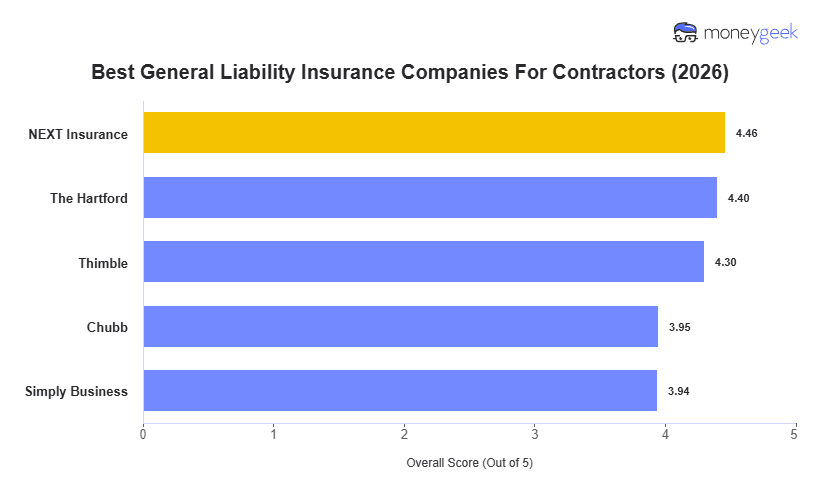
As you can see by their awards, each insurer has specialties in terms of where they are best, and no one insurer is a fit for everyone. So, keep in mind these providers are a good starting point, but the number one pick overall is not necessarily right for you. I've also broken down the rankings of the top 5 that made the cut in the table below for side-by-side performance comparisons.


NEXT Insurance4.46118
The Hartford4.40382
Thimble4.302710
Chubb3.95531
Simply Business3.94424

*Keep in mind that ranks can be misleading. For example, The Hartford ranks 8th for customer experience, but the spread for scores between providers was very narrow (within .3 of one another within the top 10) So in other words, a low rank does not necessarily mean a insurer doesn't excel in an area or is disproportionately better than another.

While this table gives an overview, it isn't the full story, and there are a lot of nuts and bolts to get into the makes a provider best for some and the worst choice for others. Below, I've done a deep dive into my top 3 providers breaking down exactly who they are best for and who should stay away from their insurance products for contractor general liability coverage.

ERGO NEXT

1. ERGO NEXT: Best Overall, Best For Lower Risk Contractors

On ERGO NEXT's site
COMPANY HIGHLIGHTS

ERGO NEXT (formerly NEXT Insurance) wins overall for contractors who need affordable, fast general liability coverage they can manage without an agent. For a solo tradesperson or a small residential crew, the buying experience is genuinely the easiest of any carrier I looked at. You get a quote in under 6 minutes, a certificate of insurance you can pull from your phone at any time, and the ability to add a general contractor as an additional insured through the portal without a phone call.

Where I'd pull back is on more complex commercial work. Their GL caps at $1 million per occurrence, and many GC subcontracts for larger construction jobs now require $2 million per occurrence as a floor. If you're bidding on commercial projects or working under a general contractor who runs tight certificate review, you may find ERGO NEXT's limits don't clear the bar.

Learn More: ERGO NEXT Business Insurance Review

The Hartford

2. The Hartford: Best For Value Coverage and Larger Operations

On The Hartford's site
COMPANY HIGHLIGHTS

The Hartford is the option I'd point a growing contractor to when the work has moved beyond simple residential jobs or you're a much larger operation, and the insurance program needs to match. With over 200 years in the industry and a dedicated construction underwriting and risk management team, they've built a reputation that's trusted by some of the largest construction firms in the United States (See what Hunt Construction says about their services). Their General Liability Choice policy is specifically designed for how contractors actually use insurance with per-project aggregate limits that reset across jobs so one bad project doesn't drain your annual coverage, limited professional liability built into the base form, and the endorsement structure that commercial GC contracts require.

They also offer pollution liability, builders risk, and excess coverage for trades where standard general liability insurance isn't enough on its own. The tradeoff is that the buying experience is slower and the pricing reflects the depth of coverage. Their average general liability costs for contractors run about 3rd overall for affordability, which is competitive for what you're getting but not the lowest number on the market for a simple residential job.

Learn More: The Hartford Business Insurance Review

Thimble

3. Thimble: Best For Gig and High-Risk Work

COMPANY HIGHLIGHTS

Thimble allows contractors to do something that they can't with other providers, the ability to buy by as little as the hour, making it ideal for those who do seasonal work or want to save on coverage with shorter policy periods. For contractors that have an advice a project management aspect to their services, they also offer a general and professional liability bundle that keeps you protected from all bases with a discount. The other main standout is its overall affordability (2nd overall), especially for higher risk trades like plumbing and electrical contracting where savings can reach as high as 28% compared to average.

Their GL is underwritten by Markel, a carrier with a strong track record on commercial general liability claims, which means the policy backing the certificate you hand to a client is coming from a financially solid source. The constraint that applies here is the same as most digital insurers: $1 million per occurrence maximum with no path to higher limits through Thimble. And if you have a contested claim, you'll be resolving it over email since there is no phone support, and it is the only option for customer service communication.

Read More: Thimble Business Insurance Review

Explore The Best General Liability Insurance For Contractors By Industry Trade

Our overall list doesn't take into account everyone's specific situation and there are nuances like specialty coverage, pricing differences due to underwriting appetite, and overall customer experience readiness for the ranges of complexity of different types of work. So, to avoid oversimplifying my answer, I've provided guides specific to finding the best general liability policies and other insurance for your specific industry or line of work in contracting.

Best General Liability Insurance For Contractors By State

Past your industry, it's good to understand how the environments you work in affect exactly how good of a deal you're getting for general liability insurance. Your state's main effect is on pricing due to different legal environments, weather condition considerations and ultimately claims patterns that all change how insurers look at risk for your work. If you'd like to get location specific guidance, I've provided resources below.

How To Find The Best Contractor General Liability Insurance

No two contractors need the same policy. A solo handyman doing residential repairs has almost nothing in common with a five-person framing crew bidding commercial subcontracts, and the policy that protects one can leave the other exposed. This guide walks you through the actual decisions you need to make, in the order you need to make them, so you end up with coverage that best fits your work.

  1. 1

    Know What You Are Buying Before You Shop

    General liability insurance covers three things including bodily injury to people who are not your employees, damage to property you do not own, and personal and advertising injury. It does not cover your employees (workers' compensation), your tools and equipment (inland marine), your vehicles (commercial auto), or damage from professional errors or bad advice (professional liability).

    Get clear on which of those gaps you also need to fill before you look at a single carrier. A lot of contractors buy a general liability policy and assume they are covered, then find out after a claim that what went wrong fell into one of those exclusions.

  2. 2

    Figure Out What Your Work Actually Requires

    Your coverage needs are not set by what sounds reasonable initially, they are set by your clients, your contracts, and your state:

    • Check your contract requirements first: If you work under general contractors, pull out a recent subcontract agreement and find the insurance section. It will specify a minimum per-occurrence limit, whether you need to name the general contractor as an additional insured, whether that coverage needs to extend to completed operations, and whether a waiver of subrogation is required. If you do not have a contract in hand, ask the GC what their certificate requirements are before you buy anything.
    • Check your state licensing requirements: Many states require a minimum GL limit as a condition of holding a contractor's license. Look up your state licensing board before assuming a standard $1 million policy is enough.
    • Check your trade-specific exposure: Roofing, demolition, work involving chemicals, and projects where you disturb existing materials can trigger exclusions that a standard policy does not cover cleanly. If your trade involves any of those, flag it when getting quotes and ask specifically how the carrier handles it.
  3. 3

    Set Your Limit Before You Compare Prices

    Shopping by price before you know what limit you need leads to buying a policy that looks cheap and turns out to be useless for the work you are doing.

    • For most residential contractors, $1 million per occurrence and $2 million aggregate is the standard starting point.
    • For commercial subcontractors, $2 million per occurrence is increasingly the baseline requirement.

    If you need higher limits, an umbrella policy on top of your base GL is usually more cost-effective than trying to buy a high-limit standalone GL policy. 

    You also need to understand your aggregate limit is shared across all claims in a policy year. If a significant claim on one job eats through most of it, your other active jobs are now underinsured for the rest of the year. Some carriers offer per-project aggregate limits that reset for each job, which eliminates that problem for contractors running multiple simultaneous projects.

  4. 4

    Understand the Endorsements Your Contracts Require

    A certificate can say almost anything. The endorsement is what actually changes what the policy covers. If it is not on the policy, the coverage is not there regardless of what the certificate says.

    The endorsements that come up most often for contractors are:

    • Additional insured for ongoing operations: Extends your GL coverage to the GC or project owner while your crew is actively on the job.
    • Additional insured for completed operations: Extends coverage for claims that surface after the job is finished, like a defect discovered months later. Required separately from ongoing operations on most commercial contracts, and the one contractors most often miss.
    • Waiver of subrogation: Prevents your insurer from pursuing the GC to recover money after paying a claim.
    • Primary and non-contributory: Specifies that your policy pays first before the GC's policy contributes anything.

    When getting quotes, tell each carrier what endorsements your contracts require and confirm they can provide them in a form a GC's risk department will accept.

  5. 5

    Match the Carrier to How You Actually Work

    Set yourself up for success in a high stress claim scenario with how you work to avoid financial stress and wasting time:

    • If you work alone or with a small crew on residential jobs and your clients need a COI but are not imposing complex endorsement requirements, a digital-first carrier is usually the right starting point. You get fast quotes, same-day binding, and certificates from your phone. The tradeoffs are a $1 million per-occurrence ceiling and limited support if a claim gets complicated.
    • If you work under GCs on commercial jobs or your contracts have specific endorsement requirements, you need a carrier with the underwriting depth to satisfy them. That typically means working through an agent, which adds time but gets you a policy that holds up when the GC's risk team reviews your certificate.
    • If your work is seasonal or intermittent, look for carriers that offer monthly or project-length policies. Paying for 12 months of coverage when you are only active for six is a cost you can eliminate.
    • If you manage subcontractors, get a certificate of insurance from every sub before they start work and verify that it shows active coverage with limits that meet your requirements and includes completed operations. Your insurer will ask about your subcontractor verification practices, and gaps there can affect both your premium and your coverage.
  6. 6

    Get Quotes the Right Way

    Give each carrier the same complete picture of your business. The information that affects your GL premium most is your annual revenue or payroll, the type of work you do, the states where you operate, whether you use subcontractors and verify their insurance, your claims history for the past three to five years, and the limits and endorsements you need.

    Be accurate with all of these detauls. Most contractor GL policies are audited at the end of the policy year, and if your actual revenue was higher than what you reported, you will owe additional premium. If the gap is significant, it can also create coverage questions on any claims filed during that period.

  7. 7

    Read the Policy Before You Bind It

    A quote summary tells you the limit and the price while the policy form tells you what is actually covered. Before you pay, ask for the actual policy or a specimen form and read the exclusions, how the policy handles your completed work, how subcontractor liability is treated, and the conditions around claim reporting. Missing a reporting deadline is one of the most common ways contractors end up with a denied claim on a policy they thought covered them.

  8. 8

    Keep Your Coverage Current as Your Business Changes

    Your policy is based on a snapshot of your business when you applied. The changes that matter most are adding employees, taking on significantly more revenue than you projected, expanding into new types of work, starting to work in new states, and beginning to manage subcontractors if you did not before. If any of those happen mid-year, contact your carrier rather than waiting for renewal. Adjusting coverage mid-policy is almost always less expensive than finding out at audit that your coverage did not match your actual operations.

Best General Liability Insurance For Contractors: Bottom Line

At the end of the day my best general liability insurance picks are good for most small businesses, but they may not be right for you. To frame up your decision, you should be asking yourself these questions before chosing an insurer:

  • Does an insurer have the coverage I need? Since requirements are often the baseline, make sure you can meet them with a provider, especially if you're bidding for larger commercial or government jobs.
  • Is a provider's customer service experience best for my operations? Residential contractors may be fine with a digital first provider due to their lower claims risk and lack of complexity, but past that point, consider a larger more experienced insurer if that's not the case.
  • Does the insurance company give me a price I can afford and the flexibility so I don't pay for something I'm not going to use? If you have more seasonal operations, looking for a provider with flexible coverage length terms saves you money in the long term while busy contractors who are working all year round really don't get that benefit. And of course, if the price isn't right, especially for smaller companies, there is not a reason to overstretch your finances if there is a cheaper option with coverage you need.

I've also summarized our top picks below so you can start comparing on your own past this article.

About Connor Bolton


Connor Bolton headshot

Connor Bolton is Senior SEO and Content Manager at MoneyGeek, where he leads the business and pet insurance editorial teams. As editorial lead for both verticals, Connor sets the research framework, data standards, and content structure that his writers execute, directly authoring in-depth guides himself and reviewing all team content for accuracy and practical value before it goes live. With over four years evaluating insurance products across personal, commercial, and specialty lines, he brings cross-vertical knowledge to every guide the team produces.

Connor architected MoneyGeek's insurance research infrastructure across all major verticals including auto, home, renters, life, health, business, and pet, building systems for pricing analysis, provider-level research, customer experience evaluation, and coverage analysis with AI support. The infrastructure includes over 6 million data points for business insurance across 408 industry areas, all 50 states, and 16 vehicle types, and over 5 million pet insurance profiles across 18 major providers and hundreds of breed and age combinations. Connor's insurance cost research and his team's work has been cited by the U.S. Chamber of Commerce, Allstate, Liberty Mutual, CBS News, Forbes and LegalZoom.

Beyond the data, Connor stays connected to how the market actually operates, drawing on direct conversations with underwriters and carrier liaisons at Ethos, The Hartford, NEXT Insurance, Nationwide, and State Farm, and monitoring business and pet owner communities including Reddit, to inform how he interprets findings and frames guidance for real buyers.

He is the direct editorial contact for methodology questions at connor@moneygeek.com and can be found on LinkedIn.