Key Takeaways
blueCheck icon

ERGO NEXT leads among best general liability insurance providers in Alaska with top ranks in affordability and customer experience.

blueCheck icon

ERGO NEXT offers the cheapest general liability insurance at $135 monthly, saving businesses $17 per month or 11%.

blueCheck icon

Reliable general liability insurers deliver consistent performance across rate stability, customer service responsiveness and coverage flexibility.

Best General Liability Insurance Companies for Small Businesses in Alaska

Alaska businesses carry different risks, but these five general liability insurers consistently rank among the most affordable and reliable statewide. We analyzed 10 major providers using standard $1 million per occurrence/$2 million aggregate limits, scoring each on pricing, service quality and coverage strength to identify top performers.

  1. ERGO NEXT: Best for Hands-On and Customer-Facing Businesses
  2. biBerk: Best for Service and Wellness Businesses
  3. Thimble: Best for On-Demand Coverage
  4. Coverdash: Best for Multiple Carrier Comparisons
  5. Progressive Commercial: Best for Wholesale and Distribution

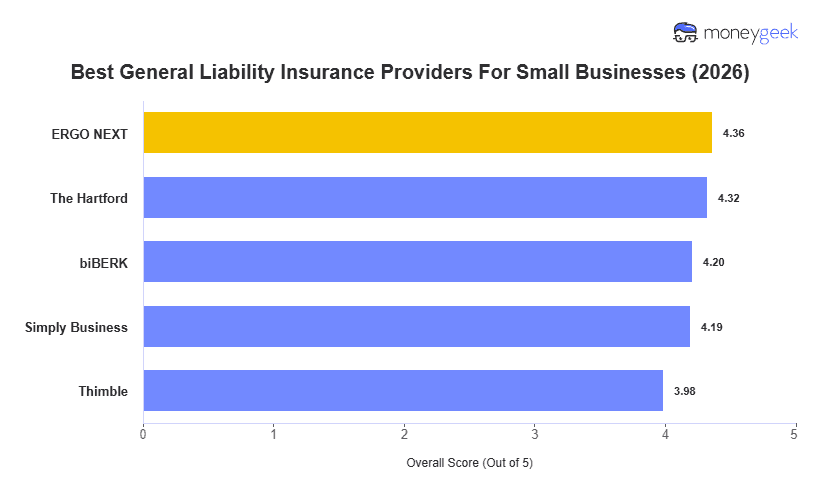
These insurers balance affordability with dependable claims service for Alaska businesses managing seasonal operations, remote locations and harsh winter conditions. The table below compares their rates and rankings, whether you run a fishing charter in Juneau, a construction company in Anchorage or a retail shop in Fairbanks.

ERGO NEXT4.36$13513
biBERK4.22$14422
Thimble3.91$14735
Coverdash3.88$16451
Progressive Commercial3.79$16744

For our Alaska general liability insurance ratings, we analyzed pricing, coverage options and customer experience across 408 industries within the state. Our analysis focuses on one-to-four-person businesses, which represent nearly half of Alaska's small businesses, while weighting results to ensure broader industry and location representation across the Anchorage Bowl, Matanuska-Susitna Valley, Fairbanks North Star Borough, Kenai Peninsula Borough and smaller markets throughout the state.

To do this, we evaluated over 20,000 business profiles, more than 200 customer experience data points and performed in-depth analysis of coverage contracts and endorsements to compare how insurers serve Alaska businesses consistently across different industries and regions. We then rated each company across categories of affordability (50%), customer experience (30%) and coverage options and terms (20%) to form an overall rating. For a detailed breakdown of the metrics, scoring methodology and pricing analysis specific to Alaska, see our full methodology.

95%

% of Small Businesses Covered

Over 20,000

Business Profiles Studied

216

Customer Experiences Analyzed

ERGO NEXT
Best Overall, Best for Hands-On and Customer-Facing Businesses

ERGO NEXT

On ERGO NEXT's site

ERGO NEXT ranks first overall for general liability insurance in Alaska, leading on customer experience and affordability. The buying experience is top-ranked, with one Alaska business owner with a brick-and-mortar location citing a competitive quote and stress-free setup. Broader customer feedback confirms quotes in under five minutes, immediate coverage and free instant COIs. Experience with claims handling is less positive because of adjuster communication and dispute resolution, which matters most for Alaska contractors and repair businesses with frequent claims exposure.

On price, ERGO NEXT has the lowest rates in 17 of 25 Alaska industries, including consulting, marketing and financial services. Hospitality and tourism see the biggest savings at 34%, followed by agriculture and beauty and wellness at 25% each, and construction at 20%. Coverage starts at the industry-standard $1 million per occurrence and $2 million aggregate, with umbrella options up to $2 million. Endorsement options are narrow, though, which pulls its coverage ranking below competitors with broader customization.

Where ERGO NEXT performs best:

  • Solo operators and micro-businesses that prioritize the lowest Alaska rates
  • Physical trade businesses like construction, repair, food service and transportation
  • Owners who need fast COIs and simple digital policy management
  • First-time buyers wanting a fully guided, online purchase

Where ERGO NEXT performs less competitively:

  • Health care, fitness and education businesses searching for affordable coverage
  • High-claims-risk businesses that need reliable adjuster communication and dispute support
  • Contractors with contract requirements for online waiver of subrogation

Learn More: ERGO NEXT Review

biBerk
Best for Service and Wellness Businesses

biBerk

biBerk ranks second overall for general liability insurance in Alaska and is the most affordable option for 40% of Alaska industries in our analysis. The biggest savings are enjoyed by businesses in health care, fitness, cleaning services, education and recreation, ranging from 14% to 24%. It offers tech and IT firms the lowest possible rate of $26 per month for general liability coverage and is the most affordable option for sole proprietors, who spend $69 per month for a general liability policy. biBERK has six confirmed endorsements, including cyber liability, liquor liability, EPLI, and contractors' tools and equipment. 

The buying process is fully online with phone support available before purchase, but that experience doesn't carry through the full policy lifecycle. Adding a named additional insured requires contacting support and takes up to three business days. Claims rank fourth, with a higher-than-average rate of customer complaints filed with state regulators. Alaska businesses with frequent COI requests, midterm endorsement needs or active claims exposure will get better service support from higher-ranked providers.

Where biBerk performs best:

  • Tech, health care, fitness and cleaning businesses prioritizing the lowest Alaska rates
  • Sole proprietors who need low-cost GL coverage with a simple online process
  • Businesses whose endorsement needs match biBerk's six available add-ons
  • Low-claims-frequency businesses that won't depend on active adjuster support

Where biBerk performs less competitively:

  • Alaska contractors or businesses that don’t have a confirmed waiver of subrogation
  • Businesses that request COIs often or need to adjust policies midterm
  • Owners who want to see limit options upfront before they commit to a quote

Learn More: biBerk Review

Thimble
Best for On-Demand Coverage

Thimble

Thimble ranks third overall for general liability insurance in Alaska, earning competitive marks in both customer experience and affordability. The buying process is one of the fastest available, with full quote-to-bind in under 60 seconds, instant COI delivery and unlimited free COI generation at no charge. That experience holds for straightforward coverage needs but weakens after purchase, as claims are handled by a third-party underwriter rather than Thimble directly. That creates coordination concerns, and post-purchase support is online only with no phone option.

While Thimble doesn't lead on price in any Alaska industry, fitness and health care businesses still see 3% to 4% savings against the Alaska average, and construction businesses see the most notable discount at 15% below average. Thimble's most distinctive coverage feature is its on-demand policy structure. Alaska businesses can buy coverage by the hour, day, month or year, which no other provider in our analysis offers. Every policy also automatically includes a blanket additional insured and waiver of subrogation, with no added cost or paperwork.

Where Thimble performs best:

  • Alaska contractors needing automatic waiver of subrogation at no added cost
  • Seasonal or project-based businesses that need short-term or on-demand coverage
  • Construction, fitness and health care businesses prioritizing competitive rates
  • Service businesses with variable crew sizes using monthly GL policies

Where Thimble performs less competitively:

  • Hospitality, retail and marketing businesses where rates run above the Alaska average
  • Businesses expecting phone support or active claims management after purchase
  • Tech/IT businesses that need cyber liability coverage bundled with GL

Learn More: Thimble Review

Coverdash
Best for Multiple Carrier Comparisons

Coverdash

Coverdash ranks fourth overall for general liability insurance in Alaska, but leads every industry and employee count band in coverage. With a multi-carrier broker model that gives Alaska businesses access to GL quotes from 30+ carriers through a single application, it presents options rather than a single policy form. That means coverage terms and limits vary by carrier and aren't standardized upfront. Construction companies save 11% with Coverdash, while below the Alaska industry average, and agriculture businesses see more at 16%.

Comparing quotes across multiple carriers adds complexity that single-carrier providers don't have, which likely pulls down clarity and transparency scores. Businesses with specialized coverage requirements should review carrier-specific policy details carefully before binding. The platform works best when coverage needs are straightforward enough to compare across multiple policy forms.

Where Coverdash performs best:

  • Alaska businesses that want to compare GL quotes from multiple carriers at once
  • Construction and agriculture businesses
  • Businesses that want to review several carriers before choosing a policy
  • Alaska businesses with simple GL needs and no specialized coverage

Where Coverdash performs less competitively:

  • Businesses that don’t see standardized GL limits and terms upfront
  • Any business that wants a clear and low-friction buying experience
  • Alaska businesses where another top-ranked provider offers a lower price

Learn More: Coverdash Review

Progressive
Best for Wholesale and Distribution

Progressive

Progressive Commercial ranks fifth overall for general liability insurance in Alaska, with competitive rates in several industries and above-average claims handling relative to its overall placement. GL policies include liquor liability, EPLI and inland marine as add-on endorsements, giving food, hospitality and contractor businesses more customization options. One gap is the unavailability of excess and surplus lines (E&S) coverage in the state, so high-risk businesses will need to source that coverage elsewhere.

Buying general liability coverage from Progressive requires working with an agent to complete the purchase, which adds a step compared to fully digital competitors. Claims are handled well, as it has one of the lowest complaint rates in the reviewed field. Manufacturing businesses see 26% savings, as well as those in hospitality (24%).

Where Progressive Commercial performs best:

  • Alaska food, beverage and hospitality businesses needing liquor liability as a GL add-on
  • Manufacturing businesses where rates run 26% below the Alaska average
  • Businesses that prioritize claims outcomes over buying convenience
  • Wholesale businesses where it ranks top overall in Alaska

Where Progressive Commercial performs less competitively:

  • High-risk Alaska businesses that need E&S coverage
  • Businesses that want a fully digital GL buying experience without agent involvement
  • Alaska businesses prioritizing affordability

Learn More: Progressive Commercial Review

Explore the Best General Liability Insurance in Alaska by Industry

Different industries carry different liability risks, which affects both pricing and coverage needs. A Ketchikan seafood processor managing cold storage and shipping claims has different exposures than a Wasilla construction contractor or a Sitka bed-and-breakfast owner dealing with seasonal tourism.

The tables below show which insurers price competitively for your line of work and how policy terms compare across carriers. Use these industry breakdowns to identify providers that understand your business's risk profile and price accordingly.

What Determines the Best General Liability Insurance for Alaska Businesses

Look past the initial premium to find the right general liability insurance in Alaska. A Homer fishing charter and a Soldotna hardware store have different claim risks, cash flow patterns and coverage needs as they grow. These four factors separate insurers that work well on paper from those that work well in practice.

    coins2 icon
    Affordability without pricing volatility

    A Kenai restaurant paying $145 monthly expects that rate to stay predictable, not jump 30% at renewal due to industrywide trends unrelated to their own claims record. Many Alaska businesses run tight margins during slower months, making unexpected mid-year rate increases especially problematic.

    Insurers that price aggressively to win business sometimes raise rates sharply at renewal. Look for providers with stable pricing patterns in Alaska if consistent budgeting is important for your operations. Rate volatility forces annual insurance shopping instead of letting you focus on business growth.

    talk icon
    Responsive service throughout your policy term

    Good service counts when time-sensitive needs arise. A Ketchikan brewery expanding its tasting room needs coverage adjusted before opening weekend. A Valdez logistics company dealing with a loading dock injury during winter needs accessible claims support, not voicemail loops.

    Top insurers show up when Alaska businesses need them most:

    • Certificate requests processed same-day for contract deadlines
    • Coverage questions answered clearly for Alaska-specific exposures like permafrost foundation damage or ice fog visibility incidents
    • Claims handled directly with minimal paperwork delays
    • Policy updates completed quickly when adding seasonal staff or expanding services

    Slow responses cost you contracts, delay time-sensitive projects or force out-of-pocket payments while waiting for claim resolution.

    insurance2 icon
    Coverage options that fit common small business risks

    Match your limits to actual risk exposure. A Bethel consulting firm might start at $1 million per occurrence/$2 million aggregate. A Cordova seafood processor working with high-value cold storage equipment likely needs higher limits.

    As you expand, you'll want endorsements available without switching carriers: hired auto liability if employees drive personal vehicles for deliveries, liquor liability if you start serving alcohol or professional liability for advisory services. Flexible coverage options mean you can scale protection as operations evolve instead of shopping for new insurance and restarting underwriting from scratch.

    building icon
    Why consistency across all three areas matters most

    Low rates paired with poor claims handling leave you fighting for payment during critical moments. Great service with limited coverage forces you to switch providers as you grow, losing loyalty discounts you've built.

    The best general liability insurers balance pricing stability, responsive support and flexible coverage. That consistency lets you run your business without managing insurance headaches.

How to Choose the Best General Liability Insurance in Alaska

Focus on what’s most important for your business, then compare how insurers perform across pricing, service and coverage. Use this framework to narrow your options.

  1. 1
    Optimize your payment and coverage structure

    Look at your risk exposure and budget before you shop. A Sitka bed-and-breakfast with occasional guest injuries carries different liability than a Wasilla welding shop handling commercial projects or a Haines tour operator leading backcountry trips. To get a clearer picture, review how much general liability coverage you need based on your operations.

    Ask yourself:

    • Do clients visit your business location often, which creates premises liability risk?
    • Does your work involve possible damage to client property or equipment?
    • Do you prefer monthly payments to manage seasonal cash flow or annual payments to cut down on admin?
    • Can you raise your deductible to lower premiums if you have cash reserves for smaller claims?

    Most Alaska small businesses carry $1 million per occurrence and $2 million aggregate limits. A small consulting firm in Juneau often needs less coverage than a Palmer construction company that manages multiple job sites.

  2. 2
    Choose your primary priority

    Pick the factor that counts most right now since it becomes your tiebreaker when providers look similar. Your priority shifts based on your business stage, cash flow and how complex your operations are.

    • Prioritize affordability if tight margins make stable pricing a must. A Kodiak retail shop or Soldotna restaurant doesn’t have room for a 20% mid-year increase without cutting other costs. Steady rates matter more than extra features you won’t use right away.
    • Prioritize customer experience if you need fast COIs for time-sensitive contracts or deal with frequent policy updates for seasonal staff. A Nome construction business handling winter site injuries needs quick claims support, not long call queues when timing matters during weather delays.
    • Prioritize coverage options if you’re expanding services or taking on higher-risk work across multiple locations. A Ketchikan marine services company that adds vessel repair needs flexible general liability limits and access to endorsements without switching carriers mid-growth.
  3. 3
    Shortlist two to three providers

    Skip broad comparisons that don’t match your business or priorities. Focus on two or three providers that fit your main goal and actually serve your industry and location in Alaska.

    Choose insurers that write policies for your type of business and operate in your area, with pricing that lines up with the cost of general liability insurance in Alaska for similar work. A Fairbanks HVAC contractor and a Seward fishing charter need different expertise. Don’t spend time on quotes from providers that focus on low-risk office work when you run a hands-on operation.

  4. 4
    Double-check for dealbreakers before investing more time

    Rule out providers that don’t meet your must-haves before you spend time gathering documents and filling out applications. Each business has its own dealbreakers. A cold storage operator won’t look at the same limits as a seasonal tour company.

    Common dealbreakers for Alaska businesses include:

    • Year-round premium requirements: A Talkeetna wilderness lodge that runs May through September doesn’t need to pay for six idle winter months. It needs an option to pause or adjust coverage during closure.
    • Remote location restrictions: A Dillingham fish processing facility that’s only accessible by air or barge needs insurers that handle bush operations. Some carriers don’t cover areas outside road-connected communities.
    • Equipment-specific exclusions: A Whittier marine equipment rental business needs protection for machinery breakdown in extreme cold. Policies that exclude mechanical failure leave winter damage claims unpaid.
    • Contract-driven coverage floors: An Eagle River event services company working corporate contracts needs $2 million aggregate limits and quick additional insured endorsements. Some insurers cap limits at $1 million or charge high fees for certificates, which doesn’t work for contract requirements.
  5. 5
    Compare your finalists using the same three lenses

    Compare your shortlisted providers across all three areas so you don’t choose one that performs well in one area but falls short elsewhere.

    • Affordability: Check renewal pricing trends in Alaska over the past two to three years, not just the initial quote. Ask how they handle midterm revenue changes, whether audits are clear and if total costs include fees beyond the base premium.
    • Customer experience: Test responsiveness before you buy. Request sample certificates and ask Alaska-specific questions. Check how easy it is to manage policies remotely, how fast endorsements are processed and how claims support performs based on real business feedback.
    • Coverage options: Check which per occurrence and aggregate limits fit your risk exposure. Make sure the endorsements you may need later, like hired auto liability, additional insured status and liquor liability, are included so you don’t have to switch carriers.
  6. 6
    Use quotes as the final confirmation step

    Request general liability insurance quotes from your finalists to confirm pricing and make sure they can support your actual business details. Quotes show whether the insurer will cover your Alaska locations, industry classification and revenue size at the rates discussed. Share accurate information about your operations since incorrect details can create coverage gaps that show up during claims when you need protection most.

Best Small Business General Liability Insurance in Alaska: Bottom Line

ERGO NEXT, biBerk and Thimble rank highest for Alaska general liability insurance, though the right provider depends on your industry classification, year-round versus seasonal operations and coverage needs across bush communities or road-connected areas. Choosing well means evaluating premium stability alongside certificate turnaround speed and endorsement flexibility as your business grows, not just comparing initial quotes.

This framework matches coverage to Alaska's operating realities: aligning limits with contract requirements, protecting equipment from extreme temperature damage and supporting expansion without requiring carrier changes mid-growth.

Best General Liability Insurance for Small Businesses in Alaska: Next Steps

Narrow to one or two providers from your shortlist and confirm pricing using consistent coverage assumptions for your Alaska business. This validates which insurer delivers the best balance of rate stability and policy flexibility for your industry classification, service area and operational needs statewide.

Focus on cost as your main deciding factor

Define your coverage needs early

Compare quotes from your top providers

How We Chose the Best General Liability Insurance Companies

To identify the best general liability insurance companies for Alaska small businesses, we evaluated insurers across pricing, customer experience and coverage options using a standardized, data-driven approach. Our goal wasn't to identify the cheapest option in every scenario, but to determine which providers offer the most consistent overall value across common Alaska small business profiles.

Our best recommendations reflect insurers that perform well across multiple dimensions and remain competitive across industries and business sizes in Alaska.

Data and Analysis Scope

We based our analysis on standardized estimates designed to represent the majority of Alaska small businesses:

  • Providers analyzed: 10 major insurers serving Alaska
  • Industries covered: 408 industries
  • Employee counts: Zero to 49 employees
  • Policy baseline: $1 million per occurrence/$2 million aggregate general liability policy
  • Pricing modeled: More than 20,000 standardized estimates for Alaska businesses

Modeled average revenues and payrolls were incorporated to improve pricing accuracy for Alaska's business landscape.

Our Scoring Model

Each insurer received a composite score based on the weighted categories below.

  • Affordability (50%): Reflects how competitively and consistently insurers price general liability coverage across Alaska business profiles.
  • Customer experience (30%): Evaluates how insurers support Alaska businesses from purchase through claims, including buying, policy management and claims handling.
  • Coverage options (20%): Assesses how well insurers address common Alaska small business risks and provide flexibility as operations grow or change.

Read our full business insurance methodology.

About Connor Bolton


Connor Bolton headshot

Connor Bolton is Senior SEO and Content Manager at MoneyGeek, where he leads the business and pet insurance editorial teams. As editorial lead for both verticals, Connor sets the research framework, data standards, and content structure that his writers execute, directly authoring in-depth guides himself and reviewing all team content for accuracy and practical value before it goes live. With over four years evaluating insurance products across personal, commercial, and specialty lines, he brings cross-vertical knowledge to every guide the team produces.

Connor architected MoneyGeek's insurance research infrastructure across all major verticals including auto, home, renters, life, health, business, and pet, building systems for pricing analysis, provider-level research, customer experience evaluation, and coverage analysis with AI support. The infrastructure includes over 6 million data points for business insurance across 408 industry areas, all 50 states, and 16 vehicle types, and over 5 million pet insurance profiles across 18 major providers and hundreds of breed and age combinations. Connor's insurance cost research and his team's work has been cited by the U.S. Chamber of Commerce, Allstate, Liberty Mutual, CBS News, Forbes and LegalZoom.

Beyond the data, Connor stays connected to how the market actually operates, drawing on direct conversations with underwriters and carrier liaisons at Ethos, The Hartford, NEXT Insurance, Nationwide, and State Farm, and monitoring business and pet owner communities including Reddit, to inform how he interprets findings and frames guidance for real buyers.

He is the direct editorial contact for methodology questions at connor@moneygeek.com and can be found on LinkedIn.