



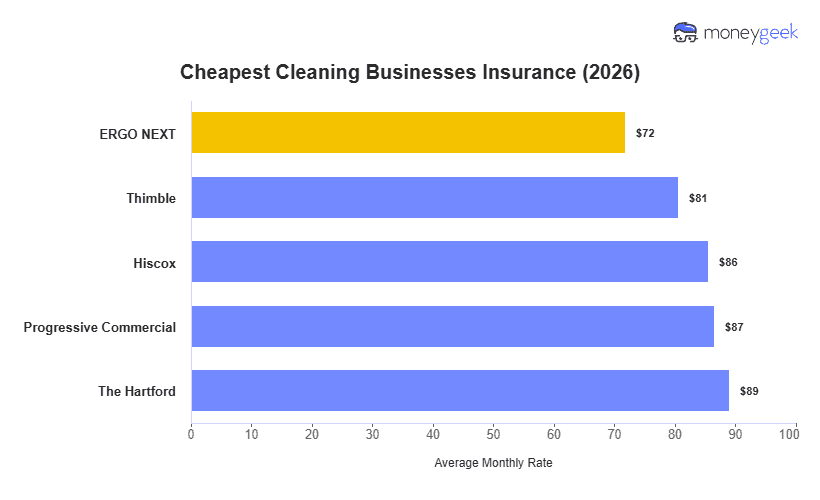
ERGO NEXT offers the cheapest business insurance for most cleaners, but six other providers come within $10 of ERGO NEXT's rate, so your lowest-cost option often comes down to the type of cleaning work you do, how many people you employ and the coverage your work actually requires. See how all seven providers compare below:
Cheap Cleaning Business Insurance
ERGO NEXT, Thimble and Hiscox offer the lowest rates for cleaning business insurance, and premiums can reach as low as $10/mo. The cheapest provider for your cleaning business depends on your type of work, company size, location and desired coverage type.
Need proof of insurance fast? Save up to 44% with your cheapest cleaning business insurer match with our tool below.
Select state
Updated: August 30, 2026
Advertising & Editorial Disclosure
Cheapest Cleaning Business Insurance Companies
| ERGO NEXT | $72 | $863 |
| Thimble | $81 | $966 |
| Hiscox | $86 | $1,026 |
| Progressive Commercial | $87 | $1,039 |
| The Hartford | $89 | $1,069 |
| biBERK | $89 | $1,074 |
| Nationwide | $91 | $1,094 |
How We Determined the Cheapest Cleaning Business Insurance Providers
Rankings are based on a standardized 1 to 4 employee business profile across 16 cleaning sub-industries, using $1 million per occurrence / $2 million aggregate limits for all coverage types except workers' comp, which follows state-mandated limits.
Cleaning businesses span a wide range of work types, from fixed-location operations like laundromats and dry cleaners to mobile crews doing gutter cleaning, air duct cleaning or commercial kitchen hood cleaning. That range affects how carriers price coverage, which is why the cheapest provider often depends on what kind of cleaning work you do. Each breakdown covers which provider prices lowest by coverage type and sub-industry, and where strong lower-cost alternatives exist.
Cheapest Cleaning Business Insurance by Cleaning Profession
The cheapest provider can change based on the kind of cleaning work you do, but the results are not evenly spread across the market. ERGO NEXT leads most cleaning professions, including air duct cleaning, chimney sweeping, pool cleaning and gutter cleaning, while biBERK shows up for dry cleaners and laundromats. That pattern suggests the lowest-cost option often depends on whether you work inside client homes or commercial spaces, bring equipment from job to job, or run a storefront-based business.
See how the cheapest provider breaks down by cleaning profession in the table below:
| Air Duct Cleaning | ERGO NEXT | $63 | $758 | 23% |
| Carpet Cleaning | ERGO NEXT | $90 | $1,075 | 19% |
| Chimney Sweep | ERGO NEXT | $54 | $643 | 22% |
| Drain Cleaning Service | ERGO NEXT | $88 | $1,050 | 22% |
| Dry Cleaners | biBERK | $75 | $902 | 10% |
| Garbage Collection | ERGO NEXT | $131 | $1,571 | 13% |
| Gutter Cleaning | ERGO NEXT | $63 | $757 | 19% |
| Hood Cleaning Service | ERGO NEXT | $70 | $841 | 21% |
| House Cleaning Service | ERGO NEXT | $79 | $951 | 17% |
| Janitorial Services | ERGO NEXT | $74 | $887 | 20% |
| Junk Removal Service | ERGO NEXT | $120 | $1,437 | 18% |
| Laundromat | biBERK | $73 | $880 | 9% |
| Maid Service | ERGO NEXT | $77 | $928 | 18% |
| Pool Cleaning | ERGO NEXT | $60 | $725 | 23% |
| Pressure Washing | ERGO NEXT | $76 | $910 | 17% |
| Window Cleaning | ERGO NEXT | $78 | $940 | 19% |
If you want to see the cheapest options by subindustry, we prepared resources showing affordable options to find the best fit for your budget:

Cheapest Cleaning Business Insurance by Coverage Type
The cheapest policy for a cleaning business can change depending on the type of work you do and the coverage you need. A solo maid service may only need general liability and a simple policy setup, while a drain cleaning or carpet cleaning business with employees, commercial contracts and company vehicles may also need workers' comp, commercial auto and higher coverage limits.
Professional liability and commercial property often cost less because cleaners usually face more risk from on-site injuries, damage to client property and driving between jobs than from errors in advice or damage to a building or equipment they own. The lowest-cost provider for each major coverage type can differ from the cheapest overall insurer, so comparing by coverage type gives you a more accurate picture.
| Professional Liability | Simply Business | $10 | $125 | 44% |
| Commercial Property | ERGO NEXT | $20 | $234 | 24% |
| General Liability | biBERK | $81 | $970 | 19% |
| Workers' Comp | ERGO NEXT | $94 | $1,129 | 30% |
| Commercial Auto | Progressive Commercial | $142 | $1,705 | 22% |
If you want to compare by coverage type, review options for each policy to find the best fit for your budget:





Is the Cheapest Insurance Right for Your Cleaning Business?
Cheap coverage can be the right call when the policy fits your work and meets the standards of the best business insurance for your cleaning businesses. These four factors help you evaluate whether a lower-cost option holds up for your operation:
- Coverage limits: Some commercial cleaning contracts specify minimum liability limits, and a policy that prices low by capping coverage may disqualify you from the jobs you're trying to win.
- Deductibles: Cleaning work generates small, frequent claims like a broken fixture, a stained carpet or a damaged surface, so a high deductible can offset whatever you saved on premiums.
- Add-ons: Bonds, equipment coverage and chemical liability aren't always included in base policies, but a hood cleaner or chimney sweep taking on commercial accounts or a cleaner working in occupied homes may need all three.
- Claims handling and customer service: When a carpet cleaner or window cleaning crew gets blamed for property damage on a job site, slow claims support can put your next booking and client relationship at risk.
How to Get More Affordable Coverage Without Being Underinsured
Cleaning businesses looking for cheap business insurance doesn't mean settling for less. It means structuring your coverage strategically, and these six strategies can help you lower your premium without leaving your operation exposed.
 Bundle policies with the same provider
Cleaning businesses that need general liability, commercial auto and tools coverage can often save by placing all three with one carrier. Bundling reduces administrative costs for the insurer, and insurers often pass those savings to you in the form of a lower premium. A hood cleaning or drain cleaning business with multiple coverage needs gets the most out of bundling.
 Check your business classification code
Insurers assign classification codes based on the type of work you do, and an incorrect code can raise your cost of cleaning business insurance beyond what your actual risk warrants. A window cleaner misclassified under a general contractor code, or a maid service grouped with industrial cleaning operations, may be overpaying significantly. Ask your insurer to confirm your code matches your actual work.
 Raise your deductible strategically
A higher deductible lowers your monthly premium, but it works best when your claims history is clean and your jobs carry lower damage risk. A solo window cleaner with no prior claims may find this trade-off worthwhile, while a crew handling high-value commercial properties may want to keep the deductible low to avoid large out-of-pocket costs on damage claims.
 Compare quotes using the same coverage limits
Rate comparisons only mean something when the underlying coverage is identical. Cleaning businesses often carry different liability limits depending on whether they work residential or commercial accounts, so a quote built around a $500,000 limit won't compare fairly against one built around $1 million. Lock in the same limits, deductibles and coverage types before comparing small business insurance quotes from multiple carriers.
 Pay annually instead of monthly
Most carriers charge an installment fee when you pay monthly, which adds to your total cost over the year. Paying your premium upfront in a single annual payment removes that fee and can reduce your overall spend. For a solo cleaner or small crew running on project-based income, timing that payment around a strong revenue period makes it easier to manage.
 Reduce your claim risk
Fewer claims over time can lead to lower premiums at renewal. For cleaning businesses, that means training crews on proper chemical handling, using floor signage during wet work, documenting property conditions before and after each job, and maintaining equipment regularly. A chimney sweep or gutter cleaning business with a strong safety record gives carriers less reason to price risk into the policy.
Cheap Cleaning Business Insurance: Bottom Line
Cleaning businesses operate across a wide range of risk profiles, and what counts as cheap coverage depends heavily on where your business sits within that range. A pool cleaner or maid service working residential accounts carries different exposure than a commercial cleaning crew handling multiple job sites, using company vehicles and working around expensive client equipment. The right measure of cheap is the lowest premium that still covers how your business actually operates.
How We Determined the Cheapest Cleaning Business Insurance Providers
To identify the cheapest cleaning business insurers, we analyzed real pricing data from seven major providers and modeled a large set of standardized pricing estimates across common U.S. cleaning business profiles.
Dataset scope and assumptions
- Providers analyzed: 7 major insurance providers
- Sub-industries covered: 16 cleaning sub-industries
- Geography: all U.S. states and territories (including Washington, D.C.)
- Employee count bands: 0, 1–4, 5–9, 10–19 and 20–49 employees
- Policy baseline: standard $1 million per occurrence / $2 million aggregate for all coverage types except workers' comp, which uses state-mandated coverage limits
- Pricing estimates modeled: 196,000 total estimates
We also incorporated modeled average revenues and payrolls across cleaning business profiles to improve pricing accuracy.
How we determined which provider was "cheapest"
We used this dataset to determine which insurers were most often the lowest-cost option across different cleaning business profiles. Our "cheapest" rankings include both:
- General Recommendation: Provider rankings based on average estimated pricing for a standardized 1–4 employee business profile across all cleaning sub-industries in our dataset.
- Factor Combination Recommendations: Provider rankings based on which insurer was most often cheapest within specific business factor combinations. For example:
- Cleaning sub-industry pricing was compared using a standardized 1–4 employee profile
- Coverage type affordability was derived by comparing aggregated pricing trends across cleaning sub-industries
Important note: These results represent standardized pricing estimates, not personalized quotes. Actual pricing can vary based on your business classification, revenue/payroll, claims history and the specific limits, deductibles and endorsements you choose. For the most accurate cheapest-provider answer, we recommend comparing quotes apples-to-apples using the same coverage limits.
About Angelique Palenzuela-Cruz

Angelique Palenzuela-Cruz is a Business Insurance Content Writer at MoneyGeek, where she specializes in general liability, workers’ compensation and professional liability insurance. Her work helps small business owners understand how these policies apply to coverage, including risks like customer injuries, employee injuries, professional mistakes, client contract terms and industry-specific coverage requirements.
She primarily covers service-based businesses where liability and employee coverage decisions are especially important, including cleaning, consulting, beauty and wellness, childcare, education, fitness, food service, pet care, repair and maintenance, and other professional services.
Before joining MoneyGeek, Angelique spent nearly 12 years at Guthrie-Jensen Consultants, one of Southeast Asia’s largest management training firms, where she advanced from Training Consultant to Managing Consultant. In that role, she worked with business clients to assess operational needs, develop training programs and present performance analyses to executive decision-makers. She also helped establish Gladwin Training Consultancy, where she served in learning solutions and client service roles.
Her background gives her practical context for writing about how businesses operate, manage client expectations, structure teams and make risk decisions. At MoneyGeek, she applies that experience to business insurance content, connecting coverage to actual business needs.
LinkedIn: linkedin.com/in/ma-angela-cruz
Email Contact: angelique.palenzuela@moneygeek.com