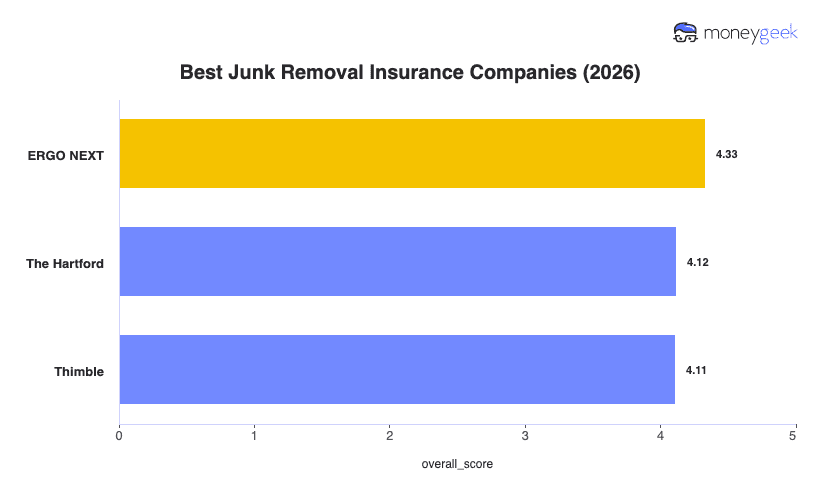
Best Business Insurance Companies For Junk Removal

My best business insurance carrier picks for junk removal services are:

  • Choose if you have a small crew and have straightforward coverage needs: ERGO NEXT
  • Choose if you have complex coverage needs and run a larger business: The Hartford
  • Choose if you need flexible coverage terms or do seasonal work: Thimble

I didn’t base my junk removal insurance rankings on price alone. I weighted affordability at 50%, customer experience at 30% and coverage options at 20% because your premium has to fit the business, but a low rate loses value if the insurer is difficult to deal with or the policy doesn’t match how you work. My analysis used AI to assist with research and analysis, not to make the rankings.

  • Affordability: I compared quoted premiums for junk removal businesses across providers and employee sizes to see where each insurer actually saves you money. I also checked whether that advantage held as a crew changed size rather than relying on one business profile.
  • Customer Experience: More than 300,000 customer reviews, forum discussions and industry sources helped identify recurring service patterns. I also went through each insurer’s quote process and policy-management tools myself to see what buying and managing coverage would actually feel like.
  • Coverage Options: I looked beyond the number of policies an insurer sells and checked whether its terms, exclusions and available add-ons fit junk removal work. That matters when your business depends on vehicles, works on customer property or needs coverage that can keep up with changes in how you operate.

See our full business insurance methodology.

ERGO NEXT

ERGO NEXT: Best for Small Crews and Straightforward Coverage Needs

On ERGO NEXT's site
checkmarkpros
  • Below-average rates for small junk removal crews

  • Fast COIs and free additional insureds

  • Contractors’ E&O included for cleanout disputes

closecons
  • Expensive for solo junk removal operators

  • No pollution or environmental liability coverage

  • Commercial auto handled through Progressive

COMPANY HIGHLIGHTS

I’d recommend ERGO NEXT for most junk removal businesses, especially small crews that need coverage quickly to start a job or meet a client requirement. You can get covered online in about 10 minutes, making it easier to take on jobs that require proof of insurance upfront. ERGO NEXT also had the lowest rates in my analysis, averaging 23% below the industry benchmark. That works out to about $422 in annual savings, which could help cover fuel or routine truck and equipment upkeep.

Learn More: ERGO NEXT Business Insurance Review

The Hartford

The Hartford: Best for Complex Coverage Needs and Larger Businesses

On The Hartford's site
checkmarkpros
  • Competitive rates for larger junk removal crews

  • Strong loss prevention and risk-management support

  • Solid claims support for property damage

closecons
  • More expensive for solo junk removal operators

  • Some COI requests may take longer to process

COMPANY HIGHLIGHTS

I’d recommend The Hartford for junk removal businesses with more moving parts, such as multiple vehicles, employees or a wider mix of jobs. You'll need to speak with an agent to complete some purchases, but that can be useful if your coverage needs aren’t straightforward and you want help sorting through your options. The Hartford won’t save you as much as some competitors, but it offers strong support after you buy, including risk-management resources that can help you prevent claims and guidance if one happens.

Learn More: The Hartford Business Insurance Review

Thimble

Thimble: Best for Flexible Coverage Terms and Seasonal Work

checkmarkpros
  • Flexible coverage for seasonal or project-based work

  • Below-benchmark rates for small crews

  • Monthly coverage can be paused temporarily

closecons
  • Higher-than-average rates for solo operators

  • Limited coverage options for junk removal businesses

COMPANY HIGHLIGHTS

If your junk removal work varies a lot month to month, I’d consider Thimble. You can buy coverage for a single job or choose shorter terms instead of committing to a full year. Thimble Monthly also lets you pause your policy once for up to 30 days, which helps if work slows temporarily and you don’t want to keep paying for active coverage you aren’t using. That flexibility makes Thimble especially useful for seasonal operators, newer businesses testing demand or crews that take on junk removal work only part of the year.

Learn More: Thimble Business Insurance Review

What Types of Insurance Do Junk Removal Businesses Need?

I’d start with general liability and commercial auto insurance for most junk removal businesses. If replacing stolen or damaged tools would strain your budget, consider tools coverage. Once you start hiring employees, workers’ comp becomes another policy to include in your mix. From there, your needs depend on how your business operates, especially if you own a yard or handle hazardous materials.

Pays for third-party injury or property damage claims. That includes a damaged doorway during a move-out or someone getting hurt near the work area.
You’re taking jobs inside homes, offices or other customer properties.
Moving bulky items through someone else’s property creates plenty of opportunities for accidental damage. Commercial clients may also require proof of liability coverage before your crew can start.
Protects vehicles used for business and can cover liability after an accident while hauling junk to a landfill, transfer station or the next job.
Your truck or van is being used for junk removal work rather than personal driving.

Your truck is both transportation and part of how you earn revenue. FMCSA estimates a non-injury large-truck crash costs about $49,000 on average, so even a crash without injuries can become a major financial hit.

Helps pay medical bills and lost wages when an employee gets hurt doing the job, like lifting injuries and cuts from debris.
You hire employees and your state’s workers’ comp rules apply.

Waste collection workers had about twice the injury and illness rate of janitorial workers in 2024, so employee injuries are a real concern for junk removal crews.

Inland marine / tools and equipment
Protects portable tools and equipment when they’re in transit, at a jobsite or away from your main business location.
Replacing stolen or damaged gear would noticeably disrupt your cash flow or your ability to finish jobs.
If valuable gear is stolen or damaged, your crew won’t be able to finish jobs until you replace it. Tools coverage keeps that replacement cost from coming entirely out of your operating cash.
Covers a business location and property kept there against covered losses such as fire or theft.
You lease or own a yard, office, warehouse or storage space.
Once you have a yard or storage location, a fire, theft or other covered loss affects more than the building itself. It also puts stored gear and day-to-day operations at risk.
Pollution liability
Covers certain cleanup costs and liability tied to spills or contamination from materials your crew handles.
Your jobs involve materials that could leak, spill or create an environmental hazard.

Junk removal can bring you into contact with materials that need special handling. EPA warns that household hazardous waste such as paint, oils and batteries can create health or environmental risks when improperly handled or disposed of.

scale icon

WHY GETTING JUNK REMOVAL INSURANCE IS IMPORTANT

With a junk removal business, you carry risks across different areas of your operations. For example, your crew lifts heavy items on someone else’s property, then hauls them away in a work vehicle. On a single job, someone could strain their back or develop a more serious lumbar injury, while a truck accident could leave one of your vehicles out of service.

One bad job can eat through the profit from many routine pickups. You may also have to cover those costs while the business is still trying to operate. Insurance gives you a way to transfer some of that financial risk instead of carrying all of it yourself.

How Much Does Junk Removal Business Insurance Cost?

The cost of junk removal insurance depends on the coverage you need. In my analysis, commercial property is the most affordable, averaging about $30 per month, while workers’ comp reaches about $322 per employee. I based my estimates on a junk removal business with one to four employees, so expect your quote to be different if you've set your operations up differently. Besides the number of people in your payroll, how much you pay for coverage also depends on how many trucks you have, the types of items you haul, where you dispose of them and how much coverage your contracts require.

Costs by coverage type are as follows for junk removal companies:

  • General Liability: $142 per month ($1,703 per year)
  • Commercial Auto: $198 per month per vehicle ($2,381 per year per vehicle)
  • Workers' Comp: $322 per month per employee ($3,864 per year per employee)
  • Tools and Equipment: $25 per month ($300 per year)
  • Pollution Liability: $223 per month ($2,675 per year)
  • Commercial Property: $30 per month ($365 per year)
  • Cyber Insurance: $73 per month ($873 per year)

What Are These Costs Based On?

Use our business insurance cost calculator to choose the coverage and business details that match your junk removal operation, then select Get Quotes to see prices from insurers.

Estimate Your Junk Removal Insurance Cost
Select Coverage Type
Select State
Select Employee Cand
Select Vehicle Type
Average Monthly Cost

Calculator Disclaimer

How To Buy The Best Junk Removal Insurance

Buying junk removal insurance is easier when you work through the decisions one at a time instead of jumping straight to price. Start with what your business actually needs, then compare providers and policy terms from there. Our Junk Removal Business Insurance Buying Checklist can help you keep track as you go.

  1. 1

    Identify Required Coverage for Your Junk Removal Business

    If you have employees, check your state’s workers’ comp rules. Your trucks also need the right commercial auto coverage, and some interstate hauling or regulated waste work can trigger extra insurance requirements. Local licenses or waste-hauling permits sometimes set their own rules too, so check the agency that issues them before you start taking jobs.

    Once you've covered all state and agency mandates, review your contracts. A commercial client may require certain liability limits and ask for a certificate of insurance (COI) before work begins.Some might require you to add them as an additional insured

    Read More: Business Insurance Requirements

  2. 2

    Map Business Risks to Coverage Types

    Match each major risk to the policy that would respond. For example, if you’re likely to damage customer property on the job, you’ll probably need general liability. If you handle materials that could spill or contaminate property, check whether you also need pollution liability. But don’t stop at the obvious risks. If you sometimes remove chemicals, fuel, paint or other materials that can spill or contaminate property, check whether you need pollution liability rather than assuming general liability will respond.

  3. 3

    Set Appropriate Limits for Your Risks

    Don’t automatically buy the highest limits available. Start with what your contracts require, then think about the size of the jobs you take and how expensive a worst-case claim could be. A small residential cleanout needs less protection than commercial debris work or jobs inside high-value properties. For general liability, $1 million per occurrence and $2 million aggregate is a common starting point, but increase it when your contracts or exposures justify more.

    Read More: How Much Business Insurance Do I Need?

  4. 4

    Research Providers Before Requesting Quotes

    Marrow your list to insurers that fit the way you want to buy and manage coverage. For junk removal, I’d check how quickly you can get a COI and whether you can handle policy changes yourself or need help from an agent.

    Then look at whether the insurer is comfortable with the work you actually do. If you haul for hire or sometimes take jobs with unusual disposal risks, confirm those details upfront so you don’t spend time comparing a provider that may not fit your operation.

  5. 5

    Compare Quotes Using the Same Limits

    When you compare business insurance quotes, keep the setup as close to identical as possible. If one quote uses lower liability limits or leaves out coverage for tools, it can look cheaper without actually being the better deal. For junk removal, I’d compare the same crew size, vehicle details, deductibles and limits so you can see what each insurer really charges for the protection you need.

  6. 6

    Review Your Policy Before Buying

    Before you pay, read the exclusions against the jobs you actually take. For junk removal, I’d pay close attention to hazardous materials and pollution exclusions, since those can create expensive gaps if your crew removes items the policy doesn’t cover. Then check whether the policy reflects how you haul. Some commercial auto insurers exclude for-hire debris removal, so make sure the policy covers your trucks for the work they do.

  7. 7

    Reassess Your Needs as Your Junk Removal Business Changes

    Your insurance should keep up with how your junk removal business operates. If you drop a truck, start using subcontractors more often or stop taking residential cleanouts, some of your existing coverage may no longer fit the same way. The opposite is also true. Taking on heavier debris or jobs involving regulated materials introduces risks your current policies don’t address. Review your coverage when your work changes enough that the assumptions behind your old policy no longer match the jobs you’re taking.

Junk Removal Insurance: FAQ

These question cover topics about junk removal business insurance that are easy to miss but can still affect whether you’re ready to take on work.

Best Insurance for Junk Removal Business: Bottom Line

I’d recommend ERGO NEXT for most junk removal businesses because it combines the lowest average rate in my analysis with quick online purchasing and easy access to proof of insurance. Thimble fits businesses with seasonal or uneven workloads, while The Hartford works better for larger operations that want more coverage under one insurer and more hands-on support.

Whichever provider you choose, make sure the policy fits the jobs you actually take. Start with general liability and commercial auto, then add tools coverage or workers’ comp when your setup calls for them. Compare quotes using the same limits and check exclusions for issues like debris hauling or hazardous materials before you buy.

Best Junk Removal Insurance Chart

Get Junk Removal Business Insurance Quotes

How you run your junk removal business affects your rates and which insurer fits best. A single truck handling residential pickups has different needs from multiple crews working commercial accounts, where client contracts can dictate your limits or required endorsements. I’d compare business insurance quotes from several providers so you can see who meets those requirements at a price that works for your budget.

About Angelique Palenzuela-Cruz


Angelique Palenzuela-Cruz, Business Insurance Writer, MoneyGeek

Angelique Palenzuela-Cruz is a Business Insurance Content Writer at MoneyGeek, where she specializes in general liability, workers’ compensation and professional liability insurance. Her work helps small business owners understand how these policies apply to coverage, including risks like customer injuries, employee injuries, professional mistakes, client contract terms and industry-specific coverage requirements.
She primarily covers service-based businesses where liability and employee coverage decisions are especially important, including cleaning, consulting, beauty and wellness, childcare, education, fitness, food service, pet care, repair and maintenance, and other professional services.
Before joining MoneyGeek, Angelique spent nearly 12 years at Guthrie-Jensen Consultants, one of Southeast Asia’s largest management training firms, where she advanced from Training Consultant to Managing Consultant. In that role, she worked with business clients to assess operational needs, develop training programs and present performance analyses to executive decision-makers. She also helped establish Gladwin Training Consultancy, where she served in learning solutions and client service roles.
Her background gives her practical context for writing about how businesses operate, manage client expectations, structure teams and make risk decisions. At MoneyGeek, she applies that experience to business insurance content, connecting coverage to actual business needs.

LinkedIn: linkedin.com/in/ma-angela-cruz

Email Contact: angelique.palenzuela@moneygeek.com


Sources