



Jump to the section that meets your needs best below:
Average Junk Removal Insurance Cost (2026 Report)
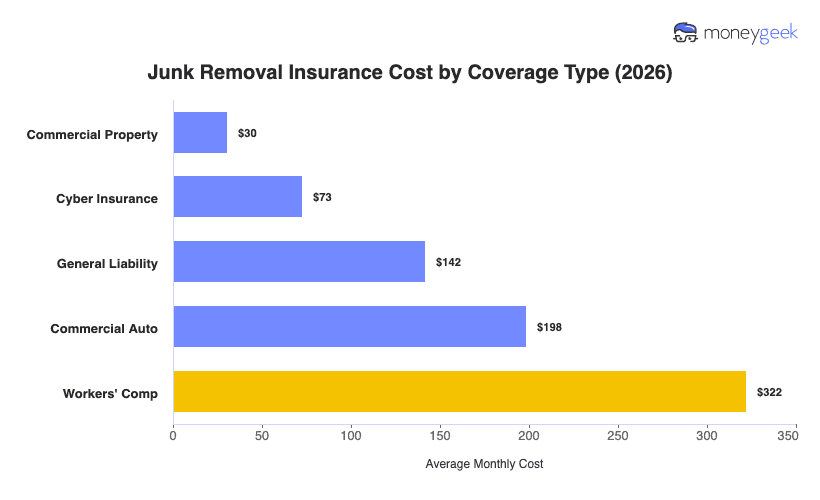
Junk removal business insurance runs between $30 and $322 per month, based on your truck count, crew size and the types of jobs you take on.
If you're ready to get a quote, use the tool below to get matched with the best business insurance provider for your junk removal operations.
Select state
Updated: September 8, 2026
Advertising & Editorial Disclosure
How Much Does Junk Removal Insurance Cost?
The cleaning business insurance cost for junk removal runs around $153 per month, or about $1,837 per year, averaged across the five coverage types, though that figure covers junk removal companies with one to four employees, policy limits of $1 million per occurrence and $2 million aggregate, across 50 states and Washington, D.C.
Individual policy costs range from around $30 per month to $322 per month. Commercial property prices low because most junk removal businesses don't own commercial real estate. Workers' compensation prices highest because your crew is rink injuring themselves from the heavy lifting, loading and unloading.
The figures below are benchmarks, not quotes, since your actual premium depends on your payroll, fleet size and the jobs you take on.
| Commercial Property | $30 | $365 | 76% | 132 |
| Cyber Insurance | $73 | $873 | 13% | 185 |
| General Liability | $142 | $1,703 | 15% | 301 |
| Commercial Auto | $198 | $2,381 | -22% | 312 |
| Workers' Comp | $322 | $3,864 | -185% | 378 |
We analyzed quote data from major U.S. commercial insurance providers and modeled standardized premium estimates across business profiles representing around 95% of the market. Results are designed to provide a consistent national benchmark showing how premiums vary by key baseline factors including business size, restaurant profession type, location and vehicle type for operations that use commercial vehicles.
Dataset Scope and Assumptions
Our cost modeling uses standardized inputs for consistent comparisons across businesses.
- Total estimates modeled: just over 6 million standardized pricing estimates
- Providers analyzed: 10 major insurance providers
- Professions covered: 6 real estate profession categories
- Geography: all U.S. states including Washington, D.C.
- Employee count bands: solo practitioners, one to four, five to nine, 10 to 19, and 20 to 49 employees
- Vehicle types studied: Sedans, SUVs, pickup trucks, vans, taxis, limousines, tractors, food trucks, semi-trucks (non-HAZMAT and HAZMAT), tanker trucks (non-HAZMAT and HAZMAT), buses, box trucks, dump trucks, flatbed trucks
- Policies studied: general liability, workers' comp, professional liability, commercial auto, commercial property, and cyber insurance
- General liability: $1 million per occurrence and $2 million aggregate
- Workers' comp: state required coverage
- Professional liability: $1 million per claim and $1 million aggregate
- Commercial auto: minimum coverage
- Commercial property: personal property coverage limits personalized to industry, business size and state
- Cyber insurance: $1 million per occurrence and $1 million aggregate
How We Calculated Average Junk Removal Business Insurance Costs
Our published averages represent modeled premiums for standardized business profiles and were aggregated in two ways.
- National benchmark average: The national average cost reflects the modeled premium for a standardized one to four employee business across all and states included in our dataset for a standard policies
- Segment averages: To show how costs vary, we calculated average modeled premiums for our national base profile and isolated for variables, including:
- Employee count (business size ranges)
- Profession / industry categories
- Vehicle types (for commercial auto)
- States (including Washington, D.C.)
Segment averages were produced by aggregating modeled pricing trends across the full dataset so readers can compare how premiums shift across coverage types and regions.
See our full business insurance methodology.
Get Junk Removal Business Insurance Cost Estimates
Use our janitorial business insurance cost calculator below to get personalized estimates based on your company details and desired coverage type. Keep in mind the following before using our tool:
- No personal information is gathered
- You will not receive spam
- Workers' comp rates are on a per-employee basis
Once you get an idea of what costs are for your company, you can click Get Quotes to get matched to your ideal insurer based on what you entered.
Get Junk Removal Insurance Cost Estimates
Select Coverage Type
Select State
Select Employee Count
Select Vehicle Type
Monthly Rate Estimate—
Select Coverage Type
Monthly Rate Estimate—
Select State
Select Employee Count
Select Vehicle Type
Factors Affecting Junk Removal Insurance Cost
Several factors affect what you pay for junk removal business insurance, and not all of them carry equal weight. In our analysis, the gap between the lowest and highest coverage costs depends on a handful of operational variables specific to how junk removal businesses work.
 Physical labor intensity and injury exposure
Junk removal crews perform some of the most physically demanding work in the service industry, including lifting refrigerators, hauling mattresses and loading debris from tight spaces. Under NCCI classification, junk removal carries one of the higher workers' compensation rates in the service industry, well above standard commercial cleaning, because of the consistent physical demands the work places on crew members every job.
 Vehicle type and fleet size
Each truck in the fleet is underwritten separately, and the type of vehicle matters as much as the count. A box truck, dump trailer and roll-off truck carry different risk profiles in the eyes of an insurer. When any vehicle exceeds 26,000 lbs GVWR, the driver requires a CDL and the premium reflects the elevated exposure that comes with operating heavier commercial equipment.
 Client and job type mix
The job mix directly shapes liability exposure. Residential cleanouts create property damage risk such as scratched floors and nicked doorframes, while commercial accounts such as property managers and general contractors require higher coverage limits and additional insured endorsements. Estate cleanouts introduce professional liability exposure that standard debris hauling does not.
- Materials handled
Load type directly affects how insurers assess operational risk. Accepting construction debris, old appliances or potentially regulated materials without screening leads underwriters to treat the operation differently than a business that runs selective load policies. Hauling without a consistent materials acceptance process invites closer scrutiny when applying for pollution-adjacent coverage.
 Subcontractor use
When subcontractors are brought in for overflow jobs, the general liability policy may not automatically extend to their work. Using uninsured subcontractors or misclassifying day laborers as independent contractors can create workers' compensation liability exposure that the policy was not written to cover.
How to Lower Junk Removal Insurance Costs
A junk removal operation carries more moving parts than most service businesses: physical labor, vehicles on the road and work performed inside client property, all on the same job. MoneyGeek's analysis shows that the combination pushes insurance costs wider than most service trades. Some of these methods can shift the premium within the current policy period, while others take longer, but both paths lead to lower business insurance rates.
 Compare quotes using the same coverage limits
When you're shopping for coverage, comparing multiple business insurance quotes only works as a cost-saving strategy if you're comparing identical coverage structures. Carrier pricing for commercial auto and workers' comp varies significantly depending on whether the insurer regularly underwrites hauling and trade operations, so a quote built on lower limits isn't a better deal. It's just a different product.
 Right-Size Your Coverage
If your operation doesn't need a particular coverage, carrying it raises your premium without adding real protection. A solo operator running residential debris jobs, for example, may be paying for a professional liability policy built for estate cleanout work that doesn't apply to anything on their actual job list. Before your next renewal, review each policy against what your clients require and what your work actually involves.
 Bundle policies with the same provider
Placing your general liability and commercial auto coverage with the same insurer often unlocks a reduced combined premium, and for most junk removal businesses, those are the two policies you need at minimum. Some carriers extend bundling to workers' comp as well, depending on their appetite for this class of business.
 Lower your risk profile
The most effective way to reduce what you pay over time is to give insurers less reason to charge you more. In junk removal, back injuries, property damage during removal and truck incidents are the claims that hurt your premiums most, and they are also among the most preventable. A clean multi-year record produces experience modification adjustments that reduce your workers' comp base premium and can lower renewal rates across your other policies.
 Invest in risk management practices
Workers' comp injuries and general liability property damage are your two biggest claim exposures in junk removal, and both are operationally preventable. Reducing how often those claims occur is the most durable way to lower what you pay at renewal.
- Walk each job site with your crew before loading begins to identify fragile flooring, narrow hallways and any damage already present on residential or commercial properties
- Make sure your team trains on proper two-person lift techniques before handling appliances, heavy furniture or bulk debris
- Keep every truck your crew operates covered on public roads to prevent debris spillage claims
- Have your crew photograph pre-existing property conditions at the start of every estate cleanout or commercial job before any removal work begins
Junk Removal Insurance Cost: Bottom Line
The $153 monthly average for junk removal business insurance is a useful reference point, but it reflects a range of business profiles across five coverage types. When you get quotes, use these questions to put the figures in context:
- Where do you fall in the distribution? Locating your profile within the right benchmark is the starting point. The state you operate in, how many people you employ and the type of work you take on all shape where your quote should land.
- Is your quote consistent with your risk profile? If your quote lands well above or below the benchmarks for your profile, understand why before accepting or rejecting it. A lower number may reflect thinner coverage, while a higher one may point to how the insurer is rating your vehicles, payroll or claims history.
- Which cost drivers apply to your business? Not every factor carries equal weight for your operation. Fleet size matters more if you run multiple trucks than if you work from a single vehicle, and material acceptance only becomes a pricing factor when your jobs involve construction debris or appliances.
Knowing which ones apply and why they move your number matters more than knowing where your quote lands relative to the average. Use these benchmarks to set expectations so when your quote arrives, you'll know which variables to ask your insurer about.
About Connor Bolton

Connor Bolton is Senior SEO and Content Manager at MoneyGeek, where he leads the business and pet insurance editorial teams. He sets the research framework, data standards and content structure for his team. All content goes through his accuracy review before publication. Connor also writes in-depth guides and has spent more than four years covering insurance products across personal, commercial and specialty lines.
The research infrastructure Connor built covers auto, home, renters, life, health, business and pet insurance across pricing analysis, carrier research, customer experience and coverage evaluation. It includes over 6 million data points for business insurance across 408 industry areas, all 50 states and 16 vehicle types. The pet insurance side covers over 5 million profiles across 18 major providers, 100+ breeds and ages up to 20 years. Connor’s insurance research and his team's work have been cited by the U.S. Chamber of Commerce, Allstate, Liberty Mutual, CBS News, Forbes and LegalZoom.
Connor also talks with underwriters and carrier liaisons at Ethos, The Hartford, ERGO NEXT, Nationwide and State Farm, and monitors business and pet owner communities on Reddit. Those sources shape how his team evaluates carriers, structures rate analysis and writes content for real pet owners.
Questions about MoneyGeek's business or pet insurance content? Reach him at connor@moneygeek.com or on LinkedIn.