
Best Pressure Washing Business Insurance Companies

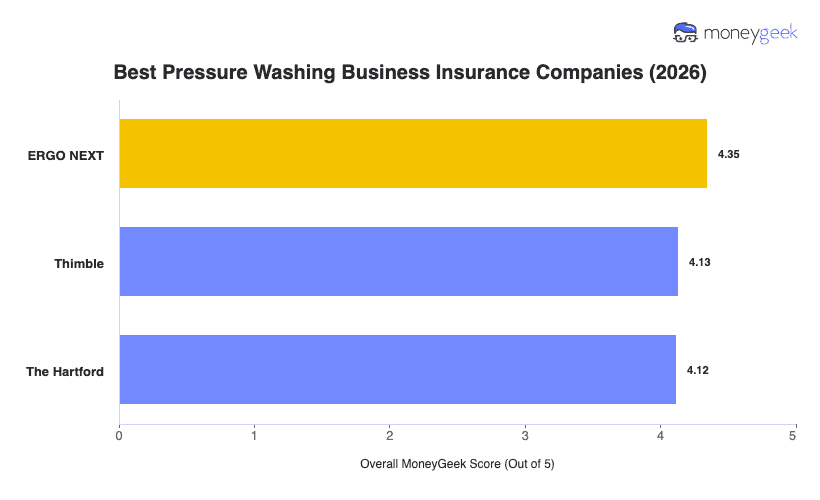
Pressure washing businesses face risks such as chemical or overspray damage to customer property and the theft or damage of mobile equipment. I compared average rates for the policies that cover these risks, then evaluated how quickly each insurer lets you buy coverage and get proof of insurance for a contract. I also considered how easy it is to update a policy and the support available when claims involve expensive damage to roofs, windows or other customer property. These three were my top picks:

  • Choose if you want the best value overall: ERGO NEXT
  • Choose if you want flexible coverage terms: Thimble
  • Choose if you want comprehensive coverage: The Hartford

Our rankings are built around small pressure washing businesses with one to four employees. We reviewed pricing from more than 1 million business profiles, over 100,000 customer experience records and policy information covering 408 sub-industries across all 50 states and Washington, D.C. Affordability makes up 50% of each provider’s score, followed by customer experience at 30% and coverage options and policy terms at 20%.

See our full methodology.

ERGO NEXT

ERGO NEXT: Best for Overall Value

On ERGO NEXT's site
COMPANY HIGHLIGHTS

ERGO NEXT is the best overall value provider for most pressure washers, but is an excellent fit for owner-operated businesses with steady residential or light commercial work. You can buy coverage, update your policy and create certificates online, which helps when a contractor or commercial customer needs proof of insurance before a job. It also has the most affordable average rate in our dataset, saving you around $18 per month. The biggest tradeoff is tools and equipment coverage. ERGO NEXT’s caps it at $10,000, which might not be enough if you have several pressure washers, tanks, generators and other gear carried on a trailer.

Learn More: ERGO NEXT Business Insurance Review

Thimble

Thimble: Best for Flexible Coverage Terms

COMPANY HIGHLIGHTS

Thimble works best for pressure washers who don't need year-round coverage. It's the only provider in our study that lets you buy insurance for a single job, a month or a full year. It's an excellent fit for seasonal businesses, washers who accept occasional side work and operators who take on short-term commercial contracts. That said, Thimble doesn't give you a lot of coverage options. It mainly provides general liability and limited equipment protection for pressure washers, so if you need pollution liability or want to insure an expensive trailer setup, you'll have to find financial protection elsewhere.

Learn More: Thimble Business Insurance Review

The Hartford

The Hartford: Best for Comprehensive Coverage

On The Hartford's site
COMPANY HIGHLIGHTS

I'd recommend The Hartford established pressure-washing businesses that need more than basic liability coverage. Its broader lineup can support operations with employees, business-owned vehicles, costly equipment and larger contracts that require higher limits. When a claim happens or a policy needs to change, you’re more likely to get clear updates, faster answers and help sorting out what happens next, which becomes more important as your coverage gets more complicated. That said, you'll have to pay more for that service. On average, The Hartford costs 7% higher than the industry average.

Learn More: The Hartford Business Insurance Review

Best Types of Insurance For Pressure Washing Businesses

For most pressure washing companies, I’d start with general liability and tools and equipment coverage, then add commercial auto if the business owns or leases a work vehicle. The best pressure washing insurance mix depends on your services, clients, vehicles and crew size, and could include coverage types that protects you financially against employee injuries or damage caused your business-owned truck in a crash.

The table below gives you a starting point for choosing your coverage:

Customer injuries and accidental damage to siding, windows, pavement or other property
All pressure washers should carry it.
$61

Tools and equipment

Theft or damage to pressure washers, hoses, surface cleaners and other mobile gear
You take equipment between job sites.
$34
Accidents involving trucks, vans and other vehicles your business owns
Your business owns a work vehicle.
$195
Medical bills and part of an employee’s lost pay after a work injury
You’ve hired a crew.
$102
Trailer coverage
Theft of or damage to a trailer used to carry equipment and water tanks
You use a trailer for work.
$22
Pollution liability
Claims and cleanup costs involving chemicals, wastewater or water flowing off the job site
You use chemicals or manage wastewater.
$192
Extra coverage when a large liability claim exceeds another policy’s limit
Contracts require higher limits.
$25

Best Pressure Washing Insurance Buying Checklist

The best business insurance for your pressure washing company isn't always the option with the lowest rate. Yes, cost matters, but you should also weigh coverage fit, contract requirements, provider eligibility and how easy the policy is to manage. This checklist helps you compare those factors in order so you don't choose a cheaper policy that leaves out coverage your business needs. This way, you're more likely to find a policy that meets your insurance requirements from a provider that fits your business.

Keep the Pressure Washing Business Insurance Buying Guide with you as you compare providers so you can capture quotes, note important policy differences and track answers that affects your final choice.

  1. 1

    Map Out How Your Pressure Washing Business Works

    A complete service description should cover standard cleaning work such as driveways, sidewalks, decks and building exteriors. Specialized services such as soft washing, roof cleaning or fleet washing should also be included. Beyond the services themselves, details that affect how insurers assess the operation, such as the surfaces cleaned and the chemicals and equipment used, should be documented. The same description should be submitted to every insurer so each quote reflects the full scope of the work.

  2. 2

    Define Your Coverage and Contract Requirements

    Matching risks to the appropriate policies before requesting quotes produces more accurate coverage. General liability and tools and equipment coverage form the foundation, with commercial auto added when business-owned trucks or trailers are in use and workers' compensation required after the first hire. Client contracts should be reviewed for required limits, additional insured status and proof of insurance deadlines. Pollution liability or umbrella coverage should be added when chemical use or larger contracts create risks the base policies do not cover.

  3. 3

    Confirm Provider Eligibility and Compare Fit

    The search should begin with insurers that clearly cover pressure washing businesses, then narrow to those that cover the specific services offered. A general provider may work for routine residential jobs, but an agency that regularly works with pressure washers is better positioned for roof cleaning, stronger chemicals, fleet washing or unusual equipment setups. Evaluating how familiar each provider is with similar operations, which coverages it carries and any limits or exclusions the policy contains helps narrow the list before requesting quotes.

  4. 4

    Request Comparable Quotes

    Each provider should receive the same information, such as revenue, payroll, services, equipment values, vehicle details and claims history. Requesting the same coverage types, limits and deductibles across every quote makes it possible to identify which carrier charges less for the same level of financial protection. A lower quote is not a stronger deal when it excludes equipment, reduces a limit or omits a service the operation provides.

  5. 5

    Review Coverage Terms and the Final Policy

    Before binding, the final policy should be compared against the selected quote. The coverages, limits, deductibles, price and start date should all be confirmed as matching. Any changes requested, such as adding a client or raising a limit, should appear in the final documents. When discrepancies exist, the insurer should be contacted before the policy is accepted.

Best Pressure Washing Business Insurance: Bottom Line

My analysis found that the best pressure washing business insurance companies are ERGO NEXT, Thimble and The Hartford, though that doesn't mean they're the ideal providers for all operations.

The strongest fit depends on how closely a policy matches the work performed. A pressure washer with routine residential jobs, portable equipment and no employees carries a different insurance profile from one handling large commercial clients or offering riskier services. The strongest choice combines the right coverage with a provider that can support how the operation runs.

Best Pressure Washing Business Insurance Chart

Best Pressure Washing Business Insurance: Next Steps

The next step depends on what is holding up the decision. Common scenarios include checking whether a policy applies, building the right coverage mix or setting a realistic budget before purchasing. The following scenarios address the most frequent decision points:

If you’re not sure what pressure washing insurance covers

If you’re not sure whether pressure washing insurance is required

If you need to prioritize pressure washing coverages

If you want to know what pressure washing insurance costs

About Angelique Palenzuela-Cruz


Angelique Palenzuela-Cruz, Business Insurance Writer, MoneyGeek

Angelique Palenzuela-Cruz is a Business Insurance Content Writer at MoneyGeek, where she specializes in general liability, workers’ compensation and professional liability insurance. Her work helps small business owners understand how these policies apply to coverage, including risks like customer injuries, employee injuries, professional mistakes, client contract terms and industry-specific coverage requirements.
She primarily covers service-based businesses where liability and employee coverage decisions are especially important, including cleaning, consulting, beauty and wellness, childcare, education, fitness, food service, pet care, repair and maintenance, and other professional services.
Before joining MoneyGeek, Angelique spent nearly 12 years at Guthrie-Jensen Consultants, one of Southeast Asia’s largest management training firms, where she advanced from Training Consultant to Managing Consultant. In that role, she worked with business clients to assess operational needs, develop training programs and present performance analyses to executive decision-makers. She also helped establish Gladwin Training Consultancy, where she served in learning solutions and client service roles.
Her background gives her practical context for writing about how businesses operate, manage client expectations, structure teams and make risk decisions. At MoneyGeek, she applies that experience to business insurance content, connecting coverage to actual business needs.

LinkedIn: linkedin.com/in/ma-angela-cruz

Email Contact: angelique.palenzuela@moneygeek.com