Key Takeaways
blueCheck icon

ERGO NEXT, The Hartford and biBERK are the best janitorial business insurance companies in our study, with rates starting at $74 per month. (Jump to Top Providers)

blueCheck icon

Because your crew works in client spaces with chemical agents and unsupervised access to client property, general liability, a janitorial bond and workers' comp are the coverage types you'll need most and the ones most commercial clients require before signing a contract. (Jump to Types You Need)

blueCheck icon

Janitorial business insurance coverage costs range from $13 to $185 per month depending on what your operation needs. (Jump to Costs)

blueCheck icon

Choosing the best janitorial business insurance means matching coverage types to your actual risks, setting limits that reflect your client contracts and revisiting your policy as your business grows. (Jump to Choosing Process)

Best Janitorial Business Insurance Companies

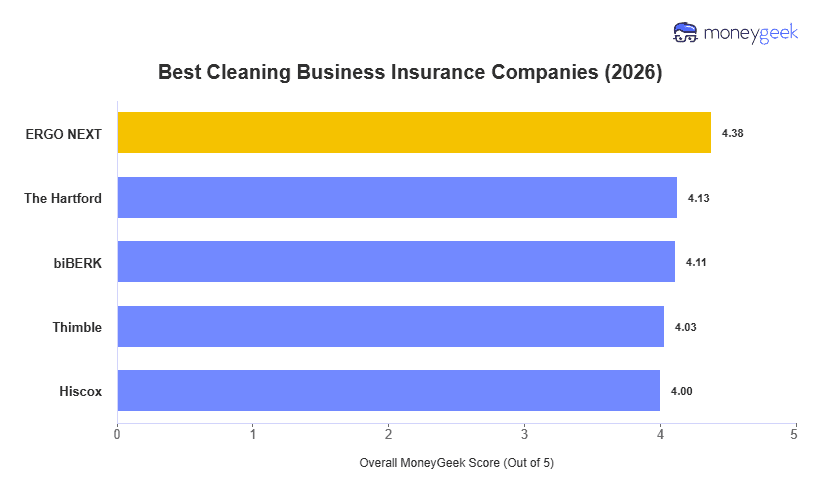
Our analysis of the best janitorial insurance companies put ERGO NEXT first, with top scores for both affordability and customer experience, an advantage when you're running a small crew and need coverage in place before a commercial client will sign. The Hartford ranked second overall on the strength of its coverage breadth, which gives larger janitorial operations more flexibility when contract terms require higher limits or additional insured endorsements.

We scored each provider on affordability, customer experience and coverage, and the table below how all seven insurers compare.

ERGO NEXT4.40$7413
The Hartford4.22$9531
biBERK4.16$8875
Thimble4.05$8056
Hiscox3.99$8727
Nationwide3.93$9462
Progressive Commercial3.92$8744

For our overall janitorial business insurance ratings, we analyzed pricing, coverage options and customer experience across all 50 states and Washington, D.C. Our analysis focuses on 1-to-4-person janitorial companies, while weighting results to ensure broader industry and location representation. We evaluated over six million business profiles, more than 100,000 customer experience data points and performed in-depth analysis of coverage contracts and endorsements to compare insurers consistently across industries and regions. We then rated each company across affordability (50%), customer experience (30%), and coverage options and terms (20%) to form an overall rating.

See our full business insurance methodology.

Rankings give you a starting point, but the best fit depends on how your janitorial operation is structured. A solo operator cleaning a mix of small offices and residential accounts has different priorities than a 12-person crew holding a commercial property management contract that specifies $2 million in aggregate GL coverage. ERGO NEXT is the stronger match when cost and turnaround matter most, while The Hartford suits operations with complex contract requirements and clients who review coverage terms closely before committing to a contract.

Each provider profile below breaks down who gets the most value from that carrier and where a different option would serve you better.

ERGO NEXT

ERGO NEXT

Best Overall for Janitorial Businesses
On ERGO NEXT's site

ERGO NEXT leads MoneyGeek's janitorial rankings across all 50 states plus the District of Columbia. ERGO Group and Munich Re backs its policies, and gives them an AM Best rating of A+ (Superior). You can expect to pay rates 18% below the industry average and its app generates certificates instantly, adds additional insureds on demand and sends them by email or text. The weaker area is claims as BBB filings include documented GL delays and denials.

Learn More: ERGO NEXT Business Insurance Review

The Hartford

The Hartford

Best for Janitorial Businesses With Complex Coverage Needs
On The Hartford's site

The Hartford ranks second overall in this study and first in coverage across all 51 geographies, with no venue exclusions, no revenue caps and no claims history limits on janitorial accounts. That consistency keeps Tom Rummel of Presto Cleaning on the same policy for six years, adding GL, umbrella and a waiver of subrogation along the way. AM Best rates the carrier A+ (Superior). At $95 per month, rates run about 6% above the industry average, which makes more sense for operations that need the coverage depth than for solo or small crews.

Learn More: The Hartford Business Insurance Review

What Types of Insurance Do Janitorials Need?

Janitorial businesses carry more coverage types than most service businesses of the same size because your crew works inside client spaces, not your own. Every job puts your crew in direct contact with client property, building occupants and chemical cleaning agents, and that combination creates exposure across multiple fronts at once. The coverage types most janitorial businesses need include:

  • General liability (since your crew works in occupied client spaces where a wet floor, a broken fixture or a displaced item can generate a claim on any job)
  • Janitorial bond (since most commercial clients require proof that your employees are bonded before they'll allow unsupervised access to their property)
  • Workers' compensation (if you have any employees, even part-time; required in most states, and janitorial work carries a higher injury rate than most service trades)
  • Commercial auto (if your crew drives to job sites in business-owned vehicles, or if you use personal vehicles regularly for work)
  • Commercial property (if you operate from a physical location where you store equipment, chemicals or supplies)
  • Cyber insurance (if you store client access credentials, building codes or employee records digitally)

For janitorial operations, coverage needs shift with headcount. Whether you're running solo or managing a crew of 15, you'll need general liability, but once you start hiring, workers' comp obligations, employment practices exposure and contract requirements also becomes necessary. The profiles below reflect those differences at each stage.

How Much Does Janitorial Business Insurance Cost?

Janitorial business insurance costs average $88 per month ($1,059 per year) across the common coverage types most janitorial businesses carry. Commercial auto runs highest because your crew drives to every job and vehicle liability is one of the most frequent claim sources in this trade. General liability ranks second because your crew works in client spaces on every shift, where slip-and-fall and property damage claims are routine.

Your actual cost depends on which coverages your business needs. If you're cleaning a handful of residential accounts on your own, your costs will sit well below that $88 average. Land your first commercial contract that requires proof of workers' comp and commercial auto, and your monthly premium can more than triple overnight. 

Your coverage mix is the strongest predictor of what you'll pay. Your per-coverage costs break down as follows:

How did we determine business insurance rates for janitorial services?

What you pay depends heavily on who your clients are and how your crew gets to job sites. Serving medical facilities or school districts pushes your GL limits higher than a roster of small office accounts. Workers' comp is calculated on total payroll, so if your crew works full-time on commercial accounts, you'll pay more than a business running the same number of part-time shifts. Run your specifics through the janitorial business insurance calculator for an estimate built around your operation.

Estimate Your Monthly Janitorial Insurance Cost

Enter your coverage type, state, number of employees and type of vehicle (if you need commercial auto coverage) to get a pricing estimate that fits your business.

We do not collect any personal information, and all rates are aggregated for all 50 states and Washington, D.C. Workers' comp rate estimates are provided on a per employee basis and all coverage types assume standard industry limit recommendations for most businesses.

Select Coverage Type
Select State
Select Employee Cand
Select Vehicle Type
Average Monthly Cost—

How to Choose the Right Janitorial Business Insurance

When you rush getting coverage, you might end up underinsured not because you chose the wrong policy but because you never matched your coverage to what your business really does. How to get business insurance right means starting with your risk profile, not a quote.

  1. 1
    Understand your risk profile and what coverage it requires

    Your risk profile in janitorial work depends on where you work, who you work for and how many people work with you. If you're cleaning residential accounts solo, your exposure looks very different from what you'd carry running a six-person crew under a hospital contract. Before you request a quote, identify which coverages are legally required in your state, which your client contracts specify and which your day-to-day work makes practically unavoidable regardless of what any contract says.

  2. 2
    Choose the right coverage limits

    Most commercial cleaning contracts accept $1 million per occurrence as a starting point, but your worst-case scenario may demand more. If you clean a medical facility and a contamination incident shuts down a procedure room, you could face remediation and liability costs that exceed your standard limits quickly. Set your limits based on the most demanding contract in your current portfolio and the most expensive claim your work could realistically produce.

  3. 3
    Evaluate providers who understand janitorial services

    A provider that scores well on affordability but poorly on coverage breadth can leave you with a policy that satisfies your budget but fails your client contract. In janitorial work, where clients review your certificate of insurance before your crew sets foot on site, carrying a policy with the wrong limits or missing endorsements leaves you as exposed as carrying no policy at all. Look for providers who score consistently across affordability, customer experience and coverage flexibility.

  4. 4
    Get compliance-ready

    When you sign a new commercial contract, buying the policy is only the first step. Your client will likely require a certificate of insurance naming them as an additional insured before your crew enters the building, and many also require a janitorial bond covering all employees with property access. Have your COI ready, confirm your bond reflects your full crew and check whether your client has any background check or documentation requirements before your first shift.

  5. 5
    Revisit your coverage as your spa janitorial service business grows

    Your coverage needs at year one look different from your needs at year three. When you add employees, you trigger workers' comp requirements and expand your bond obligations. Landing a healthcare or school district contract may push your GL limits past your current policy. Adding company vehicles shifts your auto coverage from a HNOA endorsement to a commercial auto policy. Review your coverage before each contract renewal and any time you add a new client type.

Get Janitorial Business Insurance Quotes

Not every insurer is equipped to handle the full range of janitorial operations, and the provider that works well for your solo retail route may not be the right fit if you're running a 20-person crew under a school district contract requiring $2 million in GL and named additional insured endorsements. Your crew size, your client roster and your contract terms all shape which provider actually fits. Request business insurance quotes to compare options matched to your operation.

About Connor Bolton


Connor Bolton, Senior SEO and Content Manager (Business & Pet), MoneyGeek

Connor Bolton is Senior SEO and Content Manager at MoneyGeek, where he leads the business and pet insurance editorial teams. He sets the research framework, data standards and content structure for his team. All content goes through his accuracy review before publication. Connor also writes in-depth guides and has spent more than four years covering insurance products across personal, commercial and specialty lines.

The research infrastructure Connor built covers auto, home, renters, life, health, business and pet insurance across pricing analysis, carrier research, customer experience and coverage evaluation. It includes over 6 million data points for business insurance across 408 industry areas, all 50 states and 16 vehicle types. The pet insurance side covers over 5 million profiles across 18 major providers, 100+ breeds and ages up to 20 years. Connor’s insurance research and his team's work has been cited by the U.S. Chamber of Commerce, Allstate, Liberty Mutual, CBS News, Forbes and LegalZoom.

Connor also talks with underwriters and carrier liaisons at Ethos, The Hartford, ERGO NEXT, Nationwide and State Farm, and monitors business and pet owner communities on Reddit. Those sources shape how his team evaluates carriers, structures rate analysis and writes for human buyers rather than search engines.

For questions about MoneyGeek's business and pet insurance content, contact him at connor@moneygeek.com or on LinkedIn.