



Jump to the section that meets your immediate needs best:
Average Janitorial Business Insurance Cost (2026 Report)
Janitorial business insurance costs range from $144 per month for a starting bundle to $580 per month for a full-service coverage mix.
What you pay comes down to how the operation runs, from your payroll and the facilities your crews clean to whether you put company vehicles on the road.
If you want pricing now, MoneyGeek can match you to the insurer that meets your janitorial business's coverage needs.
Select state
Safe & SecureVerified and VettedTrusted Brands
Updated: October 26, 2026
Advertising & Editorial Disclosure
How Much Does Janitorial Business Insurance Cost?
What you pay tracks with where your janitorial business is. If you're just starting out, the starting bundle is what fits, and it runs about $144 per month. It pairs a business owner's policy with a janitorial bond, covering property damage, an injury on a client's site and theft by an employee working inside a client's building. Once you hire a crew, the recommended bundle adds the coverage that comes with having employees on the payroll. Put company vans on the road and the fleet-operated bundle is the one that matches, and taking on medical or school contracts moves you up to the full-service mix.
Nothing here locks you in, and you can start small and add coverage as the operation grows. The table below breaks down each bundle, what it includes and the stage it fits.
Starting Bundle | Business owner's policy (BOP) + janitorial bond | $144 | Solo or owner-run cleaners with no employees and a personal vehicle |
Recommended Bundle | Starting bundle + workers' comp + hired and non-owned auto (HNOA) | $260 | Small crews using personal vehicles to reach client sites |
Fleet-Operated Bundle | Recommended bundle + commercial auto + cyber insurance | $527 | Larger crews running company vans and handling client building-access data |
Full-Service Bundle | Fleet-Operated bundle + professional liability + commercial umbrella | $580 | Full commercial contractors cleaning medical facilities and schools that require higher limits |
Average Janitorial Business Insurance Costs By Coverage Type
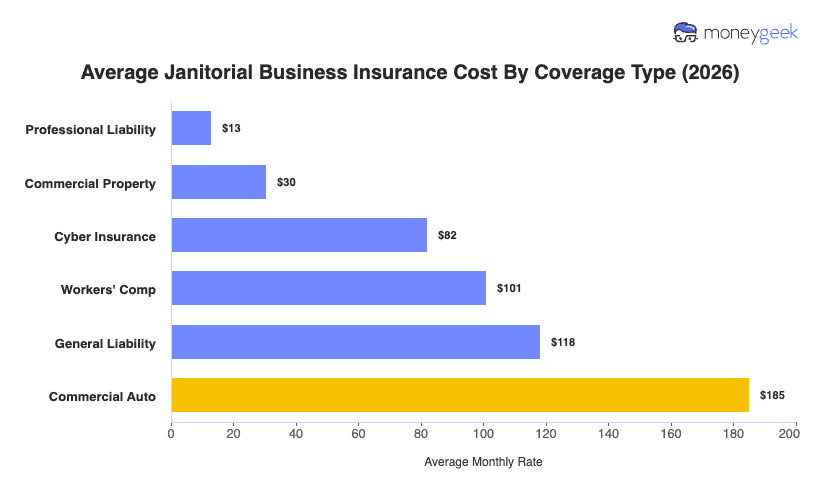
Every coverage is priced on its own, and the same policy costs more in one state than another. Here's what each one averages nationally, with a full breakdown underneath.
- Business owner's policy (BOP): $133 per month ($1,596 per year)
- General liability: $118 per month ($1,419 per year)
- Janitorial bond: $11 per month ($132 per year)
- Commercial property: $30 per month ($366 per year)
- Workers' comp: $101 per month ($1,210 per year) per employee
- Hired and non-owned auto (HNOA): $15 per month ($180 per year)
- Commercial auto: $185 per month ($2,220 per year)
- Cyber insurance: $82 per month ($985 per year)
- Professional liability: $13 per month ($161 per year)
- Commercial umbrella: $40 per month ($480 per year)
- Employment practices liability (EPLI): $222 per month ($2,664 per year)
You won't carry every coverage on that list, and the right mix depends on how you run the business. A solo owner-operator cleaning a few offices really only needs a BOP and a janitorial bond. A multi-crew operation running company vans through medical and school accounts carries the opposite profile, layering workers' comp, commercial auto, cyber and often a commercial umbrella on top of that same base.
The dropdowns below break down what each policy covers, when it applies and what pushes its cost up or down by state.
Janitorial Business Insurance Cost Estimates
Enter your state, coverage type, employee count and vehicle type into our business insurance cost calculator to see estimates built around how your operation actually runs. Select Get Quotes to be matched with providers in our network.
Before you begin:
- The calculator collects no personal information
- Workers' comp is estimated for each employee
- Commercial auto results vary with the vehicle type you choose
Estimate Janitorial Business Insurance Costs
Select Coverage Type
Select State
Select Employee Count
Select vehicle_type
Monthly Rate Estimate—
Select Coverage Type
Monthly Rate Estimate—
Select State
Select Employee Count
Select vehicle_type
Factors Affecting Janitorial Business Insurance Costs
The variables that move your premium most come down to how the operation runs, who you clean for and what happens on the job. Here are the ones that carry the most weight.
 Payroll and Crew Size
Workers' comp is priced against your payroll, so every cleaner you add raises what you pay, and for any operation with employees this is usually the largest recurring line on the policy. A two-person crew and a twenty-person crew running the same accounts sit far apart on premium for this reason alone. Growing headcount is the single change most likely to move your total.
 Client and Facility Type
Your client mix shapes your quote more than almost any variable you control. Commercial property managers typically require general liability and a janitorial bond before your crew arrives, and medical facilities and schools push those requirements higher. The claims you're likely to face in those environments also tend to carry more severity than a standard office account, which insurers price in.
 Services Offered
The work you take on determines how insurers classify your risk. Standard office cleaning carries a different workers' comp classification than post-construction cleanup, trauma cleaning or industrial facility work. Moving into those specialty services raises both your workers' comp rate and the general liability exposure your crews take on.
 Vehicle Use
Whether your crews drive company or personal vehicles changes the cost picture. Company vehicles require commercial auto coverage, your most expensive single line once you own vans. If your team uses personal vehicles instead, a hired and non-owned auto endorsement covers liability at a much lower cost, though it won't pay for damage to the vehicle itself.
 After-Hours Work and Site Access
When your crews work shifts your risk profile in ways that affect your general liability policy and bond requirements. After-hours cleaning means unsupervised access to offices with valuables, retail floors with open inventory and facilities with restricted areas. Insurers factor that exposure into your pricing, and commercial clients often verify your bond limits before signing.
 Employee Turnover and Bonding
High turnover and mixed staffing are common in janitorial work, and both raise what you pay. Your bond has to cover every active cleaner, so adding staff can mean an update or rider. High turnover also lifts your exposure to employment practices claims, especially wage-and-hour disputes and wrongful termination.
How to Lower Janitorial Business Insurance Costs
Some of these pay off at your next renewal, others compound over several policy periods. The operations that pay less over time work both.
 Compare quotes using the same coverage limits
Get quotes at identical limits from every insurer you approach, matching the same general liability per-occurrence limit, the same workers' comp class code and the same vehicle count. Premiums shift from one quote to the next because insurers weigh your client mix, facility type and after-hours access differently, so if you compare on inconsistent terms, the price gaps tell you nothing.
 Right-size your coverage
Map what your actual contracts require, then build coverage around those floors instead of defaulting to higher limits than clients ask for. Run residential accounts with no commercial contracts and you probably don't need $2 million in aggregate general liability. Clean medical facilities and the opposite holds, since your limits may need to exceed a standard policy.
 Bundle general liability and property into a BOP
If you have a fixed location, whether a storage unit, small office or equipment warehouse, bundling general liability and commercial property into a business owner's policy usually costs less than carrying them separately. Ask your insurer whether you qualify, since BOP eligibility varies by business size and revenue.
 Pay annually instead of monthly
Most insurers add an installment fee on monthly billing, which raises your total without adding coverage. Janitorial operations running on recurring commercial contracts have predictable enough revenue to pay annually, which trims cost without touching your coverage or how you operate.
 Lower your risk profile
Insurers price you partly on the services you offer and how they've performed over time. Scaling a full bar back to host-liquor service, or trimming fleet exposure, can move you into a lower-cost tier at your next renewal.
 Build a documented safety program
Your workers' comp claims history follows you from one policy period to the next, and janitorial work generates claims faster than most service trades. A documented safety program lowers claim frequency over time, which is what actually moves your workers' comp premium at renewal. Practices that cut your exposure include:
- Train crews on wet-floor protocols and safety-signage placement before and during every shift
- Set written chemical-handling procedures covering dilution ratios, protective equipment and storage rules for each product
- Run regular checks on floor buffers, extractors and other powered machinery to head off mechanical failure mid-job
- Log every safety training by employee name and date so you can show compliance to insurers and clients at renewal or contract review
Janitorial Business Insurance Cost: Bottom Line
The recommended janitorial bundle averages $260 per month, or $3,120 per year, and covers a small crew using personal vehicles to reach client sites. Treat that as a reference point, not a target price. Your own number depends on a few factors tied to how you run the operation, and these questions help place a quote in context.
- Which stage are you actually at? The bundle that fits a solo owner-operator is not the one that fits a multi-crew commercial contractor. Locate yourself by headcount, whether you run company vehicles and the kinds of accounts you clean, then match to the bundle that mirrors that setup rather than to the overall average.
- Does the quote line up with your risk profile? A quote well outside the benchmarks for your state and account type is worth a second look before you accept or reject it. The gap usually traces back to how the insurer classified your cleaning work, the limits applied and your claims history, all of which you can verify before you bind.
- Which cost drivers actually apply to you? Not every factor on this page carries equal weight for your operation. Payroll and workers' comp dominate for a crew-heavy business, while a solo residential cleaner is shaped far more by general liability and a bond. Identifying which drivers apply to your setup is what turns these benchmarks into something you can act on.
Janitorial Business Insurance Cost: FAQ
A few of the cost questions janitorial owners raise most often.
The recommended bundle averages $260 per month, or $3,120 per year, and covers a business owner's policy, a janitorial bond, workers' comp and hired and non-owned auto for a small crew using personal vehicles. A solo owner-operator starts closer to $144 per month, while a full-service contractor running company vans through medical and school accounts moves toward $580. Adjust for your headcount, whether you own vehicles and the accounts you clean.
Match the bundle to your stage. Clean a few accounts on your own and the starting bundle covers you. Hire a crew and the recommended bundle adds the workers' comp and auto coverage that comes with employees. Put company vans on the road and take on medical or school contracts, and the fleet-operated and full-service bundles are built for that.
Your quote reflects details these benchmarks can't fully capture. Insurers price your operation individually, weighing your facility types, after-hours access, claims history and the class code they assign your cleaning work. Before you reject a quote, confirm how the insurer classified your work and which limits they applied, since a misclassification or higher required limits explains most of the gap.
Janitorial work generates injury claims faster than most service trades, from repetitive-motion strains to chemical burns and slip-and-falls, so workers' comp rates run high and scale with your payroll. For any operation with employees it's usually the largest single line on the policy, which is why a documented safety program does more to lower your total over time than almost anything else.
Often, yes. Many commercial and government clients require you to be bonded before they'll let a crew onto their property, since a janitorial bond reimburses them if one of your cleaners steals on site. At about $11 per month it's a small cost, and being bonded can be the difference between qualifying for a commercial account and being passed over.
How We Determined Janitorial Business Insurance Costs
Our published figures are modeled premiums for standardized janitorial business profiles, aggregated three ways. We analyzed quote data from major U.S. commercial insurers and modeled standardized estimates across business profiles representing around 95% of the market, so the results read as a consistent national benchmark rather than a single carrier's rates.
National benchmark average
The national figure for each coverage reflects the modeled premium for a standardized one-to-four-employee janitorial business at standard policy limits, averaged across all states and Washington, D.C.
State averages
To show how location moves your rate, we isolated pricing by state for each coverage across all 50 states and D.C. Where a specialty coverage was not part of the core modeled dataset, we applied state-level pricing patterns to the national estimate rather than leaving a gap.
Bundle averages
The bundles follow clear operating thresholds. The starting and recommended bundles fit an owner-operated or small-crew business, while hiring staff, putting company vans on the road and taking on higher-limit medical and school contracts push an operation up into the fleet-operated and full-service bundles. Specialty coverage rates folded into the bundles, the janitorial bond, hired and non-owned auto and commercial umbrella, come from external research rather than the core dataset.
See our full business insurance methodology for the complete approach.
About Angelique Palenzuela-Cruz

Angelique Palenzuela-Cruz is a Business Insurance Content Writer at MoneyGeek, where she specializes in general liability, workers’ compensation and professional liability insurance. Her work helps small business owners understand how these policies apply to coverage, including risks like customer injuries, employee injuries, professional mistakes, client contract terms and industry-specific coverage requirements.
She primarily covers service-based businesses where liability and employee coverage decisions are especially important, including cleaning, consulting, beauty and wellness, childcare, education, fitness, food service, pet care, repair and maintenance, and other professional services.
Before joining MoneyGeek, Angelique spent nearly 12 years at Guthrie-Jensen Consultants, one of Southeast Asia’s largest management training firms, where she advanced from Training Consultant to Managing Consultant. In that role, she worked with business clients to assess operational needs, develop training programs and present performance analyses to executive decision-makers. She also helped establish Gladwin Training Consultancy, where she served in learning solutions and client service roles.
Her background gives her practical context for writing about how businesses operate, manage client expectations, structure teams and make risk decisions. At MoneyGeek, she applies that experience to business insurance content, connecting coverage to actual business needs.
LinkedIn: linkedin.com/in/ma-angela-cruz
Email Contact: angelique.palenzuela@moneygeek.com
Sources
- Michigan Department of Insurance and Financial Services. "Frequently Asked Questions." Accessed October 26, 2026.
- National Conference of State Legislatures. "Security Breach Notification Laws." Accessed October 26, 2026.