How Much Does General Liability Insurance Cost in Alaska?

The average cost of general liability insurance in Alaska is $151 per month, or $1,815 per year, for businesses with one to four employees with limits of $1 million per occurrence/$2 million aggregate. That run 23% above the national average of $123 monthly and places Alaska 42nd in affordability.

Every state in the Pacific region exceeds the national benchmark, and Alaska's premium reflects that broader regional pattern. Higher labor costs, elevated construction and property values, and a concentration of litigation-active markets push claim costs up across the region, which flows into base pricing. Oregon is the least expensive in the group at $138 per month, while Washington ($153) and Hawaii ($159) sit just above Alaska. California is a clear outlier at $190 monthly, 55% above the national average.

Use the state average as a regional reference point. Coverage limits, industry risk profile and claims history can move actual premiums in either direction, so treat this figure as orientation, not a projection. To get a cost estimate based on your business profile, use the Alaska general liability insurance cost calculator below.

To estimate average general liability insurance costs in Alaska, we analyzed quote data from major U.S. small business insurance providers and modeled standardized premium estimates across common business profiles. These modeled results are designed to provide a consistent state benchmark and show how premiums vary by key baseline factors including business size, industry and location within Alaska.

Dataset Scope and Assumptions

Our cost modeling uses standardized inputs for consistent comparisons across Alaska businesses.

  • Providers analyzed: 10 major insurance providers
  • Industries covered: 25 general industry categories relevant to Alaska's business landscape
  • Employee count bands: Zero, one to four, five to nine, 10 to 19 and 20 to 49 employees
  • Policy baseline: Standard general liability policy with $1 million per occurrence/$2 million aggregate limits
  • Total estimates modeled: Over 20,000 standardized pricing estimates across Alaska industry and employee count combinations

We also incorporated modeled average revenue and payroll personalized across all combinations of Alaska regions, industry and employee counts to improve the accuracy of pricing. To model these assumptions against our cost factors, we used data from these sources:

  • CBP (for employee size class density in Alaska by NAICS)
  • QCEW (for wage/payroll intensity by industry in Alaska)
  • Economic Census/SUSB (for receipts/output intensity by industry)
  • Calibrated against:
    • Private comp databases
    • IRS SOI totals

How We Calculated Average General Liability Costs in Alaska

Our published averages represent modeled premiums for standardized business profiles and were aggregated in two ways:

  • Alaska state average: The Alaska average cost reflects the modeled premium for a standardized one to four-employee small business across all industries included in our dataset for a standard general liability policy.
  • Segment averages: To show how costs vary within Alaska, we calculated average modeled premiums for our state base profile and isolated for variables, including:
    • Employee count (business size ranges)
    • General industry categories

Segment averages were produced by aggregating modeled pricing trends across the full dataset so readers can compare how premiums shift across business types and regions within Alaska.

Use our Alaska general liability insurance cost calculator below for more personalized estimates and to compare rates.

Business Insurance Rates by State and Industry

Select your general industry and employee count for a personalized general liability insurance cost estimate for your Alaska business. Estimates are based for a $1 million per occurrence and $2 million aggregate policy.

Select Industry
Select Employee Count
Average Monthly Rate

What Factors Affect General Liability Insurance Costs in Alaska?

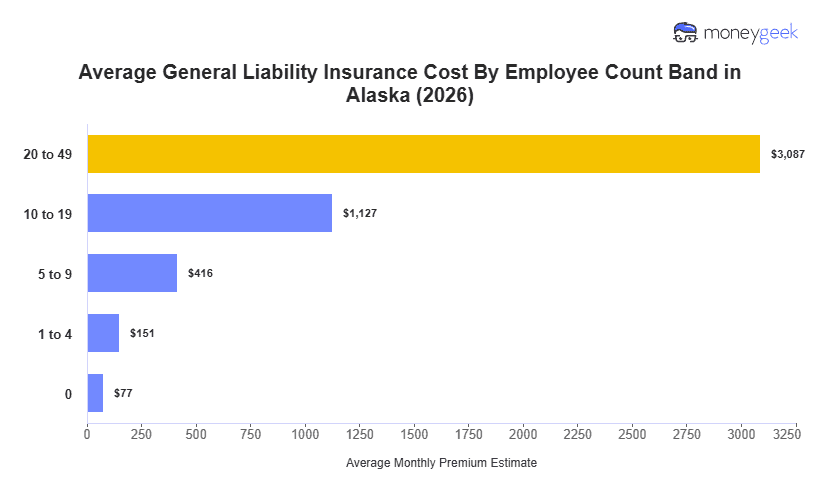
Alaska general liability insurance costs scale sharply with employee count. Solo operators pay roughly half the state average. Businesses with 20 to 49 employees pay nearly 20 times more. These are premium estimates and shift with coverage limits and the specifics of each operation.

Industry classification produces an equally wide spread through a different mechanism. Tech and IT firms average 81% below the state average. Construction and contracting businesses average 194% above it. That gap reflects how insurers weigh physical exposure and claim frequency by industry type.

Then Alaska's geography, workforce conditions and climate introduce additional pricing variables that interact with both factors above.

  • pin icon
    Remote Geography and Logistical Costs

    Alaska's dispersed population and limited road network make claims handling more expensive. Insurers factor in higher costs for adjusters, inspections and repairs in areas that are difficult to reach. For businesses outside major urban centers like Anchorage or Fairbanks, this logistical premium can push GL costs above what comparable operations pay elsewhere.

  • winterStorm icon
    Harsh Climate and Weather Exposure

    Extreme cold, ice accumulation and permafrost conditions increase the frequency of slip-and-fall incidents and property damage claims. Businesses operating physical locations or outdoor work sites carry higher exposure to weather-driven liability events, and insurers price this elevated claim frequency into base GL premiums across most industries with a physical operational footprint.

  • uninsured icon
    Limited Insurer Competition

    Fewer carriers actively write general liability policies in Alaska compared to most states. Reduced competition limits pricing pressure, which can keep premiums elevated even for lower-risk businesses. This market condition affects the entire state and operates independently of a business's individual risk profile or claims history.

  • money2 icon
    Higher Labor and Repair Costs

    Alaska's cost of living ranks among the highest in the country, and when GL claims involve bodily injury or property damage, settlements and repairs reflect those elevated baselines. Claim resolution costs in Alaska tend to be meaningfully higher than equivalent cases in other states, a severity differential that insurers price into premiums upfront.

  • houseRebuild icon
    High-Risk Industry Concentration

    Construction, fishing, oil and gas, and tourism account for a disproportionate share of Alaska's economy. These industries carry higher physical exposure and claim frequency, which shapes the state's overall GL pricing environment. Businesses outside these sectors can still see spillover effects when insurers assess Alaska as a higher-risk market overall.

  • congress icon
    Litigation Environment

    Alaska follows a pure comparative fault system where damages are apportioned according to each party's degree of fault and plaintiffs can recover even if largely responsible for an incident. While the state is not among the most litigious in the country, bodily injury jury awards reflect Alaska's higher cost baseline. Businesses in customer-facing or high-contact industries carry greater exposure to claims that reach litigation.

Average General Liability Insurance Costs in Alaska by Business Size

General liability premiums in Alaska scale with employee count across a wide range, running from $77 per month for businesses with no employees to $3,087 for those with 20 to 49. That 40x spread reflects how payroll exposure and claim frequency potential accumulate as headcount grows. The sharpest relative jump occurs between your fourth and fifth hire, where monthly premiums increase by 175%, from $151 to $416. The graph breaks down average monthly and annual premiums by employee band, showing where the largest cost transitions occur and how each tier compares to the others.

General Liability Insurance Cost in Alaska Chart

Average General Liability Insurance Costs in Alaska by Industry

Alaska general liability premiums run from $29 per month for tech and IT businesses to $444 for construction and contracting companies, a 15x range driven by how insurers weigh physical exposure, third-party contact frequency and claim severity potential by sector.

80% of industries charge below the state average of $151 per month. The five that exceed it, Food & Beverage, Hospitality, Childcare Services, Healthcare & Medical and Construction & Contracting, carry enough pricing weight to pull the state benchmark upward.

Data filtered by:
Select
Agriculture & Natural Resources$125$1,50517%
Arts, Media & Entertainment$50$59467%
Beauty, Body & Wellness Services$53$64065%
Childcare Services$192$2,300-27%
Cleaning Services$129$1,54615%
Construction & Contracting$444$5,332-194%
Consulting Services$35$41977%
Education$62$74759%
Financial Services$57$68962%
Fitness Services$124$1,48518%
Food & Beverage$156$1,866-3%
Healthcare & Medical$270$3,236-78%
Hospitality, Travel & Tourism$165$1,985-9%
Manufacturing$83$99645%
Marketing & Communications$37$44076%
Nonprofit & Associations$74$89151%
Other Professional Services$98$1,17435%
Pet Care Services$77$92249%
Real Estate & Property Services$52$62566%
Recreation & Sports$71$85853%
Repair & Maintenance$101$1,20733%
Retail & Product Rental$114$1,37224%
Tech/IT$29$34681%
Transportation & Logistics$94$1,12738%
Wholesale & Distribution$143$1,7155%

Use these resources to explore costs for your industry.

How to Lower General Liability Insurance Costs Without Sacrificing Coverage

Finding affordable general liability coverage in Alaska is worth pursuing, but cost reductions should never come at the expense of adequate financial protection. These strategies address the most practical opportunities for Alaska businesses across the buying and renewal process.

  • shoppingCart icon
    Compare multiple insurers

    Alaska's carrier market is thinner than most states, which means a Kenai Peninsula fishing charter operator and an Anchorage marketing firm may each have access to only a handful of insurers willing to write their policy. Requesting several general liability quotes reveals how much pricing varies within that limited pool. Review general liability exclusions across each option, since a lower premium with broader exclusions can leave meaningful gaps.

  • building icon
    Bundle general liability into business owner's policies (BOP)

    For an Anchorage retailer or a Fairbanks service business that leases commercial space, buying general liability and commercial property coverage separately often costs more than packaging them together. The cost of a BOP is typically lower for small businesses that need both coverage types, making it a practical starting point for owner-operated businesses with a physical location.

  • loanReview icon
    Adjust your coverage limits

    A Fairbanks IT consultant or a Juneau bookkeeping firm carrying limits sized for a much larger operation pays for protection their actual exposure doesn't warrant. Review your general liability limits against your business's real risk profile. Use how much general liability you need as a reference to avoid paying for coverage that exceeds what your operation actually requires.

  • insurance2 icon
    Provide clean, accurate underwriting information

    A Mat-Su Valley contractor whose crew size and revenue shift between summer and winter seasons presents a more complex underwriting picture than a year-round operation. Incomplete or inaccurate submissions about payroll, operations or claims history can push premiums above what actual exposure warrants. Accurate data gives underwriters a clearer picture of your risk and reduces the likelihood of upward rate adjustments at audit.

  • graph icon
    Improve your loss profile over time

    For a Southeast Alaska lodge or tour operator, a multi-year record with few or no claims carries real pricing weight at renewal. Insurers treat prior claims as a forward-looking signal, and businesses that demonstrate consistent loss control over several policy cycles are rewarded with lower rates over time.

    This is a slower lever, but in Alaska's above-average pricing environment, the cumulative effect across renewals can be meaningful. Each clean policy cycle shifts your risk profile in a direction that works in your favor when carriers re-evaluate your premium.

  • stackOfBooks icon
    Strengthen risk controls Alaskan insurers care about

    A Juneau café or a Sitka childcare center that documents staff training, incident response procedures and daily safety checks gives underwriters measurable evidence of lower exposure. These records don't just reduce claim likelihood. They support better pricing conversations at renewal by demonstrating that risk is actively managed rather than assumed.

    For client-facing Alaska businesses where daily operations bring consistent public contact, the controls that matter most are those tied to your specific environment: wet entryways during rain season in Southeast Alaska, icy parking lots in Interior communities or supervised activity protocols for businesses working with children or vulnerable populations.

General Liability Insurance Cost in Alaska: Bottom Line

Alaska general liability premiums reflect how insurers price risk across a business's full profile. Employee count, industry classification and state-specific conditions like limited carrier competition and elevated claim costs all contribute to where a business lands relative to the state average

Use this report to understand the factors shaping your cost position before drawing conclusions from any single number.

  1. What's setting your baseline? Determine whether your cost position comes from core operational factors (employee count and industry classification) or from policy design choices like limits and deductibles, which you can adjust without changing your operations.
  2. Where do you sit relative to the benchmark? Find your industry and employee band in the distributions to see whether your profile falls above or below the state reference point.
  3. What affects your price at renewal? Claims history, coverage structure and risk controls are the factors most likely to shift your premium from one renewal to the next. Identify which one applies most to your situation.

The state average is a reference point, not a verdict. A more useful read of your costs comes from identifying which operational and policy factors carry the most pricing weight in your specific profile.

General Liability Insurance Cost in Alaska: Next Steps

The next step is comparing how specific providers price your profile against these benchmarks. Use the figures here to set a baseline expectation for your employee count, industry and location, then get quotes using identical details from every provider you're comparing.

When a quote diverges from that expectation, the difference traces back to one of three places: your core risk profile, a difference in coverage structure or how a carrier weighted your underwriting inputs.

About Connor Bolton


Connor Bolton, Senior SEO and Content Manager (Business & Pet), MoneyGeek

Connor Bolton is Senior SEO and Content Manager at MoneyGeek, where he leads the business and pet insurance editorial teams. He sets the research framework, data standards and content structure for his team. All content goes through his accuracy review before publication. Connor also writes in-depth guides and has spent more than four years covering insurance products across personal, commercial and specialty lines.

The research infrastructure Connor built covers auto, home, renters, life, health, business and pet insurance across pricing analysis, carrier research, customer experience and coverage evaluation. It includes over 6 million data points for business insurance across 408 industry areas, all 50 states and 16 vehicle types. The pet insurance side covers over 5 million profiles across 18 major providers, 100+ breeds and ages up to 20 years. Connor’s insurance research and his team's work has been cited by the U.S. Chamber of Commerce, Allstate, Liberty Mutual, CBS News, Forbes and LegalZoom.

Connor also talks with underwriters and carrier liaisons at Ethos, The Hartford, ERGO NEXT, Nationwide and State Farm, and monitors business and pet owner communities on Reddit. Those sources shape how his team evaluates carriers, structures rate analysis and writes for human buyers rather than search engines.

For questions about MoneyGeek's business and pet insurance content, contact him at connor@moneygeek.com or on LinkedIn.


Sources