



Jump to the section that meets your needs best below:
Average Contractor & Construction Business Insurance Cost (2026 Report)
Most contractors, tradespeople and construction related companies pay within $64/mo to $986/mo for a single policy type. However, pricing can vary widely from $6/mo up to as high as $26,879 depending on location, trade focus, business size and the coverage you need.
If you're ready to get a quote, use the tool below to get matched with the best business insurance provider for your contracting operations.
Select state
Updated: September 11, 2026
Advertising & Editorial Disclosure
Featured Partner

The Hartford
- The Hartford insures contractors, landscapers, electricians and carpenters.
- Operating in 48 states, The Hartford leaves out only Alaska and Hawaii.
- A $1 million general liability policy runs about $69 a month for The Hartford's small business customers.
- The Hartford holds an A+ (Superior) financial strength rating from AM Best and has paid claims since 1810.
On The Hartford's site
*MoneyGeek featured partner. Editorial rankings below are independent of this placement. Rates, rankings and savings comparisons are based on MoneyGeek's independent research and Hartford-reported data as of 2026. Figures are estimates and averages, not a guarantee of any individual quote, premium or discount.
How Much Does Contractor & Construction Business Insurance Cost?
Commercial insurance costs for contractors and those in construction are expensive, sitting at a rate of $190/mo ($2,274/yr) in aggregate across the six most common coverage types and all 50 states for a 1-to-4-person company. This makes it the 3rd most expensive industry area to operate in, only trumped by manufacturing and wholesale/distribution. This is primarily due to the broad and frequent risk of claims due to the high rates of property damage, tools and equipment theft and injury to both the public and employees associated with the work area.
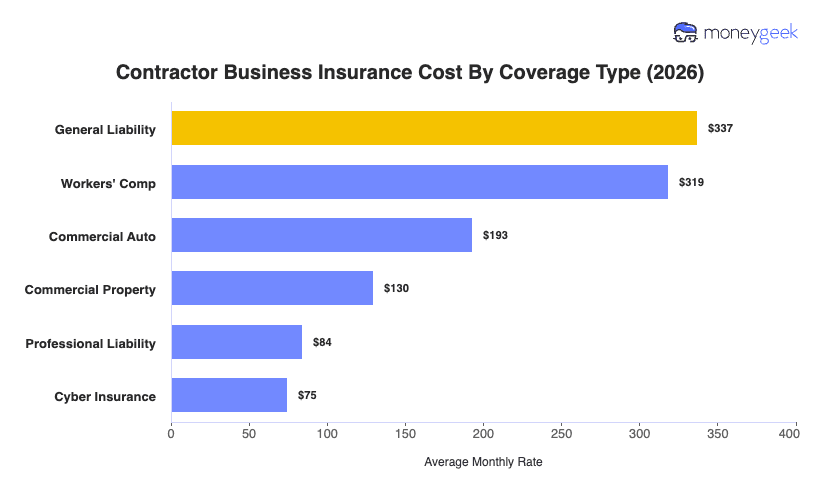
Considering these assumptions, a single policy's on average price can sit anywhere from $75/mo for cyber insurance up to $337/mo for general liability policies. If you are a tradesperson or contracting company, you'll have some of the highest costs, regardless of what policy you choose. Though keep in mind, this doesn't apply to every company, and particularly your industry area and employee count will impact the costs heavily. Your location is more supplementary when compared to these factors, especially for liability focused policies.
| Cyber Insurance | $75 | $898 | 11 |
| Professional Liability | $84 | $1,010 | 16 |
| Commercial Property | $130 | $1,558 | 20 |
| Commercial Auto | $193 | $2,317 | 23 |
| Workers' Comp | $319 | $3,822 | 24 |
| General Liability | $337 | $4,041 | 25 |
We analyzed quote data from major U.S. commercial insurance providers and modeled standardized premium estimates across business profiles representing around 95% of the market. Results are designed to provide a consistent national benchmark showing how premiums vary by key baseline factors including business size, contractor profession type, location and vehicle type for operations that use commercial vehicles.
Dataset Scope and Assumptions
Our cost modeling uses standardized inputs for consistent comparisons across businesses.
- Total estimates modeled: just over 6 million standardized pricing estimates
- Providers analyzed: 10 major insurance providers
- Professions covered: 45 contractor profession categories
- Geography: all U.S. states including Washington, D.C.
- Employee count bands: solo practitioners, one to four, five to nine, 10 to 19, and 20 to 49 employees
- Vehicle types studied: Sedans, SUVs, pickup trucks, vans, taxis, limousines, tractors, food trucks, semi-trucks (non-HAZMAT and HAZMAT), tanker trucks (non-HAZMAT and HAZMAT), buses, box trucks, dump trucks, flatbed trucks
- Policies studied: general liability, workers' comp, professional liability, commercial auto, commercial property, and cyber insurance
- General liability: $1 million per occurrence and $2 million aggregate
- Workers' comp: state required coverage
- Professional liability: $1 million per claim and $1 million aggregate
- Commercial auto: minimum coverage
- Commercial property: personal property coverage limits personalized to industry, business size and state
- Cyber insurance: $1 million per occurrence and $1 million aggregate
How We Calculated Average Contractor Business Insurance Costs
Our published averages represent modeled premiums for standardized business profiles and were aggregated in two ways.
- National benchmark average: The national average cost reflects the modeled premium for a standardized one to four employee business across all contractor profession categories and states included in our dataset for a standard professional liability policy
- Segment averages: To show how costs vary, we calculated average modeled premiums for our national base profile and isolated for variables, including:
- Employee count (business size ranges)
- Profession / industry categories
- Vehicle types (for commercial auto)
- States (including Washington, D.C.)
Segment averages were produced by aggregating modeled pricing trends across the full dataset so readers can compare how premiums shift across profession types and regions.
See our full business insurance methodology.
Get Contractor Business Insurance Cost Estimates
Use our contractor business insurance cost calculator below for more personalized estimates and to compare rates.
Get Contractor Insurance Cost Estimates
Select Coverage Type
Select State
Select Employee Count
Select Vehicle Type
Monthly Rate Estimate—
Select Coverage Type
Monthly Rate Estimate—
Select State
Select Employee Count
Select Vehicle Type
This is only an overview, and cost estimates are only as accurate as they are related to your specific type of work (if you do multiple, your primary focus). So, I've provided guides below to help you more specifically nail down what you may expect when comparing business insurance costs.





Ways to Lower Contractor & Construction Business Insurance Costs
While getting coverage is inherently expensive in this area of work, getting more affordable contractor insurance is possible as long as you manage coverage and long-term risk management effectively. We've broken down key methods below to ensure in both the short-term and future you save as much as possible without reducing protection you need.
Quick Contractor & Construction Business Insurance Cost Lowering Methods
Start with these methods if you want lower costs quickly for contractor insurance.
 Compare quotes using the same coverage limits
Carrier appetites for contractor risks shift regularly, and rates can vary significantly between providers for the same coverage profile. Working with a broker who specializes in construction rather than a generalist gives you access to specialty markets and contractor-specific programs that standard carriers don't offer, and comparing quotes at renewal is one of the most reliable ways to keep premiums in check immediately.
 Bundle policies where it makes sense
Combining general liability and commercial property into a Business Owner's Policy typically costs less than buying both separately. Some carriers also offer package discounts for bundling GL, workers' comp, and commercial auto with the same provider, and consolidating policies simplifies your renewal and audit process as well.
 Adjust deductibles strategically
Higher deductibles lower your premium across most coverage types. A roofing contractor paying $656/mo for GL at a $500 deductible may be able to reduce that meaningfully by moving to a $2,500 or $5,000 deductible, provided the business has sufficient reserves to absorb that cost if a claim occurs.
 Pursue pay-as-you-go workers' comp
Rather than paying a lump-sum annual premium based on projected payroll, pay-as-you-go workers' comp programs tie your premium directly to actual payroll each pay period. For contractors with fluctuating crew sizes across seasons or projects, this eliminates overpayment and reduces the risk of a large audit bill at year-end.
 Explore wrap-up programs for large projects
For contractors bidding on projects above $25 million in construction value, Owner Controlled Insurance Programs (OCIPs) and Contractor Controlled Insurance Programs (CCIPs) consolidate GL, workers' comp, and excess liability into a single policy covering all parties on the job. CCIPs typically deliver cost savings of 5% to 15% compared to each subcontractor carrying individual coverage by eliminating duplicate premiums and contractor markup on insurance costs.
 Pursue providers with flexible coverage terms
Insurers like ERGO NEXT and Thimble provide the ability to provide coverage on a by job basis which can easily lower costs to manageable levels, especially when you don't need coverage during seasonal lulls or just when you're not working actively.
Long-Term Contractor & Construction Business Insurance Cost Lowering Methods
Some cost reductions only show up after your claims history and risk profile have had time to shift, typically across one or more full policy periods.
Contractor & Construction Business Insurance Cost: Bottom Line
Across six common coverage types, contractor businesses average $190 per month in insurance costs, but that figure reflects a broad mix of trades and locations. A solo handyman in Indiana and a roofing contractor with 20 employees in New York represent opposite ends of the distribution, and both would land far from that average for different reasons.
These three questions help put a received quote into context:
- Where does the operation fall in the distribution? The trade, employee count and state should be located against the benchmarks on this page. A quote that looks high in isolation may sit exactly where expected for a roofing operation in a high-cost state with ten employees. A quote that looks low may reflect narrower coverage than the operation actually requires.
- Is the quote consistent with the risk profile? When a quote sits well above or below the benchmarks for the trade and state, that gap is worth understanding before accepting or rejecting it. A lower-than-expected quote may reflect narrower coverage limits or missing coverage types. A higher-than-expected quote may reflect how the insurer has classified the operation or trade.
- Which cost drivers apply to the operation? Not every factor carries equal weight across contractor trades. Vehicle type matters far more for a paving contractor running a fleet of dump trucks than for an interior designer with one company vehicle. The two or three drivers that actually shape the specific profile should be identified before drawing conclusions about price.
For most contractor businesses, the gap between the industry average and an actual quote comes down to two or three factors specific to the operation, not the full list. Arriving at an accurate cost picture means starting with the benchmarks that match the trade, not the ones that match the industry broadly.
About Connor Bolton

Connor Bolton is Senior SEO and Content Manager at MoneyGeek, where he leads the business and pet insurance editorial teams. He sets the research framework, data standards and content structure for his team. All content goes through his accuracy review before publication. Connor also writes in-depth guides and has spent more than four years covering insurance products across personal, commercial and specialty lines.
The research infrastructure Connor built covers auto, home, renters, life, health, business and pet insurance across pricing analysis, carrier research, customer experience and coverage evaluation. It includes over 6 million data points for business insurance across 408 industry areas, all 50 states and 16 vehicle types. The pet insurance side covers over 5 million profiles across 18 major providers, 100+ breeds and ages up to 20 years. Connor’s insurance research and his team's work have been cited by the U.S. Chamber of Commerce, Allstate, Liberty Mutual, CBS News, Forbes and LegalZoom.
Connor also talks with underwriters and carrier liaisons at Ethos, The Hartford, ERGO NEXT, Nationwide and State Farm, and monitors business and pet owner communities on Reddit. Those sources shape how his team evaluates carriers, structures rate analysis and writes content for real pet owners.
Questions about MoneyGeek's business or pet insurance content? Reach him at connor@moneygeek.com or on LinkedIn.