
Best Construction and Contracting Business Insurance Companies

Contractors can drill into a pipe and damage a customer’s home, or leave materials where someone trips over them. To find the best small business insurance, I compared what insurers charge for policies that can help with those claims, and looked at how quickly you can get a certificate of insurance (COI) or update your policy, since either could hold up a project. 

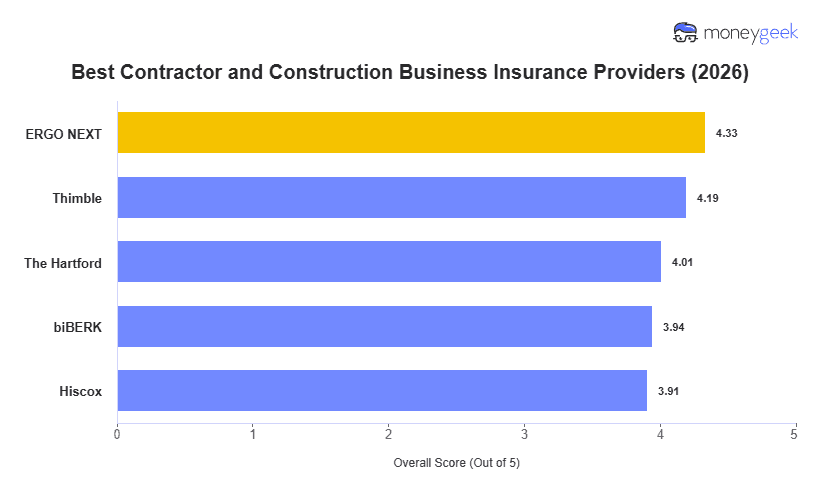
My analysis put these three providers on top:

  • Choose if you're in a lower-risk industry: ERGO NEXT
  • Choose if you do project-based and high risk work: Thimble
  • Choose if you're a complex or larger construction firm: The Hartford

My recommended picks is a good starting point, but the best provider for you could change depending on the type of contracting work you do. These pages detail your top options for your specific business.

Given the expensive and often confusing nature of contractor and construction business insurance, I did not take my research lightly. My best contractor business insurance rankings are built on three things: what you'll actually pay, what happens when you need help, and whether the coverage holds up when it counts. I scored each provider across affordability (50%), customer experience (30%), and coverage options (20%) which are weighted that way because price is what determines what you can financially sustain, but it's rarely where the decision should end.

This is what made up my analysis of popular insurers, which was assisted (not run) by AI:

  • Affordability: I pulled quotes isolating pricing factors for 45 of the most common contracting and construction industries , state (plus DC), employee count (5 ranges from 0 to 49), 16 vehicle types (for auto) and six of the most common coverage types, extrapolating 500,000+ estimates to get a full picture.
  • Customer Experience: 300,000+ reviews, forum conversations and industry research were aggregated and manually parsed to see the trends that made customers enjoy and dislike service from insurers. I also went through what an actual small business owner would go through for all providers analyzed for their quotes experiences and policy management tools available (excluding claims due to limitations).
  • Coverage Options: I read the fine print of policy terms, isolated the invisible exclusions or extra costs, and documented all options available for all providers to determine which has the best coverage for you now and as you grow your company.
ERGO NEXT

ERGO NEXT: Best Overall, Best For Lower-Risk Industries

On ERGO NEXT's site
COMPANY HIGHLIGHTS

As the clear winner for most industries in contracting and construction, ERGO NEXT delivers superior value that applies to most company's work in the industry. It is the most affordable contractor insurer for low-risk  professionals like painters and those in lawn care, has by flexible by job coverage terms available making getting lower prices in an often-expensive field to insure more feasible.

Buying a policy and managing it was easy in my experience as well and I got a quote and a COI in under 6 minutes, could access proof of coverage on both their website and their app easily, and was able to make simple policy changes easily, all without an agent being involved. However, high-risk trades like roofers will find extremely high rates with the company and coverage options they have may not be sufficient.

Read Our Review: ERGO NEXT Business Insurance Review

Thimble

Thimble: Best For Project-Based and High Risk Work

COMPANY HIGHLIGHTS

Thimble earns second place for reasons beyond price and it's the only provider in my analysis that sells coverage by the job, month, or hour, which solves a real problem for contractors who work seasonally or need a COI for a single job without an annual commitment. Its Certificate Manager lets general contractors define insurance requirements for subcontractors, send those requirements directly, and verify compliance or route subs to purchase a compliant policy on the spot. On pricing it sits at 2nd for affordability with particularly competitive rates in higher-risk trades like roofing where ERGO NEXT's advantage narrows. The main limitation claims and customer support since they route this to third-party administrators who only can communicate through email, which creates friction if a dispute needs to be resolved quickly.

Read Our Review: Thimble Business Insurance Review

The Hartford

The Hartford: Best For Complex and Larger Construction Firms

On The Hartford's site
COMPANY HIGHLIGHTS

While The Hartford only sits at third in our study, it stands out as the best contracting and construction insurer in terms of coverage options and included project and risk-management support. With over 200+ years in the industry, they have dedicated teams assigned to your company to help you from simple to complex construction projects and coverage tailored packages for general liability and pollution liability with broad form coverage that others don't provide. 

They also back up their customer experience with genuinely strong customer experience performance, ranking higher than anyone on my top 5 list for claims support, a lower-than-average NAICS complaints score (22% below average), and many testimonials speaking to how seamless the company made projects (See Hunt Construction's testimonial). All these perks come at a higher premium than competition which is not as ideal for smaller companies and buying and managing a policy is not as easy, but for a larger firms with more complex risks, it is a great fit.

Read Our Review: The Hartford Business Insurance Review

Best Types of Contractor Business Insurance

Most contractors start with general liability because loose debris could injure someone near the jobsite or renovation work could damage a finished part of the customer’s property. Your insurance bundle is sure to include need more than that, but the rest of your coverage mix should reflect how you run your jobs and what each contract makes you responsible for.

Claims and legal costs when someone outside your crew is injured or you damage their property
All contractors need this before taking their first paid job
Injuries and property or vehicle damage after a work-related crash
You invest in a business-owned vehicle
Tools and equipment
Portable tools and mobile equipment stolen or damaged at jobsites or in transit
You’re carrying tools worth $1,000 or higher
An employee’s medical bills and part of their lost wages after a work injury
When you hire employees
Surety bonds
Promises a client or government agency that you’ll meet a licensing or contract obligation
A license or project contract requires a bond
Extra liability protection after another covered policy reaches its limit
A contract requires more coverage than your current liability policies provide
Builders risk
Covered damage to a structure and its materials while construction is underway
You’re responsible for insuring a structure during construction
Installation floater
Materials stolen or damaged before or while you install them
Materials become your responsibility before installation
Pollution liability
Cleanup costs and claims after your work releases a hazardous substance
Your work could contaminate nearby soil or water
Combines general liability with coverage for property kept at a fixed location
You keep equipment and supplies at an office or workshop
Costs from stolen data or an attack that locks you out of business systems
You store client records or take payments online

Best Contractor Business Insurance Checklist

Two contractor quotes can look similar even when one prices you as a remodeler and the other assumes you handle structural projects. If the insurer used the wrong assumptions, the policy won't match the work you accept. A buying checklist helps you give insurers the same accurate description of your business and verify project requirements before completing your purchase.

You can also download a companion worksheet to help you keep all the information you get from quotes and insurers organized.

  1. 1
    Identify the Risks in Your Contracting Work

    Think about two kinds of projects you’ve handled. One that’s routine and another that stretched your normal scope. Walk through each from arrival to handoff and note where you’re responsible for existing property or where one problem could have stopped the job. Separate the work your crew performed from anything assigned to subcontractors because insurers may evaluate those risks differently. You’ll end up with a clearer description of your actual operations than “general contractor” provides.

  2. 2
    Match Your Jobsite Risks to Coverage

    Take each risk you identified and see which policy would pay if it happened. Suppose cabinets you purchased were stolen after delivery but before installation. Tools coverage won’t cover them because the cabinets aren’t your equipment, but an installation floater would. Apply the same test to subcontracted work by asking whether your policy covers damage caused by a subcontractor or requires their insurer to respond. If you find any unanswered scenarios, consider it a potential coverage gap.

  3. 3
    Check Licensing and Contract Requirements

    Before requesting quotes, gather the requirements from the agency that issues your license and the insurance section of your next contract. The first determines what you need to operate legally, while the second sets the client’s conditions for that project. To get the job, you must satisfy both. If the contract asks you to add the project owner as an additional insured, send that wording to your insurer, who must add them through an endorsement. Simply giving the owner a certificate of insurance (COI) only proves you have coverage, so it doesn’t extend that coverage to them.

  4. 4
    Choose an Insurer That Covers Your Trade

    An insurer may cover one contractor but refuse another even when both use the same business label. Describe your everyday work first, then explain how your largest planned project differs. If subcontractors will complete part of it, tell the insurer what work they’ll perform because the policy could limit subcontracted operations. While talking to your insurer, confirm they’ll cover both routine work and larger projects. That way, you’re sure that your policy applies even when you take on work beyond your usual scope.

  5. 5
    Compare Quotes and Policy Terms Before Buying

    Don’t assume the lowest quote offers the best value. First, compare the limits since one policy might pay the same maximum for a single claim but less for all claims combined during the policy period. If one quote is noticeably cheaper, ask what accounts for the difference so you know whether you’re saving money or taking on more risk. Lastly, remember that your premium could change after the insurer reviews your actual payroll or subcontractor costs.

Best Contractor Insurance: The Bottom Line

You now know which providers belong on your shortlist and what coverage your contractor business actually needs from them. When you start comparing quotes, the premium is not the whole picture. Two policies at the same price can have very different completed operations periods, pollution exclusions, and subcontractor terms behind them, details that don't matter until a claim happens. The best policy is the one that covers the work you actually do, at limits that reflect your real exposure by trade and crew size, from a carrier that will show up when something goes wrong on a job site.

And as a reminder before you compare, these are my top picks overall for contractors.

Best Contractor Business Insurance Chart

Best Contractor Insurance: FAQ

About Connor Bolton


Connor Bolton, Senior SEO and Content Manager (Business & Pet), MoneyGeek

Connor Bolton is Senior SEO and Content Manager at MoneyGeek, where he leads the business and pet insurance editorial teams. He sets the research framework, data standards and content structure for his team. All content goes through his accuracy review before publication. Connor also writes in-depth guides and has spent more than four years covering insurance products across personal, commercial and specialty lines.

The research infrastructure Connor built covers auto, home, renters, life, health, business and pet insurance across pricing analysis, carrier research, customer experience and coverage evaluation. It includes over 6 million data points for business insurance across 408 industry areas, all 50 states and 16 vehicle types. The pet insurance side covers over 5 million profiles across 18 major providers, 100+ breeds and ages up to 20 years. Connor’s insurance research and his team's work have been cited by the U.S. Chamber of Commerce, Allstate, Liberty Mutual, CBS News, Forbes and LegalZoom.

Connor also talks with underwriters and carrier liaisons at Ethos, The Hartford, ERGO NEXT, Nationwide and State Farm, and monitors business and pet owner communities on Reddit. Those sources shape how his team evaluates carriers, structures rate analysis and writes content for real pet owners.

Questions about MoneyGeek's business or pet insurance content? Reach him at connor@moneygeek.com or on LinkedIn.