Key Takeaways
blueCheck icon

NEXT, Thimble and The Hartford are the top-rated providers in our analysis of lawn care insurance carriers, with consistent performance across affordable, coverage and customer experience. (Jump to Top Providers)

blueCheck icon

Thimble has the lowest average rate at $122 per month, saving your business $28 per month and coming in 19% below the industry average. (Jump to Cheapest Providers)

blueCheck icon

Your lawn care business needs general liability, commercial auto and workers' comp as a foundation, plus inland marine if your crew hauls equipment to job sites and a pesticide applicator endorsement if you apply chemicals. (Jump To Types You Need)

blueCheck icon

Lawn care business insurance costs range from $65 to $202 per month, and the coverage types your operation needs most are at the higher end of that range. (Jump To Costs)

blueCheck icon

The right policy for your lawn care business aligns to your route volume, crew headcount and what commercial property managers require before awarding a seasonal contract. (Jump to Choosing Process)

Best Lawn Care and Landscaping Business Insurance Companies

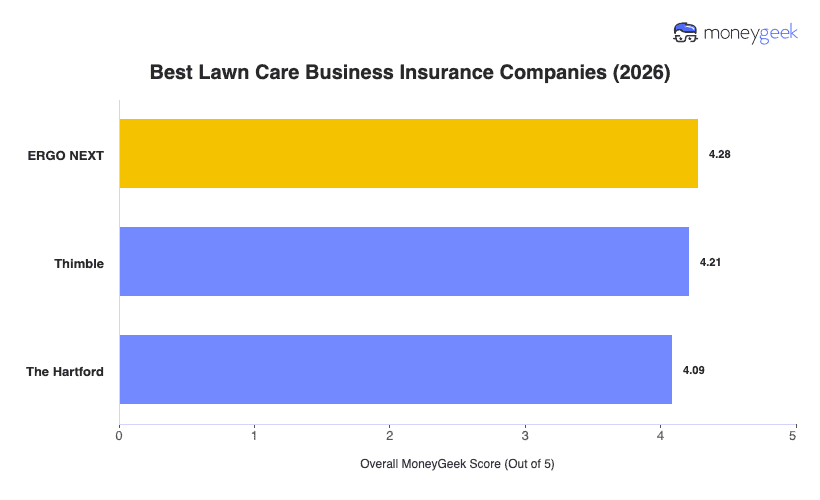
NEXT tops our lawn care rankings, leading in customer experience and finishing second in affordability at $124 per month. That balance matters when you need a COI turned around quickly for a new seasonal contract. Thimble ranks second with the lowest rate at $122 per month but scores last on coverage in our analysis. Verify the policy options if your operation applies pesticides or hauls equipment beyond basic mowers.

These seven providers each balance price and coverage differently. The cheaper options tend to have less coverage, while the ones with better coverage cost more. Pick based on what your business actually needs.

ERGO NEXT4.28213
Thimble4.21127
The Hartford4.09761
Hiscox3.94345
Nationwide3.93472
Progressive Commercial3.90534
biBERK3.90656

For our overall best lawn care and landscaping business insurance ratings, we analyzed pricing, coverage options, and customer experience across all 50 states and Washington, D.C. Our analysis focuses on 1-to-4-person lawn care businesses, while weighting results to ensure broader industry and location representation. To do this, we evaluated over six million business profiles, more than 100,000 customer experience data points and performed in-depth analysis of coverage contracts and endorsements to compare insurers consistently across industries and regions. We then rated each company across categories of affordability (50% of overall score), customer experience (30% of overall score) and coverage options and terms (20% of overall score) to form an overall rating.

See our full business insurance methodology.

These rankings give you a good starting point, but no single company works for every lawn care or landscaping business. Whether you're running a solo residential route or managing crews on HOA and commercial properties, you need the same basic coverage: general liability, commercial auto, and workers' comp. The best provider for you depends on how you actually operate.

Thimble makes sense if your routes are mostly residential, your coverage needs are straightforward, and you're watching every penny on expenses. ERGO NEXT is better if you run multiple commercial contracts and need certificates of insurance fast when clients ask for proof before the season starts.

Below, each provider profile breaks down when it's a good fit and when it might not work as well.

ERGO NEXT

ERGO NEXT

Best Overall for Lawn Care and Landscaping Businesses
On ERGO NEXT's site

ERGO NEXT ranks first overall for lawn care businesses, with the top customer experience scores and rates 18% below the industry average. You can quote, bind, download your COI and add additional insureds entirely online in about 10 minutes, with 24/7 access via app or web. Where it earns less confidence is claims since BBB complaints point to processing delays and denials tied to policy terms, which matters most when a chemical treatment or completed operations dispute surfaces weeks after the job.

Learn More: ERGO NEXT Business Insurance Review

Thimble

Thimble

Best for Flexible Lawn Care Business Insurance

Thimble ranks second overall for lawn care businesses and beats everyone on price. Rates run 19% below what the industry averages. What sets Thimble apart is how flexible the coverage is. You can buy by the hour, day, month, or year, so if your season is only eight months, you only pay for eight months. The downside: when you file a claim, a third-party administrator handles it, not Thimble directly. That can make the process slower.

Learn More: Thimble Business Insurance Review

Cheapest Lawn Care and Landscaping Business Insurance

For cheap landscaping insurance, Thimble, NEXT and Hiscox have the most competitive options for your business at $122, $124 and $149 per month. Thimble leads on affordability, coming in 19% below the lawn care industry average and saving your business $28 per month. We find that the cheapest policy rarely covers the full picture for lawn care operations. Chemical application, mobile equipment and commercial contract requirements all push coverage needs beyond what a bare-minimum policy provides.

Rates across all seven providers we analyzed break down as follows:

ERGO NEXT$172$2,059
Thimble$194$2,322
Nationwide$239$2,863
Hiscox$248$2,979
Progressive Commercial$250$3,002
biBERK$251$3,010
The Hartford$269$3,224

What Types of Insurance Do Lawn Care and Landscaping Businesses Need?

Every lawn care and landscaping job comes with insurance risks. You're running powered equipment on client property, sometimes applying chemicals, and moving thousands of dollars' worth of gear from one stop to the next. The coverage types you need for your lawn care business depend on what services you offer, how many people work for you, and what your clients require. But most lawn care contractors carry these basics:

  • General liability (since your crew works on client property and mower debris, spray drift and injuries generate claims on any route)
  • Commercial auto (because your trucks and trailers are business vehicles and personal auto policies exclude business use)
  • Workers' comp (most states require it once you hire, and heat illness and equipment injuries are common)
  • Inland marine (if your mowers and equipment travel on a trailer to job sites, not a fixed location)
  • Commercial property (if you operate from a shop or yard where you store mowers, trailers or chemical supplies)
  • Pesticide applicator endorsement (needed if you apply herbicides or fertilizers, since standard GL policies often exclude chemical drift claims)

We find most lawn care contractors start with general liability and commercial auto, then add workers' comp once they hire. What shifts as your business grows is less often the coverage list and more often the limits, your equipment schedule and what your commercial and HOA contracts require. Each profile below maps that progression by headcount.

How Much Does Lawn Care and Landscaping Business Insurance Cost?

Your lawn care business insurance costs an average of $148 per month, or $1,775 per year, $37 per month lower than the industry average. Workers' comp, general liability and commercial auto are the most expensive and essential coverage types for your operation. Workers' comp sits highest because outdoor labor, equipment use on uneven terrain and summer heat illness generate more claims than most service industries. We find total cost shifts sharply with your coverage mix: a solo operator with GL and commercial auto pays around $390 per month, while a crew adding workers' comp and property reaches $657 per month.

Costs vary more by coverage type than most lawn care operators expect:

How did we determine business insurance rates for lawn care businesses?

The averages above reflect what a typical lawn care business pays, but your actual number moves based on factors those averages can't capture. How much equipment you haul on routes, whether your crew applies chemicals and how many of your accounts are commercial rather than residential all shift your premium in ways the coverage type alone doesn't explain. A lawn care business insurance calculator can build a figure closer to what your specific operation would actually pay.

Estimate Your Monthly Lawn Care and Landscaping Insurance Cost

Enter your coverage type, state, number of employees and type of vehicle (if you need commercial auto coverage) to get a pricing estimate that fits your business.

We do not collect any personal information, and all rates are aggregated for all 50 states and Washington D.C. Workers' comp rate estimates are provided on a per employee basis and all coverage types assume standard industry limit recommendations for most businesses.

Select Coverage Type
Select State
Select Employee Cand
Select Vehicle Type
Average Monthly Cost—

How to Choose the Right Lawn Care and Landscaping Business Insurance

Choosing the right lawn care business insurance is a process that should track how your operation runs, not a box you check once. We find that skipping to price without mapping your exposures first often leaves gaps that only surface when a claim is filed. Your best starting point for getting business insurance is understanding what your specific operation puts at risk.

  1. 1
    Understand your risk profile and what coverage it requires

    Your risk profile in lawn care depends on what your crews do, how many people you employ and who your clients are. Your exposure as a solo operator running residential routes looks nothing like what a 15-person crew managing HOA and commercial accounts carries. Start by mapping your three biggest liability scenarios: what could go wrong on a client's property, what happens to your workers on the job and what you'd lose if your equipment was stolen overnight.

  2. 2
    Choose the right coverage limits

    The minimum limit that satisfies a requirement isn't always the right limit for your operation. Your residential accounts will typically accept $1 million per occurrence, but commercial property managers and municipal contracts routinely require $2 million. Match your limits to the contracts you're actively pursuing, not just the ones you currently hold; getting the limit right before you sign is less painful than renegotiating afterward.

  3. 3
    Evaluate providers who understand lawn care businesses

    Your insurer needs to understand lawn care risk, and not all of them do. Look for carriers with experience writing contractor and outdoor service businesses as they're more likely to offer pesticide applicator endorsements, inland marine for mobile equipment and seasonal workforce flexibility without policy headaches. Balanced performance across affordability, coverage breadth and customer experience matters more than optimizing for one pillar, especially when you need a COI fast for a new account.

  4. 4
    Get compliance-ready

    Your policy is only the starting point. What happens next depends on your clients, your state and the type of work you do. Property managers and HOAs will ask you for a certificate of insurance with an additional insured endorsement before your crew starts work. If your operation applies pesticides or herbicides, your state requires a licensed applicator; verify whether clients also want proof of that license before the season begins.

  5. 5
    Revisit your coverage as your lawn care business grows

    Your coverage needs at five employees are not the same as your needs at fifteen. Each time you hire, add a commercial account or expand your fleet, your policy needs to keep pace. Workers' comp kicks in with your first hire, commercial clients raise the GL limits they expect and more vehicles mean a longer schedule on your auto policy. Review your coverage at least once a year and before you sign any new commercial contract; the terms may require coverage your current policy doesn't provide.

Get Lawn Care and Landscaping Business Insurance Quotes

Pricing for lawn care business insurance varies enough between insurers that two operators with similar crew sizes can pay very different rates. If your operation is a solo residential route with no chemical application, your risk profile is straightforward and most carriers price it competitively. A mid-sized operation with commercial accounts, multiple vehicles and licensed pesticide applicators is a more complex risk that not every carrier handles equally well. Request business insurance quotes to see which providers fit what your operation actually looks like.

About Connor Bolton


Connor Bolton, Senior SEO and Content Manager (Business & Pet), MoneyGeek

Connor Bolton is Senior SEO and Content Manager at MoneyGeek, where he leads the business and pet insurance editorial teams. He sets the research framework, data standards and content structure for his team. All content goes through his accuracy review before publication. Connor also writes in-depth guides and has spent more than four years covering insurance products across personal, commercial and specialty lines.

The research infrastructure Connor built covers auto, home, renters, life, health, business and pet insurance across pricing analysis, carrier research, customer experience and coverage evaluation. It includes over 6 million data points for business insurance across 408 industry areas, all 50 states and 16 vehicle types. The pet insurance side covers over 5 million profiles across 18 major providers, 100+ breeds and ages up to 20 years. Connor’s insurance research and his team's work has been cited by the U.S. Chamber of Commerce, Allstate, Liberty Mutual, CBS News, Forbes and LegalZoom.

Connor also talks with underwriters and carrier liaisons at Ethos, The Hartford, ERGO NEXT, Nationwide and State Farm, and monitors business and pet owner communities on Reddit. Those sources shape how his team evaluates carriers, structures rate analysis and writes for human buyers rather than search engines.

For questions about MoneyGeek's business and pet insurance content, contact him at connor@moneygeek.com or on LinkedIn.