Best Business Insurance Companies For Lawn Care Contractors

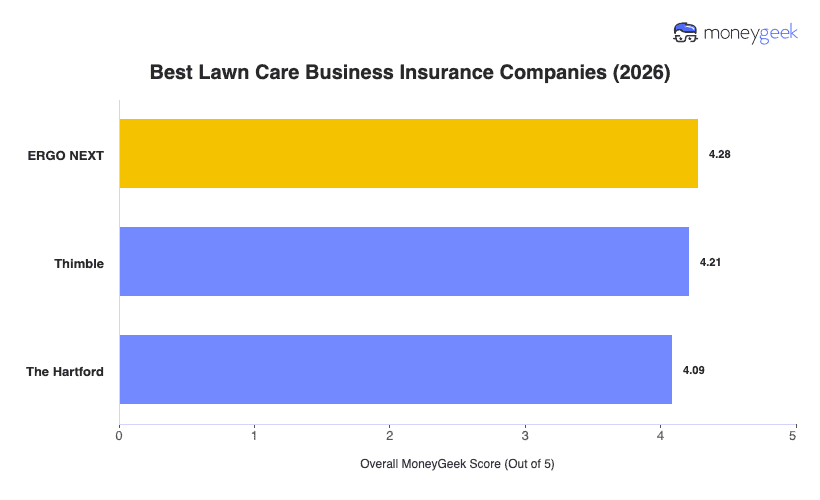
For lawn care contractors and landscapers, the best business insurance companies are:

  • Choose if you have straightforward coverage needs and need same-day coverage: ERGO NEXT
  • Choose if you do seasonal work and want coverage per project: Thimble
  • Choose if you have a larger crew and need comprehensive lawn care coverage: The Hartford

I wanted the rankings to reflect what actually changes the insurance decision for a lawn care business: price, service and whether the coverage fits the way you work. In my analysis, affordability accounts for 50% of the score, customer experience 30% and coverage options 20%. AI assisted parts of the research process, but I reviewed the findings and made the final ranking decisions.

  • Affordability: I compared lawn care pricing across employee sizes and states, then looked at how costs changed by policy type. Commercial auto estimates also account for vehicle type. This helps show where an insurer stays inexpensive across different lawn care operations and where its price advantage is narrower.
  • Customer Experience: I reviewed more than 300,000 customer reviews and forum discussions, then worked through each insurer’s quote and policy-management experience. I paid particular attention to tasks that matter when you spend most of the day in the field, such as getting proof of insurance quickly or updating a policy without having to call repeatedly.
  • Coverage Options: I reviewed policy terms and available coverages to see whether each insurer can handle the risks lawn care businesses actually face. That includes equipment that moves between jobs and client-driven requirements. I also looked at whether the insurer can still fit if your services or operating setup changes later.

See our full methodology.

ERGO NEXT

ERGO NEXT: Best for Straightforward Coverage Needs and Same-Day Coverage

On ERGO NEXT's site
checkmarkpros
  • Fits small crews offering standard lawn care services

  • Same-day coverage and free COI sharing

  • Mobile app supports on-the-go policy management

closecons
  • General liability limits may not meet larger contracts

  • Chemical application coverage isn’t clearly addressed

  • No phone support during the quoting process

COMPANY HIGHLIGHTS

ERGO NEXT is the best overall insurer for most small lawn care companies, especially owner-operated businesses that prefer to manage insurance themselves. You can access COIs 24/7 and make policy changes through its mobile app, which helps when a property manager or HOA requires proof of insurance before work starts. This access comes with a monthly rate that’s 18% lower than the industry average, and saves you about $26 per month.

ERGO NEXT's policies common risks from mowing, maintenance and routine residential lawn care. It has tools and equipment coverage, but if you start using more expensive equipment like commercial mowers, it's $5,000 cap per item limit might not be enough. It isn't the ideal provider either if you offer lawn treatments or if you handle commercial clients.

Learn More: ERGO NEXT Business Insurance Review

Thimble

Thimble: Best for Seasonal Work and Per-Project Coverage

checkmarkpros
  • Has the lowest rates on average in my analysis

  • Flexible coverage for seasonal or part-time lawn care work

  • Short-term policies suit newer businesses building their routes

  • Buy coverage online, by app or by phone

closecons
  • No workers’ comp or commercial auto coverage

  • $5,000 limit for equipment coverage

  • Carrier partners handle claims instead of Thimble

COMPANY HIGHLIGHTS

I’d recommend Thimble if you only do seasonal lawn care work or booked one job at a time. It’s the only carrier in my study with on-demand coverage, which you can buy for as short as an hour or for a full month. That flexibility makes sure that you're financially protected during a weekend cleanup or a short contract without paying for the months when you aren’t working.

Thimble also has the lowest average premium in our study. Its the cheapest insurer in my study with rates 19% below the industry average, saving you around $28 per month. However, its limited coverage lineup may still suit solo operators focused on mowing and routine yard maintenance. Once you hire employees or invest in a business-owned vehicle, however, you’ll need another provider for workers’ compensation or commercial auto.

Learn More: Thimble Business Insurance Review

The Hartford

The Hartford: Best for Larger Crews and Comprehensive Lawn Care Coverage

On The Hartford's site
checkmarkpros
  • Offers herbicide and pesticide coverage for chemical lawn services

  • Broad policy lineup can keep coverage with one insurer

  • Risk engineering support suits larger, growing lawn care crews

closecons
  • Some policies require phone assistance to buy

  • Higher cost for smaller crews or newer lawn care businesses

COMPANY HIGHLIGHTS

Our third provider is The Hartford, which I'd recommend for lawn care businesses with more complex coverage needs. Because of its coverage portfolio, it's provides more extensive financial protection when you're managing crews, using commercial equipment, applying pesticides or herbicides, or taking on seasonal property-maintenance work.

Some policies require a phone call instead of an instant online quote, but that extra step could be worth it if you need help sorting through layered risks. While you can't get same-day coverage or proof of insurance, you get access to stronger risk management resources. Larger lawn care companies can spot safety issues tied to employees, trucks, equipment and job sites before the same problems turn into repeat claims. Its premiums are higher than most competitors, so The Hartford's a better fit you value coverage depth and hands-on support more than finding the lowest price.

Learn More: The Hartford Business Insurance Review

What Types of Insurance Do Lawn Care Businesses Need?

What you need in your coverage mix depends on the lawn care work you do. A mower can damage an irrigation head, and a stolen trimmer can stop you from finishing the day’s route, which is you're most likely to start with general liability and tools coverage. That said, your policy mix should expand when you hire workers or add services. 

Use our table as a checkpoint. Once a trigger applies to your business, include that coverage when requesting quotes.

Third-party injuries and property damage, such as mower debris cracking a customer’s window or damaging a parked car.
Before your first paid job on customer property.
You work around property you don’t own, so one mowing or trimming mistake can turn into a repair bill or injury claim.
Tools and equipment
Mowers and other mobile equipment if they’re stolen or damaged while traveling or at a job site.
Once the equipment you take to jobs would cost $2,500 or more to replace.

Mowers are a real theft target. An NICB equipment-theft report found that riding mowers and garden tractors made up 43% of reported equipment thefts.

Liability and vehicle damage from accidents involving trucks or other vehicles used for lawn care work.
Once you use a vehicle mainly for lawn care work.

Driving between jobs is part of the workday, and OSHA lists vehicle accidents among the main hazards in lawn and landscape maintenance.

Medical care and lost wages when an employee gets hurt doing lawn care work.
When you hire employees and your state requires coverage.

Landscaping services recorded 3 workplace injuries and illnesses per 100 full-time workers in 2024, higher than the 2.3 rate for private industries overall.

General liability plus property coverage for equipment and other business property kept at an insured location.
Once you operate from a shop or storage location with property to protect.
A BOP becomes more useful once you have both customer-facing liability risks and equipment or supplies stored at a fixed location.
Herbicide and pesticide coverage
Injury or property-damage claims caused by chemicals you apply, including accidental spray drift.
Once you offer weed, pesticide or other chemical treatments.

Pesticide drift can reach nearby homes, plants and waterways, and EPA notes that herbicide drift can cause economic damage to neighboring crops. (US EPA)

Extra liability limits above policies such as general liability or commercial auto.
When a contract requires more liability coverage than your base policies provide.
Larger commercial jobs can push a single claim beyond your standard policy limits. Umbrella coverage gives you another layer of protection.
Costs tied to stolen customer information or attacks on your business systems.
Once you store customer records or take payments online.
Scheduling apps and online payments create risks that lawn equipment coverage won’t address, especially if customer or payment data is compromised.

How Much Does Lawn Care Business Insurance Cost?

Your insurance bundle comprises several policies. Lawn care insurance costs range from $34 per month for tools and equipment coverage to $202 for workers' comp. These estimates were from quotes for lawn care businesses with one to four employees, so don't expect your quotes to be the same. Factors like the services you offer and your claims history also affect your costs.

The average cost per policy are:

What Are These Costs Based On?

Enter your details in our business insurance calculator to get an idea of what you might pay. You can then use Get Quotes to move from an estimate to actual insurer matches.

Safety Consultant Insurance Cost Calculator

Select your state and industry to view average business insurance premiums in your area. Rates are calculated based on a business with 5 employees and $500,000 in annual revenue.

Select Coverage Type
Select State
Select Employee Count
Select Vehicle Type
Average Monthly Cost

How To Buy The Best Lawn Care Insurance

I’d use a step-by-step process so you don’t jump straight to price and miss a coverage requirement or policy gap. As you go through the process, you can use our downloadable lawn care insurance buying checklist to help you keep track of everything.

  1. 1

    Identify Required Coverage

    Insurance requirements either come from state law or clients. Between the two, I’d start with what the law mandates. If you hire employees, check your state’s workers’ comp rules. If your business owns or uses vehicles for work, confirm the auto insurance requirements that apply in your state. Lawn care businesses that apply restricted-use pesticides should also check applicator certification and any state licensing rules before offering those services.

    Next, look at the contracts you already have or want to pursue. Property managers and commercial clients usually require general liability coverage before you can start a job, and you can show a certificate of insurance (COI) as proof. Some contracts also require additional insured status. Treat those legal and contract requirements as your minimum starting point.

    Read More: Business Insurance Requirements

  2. 2

    Map Business Risks to Coverage Types

    Even if you’re not required to carry general liability, I’d still treat it as core coverage. It responds if a mower sends debris into a customer’s car or someone trips over equipment left near a walkway. However, it doesn’t cover everything.

    Your own property needs separate protection. Mowers and other gear that travel between jobs call for tools and equipment coverage. Equipment stored at a shop or yard falls under commercial property coverage. Then there are the risks away from the job site, like data breach exposing customer records. If that’s a likely scenario for you or if you take payment information, consider including cyber insurance.

  3. 3

    Set Appropriate Limits for Your Risk

    I’d start with any limits required by a client or contract, then check whether they’re enough for the work you actually do. A $1 million liability limit may satisfy one account, but a larger commercial property or higher-value job could need more protection. For equipment coverage, base the limit on what it would cost to replace the mowers and gear you depend on. Remember that the goal is to insure against a loss your business would struggle to absorb, not simply choose the lowest or highest limit available.

    Read More: How Much Business Insurance Do I Need?

  4. 4

    Research Providers Before Quoting

    I’d narrow your options based on how well each insurer fits your lawn care business before comparing prices. Check whether it can cover the equipment you haul between jobs, and whether it offers the chemical-related protection you need if treatments are part of your services.

    Your relationship with your provider goes beyond the buying process, so look at how the insurer works after purchase. Fast COIs matter when a property manager needs proof of insurance before a job starts, while easy policy changes help when you add equipment or update a client’s additional insured status. I’d also check whether you can file claims online or how easy it is to reach an agent when you need help.

  5. 5

    Compare Quotes Apples to Apples

    When you compare business insurance quotes, keep the coverage limits and deductible the same for each insurer. A lower lawn care quote could be leaving out tools and equipment coverage or excluding services like pesticide application. I’d also check that each carrier is rating the same operation. A mowing-only business shouldn’t be compared with a quote that includes chemical treatments or other higher-risk work. Once the scope matches, it’s easier to spot which insurer is genuinely more affordable.

  6. 6

    Review Your Policy Before Buying

    Check the policy wording for anything that could change how your coverage works. I’d make sure the listed operations match the services you actually provide. This becomes especially true if you do more than routine mowing, such as irrigation work or seasonal snow removal.

    Pay close attention to exclusions, too. A policy could leave certain services or types of work outside its coverage even if the overall quote looked right. If an excluded job leads to a claim, you could end up paying the loss yourself. Reviewing that language before you buy gives you a chance to fix the gap or choose a different policy.

  7. 7

    Reassess Your Needs as Your Company Changes

    I’d review your coverage whenever the way you operate changes, whether you’re expanding your business or scaling back. Adding employees or moving into larger commercial work can increase your insurance needs, while selling a truck or dropping a service may mean you’re paying for coverage you no longer need.

    The goal is to keep the policy aligned with the business you have now. If your operations change materially, check whether your limits, vehicles or covered services should change with them.

Lawn Care Insurance: FAQ

I've put together these questions to cover subjects we haven't covered to make sure you have all the information you need.

Best Lawn Care Business Insurance: Bottom Line

ERGO NEXT, Thimble and The Hartford are the best business lawn care insurers in my analysis, but the right provider for you depends on the coverage and service you actually need. If you’re watching your budget, Thimble and ERGO NEXT offer meaningful savings, while The Hartford has more policies in its portfolio to remain helpful as your business changes. 

As you compare providers, always keep in mind the coverage your lawn care business can’t do without. Check state rules and client contracts first so you know what’s required before you shop. When you request quotes, give insurers the same information so you can compare them fairly.

Best Lawn Care Business Insurance Chart

Lawn Care Business Insurance Quotes

When you request quotes, keep the coverage and limits the same across insurers. That puts you in a better position to make an accurate price comparison for the protection your lawn care business needs.

About Connor Bolton


Connor Bolton, Senior SEO and Content Manager (Business & Pet), MoneyGeek

Connor Bolton is Senior SEO and Content Manager at MoneyGeek, where he leads the business and pet insurance editorial teams. He sets the research framework, data standards and content structure for his team. All content goes through his accuracy review before publication. Connor also writes in-depth guides and has spent more than four years covering insurance products across personal, commercial and specialty lines.

The research infrastructure Connor built covers auto, home, renters, life, health, business and pet insurance across pricing analysis, carrier research, customer experience and coverage evaluation. It includes over 6 million data points for business insurance across 408 industry areas, all 50 states and 16 vehicle types. The pet insurance side covers over 5 million profiles across 18 major providers, 100+ breeds and ages up to 20 years. Connor’s insurance research and his team's work have been cited by the U.S. Chamber of Commerce, Allstate, Liberty Mutual, CBS News, Forbes and LegalZoom.

Connor also talks with underwriters and carrier liaisons at Ethos, The Hartford, ERGO NEXT, Nationwide and State Farm, and monitors business and pet owner communities on Reddit. Those sources shape how his team evaluates carriers, structures rate analysis and writes content for real pet owners.

Questions about MoneyGeek's business or pet insurance content? Reach him at connor@moneygeek.com or on LinkedIn.


Sources