



Jump to the section that meets your needs best below:
Average Lawn Care Business Insurance Cost (2026 Report)
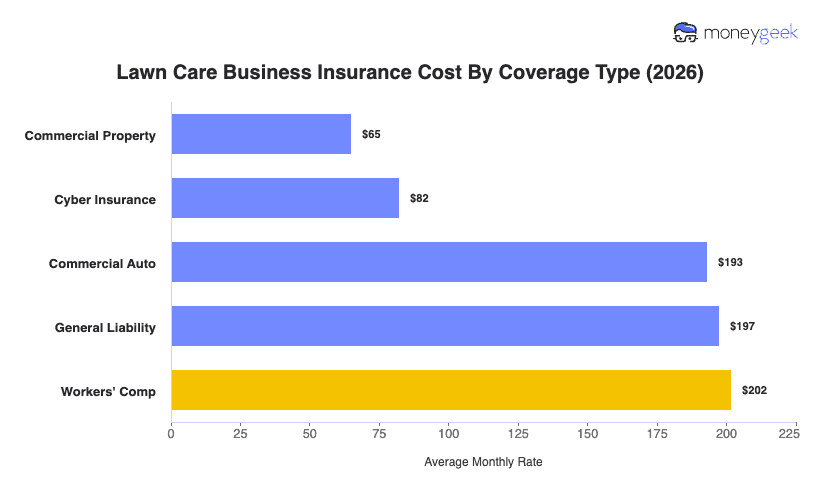
The average cost for lawn care business insurance range from $34 to $292 per month, depending on factors like your business size and services, and the coverage bundle you choose.
If you're ready to get a quote, use the tool below to get matched with the best business insurance provider for your lawn care operations.
Select state
Updated: September 11, 2026
Advertising & Editorial Disclosure
How Much Does Lawn Care Business Insurance Cost?
Lawn care business insurance costs range from an average of $390 per month for a minimum starting bundle to $931 for a full-service one, depending on which one fits your operations. Your total cost of contractor insurance increases as you include more coverages in your policy mix, whether it's workers' comp when you hire employees or pesticide/herbicide applicator coverage when you start offering lawn treatment services.
We used national averages, so use them to understand the relative cost of each bundle rather than as exact quotes. Use the table below to compare the different bundles and see which one fits your lawn care business:
Starting Bundle | General liability, commercial auto | $390 | $4,686 | Solo or newer lawn care owners |
Recommended Bundle | General liability, commercial auto, tools and equipment insurance | $424 | $5,094 | Owners with steady work and more equipment |
Crew Operations Bundle | General liability, commercial auto, tools and equipment insurance, workers’ compensation, commercial property | $691 | $8,298 | Businesses with employees and store gear in a fixed location |
Full-Service Lawn Care Bundle | General liability, commercial auto, tools and equipment insurance, workers’ compensation, commercial property, pesticide/herbicide coverage, surety bond, cyber insurance | $931 | $11,179 | Businesses with treatment or contract work |
To estimate lawn care business insurance costs, we used quotes from 10 major U.S. commercial insurance providers and modeled premiums for lawn care businesses across all 50 states and Washington, D.C. The model accounts for different staffing levels, from solo operators who handle mowing routes themselves to lawn care businesses with multiple crew members.
We modeled lawn care premiums, not live quotes, and summarized the data in three ways:
- National benchmark average: This figure gives you a broad reference point for lawn care insurance costs. It reflects standardized lawn care profiles with one to four employees, industry-recommended policy limits and modeled results from every state and Washington, D.C.
- State averages: To show how location changes cost, we compared the same base lawn care profile across each state and Washington, D.C. This keeps the business profile consistent, so the state-by-state differences reflect geography rather than changes in crew size, vehicle use, equipment exposure or services offered.
- Bundle averages: Package costs were built from the modeled prices of individual policies, plus externally researched estimates for specialized coverages beyond our dataset. These bundles reflect how lawn care insurance usually builds around the work itself: protecting customer property, business vehicles, mowers and tools, hired crew members, stored equipment and treatment-related risks.
Some specialized lawn care coverages fall outside our modeled dataset because they depend on services that not every lawn care business offers. Pesticide or herbicide coverage, hired and non-owned auto, surety bonds and contractors pollution liability may apply only if you offer treatment work, use personal or rented vehicles for business errands, need a client-required bond or take on jobs with runoff or chemical exposure risk. For these policies, we used external research so readers can estimate how much they may add when they apply.
See our full business insurance methodology.
Get Lawn Care Business Insurance Cost Estimates
If you want a more personalized estimate, use the business insurance cost calculator before comparing rates. Once you have a benchmark, MoneyGeek can connect you to the top providers for your lawn care business where you can request for quotes directly from their website.
Get Lawn Care Insurance Cost Estimates
Select Coverage Type
Select State
Select Employee Count
Select vehicle_type
Monthly Rate Estimate—
Select Coverage Type
Monthly Rate Estimate—
Select State
Select Employee Count
Select vehicle_type
Factors Affecting Lawn Care Business Insurance Costs
Lawn care insurance costs can change based on several things. Some, like the services you offer, your crew size, the type of vehicles you use and the jobs you accept. Others, such as your claims history, business size and revenue, are more general and affect costs regardless of industry.
 Employees or seasonal W-2 help
Once you put other people on payroll, your insurance isn’t only priced around your own work anymore. When you work alone, you control how equipment is handled, when to stop in extreme heat and how fast a job gets done. Add seasonal crew members, and the insurer has to account for more people lifting mowers, loading trailers, using trimmers and working long outdoor days.
 Vehicles used for lawn care work
A pickup used for nearby mowing jobs is one thing. A truck pulling a trailer full of mowers, fuel cans, blowers and debris is another. The heavier your vehicle setup, the more damage an accident can cause and the more expensive it becomes to insure.
 Type of lawn care work performed
The risks you encounter with a weekly mowing are fairly predictable. Your exposure changes when you add work that leaves lasting damage, such as weed control, fertilizer, brush clearing, aeration or snow and ice removal. A bad mow may mean an angry customer, but a bad treatment job translates to dead grass, damaged plants or a neighbor’s yard getting affected too.
 Equipment used on jobs
More than looking at how many tools you have, insurers are more concerned about what those tools can do and what they cost to replace. Handheld trimmers and push mowers keep your exposure small. Once you start using zero-turn mowers, aerators, sprayers and trailers, the risks for repair, theft and property damage compounds.
 Customers and properties served
A small backyard job has fewer moving parts than an HOA, apartment complex, school or commercial property. Working bigger sites means more parked cars, irrigation systems, walkways, people and contract rules. A single mistake can become expensive since there’s more property that you could damage while working.
How to Lower Lawn Care Business Insurance Costs
Part of lowering lawn care insurance costs involves removing unnecessary coverage now and preventing claims later. Here are multiple methods for finding more affordable coverage that you can apply immediately or over time:
 Compare quotes using the same coverage limits
Ask each insurer to quote the same limits, deductibles and coverage types when you compare quotes, so you can see the prices fairly. A cheaper quote may leave out tools, trailers, treatment work or hired crew members. Watch for those gaps because one stolen mower, damaged sprinkler system or truck-and-trailer accident can wipe out the savings.
 Right-size your coverage
Match your policy to the work you do now, not last season’s service list. A solo mowing route does not need the same coverage mix as a crew handling HOAs, fertilizer applications or commercial properties. Keep core protection like general liability, but remove add-ons for services you no longer offer.
 Bundle policies with the same provider
Bundling can help when one insurer can cover the way your business actually works: equipment in transit, trucks or trailers, customer property damage and crew injuries. Combining tools and equipment, commercial auto insurance and workers’ compensation may also make certificates easier when property managers or commercial clients ask for proof of coverage.
 Lower your risk profile
Insurers look at whether your business keeps having preventable claims. Lock trailers overnight, service mowers before the busy season, train crews to work carefully around sprinkler heads and windows, and document treatment jobs before and after application. Fewer theft, injury, auto and property damage claims can help you at renewal.
 Invest in risk management practices
You can lower your long-term insurance costs by preventing the claims insurers price against you. Start with the problems you can control on every route: damaged property, injured workers, stolen equipment, trailer accidents and treatment mistakes.
- Lock up mowers, trimmers and blowers after each route instead of leaving them exposed in trucks or open trailers overnight.
- Walk each yard before work starts so your crew can spot sprinkler heads, outdoor lighting, toys, pets and parked cars.
- Write down the products, weather conditions and customer instructions for every fertilizer, herbicide or pesticide job.
- Check trailer lights, ramps and tie-downs before leaving the yard so equipment does not shift, fall or cause an accident.
Lawn Care Business Insurance Cost: Bottom Line
The $424 monthly recommended bundle average is a reference point, not a prediction. Your actual lawn care insurance quote can land above or below it based on how your business operates, especially your crew size, vehicle setup, equipment, services and state.
Lawn care insurance costs don't rise evenly across all coverage types. In my analysis, general liability changes the most as crew size increases, while workers’ comp and commercial auto stay relatively flat. These questions help locate where yours actually falls:
- Where do you fall compared with the recommended bundle? Use your crew size, vehicle setup, services and state as starting points. If your quote is far above $424 per month, check whether the difference reflects your actual risk or whether the policy includes coverage, limits or add-ons you do not need.
- Is your quote consistent with your risk profile? Higher quotes trace back to a few major drivers. These include employees, business-owned vehicles, trailers, expensive equipment, treatment work or state pricing differences. If your business is straightforward but the quote is high, compare at least two other providers before deciding.
- Which cost drivers apply to your business? A solo operator with a push mower and a crew running a dump truck may both count as lawn care businesses, but insurers won't price them the same way. Go through the factors on this page and see which ones describe your operation. Those are the drivers most likely to explain where your quote landed.
Use the bundle average to orient yourself, then look at the cost drivers to understand why your price is lower, higher or about where it should be.
About Angelique Palenzuela-Cruz

Angelique Palenzuela-Cruz is a Business Insurance Content Writer at MoneyGeek, where she specializes in general liability, workers’ compensation and professional liability insurance. Her work helps small business owners understand how these policies apply to coverage, including risks like customer injuries, employee injuries, professional mistakes, client contract terms and industry-specific coverage requirements.
She primarily covers service-based businesses where liability and employee coverage decisions are especially important, including cleaning, consulting, beauty and wellness, childcare, education, fitness, food service, pet care, repair and maintenance, and other professional services.
Before joining MoneyGeek, Angelique spent nearly 12 years at Guthrie-Jensen Consultants, one of Southeast Asia’s largest management training firms, where she advanced from Training Consultant to Managing Consultant. In that role, she worked with business clients to assess operational needs, develop training programs and present performance analyses to executive decision-makers. She also helped establish Gladwin Training Consultancy, where she served in learning solutions and client service roles.
Her background gives her practical context for writing about how businesses operate, manage client expectations, structure teams and make risk decisions. At MoneyGeek, she applies that experience to business insurance content, connecting coverage to actual business needs.
LinkedIn: linkedin.com/in/ma-angela-cruz
Email Contact: angelique.palenzuela@moneygeek.com
Sources
- Council of the District of Columbia. "Notification of Security Breach." Accessed October 8, 2026.
- Michigan Department of Insurance and Financial Services. "New Auto Insurance Rate Filings Approved." Accessed October 8, 2026.
- U.S. Department of Labor. "Minimum Wage." Accessed October 8, 2026.