Key Takeaways
blueCheck icon

ERGO NEXT, Thimble and The Hartford top our analysis of plumbing business insurance carriers, and you can get covered starting at $150 per month. (Jump to Top Providers)

blueCheck icon

ERGO NEXT, at its $150 monthly average rate, saves plumbing businesses about 21% ($40 a month) on average compared to the plumbing industry average. (Jump to Cheapest Providers)

blueCheck icon

General liability, workers' compensation and commercial auto are the policies you'll need most. They cover water damage to client property, injuries from physical site work and the daily driving that comes with every service call. (Jump to Types You Need)

blueCheck icon

Plumbing business insurance coverage costs range from $86 to $365 per month depending on the policy. (Jump to Costs)

blueCheck icon

The right plumbing insurance starts with coverage that fits your work type, limits that reflect your biggest jobs and a provider that can scale with your business. (Jump to Choosing Process)

Best Plumbing Business Insurance Companies

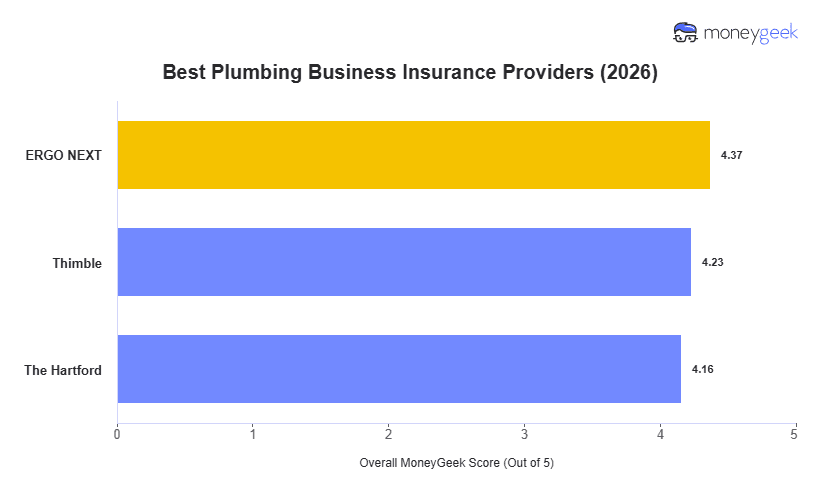
ERGO NEXT leads our plumbing insurance rankings on both affordability and customer experience, a combination that matters when you need a COI before a GC will let you on site. Thimble ranks second on both overall score and price, so if you take on project-based plumbing work and want to keep costs down, start there. Your business type and coverage priorities will shape which of the seven providers below fits your operation.

ERGO NEXT4.37113
Thimble4.23256
The Hartford4.16731
biBERK3.99375
Hiscox3.94627
Nationwide3.92562
Progressive Commercial3.89444

For our overall best plumbing business insurance ratings, we analyzed pricing, coverage options, and customer experience across all 50 states and Washington, D.C. Our analysis focuses on 1-to-4-person plumbing businesses, while weighting results to ensure broader industry and location representation. To do this, we evaluated over six million business profiles, more than 100,000 customer experience data points and performed in-depth analysis of coverage contracts and endorsements to compare insurers consistently across industries and regions. We then rated each company across categories of affordability (50% of overall score), customer experience (30% of overall score) and coverage options and terms (20% of overall score) to form an overall rating.

See our full business insurance methodology.

Rankings tell you where to start, not where to stop. A solo plumber doing residential service calls and a small firm chasing commercial plumbing subcontracts share the same core policies, but the right carrier depends on how you work. ERGO NEXT fits operators who deal with general contractors regularly and need certificates issued quickly to stay on schedule. If you work shorter engagements or take on jobs seasonally, Thimble's project-based structure gives you more flexibility on timing and cost.

Each provider profile below breaks down exactly who it serves well in the plumbing trade and where it falls short.

ERGO NEXT

ERGO NEXT

Best Overall for Plumbing Businesses
On ERGO NEXT's site

ERGO NEXT ranks first overall and tops our analysis in both cost and the day-to-day experience of running a plumbing business. You'll spend around 21% less than the industry average, roughly $486 less per year, and bundling two or more policies saves up to 10% more. It also ranks first on customer experience because of its self-serve platform that lets you pull a certificate of insurance, add a general contractor as an additional insured and share proof of coverage by text from a job site, all without calling an agent. Where some policyholders have run into trouble is understanding how GL and commercial property divide responsibility once a claim arrives.

Learn More: ERGO NEXT Business Insurance Review

Thimble

Thimble

Best for Flexible Coverage

Thimble ranks second in our analysis for plumbing contractors, with rates running about 18% below the sub-industry average. The policy structure is what sets it apart. You can buy coverage by the job, month or year, so a slow winter doesn't mean paying for a full annual policy you're not using. The Certificate Manager lets you set insurance requirements for your subcontractors, track their COI compliance and flag expiring policies from one portal, free even if your subcontractors aren't Thimble policyholders. When a claim arrives, Thimble routes it to a third-party administrator rather than handling it directly, and BBB complaints point to slow timelines and limited communication during that process.

Learn More: Thimble Business Insurance Review

Cheapest Plumbing Business Insurance Companies

The cheapest plumbing insurance options in our analysis are ERGO NEXT at $150 per month, Thimble at $157 per month and biBERK at $192 per month. At $40 per month less than the industry average, ERGO NEXT gives your business a savings of about 21%. We find that the cheapest option isn't always the right fit for your business. If you're bidding commercial subcontracts, you may need higher limits or faster certificate issuance than the lowest-cost provider offers. 

The table below shows the monthly and annual rates across all seven providers in our study:

ERGO NEXT$150$1,804
Thimble$157$1,879
biBERK$192$2,304
Progressive Commercial$196$2,356
Nationwide$197$2,358
Hiscox$197$2,364
The Hartford$202$2,427

What Types of Insurance Do Plumbers Need?

Plumbing work creates insurance needs that stack up fast. Every job puts you inside a client's home or building, working on pressurized water lines, gas connections and drain systems where a single failure can cause thousands of dollars in damage before anyone realizes something is wrong. Your truck carries your livelihood, your tools leave with you every morning, and the moment you hire your first employee, your legal obligations shift with them. The coverages most plumbing businesses need reflect all of that:

  • General liability (since every job creates third-party property damage and injury exposure, and water damage to client property is the most common claim in the trade)
  • Commercial auto (since your truck is your mobile base of operations, and personal auto policies exclude regular business use for service calls)
  • Inland marine / tools and equipment (since your tools travel to every job and standard property coverage doesn't follow them out of a fixed location)
  • Workers' compensation (if you hire employees: most states require it on your first hire, and back injuries, burns from soldering and cuts from pipe work make claims routine in this trade)
  • Commercial property (if your business operates from a shop or warehouse with owned equipment and materials inventory on site)
  • Umbrella / excess liability (if you work commercial projects or bid GC subcontracts where contract language requires limits above a standard GL policy)
  • Professional liability _(if you design plumbing systems or write specifications rather than simply executing a pr_e-specified install)
  • Cyber liability (if you store customer payment data or manage digital scheduling and service records for multiple commercial clients)

If you're running a solo operation, general liability, commercial auto and inland marine cover your core exposures. That picture shifts quickly when you start hiring: workers' comp becomes a legal requirement in most states, and more crew members working on live systems inside client buildings means more chances for a water or gas incident to become a claim. What you carry beyond that foundation depends on how you work: the jobs you take, the clients you serve and the contracts they put in front of you. 

The headcount-based breakdowns below walk through what changes at each stage.

How Much Does Plumbing Business Insurance Cost?

Plumbing business insurance costs an average of $189 per month ($2,269 per year), though your rate changes based on which policies you carry. General liability and workers' compensation run higher because water damage claims are frequent and your completed operations exposure extends past the job's close date, and crawl space work, torch equipment and heavy pipe put plumbers in a higher injury-frequency category.

Commercial auto is the first policy most plumbing businesses carry alongside their liability coverage. We find total cost varies based on coverage mix. A solo plumber with general liability and commercial auto pays roughly $570 per month, but add workers' compensation for a crew and the total moves to around $845 per month. Each policy's cost on its own:

How did we determine business insurance rates for plumbers?

What you pay for plumbing insurance depends on more than which policies you carry. The type of work moves the number: residential service calls carry different risk than commercial new construction, and gas line work adds an exposure that drain-and-fixture operations don't share. Your crew size and vehicle count shift your premium most once your coverage mix is set. The plumbing business insurance calculator builds an estimate around your actual operation, not a modeled profile.

Estimate Your Monthly Plumbing Insurance Cost

Enter your coverage type, state, number of employees and type of vehicle (if you need commercial auto coverage) to get a pricing estimate that fits your business.

We do not collect any personal information, and all rates are aggregated for all 50 states and Washington D.C. Workers' comp rate estimates are provided on a per employee basis and all coverage types assume standard industry limit recommendations for most businesses.

Select Coverage Type
Select State
Select Employee Cand
Select Vehicle Type
Average Monthly Cost—

How to Choose the Right Plumbing Business Insurance

Your plumbing insurance program doesn't come together in a single purchase decision: it's built through steps that match coverage to how your business operates. We find that plumbers who skip straight to a quote often end up underinsured where their trade creates the most exposure. Knowing what to look for before you get business insurance closes that gap.

  1. 1
    Understand your risk profile and what coverage it requires

    Plumbing work creates liability every time you touch a pressurized system inside a client's property, and the type of work you do determines where that liability lands: a residential plumber's primary exposure is property damage, while a commercial contractor bidding GC subcontracts adds contractual indemnification obligations on top. Before requesting a quote, map out what you do, who you work for and whether your clients, contracts or state rules mandate specific coverage types or limits.

  2. 2
    Choose the right coverage limits

    Your first general liability limit is often $1 million per occurrence because that's what clients ask for. But a water damage event on a commercial project, including flooded suites, business interruption and penalty clauses, can push past that limit before the remediation crew finishes. Set your limits based on the largest single loss your work could realistically generate, then check whether any current or target contracts require higher limits before you lock them in.

  3. 3
    Evaluate providers who understand plumbing businesses

    Price matters, but a cheap policy that doesn't cover your work type or can't issue a certificate of insurance before your crew is on site creates problems price alone doesn't solve. When you're comparing providers, look for one with experience insuring contractors, a claims process that moves fast enough for active job sites and coverage options that match your trade's actual needs. Weight customer experience alongside cost, not after it.

  4. 4
    Get compliance-ready

    Your compliance obligations don't end with the policy purchase. Most states require you to carry a plumbing contractor license bond before you can pull permits: it's a separate instrument, not your GL policy. Before work begins, your clients and GCs will ask for a certificate of insurance and often require you to name them as additional insureds. Confirm your bond is current, your COI is ready and your limits match each client's contract.

  5. 5
    Revisit your coverage as your plumbing business grows

    A coverage mix that fits a two-plumber service operation stops fitting the moment you take on a commercial subcontract, add a truck or cross into a new state. Review your policies at least annually and whenever you hire employees, add vehicles or sign a new master service agreement. Your insurer needs to know about those changes to keep coverage valid, and GC contracts often require updated certificates before your crew can start a new project.

Get Plumbing Business Insurance Quotes

The provider that works best for your residential service calls may not be the right fit if you're managing commercial subcontracts across multiple sites. Your coverage mix, crew size and the contracts you sign all influence which carrier offers the most value: not just on price, but on claims support and limit flexibility. Requesting business insurance quotes from multiple providers gives you a real comparison, not a guess.

About Connor Bolton


Connor Bolton, Senior SEO and Content Manager (Business & Pet), MoneyGeek

Connor Bolton is Senior SEO and Content Manager at MoneyGeek, where he leads the business and pet insurance editorial teams. He sets the research framework, data standards and content structure for his team. All content goes through his accuracy review before publication. Connor also writes in-depth guides and has spent more than four years covering insurance products across personal, commercial and specialty lines.

The research infrastructure Connor built covers auto, home, renters, life, health, business and pet insurance across pricing analysis, carrier research, customer experience and coverage evaluation. It includes over 6 million data points for business insurance across 408 industry areas, all 50 states and 16 vehicle types. The pet insurance side covers over 5 million profiles across 18 major providers, 100+ breeds and ages up to 20 years. Connor’s insurance research and his team's work has been cited by the U.S. Chamber of Commerce, Allstate, Liberty Mutual, CBS News, Forbes and LegalZoom.

Connor also talks with underwriters and carrier liaisons at Ethos, The Hartford, ERGO NEXT, Nationwide and State Farm, and monitors business and pet owner communities on Reddit. Those sources shape how his team evaluates carriers, structures rate analysis and writes for human buyers rather than search engines.

For questions about MoneyGeek's business and pet insurance content, contact him at connor@moneygeek.com or on LinkedIn.