



Jump to the section that meets your needs best below:
Average Plumbing Business Insurance Cost (2026 Report)
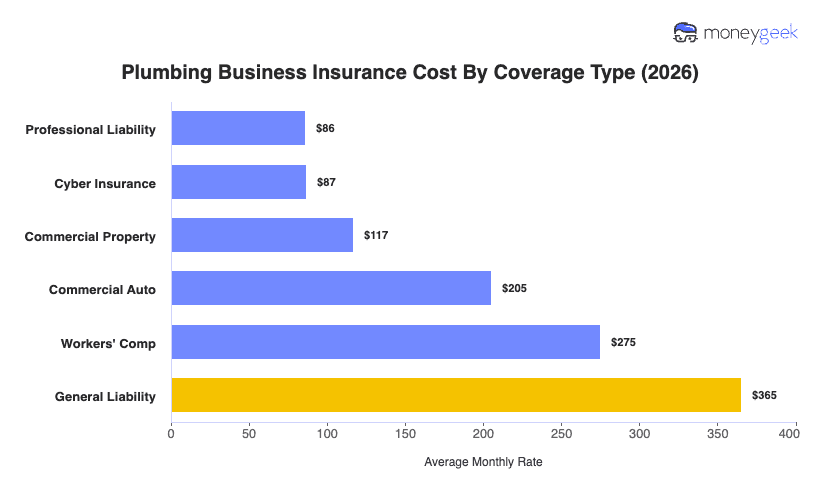
A solo contractor's plumbing business insurance costs begin with basic general liability insurance, which averages $87 per month.
Even as a start up, you'll need more than just general liability coverage.
If you're ready to get a quote, use the tool below to get matched with the best business insurance provider for your plumbing operations.
Select state
Updated: September 12, 2026
Advertising & Editorial Disclosure
How Much Does Plumbing Business Insurance Cost?
Plumbing business insurance costs around $343 per month on average for a starting bundle with general liability, tools coverage and commercial auto insurance for one van. If you're just starting out, it's enough to cover the common risks you encounter, including accidental damage at a customer’s property, stolen tools and crashes while travelling between jobs.
Your contractor insurance costs can rise when you hire employees, add vehicles, perform larger installations, store more equipment or take on higher-value contracts. The right bundle depends on how your plumbing business operates today and which risks could cost you the most.
Starting Bundle | General liability + commercial auto + tools and equipment + surety bond | $343 | Solo service plumbers with one van |
Recommended Bundle | Starting bundle + installation floater | $384 | Solo plumbers handling installations and remodels |
Growing Bundle | Recommended bundle + workers’ comp | $940 | Owner-led plumbing businesses with one to four employees handling service calls and installations |
Expanded Bundle | Business owner’s policy (BOP) + commercial auto + tools and equipment + installation floater + workers’ comp + commercial umbrella | $1,101 | Plumbing crews taking larger contracted or commercial jobs |
We started with how plumbing businesses operate, then priced the insurance changes created by specific decisions. Service work creates exposure from property damage, driving and portable tools. Installation work adds materials that may remain at a jobsite before completion. Hiring employees introduces payroll and workplace injury costs, while larger contracts can require higher liability limits.
We matched pricing from 10 major U.S. commercial insurers to those operational changes.
- Bundle averages: We built each bundle around a recognizable plumbing operation rather than the number of policies included. Starting and Recommended represent solo contractors and assume one van. Starting combines general liability, commercial auto and tools coverage. Recommended adds an installation floater for materials and equipment awaiting installation. Growing and Expanded represent businesses with one to four employees. Growing adds workers’ compensation. Expanded replaces standalone general liability with a business owner’s policy, which combines liability and property coverage, then adds commercial umbrella insurance for higher liability limits.
- National benchmark averages: We matched each cost to the business profile it represents instead of applying one staffing level across the page. Starting and Recommended use solo-operator rates, while Growing and Expanded use rates for businesses with one to four employees. In the coverage table, all estimates use solo rates except workers’ compensation, which is shown per employee using the rate for a staffed business. Commercial auto reflects one van across every profile.
- State averages: We moved the same plumbing business from state to state without changing its work, staffing level, payroll, van type, equipment values or policy terms. This keeps location as the main difference. Where specialized coverage lacked direct state data, we adjusted its national estimate using the geographic pattern of a policy exposed to the most similar type of loss.
These estimates can help you set a budget and compare a quote with the bundle closest to your operation. Your final premium may still change based on the jobs you accept, how you use employees and subcontractors, what you carry between sites, your driving exposure and the limits included in the policy.
See our full business insurance methodology.
Get Plumbing Business Insurance Cost Estimates
Use our business insurance cost calculator to estimate what your plumbing business may pay based on your state, coverage choices, crew size and work vehicle. You can model costs for a solo operation or a staffed business, then select Get Quotes to compare insurers.
Keep these points in mind:
- You don't need to enter personal details, and we don't collect or store them.
- Workers’ compensation estimates rise as you add plumbers or other employees.
- Commercial auto estimates reflect the vehicle you use for service calls, such as a van or pickup.
Get Plumbing Insurance Cost Estimates
Select Coverage Type
Select State
Select Employee Count
Select vehicle_type
Monthly Rate Estimate—
Select Coverage Type
Monthly Rate Estimate—
Select State
Select Employee Count
Select vehicle_type
Factors Affecting Plumbing Business Insurance Costs
Plumbing insurance costs tend to rise when a routine job could lead to a larger claim. A leak spreading beyond one room or stolen equipment from a van can increase the potential loss. Unfinished work left overnight or a subcontractor damaging an underground utility can do the same.
The factors below show which parts of your day-to-day work are most likely to affect your rate.
 Services you perform
Insurers look at how much damage one mistake could cause. Routine fixture repairs usually carry less risk than sewer excavation, gas-line work or full-system installations. For example, a loose fitting under a sink could damage one cabinet, but a failed connection on a commercial repiping job might flood several floors.
 Buildings you work in
Rates can rise when water damage could spread beyond the room where you're working. A leak in a single-family home might affect one household, but the same leak in an apartment building could damage several units and force tenants to relocate.
 How much work stays unfinished
Multi-day projects leave open pipes and materials exposed before the customer accepts the finished work. If you stop midway through a bathroom remodel and a temporary connection fails overnight, water could damage the unfinished room and the floor below.
 Tools and materials carried in your van
The more equipment and customer-bound materials you transport, the more an insurer could have to replace after a theft or collision. A plumber carrying hand tools faces a smaller loss than one transporting a sewer camera, press tools, a drain-cleaning machine and a new water heater.
 Use of subcontractors
Insurers typically charge more when another company’s work creates a claim tied to your project. Suppose you hire an excavation crew to expose a sewer line and it strikes an underground utility. The client could still hold your plumbing business responsible for the damage.
 Emergency and after-hours calls
Urgent jobs often involve active leaks, poor visibility and limited time to inspect the full problem. For example, a plumber called to stop a burst pipe at midnight might repair the obvious break but miss water spreading behind a wall, increasing the eventual damage.
How to Lower Plumbing Business Insurance Costs
Lowering your plumbing insurance costs starts with finding mismatches in your current setup. You may be overpaying because quotes use different terms, your policy no longer matches your work or your deductible is set too low. Longer-term savings come from preventing the water damage, vehicle accidents, tool theft and jobsite injuries that can affect future pricing. These methods can help you find more affordable coverage without cutting what your business needs.
 Compare quotes using the same coverage limits
Ask each insurer to price the same policies, limits, deductibles and endorsements when you compare quotes. A cheaper quote may simply leave out protection for tools, installation materials or certain plumbing services. Keeping the terms consistent shows whether one insurer is actually charging less for comparable coverage.
 Right-size your coverage
Match your policy mix to the work you perform today. A solo service plumber won't need employee-related coverage, while a contractor handling full installations should get financial protection for materials left at jobsites. Review your policies after hiring employees, buying another vehicle, opening a location or changing the services you offer.
 Bundle policies with the same provider
Combining your core policies with one insurer may reduce your total premium and simplify renewals. Compare the package against separately purchased policies before switching. A lower bundle price offers little value when it also comes with narrower terms or missing coverage.
- Increase your deductible strategically
A higher deductible reduces your premium because you'll pay more toward a covered loss. Choose an amount your business could handle after a van accident, tool theft or water-damage claim. The premium savings should still allow you to use the policy when something goes wrong.
 Invest in risk management practices
Fewer water-damage claims, vehicle accidents, tool losses and jobsite injuries can improve your claims record over time. Focus on practices that address the losses most closely tied to day-to-day plumbing work. If you want to increase workplace safety, I suggest starting with these:
- Pressure-test new connections, record the results and inspect temporary fittings before closing walls or leaving an installation unattended overnight.
- Screen every van driver and reinforce safe backing, parking, loading and tool-securement practices for crowded residential and commercial jobsites.
- Secure high-value tools in locked van compartments and maintain an updated inventory with serial numbers, receipts and current replacement costs.
- Verify subcontractor insurance before excavation or specialty work begins, then document each company’s responsibilities and safety duties in the job agreement.
Plumbing Business Insurance Cost: Bottom Line
A plumbing insurance quote only makes sense when you compare it with a bundle built for a business like yours. A solo plumber with one van shouldn't expect the same total as a staffed contractor running larger jobs. Use these three questions to judge whether your quote fits how you operate:
- Which bundle is closest to your business today? Start with the profile, not the price. A solo service plumber, a full-service installer and a staffed plumbing company need different combinations of coverage, so each should expect a different benchmark.
- Does the quote use the right business size and vehicle assumptions? Check how many employees and vehicles the insurer priced. Workers’ compensation can raise the total as payroll grows, while commercial auto changes with the type and number of work vehicles.
- Does the coverage match the work you actually perform? Installation projects, larger contracts, stored materials and higher-risk jobs like excavation or gas-line work can push you beyond a starting bundle. A higher quote may be reasonable when it includes protection your current operations genuinely need.
The best benchmark is the bundle that most closely reflects your day-to-day work. Compare quotes with the same limits and included coverages so you can tell whether the price is truly high or just built for a different plumbing business.
About Connor Bolton

Connor Bolton is Senior SEO and Content Manager at MoneyGeek, where he leads the business and pet insurance editorial teams. He sets the research framework, data standards and content structure for his team. All content goes through his accuracy review before publication. Connor also writes in-depth guides and has spent more than four years covering insurance products across personal, commercial and specialty lines.
The research infrastructure Connor built covers auto, home, renters, life, health, business and pet insurance across pricing analysis, carrier research, customer experience and coverage evaluation. It includes over 6 million data points for business insurance across 408 industry areas, all 50 states and 16 vehicle types. The pet insurance side covers over 5 million profiles across 18 major providers, 100+ breeds and ages up to 20 years. Connor’s insurance research and his team's work have been cited by the U.S. Chamber of Commerce, Allstate, Liberty Mutual, CBS News, Forbes and LegalZoom.
Connor also talks with underwriters and carrier liaisons at Ethos, The Hartford, ERGO NEXT, Nationwide and State Farm, and monitors business and pet owner communities on Reddit. Those sources shape how his team evaluates carriers, structures rate analysis and writes content for real pet owners.
Questions about MoneyGeek's business or pet insurance content? Reach him at connor@moneygeek.com or on LinkedIn.
Sources
- Arkansas Workers’ Compensation Commission. "Weekly Workers’ Compensation Rates for 2025 in Arkansas." Accessed October 9, 2026.
- Federal Bureau of Investigation. "2025 IC3 Annual Report." Accessed October 9, 2026.
- Michigan Department of Insurance and Financial Services. "Frequently Asked Questions." Accessed October 9, 2026.
- New York State Workers’ Compensation Board. "Schedule of Maximum Weekly Benefit." Accessed October 9, 2026.
- Pennsylvania Insurance Department. "Auto Insurance." Accessed October 9, 2026.
- U.S. Bureau of Economic Analysis. "Price Adjustment Using Regional Price Parities." Accessed October 9, 2026.
- U.S. Bureau of Labor Statistics. "County Employment and Wages in Arkansas — Fourth Quarter 2025." Accessed October 9, 2026.
- U.S. Bureau of Labor Statistics. "County Employment and Wages in Indiana — Fourth Quarter 2025." Accessed October 9, 2026.
- U.S. Bureau of Labor Statistics. "County Employment and Wages in New York — Fourth Quarter 2025." Accessed October 9, 2026.
- U.S. Census Bureau. "QuickFacts: California." Accessed October 9, 2026.
- U.S. Census Bureau. "QuickFacts: West Virginia." Accessed October 9, 2026.