
Estimate Contractor Business Insurance Costs

Enter your desired coverage type, state, employee count and vehicle type (if wanting commercial auto costs) for a instant estimate for your business profile. No personal information is gathered, and workers' comp costs are calculated on a per employee basis. Once you have a good idea of costs, click Get Quotes to compare pricing from your top provider match on their website.

Select Coverage Type
Select State
Select Employee Count
Select Vehicle Type
Monthly Rate Estimate

How Much Does Contractor & Construction Business Insurance Cost?

Commercial insurance costs for contractors and those in construction are expensive, sitting at a rate of $190/mo ($2,274/yr) in aggregate across the six most common coverage types and all 50 states for a 1-to-4-person company. This makes it the 3rd most expensive industry area to operate in, only trumped by manufacturing and wholesale/distribution. This is primarily due to the broad and frequent risk of claims due to the high rates of property damage, tools and equipment theft and injury to both the public and employees associated with the work area.

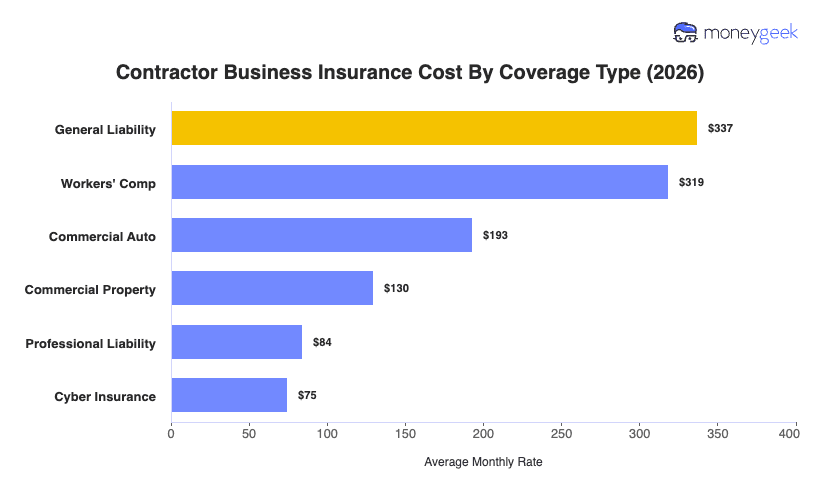
Considering these assumptions, a single policy's on average price can sit anywhere from $75/mo for cyber insurance up to $337/mo for general liability policies. If you are a tradesperson or contracting company, you'll have some of the highest costs, regardless of what policy you choose. Though keep in mind, this doesn't apply to every company, and particularly your industry area and employee count will impact the costs heavily. Your location is more supplementary when compared to these factors, especially for liability focused policies.

Cyber Insurance$75$89811
Professional Liability$84$1,01016
Commercial Property$130$1,55820
Commercial Auto$193$2,31723
Workers' Comp$319$3,82224
General Liability$337$4,04125

We analyzed quote data from major U.S. commercial insurance providers and modeled standardized premium estimates across business profiles representing around 95% of the market. Results are designed to provide a consistent national benchmark showing how premiums vary by key baseline factors including business size, contractor profession type, location and vehicle type for operations that use commercial vehicles.

Dataset Scope and Assumptions

Our cost modeling uses standardized inputs for consistent comparisons across businesses.

  • Total estimates modeled: just over 6 million standardized pricing estimates
  • Providers analyzed: 10 major insurance providers
  • Professions covered: 45 contractor profession categories
  • Geography: all U.S. states including Washington, D.C.
  • Employee count bands: solo practitioners, one to four, five to nine, 10 to 19, and 20 to 49 employees
  • Vehicle types studied: Sedans, SUVs, pickup trucks, vans, taxis, limousines, tractors, food trucks, semi-trucks (non-HAZMAT and HAZMAT), tanker trucks (non-HAZMAT and HAZMAT), buses, box trucks, dump trucks, flatbed trucks
  • Policies studied: general liability, workers' comp, professional liability, commercial auto, commercial property, and cyber insurance
    • General liability: $1 million per occurrence and $2 million aggregate
    • Workers' comp: state required coverage
    • Professional liability: $1 million per claim and $1 million aggregate
    • Commercial auto: minimum coverage
    • Commercial property: personal property coverage limits personalized to industry, business size and state
    • Cyber insurance: $1 million per occurrence and $1 million aggregate

How We Calculated Average Contractor Business Insurance Costs

Our published averages represent modeled premiums for standardized business profiles and were aggregated in two ways.

  • National benchmark average: The national average cost reflects the modeled premium for a standardized one to four employee business across all contractor profession categories and states included in our dataset for a standard professional liability policy
  • Segment averages: To show how costs vary, we calculated average modeled premiums for our national base profile and isolated for variables, including:
    • Employee count (business size ranges)
    • Profession / industry categories
    • Vehicle types (for commercial auto)
    • States (including Washington, D.C.)

Segment averages were produced by aggregating modeled pricing trends across the full dataset so readers can compare how premiums shift across profession types and regions.
See our full business insurance methodology.

This is only an overview, and cost estimates are only as accurate as they are related to your specific type of work (if you do multiple, your primary focus). So, I've provided guides below to help you more specifically nail down what you may expect when comparing business insurance costs.


How Much Does General Liability Insurance Cost for Contractor & Construction Businesses?

General liability costs for contractor businesses range from $25/mo to $26,879/mo across all trades, employee counts, and states for a standard $1 million per ocurrence and $2 million aggregate per year policy. You'll more than likely be required to get this as a subcontractor, or as a contracting company by a client. Three factors drive where you land in that range in my research:

  • Employee count moves premiums more than anything else: Solo contractors average $81/mo, 1 to 4 employees averages $339/mo, and 20 to 49 employees averages $7,894/mo, a 23x increase from the smallest to largest band, because more employees means more daily exposure on job sites, more opportunities for property damage, and more people who can trigger a third-party claim.
  • Trade type creates a nearly 5x spread at the same business size: Among 1 to 4 employee contractors, roofing ($656/mo avg) costs nearly 5x more than interior design ($137/mo avg), with demolition, railroad, asbestos, and utility contracting also sitting at the expensive end, as trades involving height, hazardous materials, or infrastructure carry a fundamentally different claim frequency and severity profile than design or finishing work.
  • State matters but less than trade: California ($596/mo) costs about 3x more than West Virginia ($204/mo) for a 1 to 4 employee contractor, driven by local litigation environments and higher property values, but that gap is still smaller than the trade spread, meaning your work type shapes your premium more than your location does.

Use the table below to filter by your state and employee count for a more specific estimate.

Data filtered by:
1 to 4
Select
West Virginia$204$2,453
Mississippi$209$2,511
South Dakota$220$2,639
Arkansas$227$2,726
Idaho$235$2,824
Wyoming$236$2,829
Montana$236$2,833
Iowa$238$2,857
North Dakota$243$2,912
Alabama$246$2,947
New Mexico$249$2,982
South Carolina$249$2,984
Oklahoma$254$3,050
Kentucky$260$3,121
Kansas$263$3,160
Nebraska$266$3,195
Missouri$278$3,341
Indiana$281$3,376
Louisiana$290$3,484
Utah$291$3,488
Maine$291$3,489
Wisconsin$291$3,490
Tennessee$294$3,522
Ohio$294$3,525
North Carolina$303$3,638
Michigan$307$3,679
Georgia$319$3,832
Vermont$333$3,995
Arizona$339$4,063
Texas$343$4,111
Pennsylvania$350$4,196
Delaware$360$4,319
Nevada$363$4,357
Minnesota$363$4,360
Rhode Island$364$4,364
New Hampshire$370$4,445
Virginia$381$4,576
Oregon$388$4,659
Illinois$402$4,827
Colorado$414$4,969
Florida$421$5,047
Alaska$444$5,332
Maryland$444$5,334
Washington$459$5,513
Connecticut$464$5,567
Hawaii$471$5,653
New Jersey$482$5,783
Massachusetts$519$6,233
New York$560$6,716
District of Columbia$573$6,875
California$596$7,148

How Much Does Workers’ Comp Insurance Cost for Contractor & Construction Businesses?

Workers' comp costs for contractor businesses range from $23/mo to $3,304/mo per employee depending on trade, state, and employee count. Coverage is required once you hire your first employee if your a contracting firm, but if you're a subcontractor, you may be required to have a personal policy before starting a job. Because this coverage is priced per employee, costs scale directly with headcount in a way GL does not:

  • Trade type drives the widest cost spread of any coverage type: at 1 to 4 employees, handyman services ($593/mo avg) and home improvement contractors ($593/mo avg) cost 16x more than interior designers ($37/mo avg), because workers' comp pricing tracks physical injury risk directly, and trades where workers are in and out of occupied homes or working at heights face both higher injury frequency and higher claim severity than office-based disciplines
  • Costs decrease modestly as employee count grows: a roofing contractor averages $569/mo at 1 to 4 employees and $444/mo at 20 to 49, a roughly 20% decrease, likely reflecting that larger operations tend to have more formalized safety programs that insurers reward at renewal
  • State variation is more pronounced here than in GL: New York ($986/mo for 1 to 4 employees) costs 5.7x more than Indiana ($174/mo), driven by state-mandated benefit levels and litigation environments that vary significantly across state lines, making location a more meaningful pricing factor for workers' comp than for general liability

Filter by your state and employee count in the table below to find a more specific estimate for your business.

Data filtered by:
1 to 4
Select
Indiana173.992087.84
Arkansas177.682132.15
South Dakota178.582143
Iowa187.562250.73
Idaho194.822337.85
Mississippi195.562346.75
Utah201.482417.75
Nebraska202.392428.68
Alabama203.392440.65
Kansas204.182450.14
Texas211.142533.63
Kentucky217.662611.96
Tennessee223.932687.11
New Mexico229.422753.06
Virginia235.072820.82
North Carolina245.252942.95
Arizona249.72996.46
Missouri251.843022.07
Oklahoma262.343148.08
Montana263.43160.78
Wisconsin265.163181.96
Nevada271.073252.83
West Virginia273.263279.16
Maine276.053312.59
Georgia276.63319.24
South Carolina284.033408.32
Florida286.923443.04
Oregon289.853478.16
Louisiana291.453497.4
Vermont296.733560.78
Minnesota311.113733.28
Michigan312.283747.38
Colorado314.113769.36
New Hampshire323.23878.43
Maryland333.083996.9
Delaware335.474025.69
Rhode Island336.744040.85
Pennsylvania346.274155.21
Hawaii388.344660.06
Illinois401.914822.88
Alaska504.326051.8
Massachusetts517.136205.61
New Jersey537.546450.44
Connecticut565.526786.23
District of Columbia656.717880.57
California727.728732.64
New York986.1111833.38

How Much Does Commercial Auto Insurance Cost for Contractor & Construction Businesses?

Commercial auto insurance costs for contractor businesses range from $52/mo to $1,893/mo depending on vehicle type, trade, and state. If you use vehicles for work like hauling equipment and driving to job sites, you'll be required to have this coverage type. Unlike GL and workers' comp, the primary pricing variable here is what you drive, not how many people work for you:

  • Vehicle type creates the largest single pricing gap in this coverage: Tanker trucks average $1,086/mo while sedans average $112/mo, a nearly 10x difference, because heavier and more specialized vehicles cause significantly more damage in a collision and cost more to repair or replace after a loss.
  • Trade type follows vehicle exposure closely: Paving contractors ($689/mo avg), railroad contractors ($672/mo avg), and utility contractors ($642/mo avg) sit at the expensive end because their work requires heavy equipment on public roads, while architecture firms ($109/mo avg) and engineering firms ($121/mo avg) typically operate standard passenger vehicles with limited road exposure.
  • Michigan stands out as an outlier worth knowing: at $807/mo average it is nearly 4x more expensive than Pennsylvania ($213/mo), driven by Michigan's unique no-fault auto insurance law which historically produces higher claim costs than any other state, making it the single most expensive commercial auto market in the data

Filter by your state and vehicle type in the table below to find a more specific estimate for your business.

Data filtered by:
California
Sedan$141$1,690
SUV$162$1,943
Pickup Truck$247$2,959
Farm Tractor$259$3,104
Van$261$3,138
Box Truck$585$7,026
Dump Truck$671$8,050
Flatbed Truck$1,115$13,383
Semi-Truck (Non-Hazmat)$1,272$15,261
Tanker Truck (Non-Hazmat)$1,372$16,459

How Much Does Commercial Property Insurance Cost for Contractor & Construction Businesses?

Commercial property costs (BPP, with no building coverage) for contractor businesses range from $6/mo to $943/mo depending mainly on trade, employee count, and state. Keep in mind these estimates also are based on recommended coverage limits scaled for likely property risk needs all combinations of these factors and may not be exact to your needs. 

The state spread here is notably compressed compared to other coverage types, which changes where contractors should focus their attention:

  • Employee count scales premiums more predictably here than in other coverages: a 1 to 4 employee operation averages $130/mo while a 20 to 49 employee operation averages $450/mo, a 3.5x increase, because more employees typically means more equipment, more tools, and more insured property value on the books
  • Trade type still creates a meaningful gap, driven by what contractors own rather than what they do: concrete contractors ($257/mo avg), railroad contractors ($254/mo avg), and paving contractors ($252/mo avg) sit at the expensive end because their operations require heavy, high-value equipment that costs significantly more to replace, while interior designers ($23/mo avg) and land surveyors ($24/mo avg) carry minimal physical assets
  • State is nearly irrelevant for this coverage type: The spread between the most expensive market (New York at $155/mo) and the least (North Dakota at $114/mo) is just 1.4x, the tightest of any coverage in this data, meaning where you operate has almost no bearing on what you pay for commercial property insurance.

You'll more than likely need this coverage once you lease a commercial building or pursue buying a property for business operations. It's also a good idea to get its sub-type, tools and equipment insurance, to protect any valuables you transport to and from, and use on job sites since theft is common in the industry. Filter by your state and employee count in the table below to find a more specific cost estimate for your business.

Data filtered by:
1 to 4
Select
North Dakota$115$1,382
Nebraska$115$1,384
South Dakota$116$1,394
Arkansas$117$1,405
West Virginia$117$1,406
Iowa$117$1,408
Kansas$117$1,410
Oklahoma$118$1,412
Mississippi$118$1,419
Wyoming$119$1,429
Kentucky$119$1,434
Missouri$120$1,439
Indiana$120$1,442
Alabama$121$1,451
Montana$122$1,460
Tennessee$122$1,466
New Mexico$122$1,469
Wisconsin$124$1,486
Michigan$124$1,489
Idaho$125$1,500
Maine$125$1,500
Ohio$125$1,503
South Carolina$126$1,510
Vermont$126$1,511
Georgia$127$1,529
Minnesota$128$1,534
North Carolina$128$1,538
Utah$129$1,546
New Hampshire$130$1,557
Arizona$130$1,562
Virginia$131$1,567
Louisiana$131$1,572
Nevada$134$1,608
Illinois$134$1,610
Colorado$135$1,623
Alaska$137$1,644
Pennsylvania$137$1,649
Delaware$138$1,651
Oregon$138$1,654
Texas$138$1,655
Maryland$140$1,680
Washington$142$1,702
Rhode Island$143$1,711
Connecticut$145$1,741
Florida$146$1,752
Hawaii$147$1,760
Massachusetts$148$1,771
California$151$1,807
New Jersey$151$1,809
District of Columbia$153$1,835
New York$155$1,863

How Much Does Professional Liability Insurance Cost for Contractor & Construction Businesses?

Professional liability costs for contractor businesses range from $32/mo to $360/mo, making it the most affordable coverage type in this analysis by a significant margin. That said, most trade contractors, plumbers, electricians, roofers, carpenters, won't need this coverage at all. It becomes relevant primarily when a contractor takes on design, project management, or consulting responsibilities, where a client can claim a professional error caused them financial harm.

I found the following insights about how costs work for contractors for this policy:

  • The trade split reverses compared to other coverage types: Asbestos contractors ($180/mo avg) and engineering firms ($137/mo avg) are the most expensive at 1 to 4 employees, while home improvement contractors ($49/mo avg) and interior designers ($41/mo avg) sit at the cheap end, because professional liability prices the risk of advice and design errors rather than physical work, and trades that involve technical specifications or hazardous material assessments carry more professional judgment exposure than hands-on trades
  • Employee count has the gentlest scaling of any coverage type: Premiums grow from $84/mo at 1 to 4 employees to $147/mo at 20 to 49, just a 1.8x increase, reflecting that professional liability is priced primarily on the nature of the work and revenue rather than headcount
  • State is effectively a non-factor here: The gap between the most expensive market (New York at $96/mo) and the least (North Dakota at $78/mo) is just 1.2x, the tightest spread in the entire dataset, suggesting underwriters treat professional negligence risk as largely uniform across state lines

Filter by your state and employee count in the table below to find a more specific estimate for your business.

Data filtered by:
1 to 4
Select
North Dakota$78$931
Wyoming$78$939
Kansas$78$939
South Dakota$78$942
Iowa$79$951
Montana$79$951
Nebraska$79$952
Vermont$79$952
Idaho$79$952
Arkansas$79$953
Alabama$80$960
Utah$80$960
Kentucky$80$961
Oklahoma$80$962
Maine$80$963
Indiana$81$971
New Mexico$81$971
New Hampshire$81$972
West Virginia$81$972
Missouri$82$980
North Carolina$82$982
Wisconsin$82$982
Tennessee$83$991
Minnesota$83$991
Ohio$83$992
Michigan$83$1,001
Virginia$84$1,002
South Carolina$84$1,002
Delaware$84$1,012
Oregon$85$1,020
Colorado$85$1,021
Rhode Island$85$1,021
Arizona$85$1,023
Nevada$86$1,032
Washington$86$1,033
Maryland$87$1,040
Mississippi$87$1,042
Connecticut$88$1,051
Georgia$88$1,051
Alaska$88$1,053
Louisiana$88$1,060
Texas$89$1,062
Hawaii$89$1,062
Massachusetts$89$1,063
Illinois$90$1,081
Washington DC$90$1,081
Pennsylvania$90$1,082
Florida$92$1,100
New Jersey$93$1,121
California$96$1,149
New York$96$1,154

How Much Does Cyber Insurance Cost for Contractor & Construction Businesses

Cyber insurance costs for contractor businesses range from $30/mo to $519/mo, and like professional liability, it sits toward the affordable end of the coverage spectrum for this industry. Most contractors aren't storing the volumes of sensitive financial or medical data that drive up cyber premiums in other sectors, which keeps the baseline low across the board:

  • The trade split here follows digital footprint rather than physical risk: architecture firms ($123/mo avg) and engineering firms ($123/mo avg) are the most expensive at 1 to 4 employees, while septic services ($45/mo avg) and irrigation services ($45/mo avg) are the cheapest, because firms handling design files, client specifications, and project data have more exposure to data theft and ransomware than trades that operate almost entirely in the field
  • Employee count is the most meaningful lever to watch: premiums grow from $75/mo at 1 to 4 employees to $255/mo at 20 to 49, a 3.4x increase, because every additional employee is a potential entry point for phishing attacks and social engineering fraud, which are the most common cyber loss types for contractors
  • State variation is minimal but slightly more noticeable than professional liability: the District of Columbia ($92/mo) costs about 1.5x more than Montana ($64/mo) at the 1 to 4 employee level, a modest gap likely driven by stricter data privacy regulations and higher litigation costs in urban markets

Filter by your state and employee count in the table below to find a more specific estimate for your business.

Data filtered by:
1 to 4
Select
Wyoming$64$763
North Dakota$64$763
Montana$64$763
Alaska$64$763
South Dakota$65$780
Idaho$65$780
West Virginia$65$780
Iowa$67$806
Vermont$67$806
Maine$67$806
Rhode Island$67$806
Nebraska$67$807
Hawaii$67$807
New Hampshire$67$807
Mississippi$69$824
Arkansas$69$824
New Mexico$69$824
Oklahoma$71$850
Utah$71$850
Kansas$71$850
Louisiana$72$867
Alabama$72$867
South Carolina$72$867
Kentucky$72$868
Indiana$74$893
Missouri$74$893
Wisconsin$74$893
Tennessee$74$894
Ohio$76$911
Arizona$76$911
Michigan$76$911
Minnesota$76$911
North Carolina$78$937
Pennsylvania$78$937
Oregon$78$937
Georgia$80$954
Florida$81$972
Texas$81$972
Colorado$81$972
Nevada$83$997
Delaware$83$997
Virginia$83$997
Washington$83$997
Maryland$85$1,023
Illinois$85$1,024
Massachusetts$85$1,024
Connecticut$85$1,024
New Jersey$87$1,041
California$88$1,059
New York$90$1,084
District of Columbia$93$1,110

Ways to Lower Contractor & Construction Business Insurance Costs

While getting coverage is inherently expensive in this area of work, getting more affordable contractor insurance is possible as long as you manage coverage and long-term risk management effectively. We've broken down key methods below to ensure in both the short-term and future you save as much as possible without reducing protection you need.

Quick Contractor & Construction Business Insurance Cost Lowering Methods

Start with these methods if you want lower costs quickly for contractor insurance.

    vsDocuments icon
    Compare quotes using the same coverage limits

    Carrier appetites for contractor risks shift regularly, and rates can vary significantly between providers for the same coverage profile. Working with a broker who specializes in construction rather than a generalist gives you access to specialty markets and contractor-specific programs that standard carriers don't offer, and competitive quoting at renewal is one of the most reliable ways to keep premiums in check immediately.

    insurance2 icon
    Bundle policies where it makes sense

    Combining general liability and commercial property into a Business Owner's Policy typically costs less than buying both separately. Some carriers also offer package discounts for bundling GL, workers' comp, and commercial auto with the same provider, and consolidating policies simplifies your renewal and audit process as well.

    money2 icon
    Adjust deductibles strategically

    Higher deductibles lower your premium across most coverage types. A roofing contractor paying $656/mo for GL at a $500 deductible may be able to reduce that meaningfully by moving to a $2,500 or $5,000 deductible, provided the business has sufficient reserves to absorb that cost if a claim occurs.

    male icon
    Pursue pay-as-you-go workers' comp

    Rather than paying a lump-sum annual premium based on projected payroll, pay-as-you-go workers' comp programs tie your premium directly to actual payroll each pay period. For contractors with fluctuating crew sizes across seasons or projects, this eliminates overpayment and reduces the risk of a large audit bill at year-end.

    calendarV2 icon
    Explore wrap-up programs for large projects

    For contractors bidding on projects above $25 million in construction value, Owner Controlled Insurance Programs (OCIPs) and Contractor Controlled Insurance Programs (CCIPs) consolidate GL, workers' comp, and excess liability into a single policy covering all parties on the job. CCIPs typically deliver cost savings of 5% to 15% compared to each subcontractor carrying individual coverage by eliminating duplicate premiums and contractor markup on insurance costs.

    building icon
    Pursue providers with flexible coverage terms

    Insurers like ERGO NEXT and Thimble provide the ability to provide coverage on a by job basis which can easily lower costs to manageable levels, especially when you don't need coverage during seasonal lulls or just when you're not working actively.

Long-Term Contractor & Construction Business Insurance Cost Lowering Methods

Some cost reductions only show up after your claims history and risk profile have had time to shift, typically across one or more full policy periods.

Contractor & Construction Business Insurance Cost: Bottom Line

Across six common coverage types, contractor businesses average $190 per month in insurance costs, but that figure reflects a broad mix of trades and locations. A solo handyman in Indiana and a roofing contractor with 20 employees in New York represent opposite ends of the distribution, and both would land far from that average for different reasons.

Use these three questions to put the quote you receive into context:

  1. Where do you fall in the distribution? Start by locating your trade, employee count, and state against the benchmarks on this page. A quote that looks high in isolation may sit exactly where expected for a roofing operation in a high-cost state with ten employees. A quote that looks low may reflect narrower coverage than your operation actually needs.
  2. Is your quote consistent with your risk profile? If a quote sits well above or below the benchmarks for your trade and state, that gap is worth understanding before accepting or rejecting it. A lower-than-expected quote may reflect narrower coverage limits or missing coverage types. A higher-than-expected quote may reflect how the insurer has classified your operation or trade.
  3. Which cost drivers apply to your business? Not every factor carries equal weight across contractor trades. Vehicle type matters far more for a paving contractor running a fleet of dump trucks than for an interior designer with one company vehicle. Identify which two or three drivers actually shape your specific profile before drawing conclusions about price.

For most contractor businesses, the gap between the industry average and an actual quote comes down to two or three factors specific to their operation, not the full list. Getting to an accurate cost picture means starting with the benchmarks that match your trade, not the ones that match the industry.

Contractor & Construction Business Insurance Cost: Next Steps

If you are still working out whether a coverage type applies to your contracting operation, what your actual risk exposure looks like, or whether coverage is legally or contractually required, starting with applicability is the right move. Contractors often carry a mix of legally required, client-required, and recommended coverage types, and knowing which category each policy falls into changes how you think about cost and priority.

If you are ready to move forward and focused on finding the best contractor insurance, the next step is understanding which providers price competitively for your trade and employee profile and how to structure your coverage to reduce costs without leaving your operation exposed.

I cover answers to commonly asked questions within your industry below to help guide you through this process.

What is the difference between general liability and workers' comp, and do I need both?

What contractor insurance is actually required by law versus just expected by clients?

Do I need my own insurance if I work under a general contractor?

What happens if I operate without insurance and a claim occurs?

Why is my quote higher than the averages I see here, and what should I do?

What should I look for when comparing contractor insurance quotes beyond the monthly premium?

About Connor Bolton


Connor Bolton headshot

Connor Bolton is Senior SEO and Content Manager at MoneyGeek, where he leads the business and pet insurance editorial teams. As editorial lead for both verticals, Connor sets the research framework, data standards, and content structure that his writers execute, directly authoring in-depth guides himself and reviewing all team content for accuracy and practical value before it goes live. With over four years evaluating insurance products across personal, commercial, and specialty lines, he brings cross-vertical knowledge to every guide the team produces.

Connor architected MoneyGeek's insurance research infrastructure across all major verticals including auto, home, renters, life, health, business, and pet, building systems for pricing analysis, provider-level research, customer experience evaluation, and coverage analysis with AI support. The infrastructure includes over 6 million data points for business insurance across 408 industry areas, all 50 states, and 16 vehicle types, and over 5 million pet insurance profiles across 18 major providers and hundreds of breed and age combinations. Connor's insurance cost research and his team's work has been cited by the U.S. Chamber of Commerce, Allstate, Liberty Mutual, CBS News, Forbes and LegalZoom.

Beyond the data, Connor stays connected to how the market actually operates, drawing on direct conversations with underwriters and carrier liaisons at Ethos, The Hartford, NEXT Insurance, Nationwide, and State Farm, and monitoring business and pet owner communities including Reddit, to inform how he interprets findings and frames guidance for real buyers.

He is the direct editorial contact for methodology questions at connor@moneygeek.com and can be found on LinkedIn.