




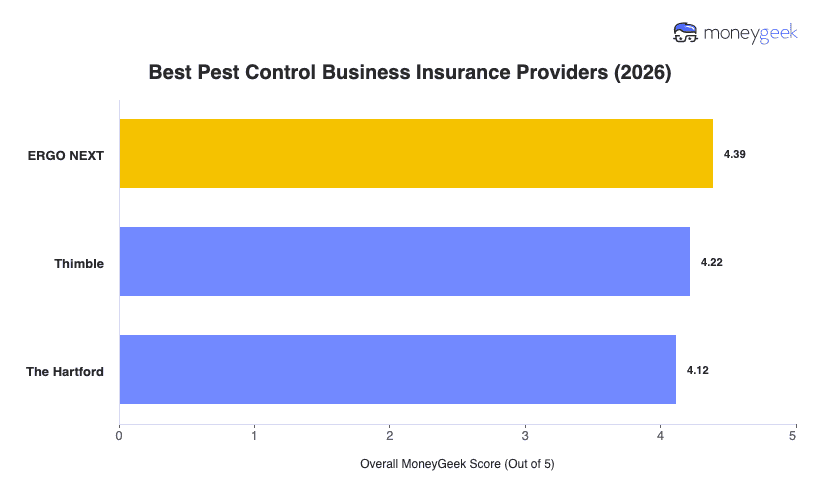
My analysis of the best business insurance providers for pest control companies put these three insurers on top:
Best Pest Control Business Insurance
The best business insurance companies for pest control companies are ERGO NEXT, Thimble and Hiscox.
MoneyGeek helps you compare the best pest control insurers, coverage types and costs, so you can find the protection you need.
Ready to shop? Use our tool below to get matched with your top provider and start your contractor insurance quote.
Select state
Updated: September 22, 2026
Advertising & Editorial Disclosure
Best Business Insurance Companies for Pest Control Companies
Pest control companies work inside homes and businesses, often under recurring service agreements where coverage needs to stay dependable from one visit to the next. I weighted providers on affordability (50%), customer experience (30%) and coverage options (20%). I gave affordability the largest share because premiums are a recurring business expense, and keeping coverage active matters just as much as getting a low starting price.
I used AI to support parts of the research process, but the conclusions and final judgments in my analysis are my own:
- Affordability: I priced each insurer against the same pest control business profile so the comparison stayed consistent. I focused on what you would actually pay for equivalent coverage rather than letting changes in company size, location or quote assumptions distort the result.
- Customer Experience: I looked at how much friction you may face once you need to use or manage the policy. That includes getting a quote, accessing proof of insurance, making policy updates and handling a claim. I also reviewed customer feedback to see whether those service experiences held up outside the buying process.
- Coverage Options: Pest control businesses can face different insurance needs as they add technicians, vehicles or larger commercial accounts. I reviewed policy terms and exclusions with that growth in mind, focusing on whether coverage could keep pace with changes in how the business operates.
See our full methodology.

ERGO NEXT: Best for Straightforward Coverage Needs and Lowest Rates
pros
Instant COIs for commercial account requirements
Strong savings for growing five-to-19-person crews
Fast quote-to-bind for new pest control businesses
cons
Higher rates for solo owner-applicators
No pesticide pollution liability endorsement
Weaker support for complex claim disputes
COMPANY HIGHLIGHTS
ERGO NEXT leads our pest control rankings on affordability and customer experience. It saves pest control businesses an average of $308 per year, 20% below the sub-industry benchmark. Its self-service model means you can get coverage, generate COIs and update your policy without calling an agent, the smoothest buying process available for operators getting coverage in place before a commercial contract. No pesticide pollution liability endorsement has been verified, a real gap if your work involves restricted-use chemicals, food service accounts or fumigation.
Learn More: ERGO NEXT Business Insurance Review

Thimble: Best for Seasonal Work and Shorter Coverage Terms
pros
Pausable monthly general liability coverage
On-demand coverage for one-off jobs
Lower pricing for mid-size pest control crews
cons
Higher pricing for solo owner-operators
Claims may involve third-party administrators
No pesticide pollution or fumigation coverage
COMPANY HIGHLIGHTS
Thimble's job, month and annual policy options let you match coverage to how your work actually runs. For instance, scaling up for termite season, adding a policy for a one-off fumigation contract or pausing when the calendar goes quiet. It ranks second overall in pest control, saving pest control businesses an average of $265 per year, 17% below the industry benchmark. If a claim turns into a dispute, the claims process here is less equipped to back you up.
Learn More: Thimble Business Insurance Review

biBerk: Best for Broker Fee-Free Rates and Pollution Liability Coverage
COMPANY HIGHLIGHTS
I'd recommend biBerk for pest control owners who like doing things online but want to have options. You can handle the quote and purchase yourself, then pull in a licensed insurance expert if you need help sorting through coverage or finishing the application. I also like the direct-to-business model for owners who’d rather deal with the insurer than go through a broker, which biBerk says can result in savings of up to 20%. And if you’re running a more established pest control company, the Berkshire Hathaway backing adds another layer of reassurance. biBerk policies are issued by subsidiaries with A++ AM Best financial strength ratings, which gives you more confidence in its ability to handle large claims.
Learn More: BiBerk Business Insurance Review
What Types of Insurance Do Pest Control Businesses Need?
The difference with pest control work is that your risk isn’t limited to the time you’re actually in a customer’s home or business. A technician might drill into a wall while treating for termites, only for the customer to discover a slow plumbing leak after the job is finished. I’d start with general liability and make sure your policy includes products-completed operations coverage, since that’s the part that covers injury or property damage tied to finished work.
Another core coverage is tools and equipment insurance since your gear is central to the job. Sprayers and inspection tools travel with you, and this coverage helps protect portable equipment that could be stolen or damaged away from your main location. Once you have those two in place, let the jobs you take and the services you offer guide the rest of your insurance mix.
Customer injuries and property damage caused by your work | Before your first paid job on customer property | You’re working inside homes and businesses, and a mistake can turn into an expensive claim. Pesticide staining a customer’s flooring or someone tripping over equipment you left near the treatment area are examples. | |
Tools and equipment | Portable gear that’s stolen or damaged away from your main location | Once replacing your everyday gear would hurt your budget | Pest control equipment adds up quickly. A professional stainless-steel sprayer can cost around $400, while a B&G Versa-Fogger costs about $972. You’re unlikely to take new jobs until you’ve replaced key gear. |
Pollution liability | Pollution claims involving spills, chemical releases and cleanup | When your work involves pesticide or chemical application | Standard general liability often excludes pollution-related losses. That matters when a pesticide spill, unintended release or contamination event causes cleanup costs or harms someone. |
Injuries and vehicle damage from work-related driving | When you regularly drive for service calls or transport equipment | Driving is a major part of pest control work. In 2024, four of the nine fatal workplace injuries recorded in exterminating and pest control services involved transportation incidents. | |
Employee job-related injuries and illnesses | When you hire employees or your state requires it | Pest control businesses recorded about 3,100 workplace injuries and illnesses in 2024. Roughly 2,200 involved time away from work, restricted duty or a job transfer. | |
Equipment, supplies and other property kept at your business location | Once you have an office, storage space or valuable inventory | The gear and supplies stored at your shop can add up fast. If the space is damaged or items are stolen, replacing everything at once could take a real bite out of your budget. | |
How Much Does Pest Control Business Insurance Cost?
The average cost of pest control business insurance is $124 per month or $1,493 per year, though individual policies range from a monthly average of $42 for tools coverage to $200 for pollution liability. These estimates are for pest control businesses with one to four employees. Your actual rate could also vary depending on the chemicals you use and how much time you spend on the road.
Your costs by coverage type, based on my analysis:
- General liability: $188 per month or $2,256 per year
- Tools and Equipment: $42 per month or $504 per year
- Pollution Liability: $200 per month or $2,400 per year
- Commercial auto: $199 per month per vehicle or $2,388 per year per vehicle
- Commercial property: $57 per month or $684 per year
- Workers' compensation: $172 per month per employee or $2,064 per year per employee
- Professional liability: $47 per month or $564 per year
- Cyber Insurance: $84 per month or $1,008 per year
What Are These Costs Based On?
These pest control cost estimates reflect small businesses with one to four employees across all 50 states and Washington, D.C. The assumptions change depending on the policy because insurers don’t price a service vehicle, employee injury risk or chemical exposure the same way.
- General liability: Uses $1 million per occurrence and $2 million aggregate limits.
- Commercial auto and workers’ compensation: Reflect the minimum coverage required in each state.
- Tools and equipment and pollution liability: I supplemented our internal data with outside research for similarly sized pest control businesses.
- Cyber insurance: Assumes a $1 million policy limit.
Your premium changes with your service mix and how much you drive, so the averages above won’t fit every pest control business. Use our business insurance calculator to estimate costs around how your pest control operation runs.
Pest Control Insurance Cost Calculator
Select Coverage Type
Select State
Select Employee Count
Select Vehicle Type
Average Monthly Cost—
Select Coverage Type
Average Monthly Cost—
Select State
Select Employee Count
Select Vehicle Type
How To Buy The Best Pest Control Insurance
Getting to the right coverage involves a series of choices, and we've seen pest control businesses buy the wrong policy, at the wrong limit, from a provider who doesn't understand their trade, because they skipped steps. Use our guide to make sure you don't miss anything. You can also download the companion checklist to keep your information organized as you go through the process.
- 1
Identify the Coverage You’re Required to Carry
I’d check your state licensing rules before shopping for policies because pest control businesses can face insurance requirements just to operate. California, for example, requires registered structural pest control companies to carry at least $500,000 in general liability coverage. Client contracts can add another layer. A property manager or restaurant group may require a certificate of insurance (COI) or additional insured status before you can start work.
Once you hire technicians, check when your state requires workers’ compensation. The employee threshold varies, so don’t assume the rule in one state applies everywhere. If you use a vehicle for pest control work, you’ll also need to meet your state’s auto liability minimums, which differ by location.
Read More: Business Insurance Requirements
- 2
Match Your Services to the Risks They Create
Once you know what coverage you’re required to carry, look at what could go wrong in the services you actually perform. If you apply pesticides or take on fumigation work, take a closer look at pollution liability. It helps with losses chemical releases and pesticide application create. Pest inspection work creates a different exposure. A missed termite or wood-destroying-organism problem could leave a client with damage that wasn’t caught in your report. Professional liability could address that.
- 3
Set Limits Around the Work You Take
Set your limits around the kind of loss your jobs could realistically create. A residential operator doing routine treatments typically needs less financial protection than a company fumigating restaurants.
If you work across multi-unit properties, where one claim could affect much more property at once, your contract might require higher liability limits before you can start work. If a client requires more coverage than your current policy provides, raise the limit before the job starts or add excess liability to make up the difference.
Read More: How Much Business Insurance Do I Need?
- 4
Research Providers Before You Quote
Pest control can involve specialized exposures that not every standard small-business policy handles the same way. I’d take the time to check whether the insurer covers the services you actually perform, especially fumigation, WDO inspections or chemical-heavy work. Some carriers offer pest-control-specific protections, while others limit certain services or require separate endorsements.
Then look at what happens post-purchase. A disputed WDO inspection or treatment claim can get complicated quickly, so find out who’ll handle claims and whether you get a dedicated contact when things escalate. Team structure matters too. If you want help with policy changes or coverage questions, make sure it’s easy to reach licensed agents or specialists.
- 5
Compare Quotes Using the Same Coverage
Once you’ve narrowed your options, start requesting quotes. When you do, keep the inputs consistent. Match the limits you chose and use the same deductible so you can compare business insurance quotes fairly.
I’d also check that important add-ons like pollution liability or tools coverage appear on every quote you’re comparing. Make sure the quotes cover the same things first. Now you can compare prices knowing you’re not paying less simply because one insurer left something out.
- 6
Review the Policy Before You Buy
Before you sign, read the policy itself rather than relying on the quote summary. Start with the exclusions. If you do fumigation or chemical treatments, make sure the policy doesn’t carve out the very work you need covered. Then look closely at the wording and definitions. A tools policy, for example, might cover equipment away from your shop but cap how much it will pay for gear stolen from a vehicle.
I’d also check the cancellation terms. Find out how much notice the insurer has to give and when coverage officially ends. If a policy gets canceled midterm, even a short gap could leave you without a valid COI for a property manager or commercial account.
- 7
Reassess Coverage as Your Business Changes
Your insurance should change when the way you operate changes, whether the business is expanding or scaling back. Hiring technicians or moving into fumigation can increase your coverage needs, while dropping a service or reducing your equipment may mean you’re paying for protection you no longer need. I’d review the policy whenever the business starts working differently, rather than waiting for renewal.
Pest Cost Insurance: FAQ
Beyond the basics, I've also gathered commonly asked questions pest control business owners have. The answers provide additional guidance so you'll have everything you need.
Pest control insurance is a group of coverages that helps protect your business when something goes wrong on the job. That could be treatment damage inside a customer’s home, stolen equipment, an injury on site or a chemical-related loss. What you need depends on the services you perform and how your operation actually works.
You may need certification before you can legally apply pesticides for customers. Federal law requires it for restricted-use pesticides, and states can set broader rules for commercial applicators. I’d check with your state pesticide regulatory agency before taking paid jobs because the licensing standard can be stricter than the federal minimum.
You might. EPA rules require specialized certification for certain application methods, including fumigation involving restricted-use pesticides. Your state can add its own requirements on top of that. If you plan to offer fumigation, verify the certification category that applies before you start advertising the service or booking jobs.
It can, but I wouldn’t assume your general liability policy handles inspection errors automatically. Some pest control programs offer pest inspection damage liability, which is designed for claims tied to inspection work. If you perform termite or other WDO inspections, make sure your policy specifically addresses that exposure before relying on your standard liability coverage.
I’d ask subcontractors to carry their own coverage rather than assume your policy will absorb every claim connected to their work. Your insurer may also require proof of insurance from them. Before they start a job, collect a current COI and find out whether your policy requires your business to be named as an additional insured.
You may be able to, but find out what happens to past work before creating a coverage gap. Thimble, for example, lets eligible monthly customers pause coverage for up to 30 days while keeping products-completed operations protection for work done before the pause. Other insurers set their own rules, so review the policy first.
Only if your policy includes the right pollution protection. A standard liability policy may not cover a pesticide spill in transit, while some pest control programs specifically cover pollution exposures during pesticide transportation. If chemicals ride in your service vehicle, verify that transit pollution is included instead of assuming your jobsite coverage follows them.
Talk to your insurer before taking the first job across state lines. You may need changes to the policy, and pesticide licensing can change too. Federal rules require restricted-use pesticide applicators to hold certification in every jurisdiction where they make those applications, while states can add their own requirements.
Best Pest Control Business Insurance: Bottom Line
If you want the best pest control insurance for your business, I’d start with the insurer that fits how you want to buy and manage coverage. ERGO NEXT works better if you want straightforward coverage and lower rates or Thimble if you need flexible terms. You can also consider Berk if you prefer online buying with expert help available. Then make general liability and tools coverage your foundation, adding policies only where your services create the need.
Treat the cost averages as a benchmark, not a quote. Before you buy, make sure your limits match the jobs and contracts you take, then compare two or three providers using the same coverage setup.
Get Pest Control Business Insurance Quotes
Pest control insurers can price the same business differently based on the work you do and the coverage you need. Compare quotes using the same limits and policy setup so you can see which provider gives you the strongest value for the same protection.
About Connor Bolton

Connor Bolton is Senior SEO and Content Manager at MoneyGeek, where he leads the business and pet insurance editorial teams. He sets the research framework, data standards and content structure for his team. All content goes through his accuracy review before publication. Connor also writes in-depth guides and has spent more than four years covering insurance products across personal, commercial and specialty lines.
The research infrastructure Connor built covers auto, home, renters, life, health, business and pet insurance across pricing analysis, carrier research, customer experience and coverage evaluation. It includes over 6 million data points for business insurance across 408 industry areas, all 50 states and 16 vehicle types. The pet insurance side covers over 5 million profiles across 18 major providers, 100+ breeds and ages up to 20 years. Connor’s insurance research and his team's work have been cited by the U.S. Chamber of Commerce, Allstate, Liberty Mutual, CBS News, Forbes and LegalZoom.
Connor also talks with underwriters and carrier liaisons at Ethos, The Hartford, ERGO NEXT, Nationwide and State Farm, and monitors business and pet owner communities on Reddit. Those sources shape how his team evaluates carriers, structures rate analysis and writes content for real pet owners.
Questions about MoneyGeek's business or pet insurance content? Reach him at connor@moneygeek.com or on LinkedIn.
Sources
- California Structural Pest Control Board. "Structural Pest Control Act." Accessed September 22, 2026.
- DoMyOwn. "B&G Sprayer 1 Gallon 18 in. Wand & Extenda-Ban Valve (N124-S-18)." Accessed September 22, 2026.
- Solutions Pest & Lawn. "B&G Versa-Fogger." Accessed September 22, 2026.
- U.S. Bureau of Labor Statistics. "TABLE 2. Numbers of nonfatal occupational injuries and illnesses by industry and case types, 2024." Accessed September 22, 2026.
- U.S. Bureau of Labor Statistics. "TABLE A-1. Fatal occupational injuries by industry and event or exposure, all United States, 2024." Accessed September 22, 2026.