
Key Takeaways
blueCheck icon

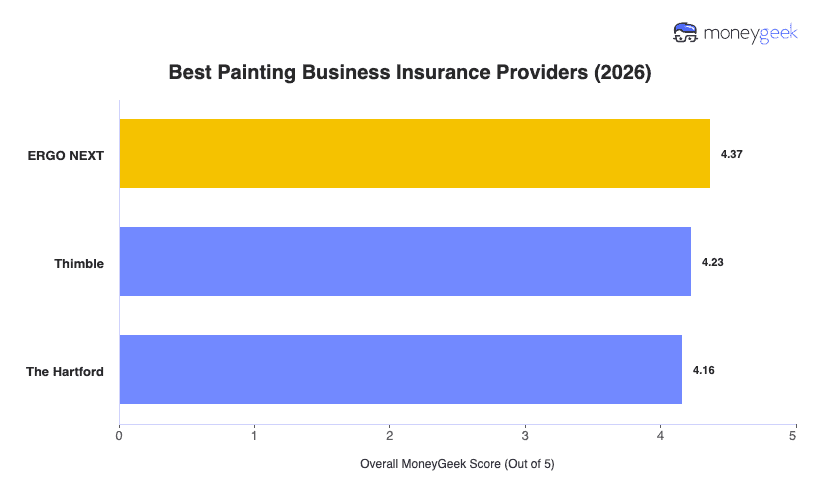
Balancing customer experience, coverage options and cost, ERGO NEXT, Thimble and The Hartford are the best painting business insurers in our analysis. (Jump to Top Providers)

blueCheck icon

With rates 25% below the industry average, ERGO NEXT has the most affordable rates for painting businesses, averaging $139 a month. (Jump to Cheapest Providers)

blueCheck icon

General liability, workers' comp and commercial auto are the core coverages for most painting businesses. General covers overspray and property damage on client sites, workers' comp protects your crew for ladder and scaffold injuries, and commercial auto covers your work vehicles on the way to every job. (Jump to Types You Need)

blueCheck icon

Painting business insurance costs range from $84 to $312 a month depending on which coverages you carry. (Jump to Costs)

blueCheck icon

Choosing the right coverage means matching your policy to your actual risks, setting limits that reflect the size of your jobs and clients, and confirming your provider can keep up as your business grows. (Jump to Choosing Process)

Best Painting Business Insurance Companies

ERGO NEXT and Thimble rank first and second, both leading on affordability and customer experience. That combination matters if you're a painting contractor, where GCs and property managers routinely require a COI before work starts. The Hartford ranks third and leads on coverage, which carries more weight as your jobs grow in size and contract complexity. 

Our analysis shows your client base shapes the right provider fit as much as price does, and the table below shows how all seven providers rank across affordability, customer experience and coverage for painting businesses.

ERGO NEXT4.35113
Thimble4.22227
The Hartford4.13761
Nationwide3.98372
Hiscox3.96445
biBERK3.95656
Progressive Commercial3.93534

For our overall best funeral home business insurance ratings, we analyzed pricing, coverage options, and customer experience across all 50 states and Washington, D.C. Our analysis focuses on 1-to-4-person funeral homes, while weighting results to ensure broader industry and location representation. To do this, we evaluated over six million business profiles, more than 100,000 customer experience data points and performed in-depth analysis of coverage contracts and endorsements to compare insurers consistently across industries and regions. We then rated each company across categories of affordability (50% of overall score), customer experience (30% of overall score) and coverage options and terms (20% of overall score) to form an overall rating.

See our full business insurance methodology.

Rankings are a starting point, not a universal answer. If you're a solo residential painter who needs competitive rates and fast COIs for property managers, ERGO NEXT is likely the better fit, ranking first on both affordability and customer experience. If you're running a crew on GC subcontracts where contract language demands stronger coverage terms and higher limits, The Hartford may serve those jobs better.

Each provider profile below lays out exactly who it serves well and where it falls short.

ERGO NEXT

ERGO NEXT

Best Overall for Paintings
On ERGO NEXT's site

ERGO NEXT leads our rankings for painting contractors, driven by the top affordability and customer experience scores in the study. You'll save an average of 25% compared to benchmark rates, and the fully digital platform lets you quote, bind and issue COIs in about 10 minutes. Appeals and dispute handling is a relative weakness, which matters when overspray and completed operations claims are on the table.

Learn More: ERGO NEXT Business Insurance Review

Thimble

Thimble

Best for On-Demand Painting Contractor Coverage

Second in our overall rankings, Thimble's defining advantage is a policy structure no other provider in this study offers: coverage by the job, month or year. If you run seasonal exterior work or take on commercial jobs intermittently, you can activate a policy for that window without a year-round commitment. You'll save an average of 18% vs. benchmark rates. Claims are handled by a third-party administrator, not Thimble, and that's where the experience has limits.

Learn More: Thimble Business Insurance Review

Cheapest Painting Business Insurance

ERGO NEXT, Thimble and Nationwide offer the cheapest painting business insurance in our analysis, at $139, $151 and $188 a month. ERGO NEXT's average rate runs 25% below the industry average and saves you about $46 a month. The cheapest option isn't always the best fit, though. We've seen painting businesses underbuy on coverage and discover a gap when a GC's contract requires higher limits or a completed operations claim surfaces months after a job wraps. Price matters, but so does what the policy actually covers.

The table below compares average monthly and annual rates across all seven providers we analyzed.

ERGO NEXT$139$1,669
Thimble$151$1,808
Nationwide$188$2,253
Hiscox$189$2,265
Progressive Commercial$190$2,283
biBERK$196$2,354
The Hartford$199$2,382

What Types of Insurance Do Paintings Need?

Painting work puts you in direct contact with client property on every job, including floors, furniture, finishes and neighboring surfaces, while your crew works from ladders, scaffolding and lifts. That combination of physical presence on hazardous sites and hands-on contact with expensive surfaces creates both property damage and bodily injury exposure on every job. The coverage types most painting businesses need include:

  • General liability (since every job puts your crew in contact with client property that can be damaged or someone who can be injured)
  • Workers' comp (since your crew works at height on ladders and scaffolding, where fall injuries are a consistent risk)
  • Commercial auto (since your crew drives to every job site, often in company vans loaded with equipment)
  • Inland marine (if you transport spray equipment, scaffolding or other high-value tools to job sites daily)
  • Commercial property (if you store equipment, supplies or vehicles at a shop or fixed business location)
  • Cyber insurance (if you store client data, process payments digitally or manage jobs through cloud-based software)

We've found that no two painting businesses carry the same mix. If you're a solo painter doing residential repaints, you have narrower needs than a painting company running multiple crews on commercial GC subcontracts. Your headcount is one of the clearest signals of where your coverage obligations start and where they grow.

How Much Does Painting Business Insurance Cost?

Painting business insurance averages $183 a month or $2,191 a year. Workers' comp is the highest-cost coverage, which reflects a rate that reflects the injury exposure of crews working from ladders, scaffolding and lifts on every job. General liability is where most painting businesses start since it's required for licensing in many states and the first thing GCs and property managers ask for before work begins. 

We've found that your total cost depends on what your operation requires. If you're a solo painter carrying GL and commercial auto, you're looking at around $399 a month, but add workers' comp once you hire a crew and your total reaches roughly $711.

Your coverage mix determines your actual cost more than any other single factor:

How did we determine business insurance rates for painting businesses?

What your painting business pays depends on more than which coverages you carry. The size of your crew, whether you do residential repaints or large commercial contracts, and how much spray equipment you transport to job sites all move your premium in ways the averages above can't capture. If you want a figure closer to what your specific operation would pay, the painting business insurance calculator builds an estimate around your actual profile.

Estimate Your Monthly Painting Insurance Cost

Enter your coverage type, state, number of employees and type of vehicle (if you need commercial auto coverage) to get a pricing estimate that fits your business.

We do not collect any personal information, and all rates are aggregated for all 50 states and Washington D.C. Workers' comp rate estimates are provided on a per employee basis and all coverage types assume standard industry limit recommendations for most businesses.

Select Coverage Type
Select State
Select Employee Cand
Select Vehicle Type
Average Monthly Cost—

How to Choose the Right Painting Business Insurance

Choosing the right painting business insurance requires ongoing attention, not a single decision. Many painting businesses carry the wrong coverage for years because they set their policy early and never revisit it as the operation grows. Knowing how to get business insurance is the first step, but building a program that protects your business takes more than that.

  1. 1
    Understand your risk profile and what coverage it requires

    Start by mapping your actual operation, whether residential or commercial, solo or crew-based, spray or brush, against the two exposures painting work consistently creates: property damage from direct contact with client surfaces, and bodily injury from elevated work on ladders, scaffolding and lifts. Some coverages are legally mandated in your state, others are contractually required by GCs and property managers, and others are practical necessities given how painting work runs.

  2. 2
    Choose the right coverage limits

    Your limits should reflect the worst-case claim your business could realistically face, not just the minimum a state or client requires. A $1 million per-occurrence GL policy works for residential repaints, but a single overspray event on a commercial interior or a scaffold injury on a government project can approach or exceed that figure. If you're bidding GC subcontract work or institutional jobs, review each contract's minimum requirements before you bind coverage.

  3. 3
    Evaluate providers who understand painting businesses

    Not every insurer prices painting contractor risk the same way. Look for providers with experience writing trade contractor policies: ones that understand spray application exposure, completed operations claims and EPA RRP compliance, not just generic small business coverage. Affordability matters, but so does how a provider handles claims on job-site damage and whether they can issue a COI quickly when a GC calls the morning a job starts.

  4. 4
    Get compliance-ready

    Buying a policy is the start, not the finish. Most GCs and property managers require a certificate of insurance before your crew sets foot on a job site, and some also require additional insured endorsements and primary and noncontributory wording. If you work on pre-1978 buildings, confirm your EPA RRP firm certification is current: some carriers condition lead paint coverage on active certification, and a lapse costs you coverage on a live job.

  5. 5
    Revisit your coverage as your painting business grows

    Your coverage needs change every time your business changes. Hiring your first employee triggers workers' comp requirements in most states. Taking on GC subcontract work raises the GL limits you need. Adding vehicles requires updating your commercial auto schedule. Review your coverage at least annually and before signing any contract with insurance requirements: a policy that fit your business last year may not fit the one you're running now.

Get Painting Business Insurance Quotes

No two painting businesses get the same quote, even when they carry the same coverages. A solo painter focused on interior residential repaints carries a different risk profile than a multi-crew commercial operation working pre-1978 institutional buildings, and carriers price both differently. The right provider depends on how your business actually runs. Requesting business insurance quotes from multiple carriers lets you compare what each would actually charge for your operation.

About Connor Bolton


Connor Bolton, Senior SEO and Content Manager (Business & Pet), MoneyGeek

Connor Bolton is Senior SEO and Content Manager at MoneyGeek, where he leads the business and pet insurance editorial teams. He sets the research framework, data standards and content structure for his team. All content goes through his accuracy review before publication. Connor also writes in-depth guides and has spent more than four years covering insurance products across personal, commercial and specialty lines.

The research infrastructure Connor built covers auto, home, renters, life, health, business and pet insurance across pricing analysis, carrier research, customer experience and coverage evaluation. It includes over 6 million data points for business insurance across 408 industry areas, all 50 states and 16 vehicle types. The pet insurance side covers over 5 million profiles across 18 major providers, 100+ breeds and ages up to 20 years. Connor’s insurance research and his team's work has been cited by the U.S. Chamber of Commerce, Allstate, Liberty Mutual, CBS News, Forbes and LegalZoom.

Connor also talks with underwriters and carrier liaisons at Ethos, The Hartford, ERGO NEXT, Nationwide and State Farm, and monitors business and pet owner communities on Reddit. Those sources shape how his team evaluates carriers, structures rate analysis and writes for human buyers rather than search engines.

For questions about MoneyGeek's business and pet insurance content, contact him at connor@moneygeek.com or on LinkedIn.