



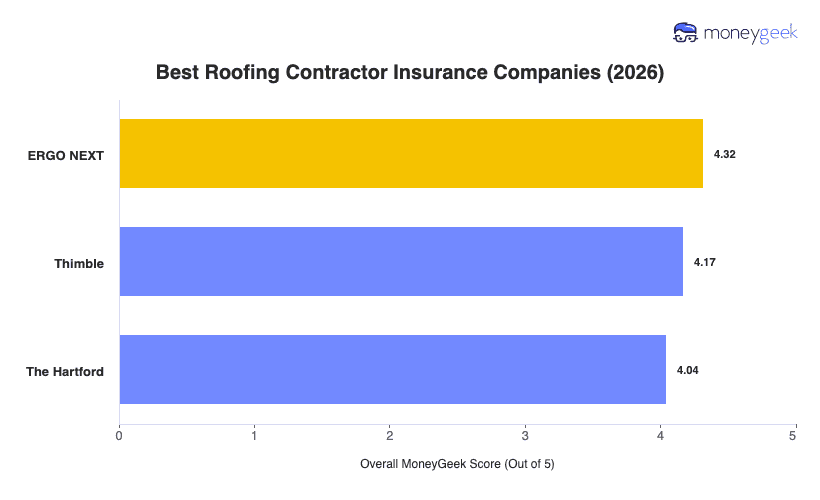
For roofing contractors, my recommendations for the best business insurance companies are:
Best Roofing Contractor Insurance
My analysis found that ERGO NEXT, Thimble and biBerk are the best business insurance providers for roofing contractors.
MoneyGeek helps you compare the best roofing contractor providers, coverage types and costs, so you can find the protection you need.
Ready to shop? Use our tool below to get matched with your top provider and start your contractor insurance quote.
Select state
Updated: September 23, 2026
Advertising & Editorial Disclosure
Best Business Insurance Companies For Roofing Contractors
Roofing contractors can run into insurance requirements before work even starts. A general contractor may ask for proof of coverage, a commercial job may require specific limits and adding a crew can change what insurance you need. I look at whether an insurer can keep up with those demands, not just whether its quote is inexpensive.
My scoring gives price the most weight, but affordability alone doesn’t determine the result. I also consider whether the provider can support a roofer’s coverage needs and how practical the company is to work with.
- Customer Experience (30%): I look at what happens after you choose an insurer. Roofers may need COIs for new jobs, quick policy updates or help when a claim interrupts work. Providers get more credit when those tasks are easy to handle online or with responsive support.
- Affordability (50%): Each insurer is compared using the same roofing contractor profile and modeling assumptions. This gives me a cleaner view of pricing differences because the underlying business risk stays consistent across providers.
- Coverage Options (20%): Roofing businesses can need more protection as they add employees, vehicles or higher-value equipment. I consider whether an insurer can support those changing needs instead of only meeting a roofer’s most basic requirements.
I used AI to support parts of the research, but I made the final calls on which providers fit roofing contractors best.
See our full methodology.

ERGO NEXT: Best for Straightforward Coverage Needs and Self-Service Policy Management
pros
Affordable for small residential roofing crews
Fast online quote-and-bind process
24/7 app-based COI management
Bundling discounts as coverage needs grow
cons
Less competitive for solo roofers
Limited support for contested claims
Weaker fit for complex service needs
Seasonal payroll swings may create billing issues
COMPANY HIGHLIGHTS
ERGO NEXT is my top choice for most roofing contractors because it combines the lowest rate in my analysis with tools that make insurance easier to manage between jobs. At $241 per month, it costs about 27% less than the roofing industry average, saving you roughly $90 monthly. That makes it a good fit for smaller roofing businesses that want to keep overhead down without a complicated buying process. You can quote and buy coverage completely online in about 10 minutes. Once you're covered, its COI Analyzer can also build a custom certificate from a sample COI. That helps when general contractors or commercial clients send specific certificate requirements before you can start work.
Learn More: ERGO NEXT Business Insurance Review

Thimble: Best for Seasonal Work and Flexible Coverage Terms
pros
Low rates for solo roofing contractors
Flexible project-based and seasonal coverage
Fast COIs and additional insured updates
Equipment coverage for tools in transit
cons
Claims handled without phone support
Limited deductible control at purchase
Standard GL limits may fall short
Cyber unavailable in CA, FL and NY
COMPANY HIGHLIGHTS
Thimble is my pick for roofers with uneven workloads or short-term projects. You can buy coverage by the job, month or year, which gives you more flexibility when work picks up after storms or slows during quieter periods. Its average rate is 17% below the roofing industry average, which helps smaller roofers keep fixed insurance costs manageable.
If you have a monthly policy and expect a slow stretch, you can pause coverage once for up to 30 days. That helps during weather-related downtime or gaps between major projects. Claims tied to work completed before the pause remain covered, but new work performed during the pause won't be. You can resume coverage early or let it restart automatically at the end of the pause.
Learn More: Thimble Business Insurance Review

biBerk: Best for Licensed Expert Support and No Broker Fees
COMPANY HIGHLIGHTS
What makes biBerk different is that it sells directly to small businesses instead of using brokers. That cuts out a middle layer in the buying process, and biBerk says the model can save you up to 20% compared with traditional providers. I think that fits roofers who want to keep distribution costs down and are comfortable buying directly from the insurer.
If you're the type who's comfortable handling most of the purchase yourself but still want help available when you need it, biBerk could also be a good match. Its buying process isn't fully self-service. You can get a quote and buy coverage digitally, but within that process, you can also speak with a licensed insurance expert if you have questions. That gives you the speed of an online process without giving up human support when your insurance needs get more complicated.
Learn More: biBerk Business Insurance Review
What Types of Insurance Do Roofing Contractors Need?
General liability matters while you’re working and after you've finished the roof. It helps if falling debris damages a customer’s car during the job, and completed-operations coverage responds if a covered installation problem later causes water damage inside the building.
Tools and equipment insurance, on the other hand, matters because roofing gear like ladders or compressors moves from job to job, which makes theft a constant risk. If someone breaks into your truck or trailer and takes your nailers or other equipment, this coverage helps pay to replace them.
Beyond these core coverages, you’ll need other policies based on the roofing work you do and the clients you serve.
Third-party injuries, property damage and certain completed-work claims tied to your roofing operations. | From your first paid job | Roofing work can damage a customer’s property or injure someone at the jobsite. GL helps cover those third-party claims, including certain problems that show up after the work is finished. | |
Tools & Equipment | Portable roofing tools and equipment while they’re being used or moved between jobs. | When replacing stolen or damaged gear would strain cash flow | A single cordless roofing nailer can cost $429 to replace. If several tools are stolen or damaged at once, the replacement bill can hit a small roofing business hard. |
Liability coverage for business-owned work vehicles, with optional protection for damage to the vehicle itself. | Once the business owns a work vehicle | Pickups do a lot of the hauling for roofing crews. They also carry real road risk. 4,034 pickup occupants died in U.S. crashes in 2024. | |
Helps pay for an employee’s medical care and lost income after a work-related injury or illness. | When you start hiring | Roofing contractors reported about 5,200 workplace injuries and illnesses in 2024. Around 3,800 involved missed work, restricted duties or a job transfer, so even a nonfatal injury can take a crew member off the roof for a while. | |
Installation Floater | Covers roofing materials while they’re in transit or temporarily stored before installation. | When you’re responsible for materials before installation | Materials can be exposed before they ever become part of the roof. If a shipment is stolen from the jobsite or damaged in transit, an installation floater can help keep the replacement cost from coming entirely out of the project budget. |
Property kept at a fixed business location, including inventory, equipment, furniture and the building if you own it. | Once you have a shop or a warehouse | This usually becomes relevant later than tools coverage. Once you have a permanent location, more of your business property is concentrated in one place, so a single covered loss can affect far more than the gear you take to one job. | |
Pollution Liability | Covers certain pollution-related cleanup costs and liability claims that standard general liability may exclude. | If older materials or hazardous substances enter the job | Older roofing materials can create exposures you won’t see on every project. EPA guidance identifies asbestos-containing roofing shingles and roofing felts, which is why tear-offs on older buildings may call for more specialized protection. |
How Much Does Roofing Contractor Insurance Cost?
The cost of roofing contractor insurance goes from $14 to $652, depending what policy you include in your bundle. These are estimates, so use them as benchmarks rather than actual quotes. The services you offer, like whether you work on steep-slope residential roofing or do tear-offs, and if you work at height can change your actual rates.
Individually, policies average as follows:
- General liability: $652 per month or $7,829 per year
- Tools and equipment: $14 per month or $168 per year
- Commercial auto: $221 per month per vehicle or $2,652 per year per vehicle
- Workers' comp: $567 per month per employee or $6,808 per year per employee
- Installation floater: $194 per month or $2,325 per year
- Commercial property: $116 per month or $1,391 per year
- Pollution liability: $223 per month or $2,675 per year
- Cyber insurance: $87 per month or $1,041 per year
What Are These Costs Based On?
These roofing cost estimates are built around a small business with one to four employees. I kept the underlying assumptions consistent across all 50 states and Washington, D.C. so differences in cost reflect the coverage being modeled rather than changes in the business profile.
- General liability uses limits of $1 million per occurrence and $2 million aggregate.
- For workers’ comp and commercial auto, the model follows each state’s minimum coverage requirements.
- Commercial property pricing reflects the estimated value of the property being insured.
- Cyber and professional liability are modeled with $1 million limits.
- Tools and equipment, installation floater and pollution liability come from separate external research focused on small roofing contractors, so those figures aren’t drawn from the same dataset.
Your roofing insurance rate changes with the size of your operation and the type of work you take on. Our business insurance calculator gives you a more tailored estimate using details from your roofing business.
Roofing Contractor Insurance Cost Calculator
Select Coverage Type
Select State
Select Employee Cand
Select Vehicle Type
Average Monthly Cost—
Select Coverage Type
Average Monthly Cost—
Select State
Select Employee Cand
Select Vehicle Type
How To Buy The Best Roofing Constractor Insurance
Getting roofing business insurance right takes more than picking a policy and moving on. When only look at the rate or don't bother checking exclusions, the gap tends to show up only after a claim is filed. I've drawn up the process below and provided you with a buying checklist you can download. Use it to organize your notes as you go through the steps.
- 1
Identify Required Coverage
Start with the rules that apply to your business. State law may require certain policies once you hire, while your roofing license can add another layer. In California, for example, active C-39 roofing contractors must carry workers’ comp even with no employees. If you own a work truck or another business vehicle, check your state’s auto insurance requirements as well.
Then look at what the job itself requires. A GC or commercial client may set a minimum liability limit or ask to be added as an additional insured, which gives them certain protections under your policy for claims tied to your work. Another common requirement is a certificate of insurance (COI), which proves you have active coverage before work starts.
Read More: Business Insurance Requirements
- 2
Cover the Risks Requirements Don’t Address
Meeting the rules doesn’t mean every roofing risk is covered. Think about what you could have to replace or pay for yourself: tools that travel between jobs may need tools and equipment insurance, while an installation floater can protect materials before they become part of the roof. If you store gear at a permanent location or remove older roofing materials that may contain asbestos, your coverage needs can expand again.
- 3
Set Limits Based on Realistic Losses
The limit in a contract tells you the minimum amount of coverage you need, but that won’t always be enough for the jobs you take on. Look at the value of the property you work on and think about what a serious mistake could cost. Water damage in one room is very different from damage that spreads through several floors of a commercial building. If one claim could cost more than your policy limit, you may need more coverage.
Read More: How Much Business Insurance Do I Need?
- 4
Research Providers Before You Get Quotes
Roofing is a higher-risk trade, so first make sure the insurer is willing to cover the work you actually do. Some carriers may accept basic residential roofing but restrict higher-risk operations, so describe your roofing methods, typical building types and working heights clearly before you spend time on a quote.
When you’re sure an insurer will cover everything you do, research on how it’ll support you after the policy’s in place. Check how easy it is to get COIs or make policy changes. Separately, look at what kind of help you get during a claim and whether you’ll work mostly online or with an agent. Also look at the policy options the company can handle as your business grows, so you know whether you’ll need to split coverage across multiple insurers later.
- 5
Compare Quotes on the Same Terms
A cheaper quote only helps if it covers the same roofing work. When comparing business insurance quotes, check that the limits and deductibles match, then confirm each insurer is pricing the same operations. If one quote leaves out part of your work or shifts more of the cost to you through a higher deductible, the lower premium may not save you much in practice.
- 6
Review the Policy Before You Buy
Before you buy, check the policy language that could affect a roofing claim. Look closely at exclusions for subcontracted work and damage that appears after the job is finished, because either one could change whether the insurer pays. If you carry tools or materials between jobs, confirm where the policy covers them and where it doesn’t. Don’t forget to check the cancellation rules and how quickly you need to report a claim, so you’re not caught off guard when something happens.
- 7
Review Coverage When Your Business Changes
Your coverage should keep pace with how your roofing business actually operates. If you hire employees or add vehicles, you may need more protection. If you scale back, drop a service or stop using certain equipment, some coverage may no longer be necessary. Review your policies after meaningful changes so you’re not left underinsured or paying for protection you no longer need.
Roofing Contractor Insurance: FAQ
To make sure you have all the information you need, I've answered some questions involving roofing contractor insurance beyond what we've already covered.
Roofing contractor insurance is a group of policies built around the risks you take on while doing roofing work. It can help when your work damages a customer’s property or when something you rely on to finish the job gets stolen. The mix you need changes with how you run the business.
Does roofing contractor insurance cover faulty workmanship?General liability usually won’t pay simply because you need to redo poor work. The distinction is what happens because of that work. If an installation problem later causes covered water damage inside the building, completed-operations coverage may respond to the resulting damage even though it doesn’t pay to redo the roof itself.
Treat subcontractor insurance as part of hiring them, not an afterthought. Ask for proof of general liability coverage before they start and confirm any workers’ comp requirements that apply. An uninsured subcontractor can leave your business with more exposure if someone gets hurt or their work causes damage.
Crossing a state line can change more than where the job happens. Workers’ comp rules may differ, your contractor license may not carry over and your current insurer may need to approve the new territory. Tell the carrier where you plan to work before accepting an out-of-state roofing job so you know what needs to change.
Don’t assume general liability will pay for damage to the exact part of the roof you’re working on. Coverage often depends on what caused the loss and whether the damaged property counts as your work. Ask specifically how the policy treats damage to the roof under your control, rather than relying on the general property-damage wording.
A subcontractor’s mistake can still become your problem if the client holds your business responsible for the job. Require subcontractors to carry their own insurance and keep a current COI on file. Your subcontract agreement should also make clear who takes responsibility when their work causes a loss.
A bond and an insurance policy solve different problems. Insurance responds to covered losses, while a surety bond backs a promise you made, such as completing contracted work or meeting a licensing requirement. Check the license rules and bid documents for the job because either one may require a bond even when you already carry insurance.
Best Roofing Contractor Insurance: Bottom Line
Build your coverage around the roofing work you actually do. General liability and tools insurance are the core starting points for most roofers, while the rest depends on how your business operates. That mix shapes your price too. Roofing contractor insurance averages $329 per month, but your cost can shift as your crew grows or the jobs you take on change.
Once you know what you need, provider fit becomes easier to judge. ERGO NEXT pairs lower rates with self-service, which fits roofers who want to manage more on their own. Thimble gives seasonal roofers more flexibility. If you prefer online buying but still want access to licensed help, biBerk takes more of a hybrid approach. Compare quotes using the same limits and terms so you can see which option truly fits your business.
Get Roofing Business Insurance Quotes
Your price and best-fit provider depend on how your roofing business operates. Business insurance quotes from multiple insurers lets you compare how each one prices your actual work and coverage needs.
About Connor Bolton

Connor Bolton is Senior SEO and Content Manager at MoneyGeek, where he leads the business and pet insurance editorial teams. He sets the research framework, data standards and content structure for his team. All content goes through his accuracy review before publication. Connor also writes in-depth guides and has spent more than four years covering insurance products across personal, commercial and specialty lines.
The research infrastructure Connor built covers auto, home, renters, life, health, business and pet insurance across pricing analysis, carrier research, customer experience and coverage evaluation. It includes over 6 million data points for business insurance across 408 industry areas, all 50 states and 16 vehicle types. The pet insurance side covers over 5 million profiles across 18 major providers, 100+ breeds and ages up to 20 years. Connor’s insurance research and his team's work have been cited by the U.S. Chamber of Commerce, Allstate, Liberty Mutual, CBS News, Forbes and LegalZoom.
Connor also talks with underwriters and carrier liaisons at Ethos, The Hartford, ERGO NEXT, Nationwide and State Farm, and monitors business and pet owner communities on Reddit. Those sources shape how his team evaluates carriers, structures rate analysis and writes content for real pet owners.
Questions about MoneyGeek's business or pet insurance content? Reach him at connor@moneygeek.com or on LinkedIn.
Sources
- Bureau of Labor Statistics. "TABLE 2. Numbers of Nonfatal Occupational Injuries and Illnesses by Industry and Case Types, 2024.." Accessed October 4, 2026.
- California Contractors State License Board. "Workers’ Compensation Requirements.." Accessed October 4, 2026.
- Home Depot. "Milwaukee Cordless Roofing Nailers.." Accessed October 4, 2026.
- Insurance Institute for Highway Safety. "Passenger Vehicle Occupants.." Accessed October 4, 2026.
- U.S. Environmental Protection Agency. "How EPA’s Asbestos Regulations Apply to Roofing Materials.." Accessed October 4, 2026.