What Is Architecture Firm Business Insurance?

Architecture firm business insurance addresses risks built into design work, such as stamped drawings that clients can challenge years after a project closes, site visits that put your staff in physically hazardous environments, sensitive project data stored on your network and employees who need protection if something goes wrong on the job. Your firm carries exposure as a design professional that general contractor business insurance might not adequately cover since you professional accountability rather than physical construction risk drive your risk. 

When looking for coverage, you need to prepare for:

  • A client disputing that a cost overrun on their project traces back to errors in your construction documents
  • A building official rejecting a permit application over an accessibility violation in your stamped drawings
  • A coordination failure between your architectural drawings and a structural engineer's documents discovered after steel is already erected
  • A ransomware attack encrypting your active BIM project files and locking you out of client deliverables
  • An injury to a staff member during a construction administration site visit

We see professional liability as the foundation of any architecture firm's coverage program, but a single policy rarely covers the range of exposures your firm carries.

What Types of Insurance Do Architecture Firms Need?

Architecture firms carry multiple coverage types because you produce stamped construction documents that clients and contractors rely on for years after your engagement ends, you send staff to active job sites during construction administration, you hold sensitive project data on your network and you employ licensed professionals whose workplace injuries are your financial responsibility. If you want your insurance plan to cover all these, you'll need more than one policy and the ones most architecture firms should carry include:

  • Professional liability (since your stamped drawings and design decisions create direct professional accountability on every project you take)
  • General liability (since clients, landlords and project contracts all require proof of coverage before you can execute agreements or occupy a space)
  • Workers' compensation (if you have employees, since most states require it and site visit injuries fall under this coverage)
  • Cyber insurance (if your firm holds active BIM project files, cloud collaboration credentials or confidential client project data)
  • Commercial auto (if your principals or staff drive personal vehicles to construction sites for CA work, since personal auto policies may not cover regular business use)
  • Commercial property (if your firm leases studio space and owns equipment such as plotters, high-performance workstations or laser scanners)

At the very least, you should have professional liability and general liability, but beyond those, what you need beyond those two depends on how you structured your practice. A solo architect and a 20-person firm face the same professional accountability from a stamped drawing, but their workers' comp obligations, employment practices exposure and contract insurance requirements look very different.

How Much Does Architecture Firm Business Insurance Cost?

Architecture firm business insurance costs an average of $98 per month or $1,171 per year across all coverage types, though your actual premium depends on your active project portfolio, whether you carry construction administration responsibilities, how many employees you have and which coverage types your client contracts require. General liability costs the most expensive because architecture firms operate in client-facing environments and on active construction sites where third-party injury risk is real. Your BIM project files, cloud collaboration credentials and client data make your firm a documented ransomware target, which is why cyber insurance also sits near the top of the cost range.

Professional liability what you'll typically need the most since your stamp creates direct professional accountability on every project and that accountability does not expire when construction ends. If you're a solo architect who stamps residential drawings and carries professional liability and general liability to satisfy client contracts, you'll spend around $288 per month for coverage. If you have four employees and your client requires cyber coverage pays around $575 per month. 

Per-coverage type costs are:

How did we determine business insurance rates for architecture firms?

What your firm pays for business insurance depends on more than which coverage types you carry. Architecture firms that provide full construction administration services typically pay more for general liability than those offering design services only, because regular site visits change how underwriters assess your physical risk exposure. Your professional liability premium is also shaped by the construction value of your active projects, not just your annual fees. A firm managing a $15 million institutional project carries more underwriting weight than its revenue suggests. The architecture firm business insurance calculator gives you a more precise number to work from.

Estimate Your Monthly Architecture Firm Insurance Cost

Enter your coverage type, state, number of employees and type of vehicle (if you need commercial auto coverage) to get a pricing estimate that fits your business. We do not collect any personal information, and all rates are aggregated for all 50 states and Washington D.C. Workers' comp rate estimates are provided on a per employee basis and all coverage types assume standard industry limit recommendations for most businesses.

Select Coverage Type
Select State
Select Employee Count
Select Vehicle Type
Average Monthly Cost—

Best Architecture Firm Business Insurance Companies

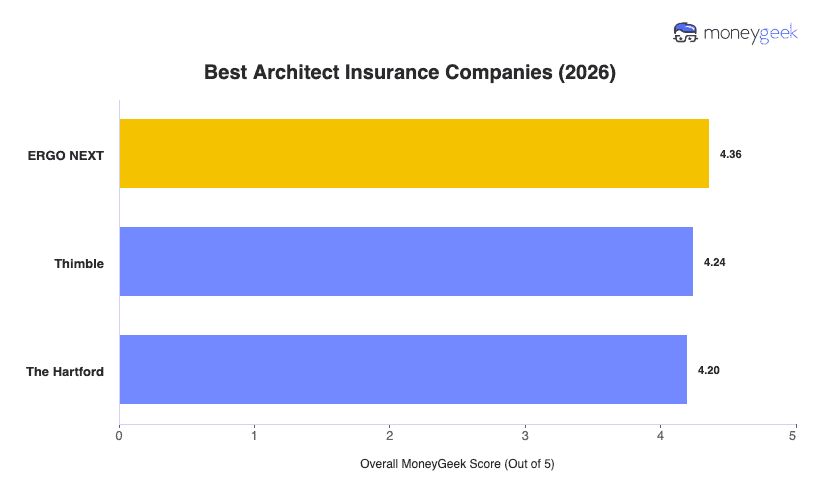
ERGO NEXT leads our analysis for business insurance companies for architecture firms and ranks first for customer experience because you can get covered in under 10 minutes without an agent, generate COIs from the app and manage your policy through self-service tools. The Hartford comes in second, has the widest coverage breadth and carries the lowest average monthly cost, giving your firm documented depth when an institutional client scrutinizes your policy before awarding a contract. We find the right fit depends on where your firm's priorities sit.

Your firm's options across cost, coverage and buying experience are compared in the table below.

ERGO NEXT4.36$9213
Thimble4.24$9357
The Hartford4.20$9121
biBERK4.04$9776
Hiscox4.01$10534
Nationwide3.93$10562
Progressive Commercial3.89$10945

For our architecture firm business insurance ratings, we analyzed pricing, coverage options, and customer experience across all 50 states and Washington, D.C. Our analysis focuses on 1-to-4-massage architecture firms, while weighting results to ensure broader industry and location representation. To do this, we evaluated over six million business profiles, more than 100,000 customer experience data points and performed in-depth analysis of coverage contracts and endorsements to compare insurers consistently across industries and regions. We then rated each company across categories of affordability (50% of overall score), customer experience (30% of overall score) and coverage options and terms (20% of overall score) to form an overall rating.

See our full business insurance methodology.

How to Choose the Right Architecture Firm Business Insurance

Getting business insurance for your architecture firm is not a one-time task you complete at startup and revisit only when a client asks for a certificate of insurance (COI). We find that approaching coverage reactively often means you discover a gap only when a contract is already on the table. The right approach starts with your risk profile and stays current as your practice evolves.

  1. 1
    Understand your risk profile and what coverage it requires

    Your stamp is the starting point, since every drawing you seal creates professional accountability that can outlast the project by years, and that accountability exists whether you have one employee or 20. Beyond that, your risk profile shifts based on whether you carry construction administration responsibilities, how many employees you have and which states your staff work in. Those factors determine what is legally required versus what your client contracts will demand.

  2. 2
    Choose the right coverage limits

    Your limits should reflect the construction value behind your active projects, not just the minimum your client contract states. A solo architect stamping a $300,000 residential addition and a firm managing a $12 million school renovation carry different professional exposure even with identical policy structures. Institutional clients often write minimum professional liability and general liability limits directly into contracts, so your coverage needs to satisfy both your actual risk and your agreement before you sign.

  3. 3
    Evaluate providers who understand architecture firms

    Look for providers with demonstrated familiarity with claims-made professional liability, including how retroactive dates and tail coverage work for your firm. Switching carriers without understanding those mechanics can leave you exposed to claims from projects completed before the change. Affordability, coverage depth and buying experience all matter, but optimizing purely for the lowest premium can leave your documentation short when an institutional client's procurement team reviews it.

  4. 4
    Get compliance-ready

    Buying coverage is the first step, not the last. Before your next contract executes, confirm that your policy includes any additional insured endorsements or waivers of subrogation your client requires, and that you can generate a COI reflecting those terms. If your professional liability is claims-made, verify your retroactive date before renewing or switching carriers. A gap in that date can leave prior projects unprotected with no visible change to your current policy.

  5. 5
    Revisit your coverage as your architecture firm grows

    Your coverage needs a check-in at least once a year and sooner when your practice changes. Hiring your first employee triggers workers' comp obligations in most states. Landing your first institutional client or government contract often means your existing PL and GL limits need to increase. Adding remote staff in a new state creates multi-state workers' comp obligations. Review your coverage before each contract renewal and whenever any of those changes occur.

Get Architecture Firm Business Insurance Quotes

What your firm pays for architecture firm business insurance depends on the provider, not just the coverage types you carry. If your practice focuses on residential design with no employees or site visits, your cost and coverage picture looks nothing like a 15-person firm running construction administration for institutional clients and carrying the higher PL limits those contracts require. Requesting business insurance quotes from multiple providers gives you an accurate comparison for your firm's specific mix of coverage and limits.

About Angelique Palenzuela-Cruz


Angelique Palenzuela-Cruz, Business Insurance Writer, MoneyGeek

Angelique Palenzuela-Cruz is a Business Insurance Content Writer at MoneyGeek, where she specializes in general liability, workers' compensation and professional liability. Her writing helps small business owners understand what a policy covers and how it applies to their business.

Before financial content writing, Angelique spent nearly 12 years at Guthrie-Jensen Consultants, one of Southeast Asia's largest management training firms, where she rose from Training Consultant to Management Consultant. She worked directly with business clients across industries, assessed operational needs, designed training programs and presented performance analysis to executive decision-makers. She also helped establish Gladwin Training Consultancy, where she served as Learning Solutions Architect and Client Services Manager. That work put her on the business side of the decisions that insurance is built around, and she writes about coverage from that angle rather than from the policy terms.

She took that experience into financial content writing and has spent nearly four years at MoneyGeek covering insurance and lending content.

LinkedIn: linkedin.com/in/ma-angela-cruz

Email Contact: angelique.palenzuela@moneygeek.com