



Jump to the section that meets your needs best below:
Average Architecture Firm Insurance Cost (2026 Report)
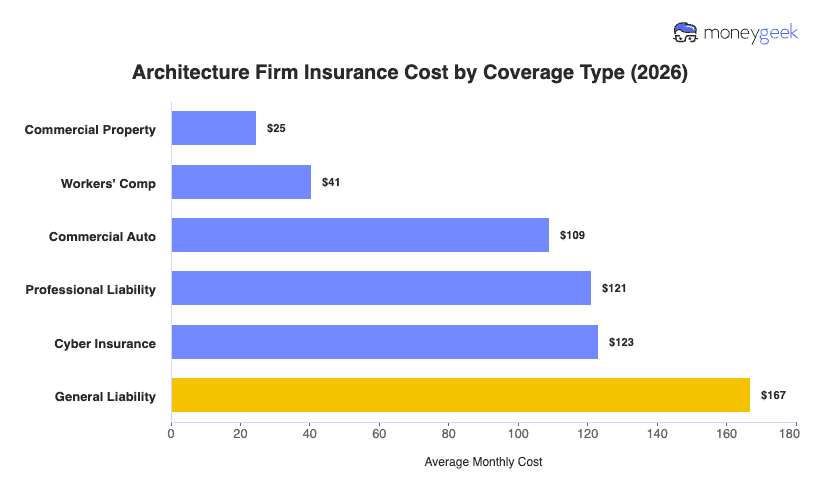
Architecture firm business insurance costs range from $25 to $167 a month, shaped by firm size, project type, and whether you visit construction sites.
If you're ready to get a quote, use the tool below to get matched with the best business insurance provider for your architecture firm.
Select state
Safe & SecureVerified and VettedTrusted Brands
Updated: September 11, 2026
Advertising & Editorial Disclosure
How Much Does Architecture Firm Insurance Cost?
Contractor business insurance costs for architecture firms average around $98 a month or $1,171 per year across six common coverage types. We determined these figures by analyzing quotes from architecture firms with one to four employees across 50 states and Washington, D.C., carrying standard policy limits of $1 million per occurrence and $2 million aggregate.
Individual coverage costs range from $25 to $167 a month, with commercial property having the lowest rates on average because your studio workstations and office contents represent a bounded, fixed-location asset base that insurers price accordingly. General liability costs the most and reflects your construction site exposure and the near-universal requirement that clients, landlords and project contracts carry it.
The table below shows average monthly costs by coverage type, but treat these figures as benchmarks for your firm's profile, not quotes.
| Commercial Property | $25 | $297 | 80% | 100 |
| Workers' Comp | $41 | $487 | 64% | 138 |
| Commercial Auto | $109 | $1,307 | 33% | 105 |
| Professional Liability | $121 | $1,458 | -116% | 142 |
| Cyber Insurance | $123 | $1,478 | -48% | 343 |
| General Liability | $167 | $2,004 | 36% | 323 |
We analyzed quote data from major U.S. commercial insurance providers and modeled standardized premium estimates across business profiles representing around 95% of the market. Results are designed to provide a consistent national benchmark showing how premiums vary by key baseline factors including business size, restaurant profession type, location and vehicle type for operations that use commercial vehicles.
Dataset Scope and Assumptions
Our cost modeling uses standardized inputs for consistent comparisons across businesses.
- Total estimates modeled: just over 6 million standardized pricing estimates
- Providers analyzed: 10 major insurance providers
- Geography: all U.S. states including Washington, D.C.
- Employee count bands: solo practitioners, one to four, five to nine, 10 to 19, and 20 to 49 employees
- Vehicle types studied: Sedans, SUVs, pickup trucks, vans, taxis, limousines, tractors, food trucks, semi-trucks (non-HAZMAT and HAZMAT), tanker trucks (non-HAZMAT and HAZMAT), buses, box trucks, dump trucks, flatbed trucks
- Policies studied: general liability, workers' comp, professional liability, commercial auto, commercial property, and cyber insurance
- General liability: $1 million per occurrence and $2 million aggregate
- Workers' comp: state required coverage
- Professional liability: $1 million per claim and $1 million aggregate
- Commercial auto: minimum coverage
- Commercial property: personal property coverage limits personalized to industry, business size and state
- Cyber insurance: $1 million per occurrence and $1 million aggregate
How We Calculated Average Architecture Firm Service Business Insurance Costs
Our published averages represent modeled premiums for standardized business profiles and were aggregated in two ways.
- National benchmark average: The national average cost reflects the modeled premium for a standardized one to four employee business across all and states included in our dataset for a standard policies
- Segment averages: To show how costs vary, we calculated average modeled premiums for our national base profile and isolated for variables, including:
- Employee count (business size ranges)
- Vehicle types (for commercial auto)
- States (including Washington, D.C.)
Segment averages were produced by aggregating modeled pricing trends across the full dataset so readers can compare how premiums shift across coverage types and regions.
See our full business insurance methodology.
Get Architecture Firm Business Insurance Cost Estimates
Our architecture firm business insurance cost calculator below gives you more personalized estimates so you can accurately compare rates.
Get Architecture Firm Insurance Cost Estimates
Select Coverage Type
Select State
Select Employee Count
Select Vehicle Type
Monthly Rate Estimate—
Select Coverage Type
Monthly Rate Estimate—
Select State
Select Employee Count
Select Vehicle Type
Factors Affecting Architecture Firm Insurance Costs
Several factors shape what your architecture firm business insurance costs, and in our analysis, the ones that move the needle most connect directly to how your firm delivers services. You’re in a better position to read your premium more accurately once you understand which factors apply to your practice.
 Project type
The mix of residential, commercial and institutional work on your active roster directly affects your overall insurance cost. Institutional projects such as hospitals, schools and government facilities carry stricter contract insurance requirements and higher professional liability scrutiny than residential remodels. If condominium development makes up a significant share of your workload, you should expect additional underwriting attention, as many A&E carriers treat it as an elevated-risk project category.
 Construction administration scope
Whether your firm provides full construction administration services or limits its role to design and documentation changes your exposure in ways insurers price carefully. Architects performing CA work make field decisions, approving submittals, responding to RFIs and observing construction progress, that generate a distinct category of claims separate from design errors. If your firm offers design-only services, you carry a narrower claim profile.
 Sub-consultant coordination
When your firm serves as architect of record, you carry coordination liability for the full document set, including drawings produced by structural, MEP and civil engineers you hired. If a coordination failure between your architectural drawings and a sub-consultant's work causes a field conflict or post-occupancy defect, your firm may face a claim even when the error originated elsewhere. Insurers factor the breadth of your coordination responsibilities into your professional liability pricing.
 Design-build participation
Architecture firms that take on design-build arrangements carry a fundamentally different liability profile than those working under a traditional architect-of-record structure. In a design-build contract, your firm may hold legal responsibility for the finished building, not just the drawings, adding contractor-equivalent general liability exposure on top of your professional liability baseline. If your firm takes on design-build work, expect your underwriter to treat it as a distinct risk category with a separate pricing structure.
 Digital asset exposure and BIM file volume
Your firm's active BIM project files represent hundreds of hours of billable work stored in formats that ransomware attacks specifically target. The volume of active project data your firm holds, the complexity of your cloud collaboration environment and whether you work with government or institutional clients on sensitive projects all influence how insurers assess your cyber exposure. If your firm runs a large, multi-project BIM environment on platforms like Autodesk Construction Cloud, you carry a broader attack surface than smaller practices.
How to Lower Architecture Firm Insurance Cost
Finding affordable business insurance as an architecture firm means addressing both how your coverage is structured now and how your practice's risk profile develops over time. In our analysis, the methods that produce the most reliable results for architecture firms work across both timelines.
 Compare quotes using the same coverage limits
The most direct way to find a lower premium is to get competing quotes, but only valid comparisons produce useful results. Professional liability limits vary significantly across A&E carriers, and a quote with a lower premium may reflect a lower limit, a narrower retroactive date or a tighter definition of covered services rather than genuine savings. Before you accept a lower quote, confirm that the coverage terms, limits and retroactive date match what your current policy provides.
 Right-Size Your Coverage
Not every coverage type on a standard contractor package applies to your firm's actual operations. If you don't own vehicles, hired and non-owned auto added to your general liability policy likely covers your exposure at a fraction of a standalone commercial auto premium, and if your studio equipment is modest, your commercial property limit may exceed what your asset base justifies. You'll likely incur unnecessary costs if you don't review each line against how your firm operates and just renew what you originally bought.
 Bundle policies with the same provider
Purchasing your general liability and professional liability from the same A&E carrier often produces a discount compared to placing them separately. Many A&E carriers that specialize in architecture firms offer package programs that combine both coverages at a lower combined rate. If your firm currently carries these policies with different insurers, ask each carrier for a bundled quote before your next renewal.
 Pay annually instead of monthly
Paying your premium in a single annual installment rather than monthly installments eliminates the installment fee most carriers charge, which typically runs between 3% and 5% of your annual premium. For a firm paying $2,000 a year in professional liability, that represents $60 to $100 in avoidable cost with no change to your coverage. This works best when your firm's cash flow allows for the upfront payment.
 Lower your risk profile
The mix of work your firm takes on is one of the most consequential long-term inputs to your professional liability premium. Reducing your concentration in high-scrutiny project categories such as condominium developments, design-build arrangements or healthcare facilities shifts your underwriting profile toward lower-risk work over time. You won't see the impact immediately, but if you actively manage your project type mix and document your quality control processes, your renewal pricing tends to reflect that over time.
Architecture Firm Insurance Cost: Bottom Line
An average of $98 a month is a cross-coverage reference point for architecture firms, though your actual premium depends on which policies you carry, your service scope and where your firm operates, so treat it as a tool for setting expectations rather than a prediction.
Use the three questions below to put any quote you receive in context:
- Where do you fall in the distribution? Locate your firm relative to the benchmarks by coverage type and state. If your quote sits well above or below the average for your coverage mix, dig into why before you accept or reject it.
- Is your quote consistent with your risk profile? Your premium reflects how insurers read your firm's exposure. If your quote diverges from the benchmarks without a clear explanation, ask your broker which underwriting inputs are driving the gap.
- Which cost drivers apply to your business? Not every factor carries equal weight for every firm. A solo architect handling residential additions faces a different cost profile than a mid-size firm coordinating structural and MEP consultants on institutional work. When you identify which drivers actually apply to your practice, the benchmarks on this page become a useful frame rather than a generic number.
The gap between a benchmark and your quote usually, if any, comes down to a few unique factors about how your firm operates. The benchmarks are most useful as a frame for understanding whether your premium reflects your actual risk or something worth questioning.
About Connor Bolton

Connor Bolton is Senior SEO and Content Manager at MoneyGeek, where he leads the business and pet insurance editorial teams. He sets the research framework, data standards and content structure for his team. All content goes through his accuracy review before publication. Connor also writes in-depth guides and has spent more than four years covering insurance products across personal, commercial and specialty lines.
The research infrastructure Connor built covers auto, home, renters, life, health, business and pet insurance across pricing analysis, carrier research, customer experience and coverage evaluation. It includes over 6 million data points for business insurance across 408 industry areas, all 50 states and 16 vehicle types. The pet insurance side covers over 5 million profiles across 18 major providers, 100+ breeds and ages up to 20 years. Connor’s insurance research and his team's work have been cited by the U.S. Chamber of Commerce, Allstate, Liberty Mutual, CBS News, Forbes and LegalZoom.
Connor also talks with underwriters and carrier liaisons at Ethos, The Hartford, ERGO NEXT, Nationwide and State Farm, and monitors business and pet owner communities on Reddit. Those sources shape how his team evaluates carriers, structures rate analysis and writes content for real pet owners.
Questions about MoneyGeek's business or pet insurance content? Reach him at connor@moneygeek.com or on LinkedIn.