
What Is Handyman Business Insurance?

Handyman business insurance is a bundle of policies that covers the risks common to contractors providing repair and maintenance services. That could include a client tripping over your ladder, a cabinet getting scratched during an installation, tools stolen from your truck or an employee getting hurt while lifting materials.

Other scenarios where your handyman insurance plan can provide financial protection include:

  • A pipe connection you worked on leaks and damages a client’s flooring
  • Paint, adhesive or construction dust damages furniture in a customer’s home
  • A customer claims your repair caused a door, shelf or fixture to fail later
  • Your parked work van is hit while carrying supplies to a job site
  • Materials you bought for a client project are stolen before installation
  • You damage a countertop, appliance or built-in fixture while moving tools through a client’s home

Is Handyman Business Insurance Required?

Your handyman insurance requirements depend on where you work, whether you hire help and how you drive for jobs. Some contractor licenses require proof of insurance, but that doesn’t mean every handyman needs the same coverage to operate. Alaska, however, is an exception since its General Contractor – Handyman registration requires general liability insurance and a $5,000 surety bond. Once you hire employees, workers’ compensation should be part of your insurance bundle. If your business owns a truck or van, you’ll also need commercial auto coverage for job-related driving.

Handyman insurance can also be required before a client lets you start work. A homeowner may ask for a certificate of insurance (COI) before a larger repair, and a landlord may require general liability insurance before you do rental-unit maintenance. If you work for a property manager, apartment building or office client, they may also ask to be added as an additional insured

Before buying coverage, check what the job requires so your policy limits and insurance documents match what the client expects.

What Types of Handyman Insurance Should You Get?

No one policy covers all the risks your handyman business has, so you need the right coverage types in your bundle. The ideal mix depends on variables like the jobs you take, whether you drive for jobs, the value of your tools and whether you hire help. A solo handyman doing small home repairs may only need a basic bundle, while a handyman who maintains rental units, drives a work van and brings on an assistant will likely need broader coverage.

It’s easier to figure out what policies you need if you know what risks they address. I’ve prepared a table below showing that connection to help you decide:

Working inside client spaces
Injuries to other people, damage to someone else’s property and related legal costs
You work around a client’s floors, walls, furniture and fixtures. If a client trips over your tools or says you damaged their property, general liability is usually the first policy they expect you to have.
Carrying tools between jobs
Tools that are stolen, lost or damaged while they’re in your truck, at a job or away from your main storage spot

Your tools move with you, so they’re not always protected by property coverage tied to one building. This is the coverage to ask about if losing your drills, saws or ladders would stop you from working.

Driving to clients
Crashes, injuries or property damage involving a truck or van used for your handyman business

If your business owns a truck or van, it needs commercial auto coverage that meets your state’s auto insurance requirements. Personal auto insurance won’t cover accident claims when a vehicle is titled to the business or used mainly for handyman work.

Hiring help
Medical costs and lost wages if an employee gets hurt or sick because of the job

Most states require you to carry workers’ comp once you hire employees, though the threshold varies. It covers job-related injuries from lifting materials, using tools, carrying equipment or working on ladders.

The table shows coverage types most handymen need, though some might need extra policies when the job goes beyond small repairs. If you buy or transport higher-value items that will become part of a client’s property, such as cabinets, doors, flooring or fixtures, look into an installation floater. Consider builder’s risk if you work on a larger renovation or construction project because the partially completed work may not be covered by a standard property policy. 

Get a surety bond if a client, platform or government agency requires it, which promises the client they can be repaid if you don’t meet the terms of the job. You might also need cyber insurance if you take online payments, store client information or book jobs through your website.

How Much Does Handyman Business Insurance Cost?

After studying our dataset, I've put the cost of handyman business insurance at $409 per month or $4,906 per year for a basic bundle that includes general liability and commercial auto. Your actual cost may be lower if you use your personal vehicle to go to clients and don’t need a commercial auto policy, or higher if you hire help, rent a workspace or add online booking and payment tools.

I’ve listed the estimates for each coverage type to give you a better idea of how they can affect your insurance costs:

How did we determine business insurance rates for handymen?

Use our handyman business insurance calculator below for more personalized estimates and to help you when you compare rates.

Estimate Your Monthly Handyman Insurance Cost

Enter your coverage type, state, employee count and vehicle type (if applicable) to estimate your monthly cost. Rates are aggregated across all 50 states and Washington, D.C. We do not collect personal information.

Workers’ compensation estimates are shown on a per-employee basis. Coverage estimates assume standard industry limit recommendations for most businesses.

Select Coverage Type
Select State
Select Employee Count
Select Vehicle Type
Average Monthly Cost

How to Choose the Right Handyman Business Insurance

Identifying which coverage types you're required to have versus those that are optional is the first step to getting business insurance. But making sure you have the right coverage for your handyman service also means ensuring you have the proper documentation after buying your bundle and revisiting your coverage needs over time. I've outlined the steps below:

  1. 1

    Identify required vs. optional coverage

    Start with coverage you’re legally required to carry. For handymen, that includes workers’ comp once you hire employees and commercial auto if your business owns a truck or van. Then check your contracts for client requirements, such as general liability limits, a certificate of insurance (COI), an additional insured endorsement or a surety bond. Once those are covered, use your day-to-day work risks to decide what else belongs in your bundle.

  2. 2

    Understand your handyman risk profile

    Match common job problems to the policy that handles them. If you work inside clients’ homes or rental units, get general liability in case someone trips over your tools or you damage a wall, floor, appliance or fixture and files a claim. If your tools move between your truck, garage and job sites, ask about tools and equipment coverage. Your bundle should reflect how you work, not a generic contractor checklist.

  3. 3

    Make sure your coverage limits align with your risk

    Choose limits based on how expensive a claim could get. I’d look at where you work, what could be damaged and what a client may require. If you work in higher-value homes, rental units or commercial spaces, you might need higher general liability limits. For commercial auto, look at who owns the vehicle and how often it’s used for jobs, while whether you store client details, take online payments or book jobs through your website determines how much cyber insurance you need.

  4. 4

    Compare providers that understand handyman risks

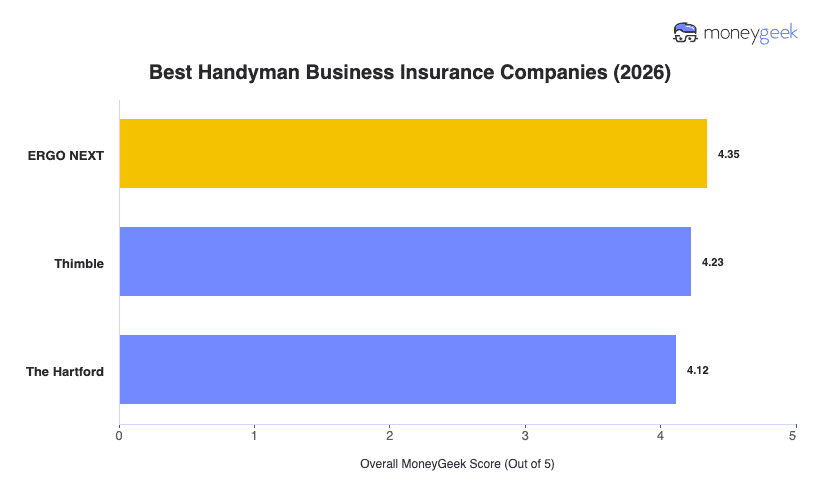
    Compare insurers that write coverage for handymen, contractors or small trade businesses. The Hartford offers contractor insurance, and Thimble markets handyman insurance for small or self-employed operators. ERGO NEXT is also worth checking if you want online quotes and instant COI access. Price matters, but I’d also compare how fast each provider can issue documents, explain exclusions and help with a claim.

    Read More: Best Handyman Insurance Companies

  5. 5

    Get compliance-ready

    Get the right insurance documents before you take jobs that require coverage. A missing certificate of insurance (COI) or endorsement can delay your start date, even if you already bought the policy. Ask your insurer or agent for a COI that lists your coverage, limits and policy dates. If a landlord, property manager or platform wants to be added as an additional insured, request that endorsement before work begins.

  6. 6

    Revisit coverage as your restaurant changes

    Update your coverage when your business changes, not just at renewal. If you hire help, buy a work van, store more tools, drop higher-risk jobs or scale back your services, it changes what your policy should cover. Reviewing your policy after a business change helps you see whether to add coverage, reduce coverage or update your documents. That way, you’re not underinsured for new risks or overpaying for protection you no longer need.

Next Steps for Getting Handyman Insurance

When you're building your ideal mix of policies for your handyman service, you'll run into different scenarios that requires quick decisions. I've gathered the most common ones and given guidance on each:

If you’re buying insurance before your first paid job

If a client sends you insurance requirements you don’t understand

If your quotes don’t look comparable

If you’re comparing handyman insurance providers

If your services are changing

Get Handyman Business Insurance Quotes

To compare handyman insurance, start by telling us about your business and MoneyGeek will match you with providers that fit your coverage needs. From there, you can compare quotes and policy options through each insurer’s website.

About Angelique Palenzuela-Cruz


Angelique Palenzuela-Cruz, Business Insurance Writer, MoneyGeek

Angelique Palenzuela-Cruz is a Business Insurance Content Writer at MoneyGeek, where she specializes in general liability, workers’ compensation and professional liability insurance. Her work helps small business owners understand how these policies apply to coverage, including risks like customer injuries, employee injuries, professional mistakes, client contract terms and industry-specific coverage requirements.
She primarily covers service-based businesses where liability and employee coverage decisions are especially important, including cleaning, consulting, beauty and wellness, childcare, education, fitness, food service, pet care, repair and maintenance, and other professional services.
Before joining MoneyGeek, Angelique spent nearly 12 years at Guthrie-Jensen Consultants, one of Southeast Asia’s largest management training firms, where she advanced from Training Consultant to Managing Consultant. In that role, she worked with business clients to assess operational needs, develop training programs and present performance analyses to executive decision-makers. She also helped establish Gladwin Training Consultancy, where she served in learning solutions and client service roles.
Her background gives her practical context for writing about how businesses operate, manage client expectations, structure teams and make risk decisions. At MoneyGeek, she applies that experience to business insurance content, connecting coverage to actual business needs.

LinkedIn: linkedin.com/in/ma-angela-cruz

Email Contact: angelique.palenzuela@moneygeek.com